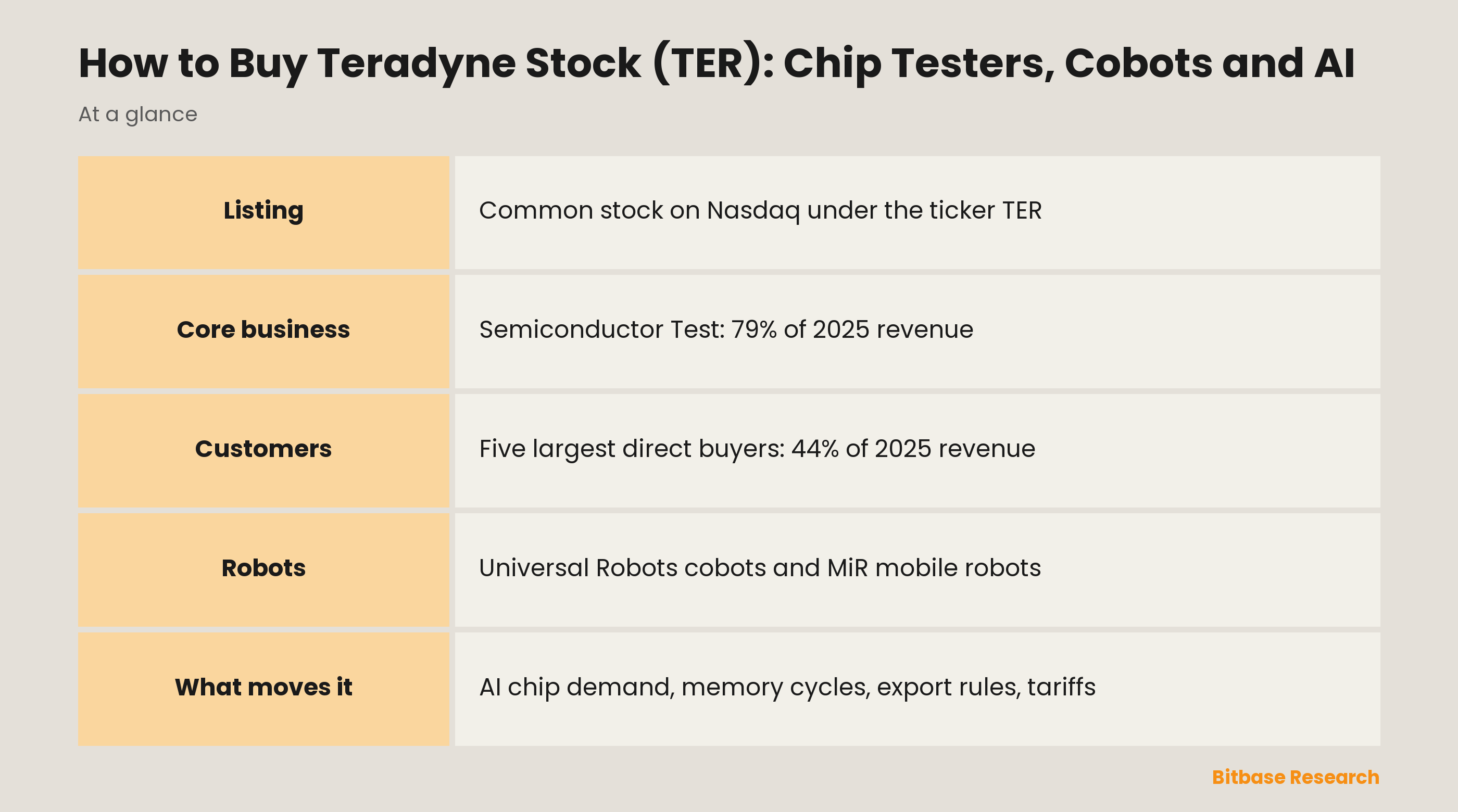
Every Teradyne share trades on Nasdaq under the ticker TER, so any broker that offers US stocks can fill the order, and many will also sell you a fraction of one share. Behind that ticker sits a Massachusetts company founded in 1960 whose machines check chips before they ship, and whose five largest direct customers accounted for 44% of its revenue in 2025. Below: what Teradyne makes, how its three segments earn money, the steps of an order, and the forces its filings keep returning to, from AI chip programs and memory cycles to export rules and a robot business that lost money for three straight years.
What Does Teradyne Do?
Teradyne builds the equipment that decides whether a piece of electronics works before it leaves the factory. Its 10-K calls it "a leading global provider of automated test equipment and robotics solutions," and the company was incorporated in Massachusetts on 23 September 1960. Its test systems examine semiconductors, wireless products, data storage, silicon photonics and complex electronic systems for makers of phones, cars, industrial machines, computers, network gear and defense hardware.
Since March 2025 the company has reported three segments.
Semiconductor Test is the core. A chip can be tested on the wafer, again after it is packaged and sometimes once more inside a finished system, and Teradyne sells testers for each stage. Its buyers come in four kinds: integrated device manufacturers that design and fabricate their own chips, fabless designers, foundries that manufacture for others, and outsourced assembly and test houses. The product families divide the work. The UltraFLEX line, whose newest member is UltraFLEXplus, targets complex compute devices; J750 handles high-volume parts such as microcontrollers; Magnum tests flash, DRAM and high-bandwidth memory (HBM); the ETS and Eagle platforms cover analog and power devices, including the silicon carbide and gallium nitride chips used in electric vehicles and data center power supplies; and the Integrated System Test group sells system-level testers plus test equipment for hard drives and solid-state drives. Much of the appeal rests on multi-site testing, "the simultaneous testing of many devices in parallel," in the 10-K's words.
Robotics combines two brands. Universal Robots makes collaborative robot arms, known as cobots, that can work beside people once a risk assessment is done, and Mobile Industrial Robots (MiR) makes autonomous mobile robots that move materials through factories and warehouses. Teradyne bought Universal Robots in 2015 and MiR in 2018. The company says it introduced "the world's first commercially viable cobot in 2008" and has since sold more than 110,000 cobots and more than 11,000 mobile robots. Unlike the testers, which go mostly through a direct sales force, robots are sold mainly through distributors and equipment makers, and they are built chiefly in Denmark and the United States.
Product Test was formed in 2025 by merging the board test, defense and aerospace test and wireless test businesses. It sells test systems and instruments for electronic and photonic assemblies, modules and components to data center, automotive, industrial, defense and consumer electronics customers. Two recent moves sit here: the purchase of Quantifi Photonics, which makes test gear for photonic integrated circuits, in May 2025, and a joint venture with MultiLane, a specialist in high-speed connection testing, formed in April 2026 with Teradyne holding 75%.
Two outside stakes complete the picture. In May 2024 Teradyne sold its Device Interface Solutions unit to Technoprobe S.p.A. and bought 10% of Technoprobe's shares, along with a seat on its board. In October 2026 it agreed to make a minority investment in FormFactor, a provider of semiconductor test and measurement technology, together with a collaboration agreement; the latest 10-Q said the investment was expected to close in the fourth quarter of 2026. At the end of 2025 Teradyne had about 6,600 employees, the largest group outside the United States in the Philippines.
How Teradyne Makes Money
Teradyne earns most of its money selling machines: about 83% of 2025 revenue came from products and the rest from service. The 10-K splits the year by segment like this:
| Segment | Share of 2025 revenue | Revenue change vs 2024 | 2025 pre-tax margin |
|---|---|---|---|
| Semiconductor Test | 79% | up about 19% | about 28% |
| Product Test | 11% | up 8.1% | about 17% |
| Robotics | 10% | down 15.5% | loss |
Pre-tax margins are calculated from the segment note in the 10-K, which reports income before taxes for each segment.
Within Semiconductor Test, testers for system-on-a-chip devices, the processors and other logic chips, produced 59% of total company revenue in 2025, memory test 16% and Integrated System Test 4%. The 10-K says "AI related customer demand" drove the majority of revenue in the second half of 2025, coming from networking and from what it calls vertically integrated producer compute customers, while memory test stayed stable "despite a smaller overall market" thanks to share gains in HBM and DRAM final test.
Total revenue rose 13% in 2025 and gross margin was 58.2%. Profit is more lopsided than revenue. Semiconductor Test turned more than a quarter of its sales into pre-tax income, Product Test about a sixth, and Robotics posted a pre-tax loss in 2023, 2024 and 2025. A restructuring of Robotics in 2025 affected about 400 employees.
The customer list is short and mostly Asian. In 2025 the five largest direct customers made up 44% of revenue, up from 36% in 2024 and 32% in 2023. Teradyne separates the company that specifies a tester, such as a chip designer, from the one that orders and receives it, often a foundry or test house: two specifying customers drove 12% and 10% of 2025 revenue, and a separate direct buyer accounted for 19%. The 10-K names none of them. By customer site, Taiwan provided 36% of 2025 revenue, China 14%, Korea 14% and the United States 11%; in all, 89% came from outside the US.
2026 has been steeper. Revenue in the third quarter, which ended on 27 September 2026, rose 70% from a year earlier: Semiconductor Test grew 77%, Product Test 56% and Robotics 28%, and Robotics "achieved profitability in the quarter." The map moved too. Korea supplied 32% of third-quarter revenue against 12% a year before, while Taiwan fell to 14% from 37%. Across the first nine months, total revenue rose 86% and Semiconductor Test revenue more than doubled.
TER Stock at a Glance
| Feature | TER |
|---|---|
| Exchange | Nasdaq Global Select Market |
| Ticker | TER |
| Security | Common stock, the only class registered under Section 12(b) |
| Sector | Semiconductor test equipment, plus collaborative and mobile robots |
| Segments | Semiconductor Test, Product Test, Robotics |
| Index membership | S&P 500 |
| Headquarters | North Reading, Massachusetts |
| Incorporated | Massachusetts, 1960 |
| Fiscal year | Ends 31 December; quarters close on a Sunday near the quarter end |
| Payouts | Quarterly cash dividend, raised in 2026, plus share repurchases |
| SEC identifier | CIK 97210 |
Price, market value and dividend yield change with every trade, so the table leaves them out; for live figures, see the Teradyne stock page on Bitbase.
How to Buy Teradyne Stock
Teradyne is a US company that files 10-K and 10-Q reports, so the Nasdaq line is the ordinary share itself, with no depositary receipt in between. An order takes six steps:
1. Choose a broker that reaches Nasdaq. Outside the United States, check which legal entity holds your account and which regulator supervises it.
2. Fill in the tax form. Non-US individuals generally give the broker IRS Form W-8BEN; the IRS says to submit it "when requested by the withholding agent or payer."
3. Fund the account. Changing your currency into US dollars can cost more than the commission, so look at the exchange spread as well as the fee.
4. Check the line. Search TER and confirm that the result reads Teradyne, Inc. common stock on Nasdaq.
5. Pick an order type. A market order fills at the best price available at that moment, while a limit order caps the price you pay and may not fill at all. The 10-K warns that the share price is "subject to wide fluctuations," which is when a cap helps.
6. Decide the size. Many brokers sell fractional shares for a set amount of money; ask yours whether a fraction carries voting rights and how its dividends are paid.
Dividend tax abroad. The IRS states that "most types of U.S. source income received by a foreign person are subject to U.S. tax of 30%," and a tax treaty between the US and your country can lower the rate, which is what the W-8BEN is for. In 2025 Teradyne spent far more on buybacks than on dividends, so most of the cash it returned did not arrive as a taxable payout.
Through a fund. TER is a member of the S&P 500, so an S&P 500 index fund holds a small slice of it alongside every other member.
What Moves TER Stock
The filings return to a handful of forces specific to Teradyne.
AI chip programs. The 10-Q credits the 77% jump in third-quarter Semiconductor Test revenue to "sustained demand in Artificial Intelligence ("AI") applications across compute, memory and storage markets." When the large designers behind those chips launch or ramp a new generation, tester orders follow; when they pause, the orders can stop just as fast.
A few big buyers. With five customers at 44% of 2025 revenue and one direct buyer at 19%, a single company's capital budget can swing a quarter. The 10-K says Teradyne "would have no or limited contractual recourse if our significant customers decided to stop buying and using our products with limited advance notice to us."
Memory waves. Memory test produced 16% of 2025 revenue and a record in the third quarter of 2026, which the 10-Q ties to AI demand. Memory makers add test capacity in bursts, and the rise in Korea's share of revenue, from 12% to 32% between the third quarters of 2025 and 2026, shows how fast the customer map can redraw itself.
Export controls and China. China supplied 14% of 2025 revenue. US rules such as the Entity List and the Foreign Direct Product Rule restrict sales to certain Chinese chip companies, and the 10-K says those listings have had "and will continue to have an adverse impact on our business with these customers." China has passed blocking laws in response, and the company calls their effect on its business there uncertain.
Tariffs and the supply chain. Contract manufacturers in Malaysia and Thailand, among them Flex and Plexus, build most of the testers, and in 2025 Teradyne bought a building in Cebu, in the Philippines, for its own Semiconductor Test production. The 10-K says recent tariff changes had not caused a material adverse effect, while warning that further tariffs and Chinese retaliation could.
The robot turnaround. Robotics is a tenth of revenue, yet it moved from three years of pre-tax losses to a profit in the third quarter of 2026. Because most Robotics sales are billed in foreign currencies, a stronger dollar shrinks its reported revenue, and the 10-Q says electronics and semiconductor customers were its largest end market in that quarter.
Stakes and ventures. The Technoprobe holding, the MultiLane venture and the pending FormFactor investment link Teradyne to probe, contactor, interface and high-speed connection technology. Their results reach the income statement through equity earnings, segment profit and, if values fall, impairment charges.
Cycles, Rivals and Suppliers in Teradyne's Risk Factors
These are the risk factors most tied to this company.
The chip equipment cycle. The first risk factor says the business "is impacted by global and industry-specific economic cycles, which are difficult to predict," and that equipment suppliers have been hurt in the past by sudden slowdowns and recurring cyclicality. Customers also tend "to wait until late in a quarter to commit to purchase," and the 10-K warns that backlog "is not necessarily indicative of the actual sales for any succeeding period," so a single quarter can surprise in either direction.
Rivals, including customers. Advantest, SPEA and Cohu are the named competitors in semiconductor test, and the 10-K adds "competition from emerging Asian companies and internal development at several of our customers." It also flags customer consolidation, which could leave it facing fewer, stronger buyers.
A market that can shrink by design. The parallel testing that makes the machines attractive could, the company says, "lead to a decrease in the ultimate size of the market" for its testers, because each machine handles more devices at once.
Outsourced manufacturing. Teradyne relies on a small group of contract manufacturers, stating that it depends on Flex "to manufacture and test our FLEX and J750 family of products from its facility in Malaysia." A disruption at one of them would delay shipments.
Crowded robot markets. Universal Robots and MiR compete with industrial robot makers such as ABB, FANUC, KUKA and Yaskawa, with newer cobot makers such as Techman and Doosan, and with mobile robot suppliers including Omron and Rockwell Automation.
The share itself. One stock ties your money to one company's results. The board can also change what it pays out: the 10-K states, "We may discontinue or reduce our quarterly cash dividend or share repurchase program."
How to Research TER Yourself
Teradyne's filings are on SEC EDGAR under CIK 97210 and free on teradyne.com under Investors. In 2026 it reported quarterly results in 8-Ks dated 2 February, 28 April, 28 July and 27 October, each with a conference call, and the third-quarter 10-Q followed on 30 October.
In the 10-K, the business section lists the products and the named competitors, the risk factors cover customer concentration and export rules, and the segment note sets revenue and pre-tax income for all three segments side by side. The revenue note splits Semiconductor Test into system-on-a-chip, memory and system test. Peer filings add context: Keysight, a named Product Test rival, is covered in our Keysight stock guide, and another chip equipment supplier in our KLA stock guide.
Two checks avoid common misreadings. Revenue by country follows the site where a tester is installed, which is often not where the chip's designer is based. And compare segment pre-tax income as well as revenue, because Robotics losses offset part of the test profit for three years. Live quotes are on the stock page linked earlier, and Bitbase's US stock pages cover other listed companies.
Teradyne Stock FAQ
Can I buy Teradyne stock with crypto?
Not directly. TER shares are bought in US dollars through a brokerage account, so crypto must first be sold for cash and deposited, and that sale can be taxable where you live. A share also carries voting and dividend rights in a registered company, which is how a share differs from a crypto asset.
Does Teradyne pay a dividend?
Yes. The board declares a quarterly cash dividend, and in January 2026 it raised the quarterly amount above the 2025 level. Repurchases run under a program approved in January 2023 that lasts until the authorized amount is used, and in 2025 they returned far more cash than the dividend. The 10-K says either can be reduced or eliminated.
Is TER in the S&P 500?
Yes. Teradyne Inc is listed in State Street's daily holdings file for SPY, a fund that tracks the S&P 500, dated 6 November 2026. Index weights change every day.
Does Teradyne own Universal Robots?
Yes. Universal Robots, bought in 2015, and MiR, bought in 2018, together form the Robotics segment, which produced about 10% of 2025 revenue.
Who are Teradyne's main competitors?
In semiconductor test the 10-K names Advantest, SPEA and Cohu. In Product Test it lists Keysight, Test Research, Rohde & Schwarz, Anritsu and National Instruments among others, and in robotics both traditional robot makers and newer cobot and mobile robot companies. It also points to emerging Asian companies and to customers' own in-house development.
Conclusion
Owning Teradyne means owning a stake in how much testing each new generation of chips demands. Its 2026 surge came from AI compute and memory customers, its sales rest on a handful of large buyers whose locations can shift within a year, and its robot arm only just turned a quarterly profit. Read the next 10-Q for customer concentration, country mix and segment profit, check whether the FormFactor investment has closed, and decide how much weight one cyclical equipment maker deserves in your portfolio.
Related reading
Other Bitbase articles on this topic:
- How to Buy Astera Labs Stock (ALAB): Retimers, Switches and Perps
- How to Buy Coherent Stock (COHR): From II-VI to AI Optics
- How to Buy Microchip Stock (MCHP): MCUs, Analog and MCHPP
- How to Buy STMicroelectronics Stock (STM): SiC, Sensors and Perps
Disclaimer: This article is educational content from Bitbase Academy, provided for information only. It explains what a company or fund does and how the instruments referenced here differ from one another; it does not constitute investment, trading, tax, or financial advice, and it is neither a recommendation nor an endorsement of any security, token, or trading strategy. A tokenized stock is issued by a third party and is designed to give economic exposure to an underlying asset: it is not a share, it carries no shareholder rights, and it depends on the issuer's structure, eligibility rules, and redemption terms, which the issuer can change. Perpetual futures are leveraged derivatives that hold no underlying asset and can be liquidated, and trading hours, product availability, and eligibility differ by instrument and by jurisdiction and can change at any time. Written as of November 2026; verify everything yourself through company filings, the issuer's own documentation, and the product pages of the venue you trade on.
References
[1] Teradyne Form 10-K for 2025 (SEC EDGAR) www.sec.gov
[2] Teradyne 2025 Form 10-K, XBRL cover page (SEC EDGAR) www.sec.gov
[3] Teradyne 2025 Form 10-K, XBRL segment data (SEC EDGAR) www.sec.gov
[4] Teradyne 2025 Form 10-K, XBRL revenue by product line (SEC EDGAR) www.sec.gov
[5] Teradyne Form 10-Q for the third quarter of 2026 (SEC EDGAR) www.sec.gov
[6] Teradyne third-quarter 2026 earnings release, filed with Form 8-K (SEC EDGAR) www.sec.gov
[7] State Street: SPY daily holdings, 6 November 2026 www.ssga.com
[8] IRS: NRA Withholding www.irs.gov
[9] IRS: About Form W-8 BEN www.irs.gov





