
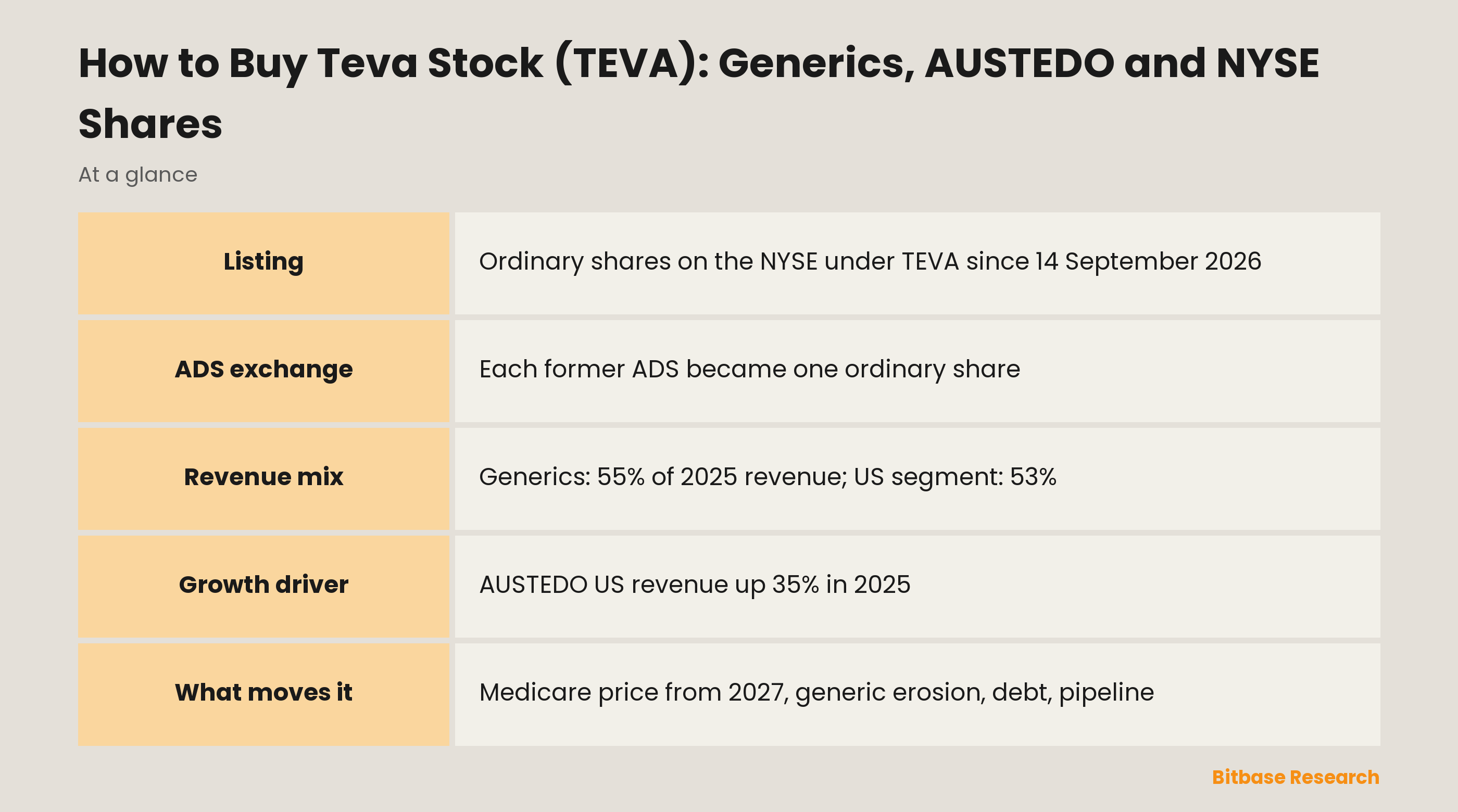
Since 14 September 2026, Teva stock has traded on the New York Stock Exchange as ordinary shares under the ticker TEVA, so any broker that reaches US-listed equities can fill the order; the American depositary shares that used the ticker before were exchanged one for one. The Israeli drugmaker still drew 55% of its 2025 revenue from generic medicines, but its growth comes from branded drugs such as AUSTEDO, whose US sales rose 35% that year. Below: what Teva sells, how an order works, and what moves the share.
What Does Teva Do?
Teva Pharmaceutical Industries describes itself as "a biopharmaceutical company, enabled by a world-class generics business." It was incorporated in Israel on 13 February 1944 and is the successor to several Israeli corporations, the oldest founded in 1901. It has approximately 34,000 employees across 57 markets, its 2025 annual report says.
Teva makes generic medicines, which in its reports include biosimilars and over-the-counter products, and branded innovative medicines. It also distributes drugs in the United States through Anda, sells active pharmaceutical ingredients (API) to third parties and offers contract manufacturing.
Generics. In the United States, Teva markets more than 350 generic prescription products in more than 1,100 dosage strengths, packaging sizes and forms, from tablets and injectables to inhalers and patches, sold mostly to retail drug chains, mail-order distributors and wholesalers. In Europe, generics make it "one of the leading pharmaceutical companies," with over-the-counter brands such as SUDOCREM alongside prescription products. Biosimilars, near-copies of biologic drugs, belong here too: SELARSDI and EPYSQLI are recent launches, and SIMLANDI, a biosimilar to Humira, was among its most significant US generic products in 2025.
Innovative medicines. The branded side centres on the central nervous system. AUSTEDO and AUSTEDO XR treat Huntington's chorea and tardive dyskinesia, a movement disorder; the 10-K says AUSTEDO "is one of only two products approved in the U.S. for tardive dyskinesia." AJOVY is an injection to prevent migraine, UZEDY a long-acting injectable for schizophrenia and bipolar I disorder in adults, and COPAXONE a long-standing treatment for relapsing forms of multiple sclerosis. On 9 October 2026 the FDA approved WELTRUZA, a once-monthly injectable form of olanzapine for schizophrenia in adults.
Three regions. Teva reports three segments, each selling the full range: the United States, Europe and International Markets, the last covering more than 35 countries, among them Canada, Israel and Russia. In March 2025 Teva sold its business venture in Japan, in which it had held 51%.
The strategy. Since May 2023 management has followed a plan called "Pivot to Growth," with four pillars: growing AUSTEDO, AJOVY, UZEDY and the biosimilars; advancing the late-stage pipeline; sustaining the generics business; and cutting costs. A central pipeline asset is duvakitug, an anti-TL1A antibody for ulcerative colitis and Crohn's disease, which Teva co-develops with Sanofi (see our Sanofi stock guide); the two companies started Phase 3 studies in October 2025. Teva also intends to sell its API business, held for sale since the end of 2024; as of the third-quarter 2026 report, the sale process was still running.
How Teva Makes Money
Teva's revenue rose 4% in 2025, or 3% in local currencies. The 10-K splits it as follows:
| Segment | Share of 2025 revenue | Change from 2024 | What it includes |
|---|---|---|---|
| United States | 53% | Up 14% | Generics and biosimilars, AUSTEDO, AJOVY, UZEDY, COPAXONE, the Anda distribution business |
| Europe | 29% | Down 1% | Generics, over-the-counter brands, AJOVY, COPAXONE, respiratory products |
| International Markets | 13% | Down 12% | Generics, branded generics and innovative medicines in more than 35 countries |
| Other activities | 5% | Down 8% | API sales to third parties, contract manufacturing, out-licensing through its affiliate Medis |
Shares are calculated from the segment revenues in the 10-K; the International Markets decline reflects the sale of the Japanese venture.
Generic medicines brought in 55% of 2025 revenue across the segments, but the 10-K says they "are generally less profitable" than innovative medicines. The growth came from the branded side. In the US segment, AUSTEDO revenue rose 35% and reached about 13% of Teva's total revenue, UZEDY grew 63% and AJOVY 42%. COPAXONE, which faces generic and oral competition, rose 6% in the US but fell 15% in Europe. A further boost came from milestone payments tied to the start of duvakitug's Phase 3 studies, booked in the fourth quarter.
The shift shows up in margins. The gross profit margin was 51.8% in 2025, up from 48.7% in 2024, and 55.5% in the third quarter of 2026, against 51.4% a year earlier, even though quarterly revenue fell 2%. Teva blamed that decline mainly on lower sales of lenalidomide capsules, its generic version of Revlimid, while US AUSTEDO revenue rose 21%.
Two details matter when you compare years. About 43% of 2025 revenue was in currencies other than the US dollar. And from 1 January 2026, Anda moved from the United States segment to Other activities, with earlier periods recast, so 2026 segment figures do not match the table above.
TEVA Stock at a Glance
| Feature | TEVA |
|---|---|
| Exchanges | New York Stock Exchange (ordinary shares, since 14 September 2026) and Tel Aviv Stock Exchange (since 1951) |
| Ticker | TEVA on both exchanges |
| Security | Ordinary shares, par value NIS 0.10; the ADS programme ended on 14 September 2026, one ADS for one share |
| Sector | Pharmaceuticals: generics, biosimilars and innovative medicines |
| Key brands | AUSTEDO, AJOVY, UZEDY, COPAXONE |
| Incorporated | Israel, 1944 |
| Principal executive offices | Parsippany, New Jersey, per the third-quarter 2026 10-Q cover; the 2025 10-K gave Tel Aviv |
| Fiscal year | Calendar year (ends 31 December) |
| SEC reports | Form 10-K, 10-Q and 8-K, not the 20-F used by many foreign issuers |
| Dividend | None paid since December 2017 |
| SEC identifier | CIK 818686 |
Price and market value move throughout the trading day; live figures are on the Teva quote page on Bitbase.
How to Buy Teva Stock
Until September 2026, US investors bought Teva through American depositary shares, issued through Citibank as depositary, each standing for one ordinary share. That layer is gone: the shares now listed on the NYSE are the same class that trades in Tel Aviv. The purchase itself:
1. Pick a broker that reaches the NYSE. Outside the US, that can be a local firm with US shares on offer or an international broker. Some also reach the Tel Aviv Stock Exchange, where the same shares trade under TEVA.
2. Open and verify the account. Expect identity checks and, abroad, a tax status form.
3. Fund it. If your money is in another currency, converting it costs something, so check the exchange rate alongside the commission.
4. Find the right line. Search TEVA and check that the result reads ordinary shares of Teva Pharmaceutical Industries on the NYSE. Older research may still say ADS; with a one-to-one ratio, the share count behind each unit did not change.
5. Choose an order type. A market order fills at the best price available at the time; a limit order fills only at your price or better and may not fill at all.
6. Decide the size. Some brokers sell fractional shares, so you can invest a set amount; availability and voting rights for fractions vary by firm.
7. Keep records. Trade confirmations show your cost basis for when you sell.
If you held ADSs. On 14 September 2026 outstanding ADSs were cancelled for an equal number of "economically equivalent NYSE-listed" ordinary shares. Your statement should now show ordinary shares; ask your broker if it does not.
Taxes for investors outside Israel. Teva is an Israeli company, so Israeli tax rules apply on top of those where you live. Its September 2026 registration statement says dividends paid to non-Israeli residents "are generally subject to 25% withholding tax," or 30% for substantial shareholders. It also says gains on the sale of the shares by non-Israeli residents "will generally be exempt from Israeli capital gains tax." Teva pays no dividend at present, and your home country may tax gains either way.
Through funds. Some international or healthcare funds may hold Teva among many companies; only a fund's published holdings list tells you.
What Moves TEVA Stock
AUSTEDO and Medicare price-setting. AUSTEDO is the largest branded product, and the 10-K says the company's "future success depends on our ability to maximize the growth and commercial success of AUSTEDO and AUSTEDO XR." On 17 January 2025 the Centers for Medicare and Medicaid Services (CMS) put both on its list of drugs selected for price negotiation under the Inflation Reduction Act. CMS announced the negotiated "Maximum Fair Price" on 25 November 2025, and it takes effect on 1 January 2027 for eligible Medicare patients. Teva sued CMS over the program's implementation and lost in a federal district court on 20 November 2025 and on appeal on 18 August 2026. The open question is how much the new price will cut AUSTEDO's US revenue from 2027.
The life cycle of a generic. The 10-K says generic prices "may, and often do, decline, sometimes dramatically," as more companies enter. Lenalidomide shows the pattern: in 2024 it drove most of the rise in Teva's US generics revenue, the company said the trend would not continue, and in the third quarter of 2026 lower lenalidomide sales were the main reason total revenue fell.
New launches and the pipeline. WELTRUZA's approval in October 2026 adds another long-acting injectable for schizophrenia to the US portfolio, and duvakitug's Phase 3 results will decide whether Teva gains a medicine in inflammatory bowel disease. In March 2026 Blackstone Life Sciences agreed to fund part of duvakitug's development in exchange for payments that depend on approval. Proposed biosimilars to Prolia, Xgeva, Eylea and Simponi were under regulatory review in the US and the EU at the time of the 10-K.
Debt and legal payments. Teva carries significant debt, which fell about 5% during 2025. Its nationwide opioid settlement with US states and local governments is paid over 13 years and includes supplying its generic version of Narcan, the naloxone nasal spray, or cash in its place. In August 2023 it entered a deferred prosecution agreement with the US Department of Justice over price-fixing charges filed in 2020. These obligations absorb cash that could otherwise fund growth or shareholder returns.
Capital returns. Teva has not paid a dividend since December 2017 and bought back no shares in 2025. In April 2026 its board instructed management to plan a share repurchase program, subject to Israeli legal requirements. Under a June 2024 agreement with the Israel Tax Authority, any future dividend or buyback will cost an additional 5% to 7% of the amount in corporate tax, up to a cap.
Price Erosion, Litigation and Debt in Teva's Risk Factors
These points from the 10-K's Risk Factors bear most directly on a TEVA share:
Dependence on generics. The 10-K's summary of risks names "that we are substantially dependent on our generic products." The faster a product's price erodes, the sooner Teva needs a replacement launch.
Concentrated buyers. "A significant portion of our sales are made to relatively few U.S. retail drug chains, wholesalers, managed care purchasing organizations, mail order distributors and hospitals." Consolidation among them strengthens their bargaining power.
Branded competition. AJOVY "faces strong competition from two products that were introduced into the market around the same time," UZEDY is "a late entrant" among long-acting injectable antipsychotics, and for COPAXONE "We expect the trend of decreasing revenues and profitability for COPAXONE to continue in the future."
Drug pricing policy. The Medicare negotiation that covers AUSTEDO from 2027 could, the 10-K says, extend to "other innovative products and biologics within our portfolio." Executive orders from 2025 on Most-Favored-Nation pricing add uncertainty.
Debt. "We have significant debt outstanding, which requires significant interest and principal payments" and comes with covenants that limit new borrowing.
Litigation. Opioid claims, competition investigations and product liability suits remain open risks.
Operations in Israel. "Our corporate headquarters and a portion of our manufacturing activities are located in Israel," the 10-K states, and "Ongoing military activity in the Middle East may result in disruption to our operations and facilities."
Two risks come with the share itself. Because Teva is incorporated in Israel, the 10-K warns that "it may be difficult for an investor" to bring or enforce an action against the company or its officers under non-Israeli law in an Israeli court. And with no dividend, any return depends on the share price.
How to Research TEVA Yourself
Despite its Israeli incorporation, Teva files the same reports as a US company: an annual 10-K, quarterly 10-Qs and 8-Ks for events, all under CIK 818686 on SEC EDGAR. The most recent quarterly report, for the period ending 30 September 2026, was filed on 3 November 2026 alongside the earnings release. Teva also files its reports in Israel through MAGNA, the Israel Securities Authority's disclosure system, and posts its SEC filings on tevapharm.com.
Three filings are worth reading together. The 2025 10-K covers the products, the strategy and the risk factors, and its MD&A gives revenue by product for each segment. An 8-K of September 2026 recasts the 2025 segment figures without Anda, bridging the annual report and the 2026 quarterly reports. And the amended Form 8-A filed on 14 September 2026 describes the ordinary shares, shareholder rights under Israeli law and the tax treatment for non-Israeli holders.
Two habits prevent common mistakes: read the product tables, not just the headline, since one generic dropping away can hide strong AUSTEDO growth; and check the currency and segment definition behind a number before comparing it with an older one. Live quotes are on the Teva page linked above, and Bitbase's complete list of US stock pages includes other listed companies.
Teva Stock FAQ
Can I buy Teva stock with crypto?
Not directly. A TEVA purchase is paid in US dollars through a brokerage account on the NYSE, so any crypto has to be converted to cash and sent to the broker first, and that conversion may count as a taxable sale where you live. A share is a claim on a company with shareholder rights, and that is how a share differs from a crypto asset.
Does Teva pay a dividend?
No. Teva has not paid a dividend on its shares since December 2017. In April 2026 the board asked management to plan a share repurchase program, but no buyback had been made as of the third-quarter 2026 report.
What happened to Teva's ADRs?
They no longer exist. Teva's American depositary shares traded in the US from 1982 and on the NYSE from May 2012. On 14 September 2026 each ADS was exchanged for one ordinary share, and the ordinary shares began trading on the NYSE under the same ticker.
Is Teva stock listed in Tel Aviv as well?
Yes. Teva's ordinary shares have been listed on the Tel Aviv Stock Exchange since 1951 and trade there under TEVA. Since September 2026 the same class of share is listed on both exchanges.
What are Teva's main branded medicines?
AUSTEDO and AUSTEDO XR for tardive dyskinesia and Huntington's chorea, AJOVY for migraine, UZEDY for schizophrenia and bipolar I disorder, and COPAXONE for multiple sclerosis; WELTRUZA, for schizophrenia, was approved in October 2026.
Conclusion
Teva sits between two identities: the generics maker that still pays most of the bills and the branded-medicines company that management's Pivot to Growth plan is trying to build. Judging the share takes more work. Teva still draws most of its revenue from generics, while its growth increasingly depends on AUSTEDO, a Medicare price that takes effect in 2027 and a pipeline led by duvakitug. Work through the newest 10-K and 10-Q, follow the product tables over several years, and decide how much one drugmaker with debt and legal obligations should weigh in your portfolio.
Related reading
Other Bitbase articles on this topic:
- How to Buy BeOne Medicines Stock (ONC): The Former BeiGene
- How to Buy Genmab Stock (GMAB): ADS Ratio and DARZALEX Royalties
- How to Buy IDEXX Stock (IDXX): Vet Diagnostics, No Dividend
Disclaimer: This article is educational content from Bitbase Academy, provided for information only. It explains what a company or fund does and how the instruments referenced here differ from one another; it does not constitute investment, trading, tax, or financial advice, and it is neither a recommendation nor an endorsement of any security, token, or trading strategy. A tokenized stock is issued by a third party and is designed to give economic exposure to an underlying asset: it is not a share, it carries no shareholder rights, and it depends on the issuer's structure, eligibility rules, and redemption terms, which the issuer can change. Perpetual futures are leveraged derivatives that hold no underlying asset and can be liquidated, and trading hours, product availability, and eligibility differ by instrument and by jurisdiction and can change at any time. Written as of November 2026; verify everything yourself through company filings, the issuer's own documentation, and the product pages of the venue you trade on.
References
[1] Teva Form 10-K for 2025 (SEC EDGAR) www.sec.gov
[2] Teva 2025 Form 10-K, XBRL cover page (SEC EDGAR) www.sec.gov
[3] Teva Form 10-Q for the third quarter of 2026 (SEC EDGAR) www.sec.gov
[4] Teva third-quarter 2026 Form 10-Q, XBRL cover page (SEC EDGAR) www.sec.gov
[5] Teva Form 8-K, 14 September 2026: ordinary shares begin trading on the NYSE (SEC EDGAR) www.sec.gov
[6] Teva Form 8-A/A, 14 September 2026: description of the ordinary shares (SEC EDGAR) www.sec.gov
[7] Teva Form 8-K, 3 September 2026: amendment to the ADS deposit agreement (SEC EDGAR) www.sec.gov
[8] Teva Form 8-K, 3 September 2026: recast segment information (SEC EDGAR) www.sec.gov
[9] Teva Form 8-K, 3 November 2026: third-quarter 2026 results (SEC EDGAR) www.sec.gov





