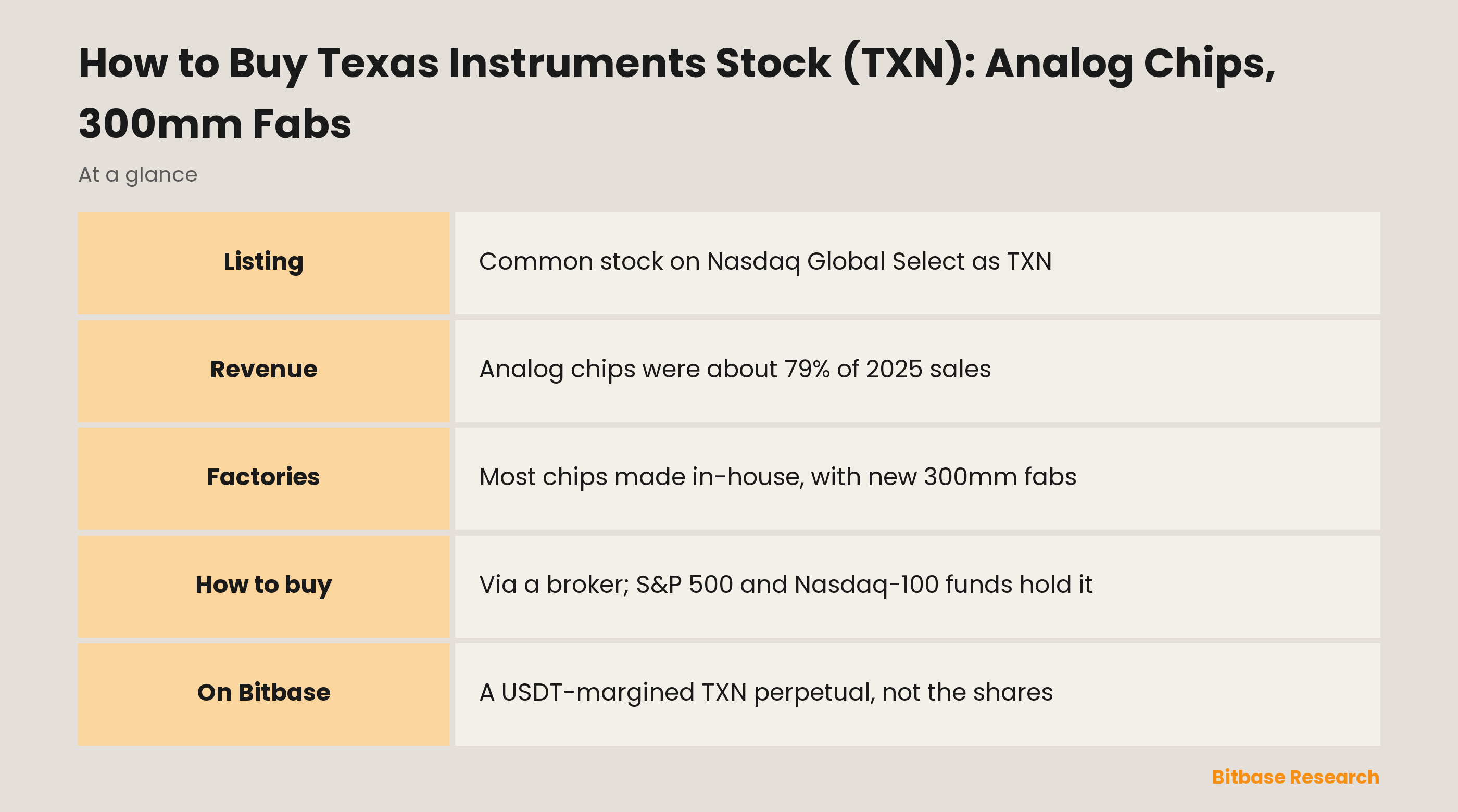
It takes nothing more than a brokerage account with Nasdaq access to buy Texas Instruments stock, which is quoted on the Nasdaq Global Select Market as TXN. What sets the company apart is that it makes most of its analog and embedded chips in its own factories, including new 300mm wafer fabs in Texas and Utah that were still ramping in 2025. Bitbase does not sell TXN shares; what it offers is a TXN perpetual contract, margined in USDT, that follows the share price without holding any stock.
What Does Texas Instruments Do?
Texas Instruments, which calls itself TI, sums up its business in one line of its annual report: "We design and manufacture semiconductors that we sell to electronics designers and manufacturers all over the world." Its operations began in 1930. It is incorporated in Delaware, headquartered in Dallas and active in more than 30 countries, and its catalogue runs to more than 80,000 products.
The business has two reportable segments. Analog chips deal with the physical world: in the 10-K's words, they "change real-world signals, such as sound, temperature, pressure or light," amplifying them and often converting them into digital data, and they manage power in every kind of electronic equipment. Its two product lines are Power, which covers battery management, voltage regulators and power switches, and Signal Chain, which covers amplifiers, data converters, interface chips, motor drives and sensing products.
Embedded Processing is what the filing calls the digital "brains" of electronic equipment: microcontrollers, processors, wireless connectivity and radar chips. Customers often write their own software for these parts, and because "many customers prefer to reuse software from one product generation to the next," those relationships tend to last. Everything else sits in Other: DLP products, mainly used to project high-definition images, calculators, and custom chips known as ASICs.
TI's roots run to the chip itself. According to the company, Jack Kilby "unveiled the first working integrated circuit in a TI lab" on 12 September 1958, work that later earned him a Nobel Prize in Physics. Today the 10-K names one yardstick for the strategy, "the growth of free cash flow per share over the long term," and no competitors, describing markets that "remain highly fragmented," with rivals ranging from "dozens of large and small companies" to emerging companies "particularly in Asia."
How Texas Instruments Makes Money
Analog carries the company. In 2025, Analog products generated about 79% of revenue and Embedded Processing about 15%, with Other making up the rest. Total revenue rose 13% that year: Analog grew 15% and Embedded Processing 6%. The year before ran the other way, with revenue down about 11% in 2024 and Embedded Processing down about 25%.
TI realigned its end-market categories in 2025 and now reports data center as a market of its own. Its estimates for that year put industrial at about 33% of revenue, automotive at about 33%, personal electronics at about 21%, data center at about 9% and communications equipment at about 3%, with calculators adding about 1%. Industrial runs from industrial automation and aerospace to medical equipment; automotive from infotainment to driver assistance. TI says it places "additional strategic emphasis" on industrial, automotive and data center.
The customer list is long but not flat. TI sells to more than 100,000 customers, and about half of its revenue comes from customers outside its largest 50. More than 80% of 2025 revenue was sold directly, including through TI.com, with distributors handling the rest. Even so, one end customer, which the filing does not name, accounted for 12% of revenue in both 2025 and 2024, mostly in Analog.
Location matters too. About 60% of revenue comes from customers headquartered outside the United States. End customers headquartered in China accounted for about 20% of 2025 revenue, while products shipped into China accounted for about 50%. The two figures measure different things: one counts where the buyer is based, the other where the chips are delivered.
TXN Stock at a Glance
| Fact | Detail |
|---|---|
| Ticker | TXN |
| Exchange | Nasdaq Global Select Market |
| Share class | Common stock, the only class registered on an exchange |
| Industry | Semiconductors: analog and embedded processing |
| Index membership | S&P 500 and Nasdaq-100, based on fund holdings dated 16 October 2026 |
| Headquarters | Dallas, Texas |
| Incorporated | Delaware |
| Operating since | 1930 |
| Fiscal year | Calendar year, ending 31 December |
| Dividend policy | Quarterly cash dividend, raised for 23 consecutive years as of September 2026 |
| Share buybacks | Board authorizations from 2018 and 2022, no expiration date |
| Pending deal | All-cash agreement to acquire Silicon Labs, announced 4 February 2026 |
Bitbase's Texas Instruments stock page shows the live price and chart.
How to Buy Texas Instruments Stock
TXN is the company's own US-listed common stock, with no depositary receipt to compare. The purchase runs through a broker:
1. Choose a broker with US market access. Make sure it takes clients from your country and offers Nasdaq-listed shares.
2. Complete the account checks. Identity verification comes first, and non-US clients are usually asked for Form W-8BEN.
3. Deposit funds. When your money is not in US dollars, the currency conversion is part of what the trade costs.
4. Look up TXN and choose how to order. A market order fills at whatever the price is when it executes; a limit order sets your maximum and may not fill at all. Fractional shares depend on the broker.
5. Keep the records. TI pays its dividend in cash each quarter, and for a holder outside the US any tax withheld is deducted first.
Outside the US, the instrument stays the same and the tax treatment changes. The IRS states that "Most types of U.S. source income received by a foreign person are subject to U.S. tax of 30%," and that a reduced rate, including exemption, may apply where a tax treaty exists between your country of residence and the United States. Form W-8BEN is what a foreign beneficial owner gives the withholding agent or payer, "whether or not you are claiming a reduced rate." None of this is tax advice.
Through an index fund, the exposure comes bundled. SPY, an S&P 500 tracker, and QQQ, a Nasdaq-100 tracker, both held TXN on 16 October 2026. Funds of this kind hold TI as one position among many, at a weight that shifts every trading day.
Trading TXN on Bitbase
On Bitbase, the route to TXN is a TXN perpetual futures contract that uses USDT for margin and settlement. The contract follows the price of Texas Instruments shares, yet it is not the stock: no share, no dividend, no vote. In return, a position can be long or short, can carry leverage and trades on through the nights and weekends when Nasdaq is shut.
Two mechanisms take the place of ownership. A funding payment passes periodically between longs and shorts, its direction set by whichever side is more crowded, and how funding works on a stock perpetual explains why that cost builds with time. When a position's margin runs out, it is liquidated on the mark price rather than the last trade. Since Nasdaq is open for only part of the week, the contract can travel overnight while the share later opens at a different level.
Before opening a position, read the contract's own rule page on Bitbase: it sets how often funding is paid, the margin tiers, the leverage cap and how the mark price is formed while Nasdaq is closed. Bitbase's TradFi page lists the other stocks available and the form each takes there.
What Moves TXN Stock
The inventory cycle. The 10-K describes chip demand as swinging between "periods of tight supply" and "periods of surplus inventory," and TI's revenue followed that pattern from the 2024 decline to the 2025 recovery. TI builds inventory "ahead of demand" for broad-based products with low risk of obsolescence and adjusts factory loadings to match. Within a year, sequential growth "tends to be weaker in the first and fourth quarters."
Industrial and automotive orders. These two markets made up about two thirds of 2025 revenue, and TI's own list of factors that could make results differ from expectations names "Market demand for semiconductors, particularly in the industrial and automotive markets."
Factory loadings and fixed costs. Because TI owns much of its capacity, a large part of its cost base stays put when demand drops; the filing warns that these fixed costs "do not decline with reductions in customer demand or factory loadings." Gross margin slipped to about 57% of revenue in 2025 from about 58% in 2024, which the 10-K links partly to higher manufacturing costs from capacity expansion. TI's LFAB fab, bought as an operating fab and still early in its ramp, mainly supports Embedded Processing, and that segment's operating profit fell 14% in 2025 even as its revenue grew 6%.
The end of the 300mm build-out. Capital expenditures equalled about 31% of revenue in 2024 and about 26% in 2025, and TI's 2025 annual report said it was "nearing the end of our six-year elevated capital expenditures cycle," with a 2026 range below the 2025 outlay. The case for the spending is cost: an unpackaged chip built on a 300mm wafer "costs about 40% less" than one built on a 200mm wafer, and TI plans to close its two remaining factories with 150mm production. The CHIPS Act adds a 35% investment tax credit on qualifying manufacturing investments placed in service after 2025, plus direct funding for three large 300mm fabs in Sherman, Texas, and Lehi, Utah. Free cash flow, meanwhile, went from about 10% of revenue in 2024 to about 17% in 2025.
China. With about 20% of revenue from customers headquartered in China and about 50% from products shipped there, tariffs, export controls and China's drive to build its own chip industry reach TI's results directly.
The Silicon Labs deal. In February 2026, TI agreed to buy Silicon Labs for cash. The deal would add approximately 1,200 wireless connectivity products, and TI plans to move Silicon Labs' manufacturing from external foundries into its own fabs. Its quarterly report filed in July 2026 still expected the deal to close in the first half of 2027, subject to regulatory approvals, funded with cash and debt.
Risks TI Flags in Its Own Filing
Trade and geopolitics. The risk factors warn that "Geopolitical tensions and administrative measures could limit our access to markets" or TI's ability to deliver products and obtain equipment, naming tariffs, export restrictions and sanctions among those measures.
Competition shaped by state policy. TI says it "may face increased competition as a result of China actively promoting and reshaping its domestic semiconductor industry through policy changes and investment."
Large customers. Results could suffer from "the loss or significant curtailment of purchases by one or more of our large customers," and a single end customer was 12% of revenue in both 2025 and 2024.
Fixed costs and incentives. With so much capacity owned, margins depend on keeping factories loaded. Government incentives "could be subject to reduction, modification, clawback or termination," and the CHIPS Act direct funding is paid only as milestones are met.
The stock itself. The 10-K notes that "the price of our securities is subject to volatility due to fluctuations in general market conditions" and to results that miss expectations. A dividend increase takes effect only once the board formally declares it.
The perpetual's extra layer. A leveraged position can lose more than the share's move alone, funding keeps accruing while it stays open, and a gap when Nasdaq opens can jump straight past the liquidation price. The guide to stock perpetual margin and liquidation shows how that happens.
How to Research TXN Yourself
TI files with the SEC under CIK 97476, so EDGAR is the first stop. In the 10-K, Item 1 holds the business and the end-market table, Item 1A the risk factors and Item 7 the segment results and capital spending plan; Note 1 carries revenue by customer headquarters and the major-customer disclosure. Each 10-Q updates the picture, including the Silicon Labs deal, and the 8-Ks carry quarterly results and announcements such as the September dividend increases. TI also posts these reports on its investor relations website.
Texas Instruments Stock FAQ
Does Texas Instruments pay a dividend?
Yes, a quarterly cash dividend. The increase TI announced on 17 September 2026 marked 23 consecutive years of dividend increases, and the company describes its aim as "a sustainable and growing dividend," with a commitment "to return all free cash flow to its owners over time." An increase takes effect only once the board formally declares it; the amount per share is in TI's latest dividend announcement.
Is TXN in the S&P 500?
Yes. TXN appeared in the 16 October 2026 holdings of SPY, an S&P 500 fund, and of QQQ, a Nasdaq-100 fund. Membership can change, hence the date.
Can I buy Texas Instruments stock with crypto?
Not directly. A broker sells TXN shares for money, so crypto must first be turned into cash. What Bitbase offers is the TXN perpetual, tradable with USDT: it follows the share price but is a derivative with no dividend, no vote and a liquidation price. For the broader picture, see buying stocks with crypto.
Does Texas Instruments still sell calculators?
Yes. Calculators are reported in Other, alongside DLP products and custom ASICs, and brought in about 1% of revenue in 2025.
Is Texas Instruments buying Silicon Labs?
TI agreed on 4 February 2026 to acquire Silicon Labs in an all-cash transaction. Its quarterly report filed in July 2026 still expected the deal to close in the first half of 2027, subject to regulatory approvals and other customary closing conditions. Until then, the two remain separate listed companies.
When does Texas Instruments report earnings?
Quarterly, and TI's fiscal year is the calendar year. During 2025, its results releases were filed on Form 8-K in January, April, July and October, and the 10-K for that year followed on 6 February 2026.
Conclusion
Buying TXN is a routine broker order; the time is better spent on the company behind it. About four fifths of revenue comes from analog chips and two thirds from industrial and automotive markets, with most production in TI's own fabs, so the chip cycle, factory loadings and the payoff from six years of elevated capital spending drive results, with China and the Silicon Labs deal on top. Anyone who only wants exposure to the price can use the Bitbase perpetual instead, but it is a different instrument, with funding costs and liquidation risk, and it gives no ownership in TI.
Related reading
Other Bitbase articles on this topic:
- How to Buy KLA Stock (KLAC): Chip Inspection, 10-for-1 Split
- How to Buy Lam Research Stock (LRCX): Chip Tools, China and Perps
- How to Buy Marvell Stock (MRVL): Custom AI Chips and USDT Perps
Disclaimer: This article is educational content from Bitbase Academy, provided for information only. It explains what a company or fund does and how the instruments referenced here differ from one another; it does not constitute investment, trading, tax, or financial advice, and it is neither a recommendation nor an endorsement of any security, token, or trading strategy. A tokenized stock is issued by a third party and is designed to give economic exposure to an underlying asset: it is not a share, it carries no shareholder rights, and it depends on the issuer's structure, eligibility rules, and redemption terms, which the issuer can change. Perpetual futures are leveraged derivatives that hold no underlying asset and can be liquidated, and trading hours, product availability, and eligibility differ by instrument and by jurisdiction and can change at any time. Written as of October 2026; verify everything yourself through company filings, the issuer's own documentation, and the product pages of the venue you trade on.
References
[1] Texas Instruments 2025 Form 10-K (SEC EDGAR) www.sec.gov
[2] Texas Instruments Form 10-Q for the quarter ended 30 June 2026 (SEC EDGAR) www.sec.gov
[3] Texas Instruments press release, 17 September 2026: dividend increase (SEC EDGAR) www.sec.gov
[4] Texas Instruments press release, 4 February 2026: agreement to acquire Silicon Labs (SEC EDGAR) www.sec.gov
[5] Texas Instruments: the origin story of the integrated circuit www.ti.com
[6] State Street: SPY daily holdings, 16 October 2026 www.ssga.com
[7] Invesco QQQ: fund overview and holdings (tracks the Nasdaq-100) www.invesco.com
[8] IRS: NRA withholding www.irs.gov
[9] IRS: About Form W-8 BEN www.irs.gov





