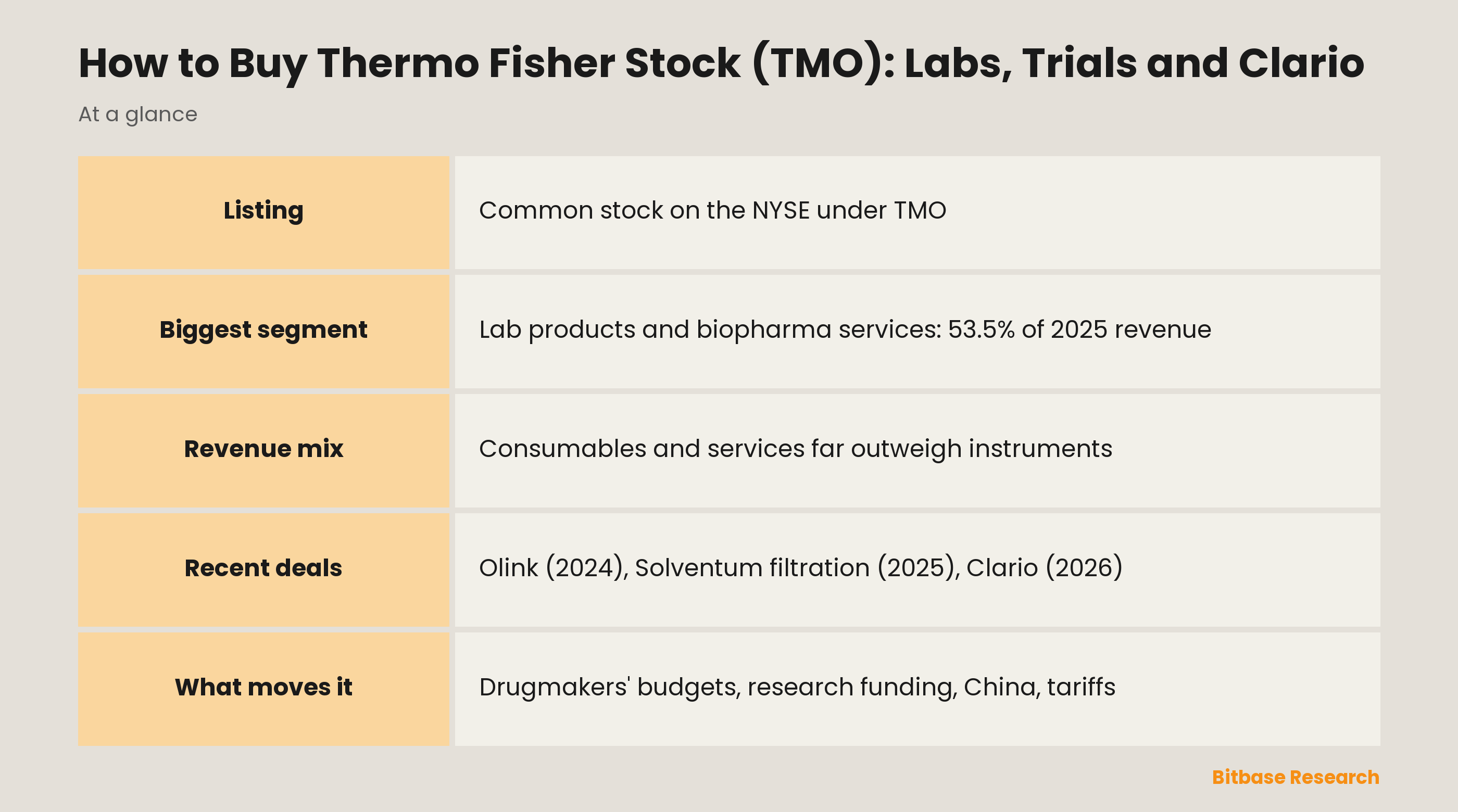
Once you have a brokerage account that can trade New York Stock Exchange shares, buying Thermo Fisher Scientific stock is a single order for the ticker TMO. What that order buys is harder to see: more than half of the company's 2025 revenue came from one segment that runs a lab-supply channel, makes medicines for other companies and manages clinical trials. This guide covers the four segments, the steps to buy, and the pressures its own filings name: drugmakers' budgets, research funding, tariffs and acquisitions.
What Does Thermo Fisher Do?
Thermo Fisher Scientific sells the equipment, materials and services that laboratories and drug developers work with. Its annual report calls the company "the world leader in serving science"; customers range from drugmakers, hospitals and diagnostic labs to universities, government agencies and industrial users. Its brands include Thermo Scientific, Applied Biosystems, Invitrogen, Fisher Scientific, Unity Lab Services, Patheon and PPD.
It was incorporated in Delaware in 1956, went public in 1967 and joined the New York Stock Exchange in 1980. It was known as Thermo Electron until its merger with Fisher Scientific International, completed on 9 November 2006, after which it took its current name. Headquarters are in Waltham, Massachusetts.
The business reports four segments. Life Sciences Solutions supplies reagents, instruments and consumables for research, drug discovery and the production of drugs and vaccines; its bioproduction business covers the making of a biologic, from cell culture to purification. Analytical Instruments makes chromatography and mass spectrometry systems, chemical analysis instruments and electron microscopes, the last also sold to the semiconductor industry. Specialty Diagnostics sells test kits, reagents, culture media and instruments to hospitals and to clinical, industrial and food safety labs, from allergy testing to tissue typing for organ transplants.
Laboratory Products and Biopharma Services offers, in the company's words, "virtually everything needed for the laboratory," plus outsourced work for drug companies: pharma services that develop and manufacture small- and large-molecule medicines, and clinical research covering Phases I to IV of drug trials.
Recent deals added Olink, a Swedish proteomics company, on 10 July 2024, a purification and filtration business from Solventum on 1 September 2025 and Clario, a provider of clinical trial endpoint data, on 24 March 2026.
How Thermo Fisher Makes Money
Revenue rose 4% in 2025. Leaving out acquisitions and currency, the company's organic growth measure, which is not a GAAP figure, came to 2%. The segment data show where the money comes from:
| Segment | Share of 2025 revenue | Change from 2024 | Businesses named in the 10-K |
|---|---|---|---|
| Laboratory Products and Biopharma Services | 53.5% | +3.5% | Laboratory products, research and safety market channel, pharma services, clinical research |
| Life Sciences Solutions | 19.7% | +7.6% | Biosciences, genetic sciences, bioproduction |
| Analytical Instruments | 16.5% | +1.2% | Chromatography and mass spectrometry, chemical analysis, electron microscopy |
| Specialty Diagnostics | 10.3% | +3.5% | Clinical diagnostics, immunodiagnostics, microbiology, transplant diagnostics, healthcare market channel |
Both columns use revenue from external customers, which adds up exactly to the consolidated total.
Inside the largest segment, laboratory products are the smallest of the four businesses. The rest is a sales channel that also resells other companies' brands, plus two service operations working for drug developers.
Split by type, consumables made up 41.9% of 2025 revenue, services 41.7% and instruments 16.4%. Instrument sales fell 1.9% while consumables and services grew.
By customer location, the United States accounted for 49.9% of 2025 revenue, leaving slightly more than half abroad; Europe contributed 26.5% and Asia-Pacific 18.2%. Exchange rates therefore run through reported results.
TMO Stock at a Glance
| Item | Detail |
|---|---|
| Exchange | New York Stock Exchange (NYSE) |
| Ticker | TMO |
| Security | Common stock, the only equity security registered on the 10-K cover |
| Other NYSE listings | 13 series of company notes, with symbols such as TMO 27 and TMO 49 |
| Index membership | S&P 500 |
| Headquarters | Waltham, Massachusetts |
| Incorporated | Delaware, 1956 |
| Fiscal year | Ends 31 December; each quarter closes on a Saturday near the calendar quarter-end |
| Dividend policy | Quarterly cash dividend, paid since April 2012 |
| SEC identifier | CIK 97745 |
The table leaves out everything that changes during a trading session. For the current quote, market value and dividend yield, open the Thermo Fisher stock page on Bitbase.
How to Buy Thermo Fisher Stock
Thermo Fisher is a US company with one listed class of shares, so no depositary receipt is involved. The purchase runs through a broker:
1. Choose a broker with US market access. Outside the United States that may be a local firm routing orders to New York or an international one; find out which company keeps your assets and which authority licenses it.
2. Complete the account checks. Individuals who are not US persons normally file IRS Form W-8BEN, so the broker can withhold US dividend tax at a treaty rate where one applies.
3. Fund the account. Converting into US dollars costs a spread on top of any commission.
4. Search for TMO and check the line. You want Thermo Fisher Scientific common stock on the NYSE. Exchange symbols are reserved centrally, so stock symbols do not collide the way crypto tickers do, but one company can list several securities: TMO 27 or TMO 35A are Thermo Fisher notes, which are debt, not shares.
5. Pick an order type. The SEC's investor website points out that "the last-traded price is not necessarily the price at which a market order will be executed." A limit order caps that: "A buy limit order can only be executed at the limit price or lower."
6. Decide how much to buy. If whole shares are too large a step, fractional shares let you put in a set sum. Availability varies; the SEC notes that "some firms only allow fractional share investing in S&P 500 stocks," which would include TMO, and that "when you own fractional shares you will still receive dividends."
7. Submit the order and keep the confirmation. Your cost basis and every dividend will appear in the broker's statements.
Tax outside the US. The IRS states that "most types of U.S. source income received by a foreign person are subject to U.S. tax of 30%," though a treaty can lower the rate. It is normally withheld before the dividend reaches you, and your own country can tax the same income too.
Holding it through a fund. TMO appeared in State Street's holdings files for both SPY, its S&P 500 trust, and XLV, its Health Care Select Sector fund, on 16 October 2026. Such a fund holds Thermo Fisher among many companies; what tracking an index actually buys is a different choice from picking one stock.
What Moves TMO Stock
Drugmakers' spending. Bioproduction, contract manufacturing and clinical research all sell to pharmaceutical and biotech companies. Their demand rose in 2025, though the 10-K says the gain was "partially offset by reduced demand for COVID-19 vaccine and therapy related products and services." Bioproduction revenue grew 20.7%, helped by the Solventum filtration business. When drug developers trim research or slow trials, several segments feel it at once.
Research funding. Revenue from universities and government research bodies fell in 2025, which the company linked to "customer hesitancy in a more uncertain environment in the U.S. and macro conditions in China." Its risk factors tie demand to "government funding policies" and cite the October 2025 US federal shutdown as an example of budget disruption.
China and tariffs. Sales rose in North America, Europe and Asia-Pacific in 2025 but declined in China, where, according to the 10-K, regulations push buyers toward local suppliers. Tariffs show up in instruments: Analytical Instruments posted flat organic revenue while its segment income fell 11%, and the company said the lower margin "resulted primarily from the impacts of tariffs and related foreign exchange, strategic investments, and unfavorable business mix." Chemical analysis revenue fell 5.9%.
The fourth quarter. Fourth-quarter revenue is "historically stronger than in other quarters due to the capital spending patterns of industrial, pharmaceutical and government customers," so compare each quarter with the same one a year earlier.
Acquisitions and capital allocation. The company "deploys its capital primarily via mergers and acquisitions and secondarily via share buybacks and dividends." Past deals left significant goodwill on the balance sheet, which might have to be written down if acquired businesses fall short, and total debt at the end of June 2026 was higher than at the end of 2025. In 2025 buybacks took more cash than dividends, and the board approved a new repurchase authorization that November.
Risks Thermo Fisher Flags in Its 10-K
Of the many headings in Item 1A, these sit closest to what a TMO shareholder owns:
Cyclical end markets. "Our growth would be impacted if the markets into which we sell our products and services decline, do not grow as anticipated or experience cyclicality."
Customer budgets. "Demand for some of our products depends on capital spending policies of our customers and on government funding policies."
Pharma services quality. "Our pharma services offerings are highly complex, and if we are unable to provide quality and timely offerings to our customers, our business could suffer." The company is also "the sole manufacturer of a number of pharmaceuticals for many of our customers," so a regulatory setback can disrupt customers' own supply.
Integration. "Our inability to complete any pending acquisitions or to successfully integrate any new or previous acquisitions could have a material adverse effect on our business."
Owning the stock adds two risks of its own: money in one company rides on that company's results, and for investors outside the US, price and dividend both arrive through an exchange rate.
How to Research TMO Yourself
Thermo Fisher's SEC filings sit under CIK 97745: the 10-K annually, 10-Qs quarterly and 8-Ks for events, including deals such as Clario and the quarterly results releases, which arrive in January, April, July and October. The same filings are posted in the Investors section of thermofisher.com.
Within the 10-K, the segments are described in Item 1, the risks in Item 1A and segment results in Item 7. Note 6 breaks revenue down by type, region and business; Note 11 carries the segment data.
Three checks prevent misreadings. Quarters end on a Saturday rather than a month-end: the 2026 quarterly reports cover periods ending 28 March and 27 June. Organic growth is a company measure that the filings reconcile to reported revenue; the difference is acquisitions, divestitures and currency. And segment totals in the 10-K include sales between segments, so they add up to more than consolidated revenue. Live quotes are on the TMO page linked earlier, and peers can be checked through the full list of US stock pages on Bitbase.
Thermo Fisher Stock FAQ
Does Thermo Fisher pay a dividend?
It does, four times a year. The board decided in February 2012 to start a quarterly cash dividend, first paid on 16 April 2012; the 2006 annual report had said the company had never paid one. The amount declared per share in the second quarter of 2026 was higher than a year earlier; the latest 10-Q has the figures.
Can I buy Thermo Fisher stock with crypto?
Not directly. TMO trades in US dollars through brokerage accounts, which means converting crypto to cash and transferring that cash to the broker first; depending on your country, the conversion can itself be taxable. A share and a coin carry different rights, so treat it as two decisions. Crypto or stocks: the six measures that decide it sets out how they compare.
Is TMO in the S&P 500?
Yes. State Street's daily holdings file for its S&P 500 trust (SPY) listed Thermo Fisher Scientific on 16 October 2026, as did the file for its Health Care Select Sector fund (XLV). Weights change every day.
Is Thermo Fisher the same company as Fisher Scientific?
They are one company now. Fisher Scientific International filed its own reports with the SEC until it merged with Thermo Electron on 9 November 2006; the combined company took the name Thermo Fisher Scientific, and Fisher Scientific is now one of its brands.
Why did Thermo Fisher buy Clario?
Clario supplies endpoint data for clinical trials: the outcomes measured to decide whether a treatment under study is effective and safe. Announced on 29 October 2025 and completed on 24 March 2026, it joined Laboratory Products and Biopharma Services, where the company says it complements its clinical research business.
Conclusion
Placing the order is the easy part: an NYSE-capable broker, the TMO common stock line rather than a note, and a market or limit order. Understanding the share takes longer. Thermo Fisher earns most of its money from consumables and services sold to drug developers, labs and hospitals, so its results follow their budgets, research funding in the US and China, tariffs and its own deals. Read the latest 10-K and 10-Q before deciding how much room one life sciences supplier deserves in a portfolio.
Related reading
Other Bitbase articles on this topic:
- How to Buy Edwards Lifesciences Stock (EW): TAVR, No Dividend
- How to Buy Elevance Health Stock (ELV): Anthem, BCBS, Carelon
- How to Buy HCA Healthcare Stock (HCA): Payers, Texas and Florida
Disclaimer: This article is educational content from Bitbase Academy, provided for information only. It explains what a company or fund does and how the instruments referenced here differ from one another; it does not constitute investment, trading, tax, or financial advice, and it is neither a recommendation nor an endorsement of any security, token, or trading strategy. A tokenized stock is issued by a third party and is designed to give economic exposure to an underlying asset: it is not a share, it carries no shareholder rights, and it depends on the issuer's structure, eligibility rules, and redemption terms, which the issuer can change. Perpetual futures are leveraged derivatives that hold no underlying asset and can be liquidated, and trading hours, product availability, and eligibility differ by instrument and by jurisdiction and can change at any time. Written as of October 2026; verify everything yourself through company filings, the issuer's own documentation, and the product pages of the venue you trade on.
References
[1] Thermo Fisher Scientific Form 10-K, fiscal 2025: business, segment and revenue data, risk factors (SEC EDGAR) www.sec.gov
[2] Thermo Fisher Scientific Form 10-Q for the quarter ended 27 June 2026: Clario acquisition, dividends declared, debt (SEC EDGAR) www.sec.gov
[3] Thermo Fisher Scientific press release, 24 March 2026: completion of the Clario acquisition (Form 8-K, Exhibit 99.1) www.sec.gov
[4] Thermo Fisher Scientific press release, 29 October 2025: agreement to acquire Clario (Form 8-K, Exhibit 99.1) www.sec.gov
[5] Thermo Fisher Scientific Form 10-K, fiscal 2006: incorporation, listing history and the merger with Fisher Scientific (SEC EDGAR) www.sec.gov
[6] Thermo Fisher Scientific Form 10-K, fiscal 2011: board decision to initiate a quarterly cash dividend (SEC EDGAR) www.sec.gov
[7] State Street SPDR S&P 500 ETF Trust (SPY): fund page and daily holdings www.ssga.com
[8] State Street Health Care Select Sector SPDR ETF (XLV): fund page and daily holdings www.ssga.com
[9] Investor.gov (SEC): Types of Orders www.investor.gov
[10] Investor.gov (SEC): Investor Bulletin on fractional share investing www.investor.gov
[11] IRS: NRA Withholding www.irs.gov





