
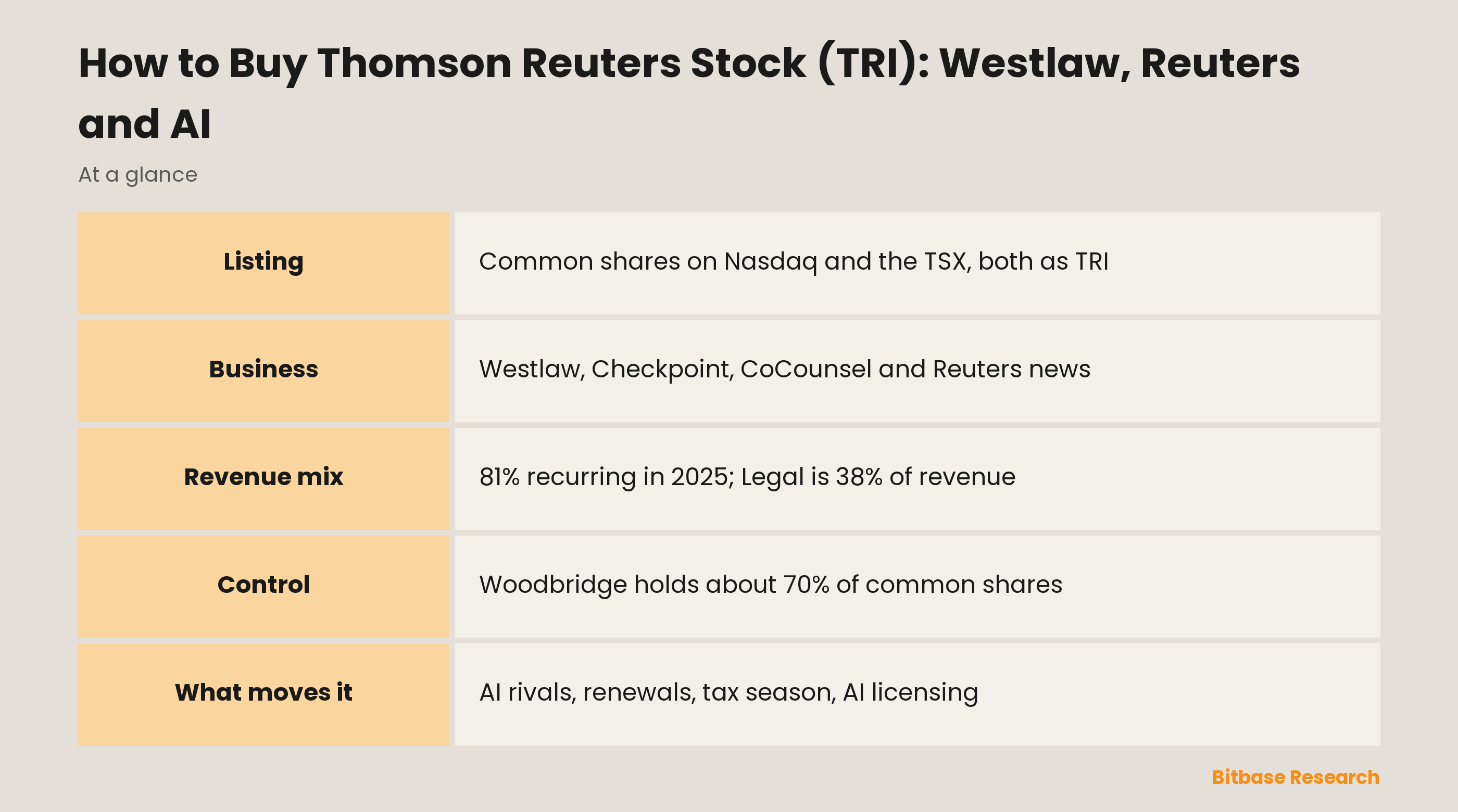
On either Nasdaq or the Toronto Stock Exchange, any broker with access to that market can buy you Thomson Reuters stock under one ticker, TRI: it is the same common share, priced in US dollars on Nasdaq and in Canadian dollars in Toronto. Behind it sit Westlaw, the Reuters news agency and a controlling shareholder, Woodbridge, the Thomson family's investment company, which owned about 70% of the common shares in March 2026.
What Does Thomson Reuters Do?
Thomson Reuters sells specialist information, software and news to lawyers, tax advisers, auditors, compliance teams and newsrooms. Its products, in the words of its annual report, "combine highly specialized software and insights." What makes them hard to copy is the content underneath. Westlaw, its legal research service, holds 1.9 billion documents from more than 3,500 sources, enhanced by 1,500 attorney editors who add headnotes, summaries and classifications.
The company was incorporated in Ontario in 1977 and was called The Thomson Corporation until April 2008, when it adopted its current name.
For 2025 it reported five segments.
Legal Professionals serves law firms, courts and governments with Westlaw, Practical Law and CoCounsel, its AI assistant. The annual report names LexisNexis, owned by RELX (see our RELX stock guide), and Wolters Kluwer as its main global competitors.
Corporates sells tax, trade, legal and risk software to companies of every size, including the seven largest global accounting firms. Its products include ONESOURCE and Pagero, an e-invoicing business. Rivals include Bloomberg and specialists such as Avalara and Vertex.
Tax, Audit & Accounting Professionals serves the other accounting firms with Checkpoint research and tools such as UltraTax, SafeSend and SurePrep. Competitors include Wolters Kluwer's CCH business, Bloomberg Industry Group and Intuit, profiled in our Intuit stock guide.
Reuters, founded in 1851, supplies news to media organizations, professionals and readers of Reuters.com, and to financial firms exclusively through products of London Stock Exchange Group (LSEG).
Global Print sold legal and tax information in print. That segment has since left the group: on 1 October 2026 Thomson Reuters sold 51% of it to accounts advised by KKR. The business now runs as Westbridge Print, a joint venture in which Thomson Reuters keeps 49% and pays a royalty of 20% of its professional revenues to distribute the company's content in print and on the ProView eBook platform.
How Thomson Reuters Makes Money
Mostly through subscriptions. In 2025, 81% of revenues were recurring: fees for access to products such as Westlaw and Practical Law, on terms of one to five years that most customers renew. The company reported a 92% retention rate. Transactions revenue, such as fees tied to tax filings, "can fluctuate significantly from period to period," the annual report warns.
| Segment | Share of 2025 revenues | 2025 segment adjusted EBITDA margin | Main products |
|---|---|---|---|
| Legal Professionals | 38% | 47.3% | Westlaw, Practical Law, CoCounsel |
| Corporates | 27% | 36.0% | ONESOURCE, Pagero, CLEAR |
| Tax, Audit & Accounting Professionals | 17% | 47.1% | Checkpoint, UltraTax, SafeSend |
| Reuters | 11% | 20.4% | News agency, Reuters.com, events |
| Global Print | 7% | 37.7% | Print reference works (sold down in 2026) |
Revenue shares are calculated from the segment note of the 2025 annual report; the margins are the company's own non-IFRS measures.
The first three segments, which the company calls its "Big 3," grew 9% on an organic basis in 2025, a measure that strips out currency and acquisitions and disposals. Total revenues rose 3%, or 7% organically. Legal Professionals shows the gap: reported revenues fell after the December 2024 sale of FindLaw, while organic revenues rose 8%.
The customer base is broad, at about 450,000 customers, but one contract stands out. The largest customer, at about 5% of revenues, is LSEG's Data & Analytics business, which takes Reuters news under an agreement that runs to 1 October 2048. In 2025 that agreement supplied 47% of the Reuters segment's revenues; the annual report calls the amount "the current minimum annual value," adjusted over time for inflation and exchange rates. By geography, 72% of 2025 revenues were US-based.
TRI Stock at a Glance
| Item | TRI |
|---|---|
| Listings | Nasdaq and Toronto Stock Exchange, both under TRI |
| US venue | Nasdaq since February 2025; New York Stock Exchange before that |
| Security | Common shares, one vote each |
| Trading currency | US dollars on Nasdaq, Canadian dollars in Toronto |
| Sector | Industrials, in BlackRock's iShares S&P/TSX 60 fund data |
| Index funds | Held by QQQ (Nasdaq-100) and XIU (S&P/TSX 60); not held by SPY |
| Headquarters | Toronto, Ontario |
| Reporting | Form 40-F yearly, Form 6-K for quarterly reports; IFRS, US dollars |
| Fiscal year | Ends 31 December |
| Dividends | Quarterly, declared in US dollars |
| Controlling shareholder | Woodbridge, about 70% of common shares (March 2026) |
Live prices are on the Thomson Reuters stock page on Bitbase.
How to Buy Thomson Reuters Stock
There is no depositary receipt involved: the share bought on Nasdaq is the share bought in Toronto.
1. Choose the market. A broker with US access trades TRI on Nasdaq; one with Canadian access trades it on the TSX.
2. Open and verify the account, including a declaration of tax residence.
3. Fund it in the trading currency. Nasdaq quotes are in US dollars and TSX quotes in Canadian dollars; the exchange rate your broker applies can cost more than the commission.
4. Read the security name, not just the ticker. You want Thomson Reuters Corporation common shares. In Toronto, TRI.PR.B is a different security: a Series II preference share whose dividend is set at 70% of the Canadian bank prime rate.
5. Pick an order type. A market order fills at the best price available when it reaches the exchange, which may differ from the last quote; a limit order sets the most you will pay but may not fill.
6. Decide on fractional shares. Some brokers sell fractions of a share and some do not, and fractional holdings may not carry voting rights.
Dividends. Thomson Reuters declares its common dividend in US dollars, pays it in US dollars by default and lets holders elect Canadian dollars or British pounds instead. Tax may be withheld on dividends paid across borders, so ask your broker what will be deducted where you live.
The May 2026 share consolidation. On 4 May 2026 the company returned capital to shareholders and consolidated its shares, each old share becoming 0.984560 of a new one. The ticker stayed TRI. Adjust older per-share data before comparing it with later figures.
Through a fund. On 5 November 2026, Invesco's QQQ listed TRI among its holdings, and BlackRock's XIU did so on 6 November.
What Moves TRI Stock
AI in legal and tax work. CoCounsel sits at the center of the company's product plans, and the third-quarter 2026 release mentions customer talks about commercial uses of Thomson LLM, the company's own language model. The same technology lowers the cost of building rivals: the annual report warns that "rapid advancements in coding tools may enable new and existing competitors to create competing offerings rapidly."
Organic growth and renewals. With most revenue recognized over contract terms, the annual report says revenues are "typically slower to decline when economic conditions worsen, but slower to return to growth when economic activity improves." Big 3 organic growth was 10% in the third quarter of 2026.
Tax season. Tax, Audit & Accounting Professionals is the most seasonal unit, generating about 60% of its full-year revenues in the first and fourth quarters, so its margins swing within the year.
AI licensing at Reuters. Reuters also licenses its content for generative AI uses, and that income comes in lumps. In 2025 lower generative AI licensing revenue helped cut the segment's adjusted EBITDA by 11%; in the third quarter of 2026 higher licensing lifted Reuters revenues 13% at constant currency.
Capital returns and portfolio changes. In February 2026 the board raised the annualized dividend by 10%, the 33rd consecutive annual increase. The same year it returned capital, sold control of Global Print and bought Noetica, an AI start-up.
Woodbridge, AI Rivals and Other Thomson Reuters Risks
A controlling shareholder. Woodbridge, the investment vehicle of the family of the first Lord Thomson of Fleet, owned about 70% of the common shares in March 2026, so it can generally decide any matter put to a majority vote. Its shares carry one vote each, like everyone else's. The annual report spells out the cost: "The effect of this control may be to limit the price that investors are willing to pay for our shares," and a sale by Woodbridge, or the market's belief that one may come, "may adversely affect the market price of our shares."
The Founders Share. A separate company holds one Thomson Reuters Founders Share to protect the Trust Principles on news independence. It can cast extraordinary votes if anyone acquires 15% of the voting shares or tries to control 30%, a safeguard aimed at any holder whose stake threatens those principles.
Faster competitors and AI errors. Beyond the competition risk above, the company says the use of AI in its products "may give rise to risks related to harmful content, inaccuracy, misinformation, bias," among others.
Currency and the print deal. The company reports in US dollars while Toronto prices the share in Canadian dollars. In the Global Print deal it also agreed to provide financial support designed to give KKR a minimum return on its equity "under certain circumstances."
A single stock also ties your result to one company's execution.
How to Research TRI Yourself
Thomson Reuters files with the SEC under CIK 1075124. Its Form 40-F carries the annual report, which combines the annual information form, the management's discussion and analysis (MD&A) and the audited statements; quarterly reports and earnings releases arrive on Form 6-K, and the same documents are on SEDAR+.
The MD&A gives organic growth by segment and splits recurring from transactions revenue, which is where to look for the Reuters licensing swings. Compare like with like: from the first quarter of 2026 some customers moved among the three largest segments, and from the third quarter Global Print left continuing operations, so 2025 segment figures in recent releases differ from those in the 40-F. Quotes for other listed companies are on Bitbase's stock pages.
Thomson Reuters Stock FAQ
Can I buy Thomson Reuters stock with crypto?
Not directly. Brokers sell TRI for US dollars on Nasdaq and Canadian dollars on the TSX, so crypto has to be sold for cash first, and that sale may be taxable where you live. A share also works differently from a token, as our guide to how stocks and crypto differ explains.
Is TRI listed on Nasdaq or the NYSE?
Nasdaq. Thomson Reuters moved its US listing from the New York Stock Exchange to Nasdaq in February 2025. The shares also trade on the Toronto Stock Exchange, under TRI in both places.
Does Thomson Reuters pay a dividend?
Yes, every quarter, declared in US dollars. The increase announced in February 2026 was the 33rd in a row, but the annual report states that the declaration and amount of dividends are "at the discretion of the Board."
Did Thomson Reuters do a reverse stock split?
Yes. On 4 May 2026, alongside a return of capital, each share was consolidated into 0.984560 of a new share.
Is Thomson Reuters in the S&P 500?
No. State Street's SPY holdings file for 5 November 2026 did not include it. It was, however, among the holdings of QQQ, which tracks the Nasdaq-100.
Conclusion
Buying TRI takes a broker that reaches Nasdaq or the TSX, a choice of currency and a check that the order is for the common shares. Understanding it takes longer: a subscription business built on legal and tax content, racing to turn that content into AI products as rivals do the same, with a news agency tied to LSEG until 2048 and a family holder with about 70% of the common shares. Read the latest 40-F and quarterly release before deciding how much of your portfolio it should be.
Related reading
Other Bitbase articles on this topic:
- How to Buy Global Payments Stock (GPN): After the Worldpay Swap
- How to Buy Infosys Stock (INFY): 1:1 ADS, Dividends and H-1B Risk
- How to Buy MSCI Stock (MSCI): Indexes, ETF Fees and BlackRock
Disclaimer: This article is educational content from Bitbase Academy, provided for information only. It explains what a company or fund does and how the instruments referenced here differ from one another; it does not constitute investment, trading, tax, or financial advice, and it is neither a recommendation nor an endorsement of any security, token, or trading strategy. A tokenized stock is issued by a third party and is designed to give economic exposure to an underlying asset: it is not a share, it carries no shareholder rights, and it depends on the issuer's structure, eligibility rules, and redemption terms, which the issuer can change. Perpetual futures are leveraged derivatives that hold no underlying asset and can be liquidated, and trading hours, product availability, and eligibility differ by instrument and by jurisdiction and can change at any time. Written as of November 2026; verify everything yourself through company filings, the issuer's own documentation, and the product pages of the venue you trade on.
References
[1] Thomson Reuters Form 40-F for 2025 (SEC EDGAR) www.sec.gov
[2] Thomson Reuters Annual Report 2025, filed with Form 40-F (SEC EDGAR) www.sec.gov
[3] Thomson Reuters 2025 Form 40-F, XBRL cover page (SEC EDGAR) www.sec.gov
[4] Thomson Reuters 2025 Form 40-F, XBRL segment data (SEC EDGAR) www.sec.gov
[5] Thomson Reuters third-quarter 2026 results, filed with Form 6-K (SEC EDGAR) www.sec.gov
[6] Thomson Reuters and KKR Global Print joint venture release, Form 6-K (SEC EDGAR) www.sec.gov
[7] Thomson Reuters return of capital and share consolidation ratio, Form 6-K (SEC EDGAR) www.sec.gov
[8] Thomson Reuters Form 8-A: listing transfer from the NYSE to Nasdaq (SEC EDGAR) www.sec.gov
[9] Invesco QQQ: fund holdings dng-api.invesco.com
[10] State Street SPDR S&P 500 ETF Trust (SPY): fund page and daily holdings www.ssga.com
[11] BlackRock iShares S&P/TSX 60 Index ETF (XIU): fund page and holdings www.blackrock.com





