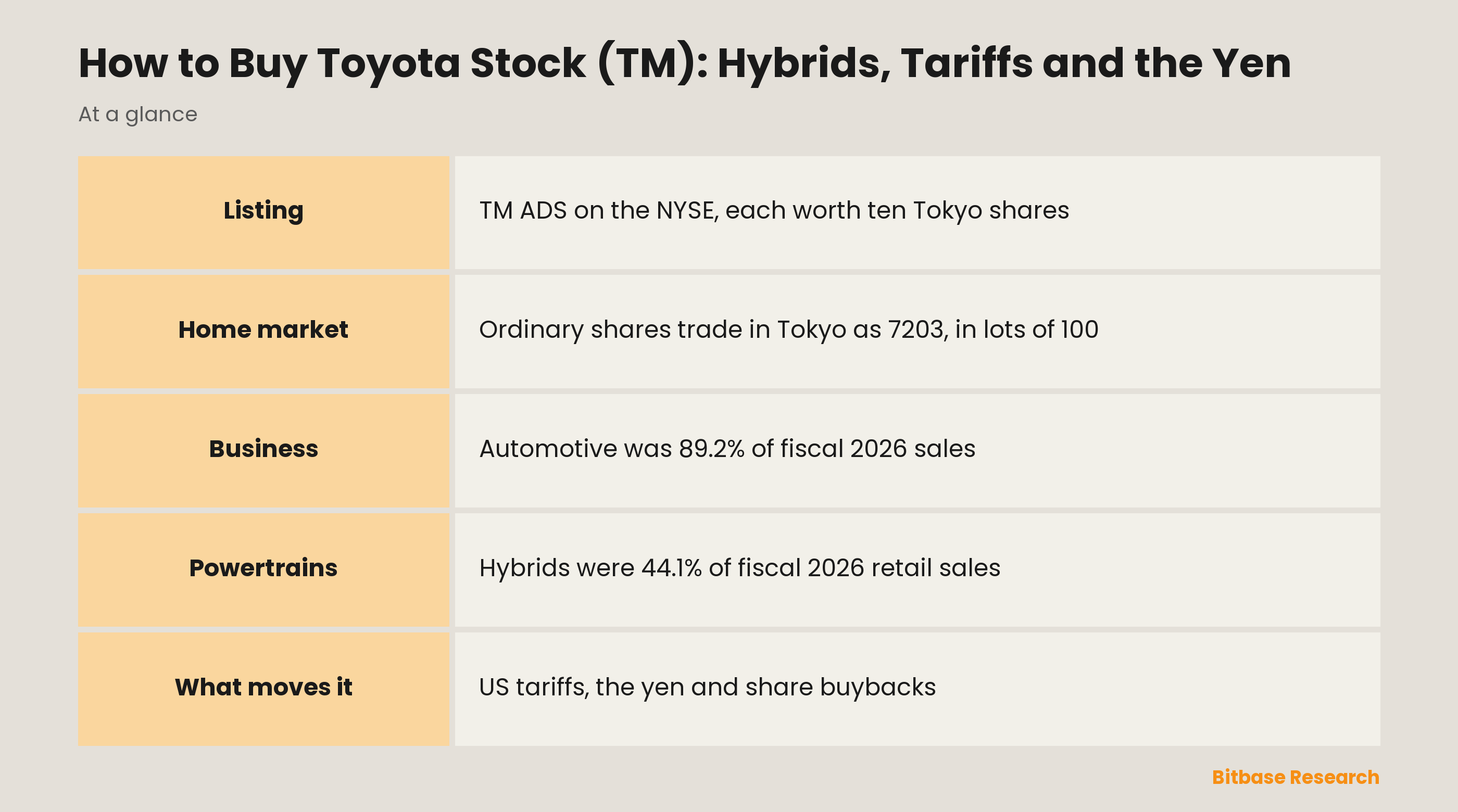
Ten ordinary shares of Toyota Motor stand behind every TM, the American depositary share (ADS) listed on the New York Stock Exchange, so any broker with NYSE access can buy one; with access to Tokyo, you can buy the ordinary shares themselves under the code 7203. In fiscal 2026, the year to 31 March 2026, hybrids were 44.1% of Toyota and Lexus retail sales and battery electric cars 2.3%, while the cost the company attributes to US tariffs was larger than the entire fall in its operating income. This guide covers how Toyota earns its money, how the ADS differs from the Tokyo share, and what moves the price.
What Does Toyota Do?
Toyota Motor Corporation designs, builds and sells passenger cars, minivans and commercial vehicles, along with their parts, in about 200 countries and regions. Its main markets are Japan, North America, Europe and Asia, and its head office is in Toyota City, Aichi Prefecture.
The company began in 1933 as the automobile division of Toyoda Automatic Loom Works, the firm now called Toyota Industries. It became a separate company in August 1937, and in 1982 Toyota Motor Company and Toyota Motor Sales merged into the present Toyota Motor Corporation. In 2026 Kenta Kon, previously chief financial officer, became president and chief executive.
The product line now runs under five brands. At the Japan Mobility Show in October 2025 the company added Century as a brand of its own, alongside Toyota, Lexus, Daihatsu and GR. Its engineering bet is what the annual report calls a "multi-pathway" strategy: hybrids, plug-in hybrids, battery electric and fuel-cell vehicles side by side, plus work on carbon-neutral fuels and hydrogen. In fiscal 2026 electrified vehicles of all kinds made up 48.1% of Toyota and Lexus retail sales, almost all of them hybrids.
A plant in North Carolina began supplying batteries in 2025; the company calls it "the company's first and only battery plant outside of Japan." The 20-F also sets a target of bringing all-solid-state batteries to market between 2027 and 2028. One project went the other way: in late May 2026 Toyota stopped developing the LF-ZC, an electric model planned for sale in North America, Europe and Japan, while stating that "there will be no changes to the development of other key BEVs."
The group around it was reshaped in 2026 as well. The truck maker Hino stopped being a consolidated subsidiary on 1 April 2026, when it combined with Mitsubishi Fuso Truck and Bus under an agreement signed with Daimler Truck in June 2025. Toyota Industries, the company where it all started, was taken private: a tender offer by Toyota Fudosan, an affiliate that Toyota accounts for by the equity method, was completed on 24 March 2026, and Toyota Industries shares were delisted on 1 June 2026.
How Toyota Makes Money
Nearly all of the revenue comes from selling vehicles, but a large share of the profit does not. The table sets each segment's share of fiscal 2026 sales to external customers beside its share of segment operating income.
| Segment | Share of fiscal 2026 sales | Share of fiscal 2026 segment operating income | What it does |
|---|---|---|---|
| Automotive | 89.2% | 73.8% | Designs, builds and sells vehicles, parts and accessories |
| Financial services | 9.5% | 22.6% | Loans and leases to dealers and customers buying Toyota vehicles |
| All other | 1.3% | 3.5% | IT-related businesses, including the GAZOO.com car portal |
Shares are calculated from the segment note of the fiscal 2026 Form 20-F; operating income shares use the three segments' combined total before eliminations.
The gap widened in fiscal 2026. A year earlier, automotive had produced 82.2% of operating income and financial services 14.3%. In fiscal 2026, automotive operating income fell 29.5% while financial services rose 24.6%, on a larger loan balance. The finance arm is closely tied to car sales: about 40% of Toyota's unit sales in the United States in fiscal 2026 "included a finance or lease arrangement with Toyota."
Within automotive, new vehicles account for most of the money, about 76.6% of total fiscal 2026 revenue, and parts for after-sales service another 7.1%. Geography matters as much as product. The United States alone brought in about 36.5% of fiscal 2026 revenue and Japan 21.7%. By consolidated vehicle sales, North America took 30.6%, Asia 18.3% and Europe 12.3%.
The home market is the stronghold. Excluding mini-vehicles, Toyota held 50.9% of Japanese retail sales in fiscal 2026, against 15.1% of the North American market in calendar 2025. China works differently: much of the business there runs through joint ventures with China FAW Group and Guangzhou Automobile Group, and in 2025 Toyota had a 7.4% share of China's market for domestically produced passenger cars.
TM Stock at a Glance
| Item | Detail |
|---|---|
| What TM is | An American depositary share (ADS) backed by ten shares of common stock |
| New York | NYSE, ticker TM, through a sponsored facility since 29 September 1999 |
| Home listing | Tokyo Stock Exchange Prime Market, code 7203; also listed in Nagoya and London |
| Depositary | The Bank of New York Mellon; custodian in Japan named in the deposit agreement: Sumitomo Mitsui Banking Corp. |
| Trading unit in Japan | 100 shares make one unit, and each unit carries one vote |
| Shares held as ADSs | About 2.7% of shares outstanding on 31 March 2026 |
| Legal home | Joint-stock company under Japanese law; head office in Toyota City, Aichi |
| Fiscal year | Ends 31 March; accounts under IFRS, reported in yen |
| Dividend schedule | Interim dividend (record date 30 September) and year-end dividend (record date 31 March) |
| SEC reporting | Annual Form 20-F and interim Forms 6-K under CIK 1094517 |
Prices are left out on purpose: the live quote and trading volume sit on the Toyota stock page on Bitbase.
How to Buy Toyota Stock
There are two ways in, and they differ in currency and lot size: TM in New York, priced in US dollars, or the ordinary shares in Tokyo, priced in yen and traded in units of 100.
1. Pick the market. TM suits an account that already trades US stocks; the Tokyo share needs a broker with Japanese market access.
2. Open an account where you are eligible. Brokers decide which countries' residents they accept, and identity checks come before any trade.
3. Add funds. Dollars or yen have to come from somewhere, and the conversion rate your broker uses is a cost in its own right, separate from commission.
4. Look up the right symbol. Search TM and confirm the result reads Toyota Motor ADS on the NYSE. EDGAR's company record also lists a second symbol, TOYOF, marked as over-the-counter; the security registered on the NYSE is TM.
5. Choose how to price the order. A market order trades at whatever price is available next; a limit order names the highest price you will pay and waits until it can be met, if ever.
6. Size the purchase. A few brokers split an ADS into fractions. In Tokyo the smallest purchase is one unit of 100 shares.
TM trades during New York hours and the ordinary shares during Tokyo hours, so the two prices are set at different times of day; when you compare them, check which session a quote comes from.
What the ADS gives you. Behind each TM are ten shares held by a custodian for The Bank of New York Mellon as depositary. The depositary, not you, is the registered shareholder, and the 20-F states what follows from that: "holders of ADSs will not be able directly to assert shareholders' rights." You still vote: "The voting rights of holders of ADSs are exercised by the Depositary based on instructions from those holders." Dividends reach you in dollars because the depositary changes the yen. It may deduct a per-ADS fee from each cash distribution and can charge an annual service fee, and surrendering ADSs to take delivery of the shares carries a fee too. For tax purposes an ADS holder is treated as owning the underlying shares, and swapping between the two forms is not a taxable event in the United States or Japan.
Japanese withholding tax. Japan takes tax at source from dividends paid to holders outside the country, generally 15.315% for listed shares such as Toyota's. Tax treaties usually cut that to 15%, 10% or 5%; under the US treaty an eligible US portfolio investor pays at most 10%. For ADSs, the reduced rate depends on the depositary filing the required forms with the Japanese tax authority. Your home country may tax the dividend again. None of this is tax advice.
Index funds. Toyota's Tokyo shares can also come bundled with other Japanese companies: the iShares MSCI Japan ETF listed Toyota Motor's Tokyo shares among its holdings in October 2026. Read the holdings list before relying on any fund.
What Moves TM Stock
US tariffs. In 2025 the United States announced a significant increase in tariffs on imports, including tariffs aimed at cars, and the 20-F reports that "such elevated tariff rates remain in effect as of the date of this report." The effect shows in the results: fiscal 2026 operating income fell 21.5% on revenue that grew 5.5%, and the cost the company attributes to US tariffs was larger than that whole decline. Local production softens the blow without removing it. In fiscal 2026, 74.6% of the vehicles Toyota sold in North America were built there.
The yen. Toyota reports in yen and sells around the world, so currency runs through every line. The annual report states that "strengthening of the Japanese yen against the U.S. dollar can have an adverse effect on Toyota's operating results," and that "Toyota does not hedge against translation risk." In fiscal 2026 exchange rates reduced operating income; in the April to June 2026 quarter they added to it. A TM holder carries a second layer, because the dollar price of the ADS reflects both the Tokyo share price and the dollar-yen rate. Sharp moves in the yen can also ripple through other markets, as the explainer on carry-trade unwinds describes.
The hybrid bet. With hybrids at 44.1% of fiscal 2026 retail sales and battery electric cars at 2.3%, the way buyers choose between powertrains feeds straight into Toyota's sales mix. The 20-F names the test directly: Toyota's ability to respond to "shifts in consumer preferences to electrified vehicles" will be "fundamental to its future success."
The finance arm and interest rates. Financial services earned 22.6% of segment operating income in fiscal 2026, so funding costs and used-car prices matter. The 20-F notes that leasing is "subject to residual value risk" and that funding costs rose in fiscal 2025 and 2026 as financial liabilities grew.
Buybacks and the share count. Toyota Industries was the only holder of 5% or more at 31 March 2026, with 9.17% of the voting shares. Toyota then repurchased about 9.1% of its outstanding shares through a tender offer that ran from 31 March to 27 April 2026; Toyota Industries tendered and was left with 0.1%. At the end of June 2026 Toyota cancelled treasury shares equal to about 7.6% of its issued stock, and on 4 August 2026 its board authorised open-market purchases of up to 4.22% of the shares issued, excluding treasury stock, through 4 August 2027. The dividend also rose: the fiscal 2026 payment per share was about 5.6% higher than fiscal 2025's.
Risks to Weigh Before Buying TM
The risk factors in Item 3.D run to several pages. Five of them matter most for someone holding TM.
Competition. "The worldwide automotive market is highly competitive." The filing expects competition to intensify as connected, automated, shared and electric technologies spread, possibly bringing industry reorganisations.
Trade policy. "The recently announced tariffs and trade actions have increased the cost of our products and may cause stagnation in demand for them in the future."
Certification and quality. After an inquiry ordered by Japan's transport ministry, Toyota confirmed in 2024 that seven models since 2014 had been tested using methods that differed from government standards, and it received a correction order in July 2024. Hino and Daihatsu had disclosed certification problems of their own in 2022 and 2023. Recalls bring the cost of free repairs, and the filing notes that they have led to a number of claims and legal proceedings.
Suppliers and systems. "For some supplies, Toyota relies on a single supplier or a limited number of suppliers, whose replacement with another supplier may be difficult." Its networks are a target as well: "Toyota has been and expects to continue to be the subject of such attacks."
The ADS itself. TM layers currency risk on top of business risk, its rights run through a deposit agreement, and the depositary's fees come out of what you receive. Each dividend needs a board resolution, and however many brands Toyota sells, all of your money in TM rides on one company.
How to Research TM Yourself
Under CIK 1094517, Toyota reports to the SEC as a foreign private issuer. Its annual report is a Form 20-F, filed each June, and Forms 6-K carry the rest; many are English translations of documents first filed with the Tokyo Stock Exchange, such as quarterly results, presentation slides and notices on the progress of share repurchases. The fiscal 2026 20-F was filed on 10 June 2026.
Inside the 20-F, the risk factors are in Item 3.D and the business and its markets in Item 4. Item 5 carries the operating results, with a bridge that explains each change in operating income, while the tax summary for Japan and the United States is in Item 10.E and the depositary's fee table in Item 12.D. The structured cover, R1.htm, registers just two securities: the ADS, trading as TM, and the common stock, registered only in connection with the ADS. Read the dates carefully: "fiscal 2026" means the year ended 31 March 2026, and the first quarter of fiscal 2027 is April to June 2026.
The company's investor pages at global.toyota publish the same reports, and the executive pay section of the 20-F shows the benchmark the board uses for comparison: TOPIX. Quotes for other listed companies are collected on Bitbase's stock pages.
Toyota Stock FAQ
How is TM different from Toyota's Tokyo shares?
Both give you Toyota; what differs is the currency, the venue and whose name is on the share register. TM is a dollar-priced ADS on the NYSE, worth ten ordinary shares registered to the depositary. Code 7203 is the share itself, bought in yen in Tokyo in lots of 100.
Can I buy Toyota stock with crypto?
Not directly. TM settles in US dollars and the Tokyo shares in yen, so the order goes through a brokerage account funded with cash. Selling crypto to raise that cash comes first, and in your country that sale can count as a taxable event with its own record to keep.
Does Toyota pay a dividend?
Yes, twice a year: an interim dividend with a 30 September record date and a year-end dividend with a 31 March record date. The 20-F states that "Toyota will strive for the stable and continuous increase of dividends." Amounts are set in yen and change, so check the latest 6-K.
Is Toyota in the S&P 500?
No. The 16 October 2026 holdings file of State Street's SPY, a fund that tracks the S&P 500, includes General Motors, Ford and Tesla but not Toyota. Funds that track Japanese indexes are the place to look instead.
Has Toyota stock ever split?
Yes. Each share became five on 1 October 2021, a move the company made "to create an environment in which Toyota shares are more accessible to a broader base of investors by reducing the price per investment unit." The ADS ratio changed with it: the 20-F for fiscal 2021 describes each ADS as two shares, the one for fiscal 2022 as ten.
Conclusion
The practical choice is the route: TM in New York, where one ADS equals ten shares, or the Tokyo line, sold in units of 100. Either way you own a carmaker that leans on hybrids, earns over a third of its revenue in the United States and answers to both US tariffs and the yen. The 20-F and the latest 6-Ks show how those forces are running before you decide how large a position to take.
Related reading
Other Bitbase articles on this topic:
- How to Buy Marriott Stock (MAR): Fees, Bonvoy, Ten Votes a Share
- How to Buy Nike Stock (NKE): Class B Shares, Dividend and Perps
- How to Buy O'Reilly Automotive Stock (ORLY): Split, No Dividend
Disclaimer: This article is educational content from Bitbase Academy, provided for information only. It explains what a company or fund does and how the instruments referenced here differ from one another; it does not constitute investment, trading, tax, or financial advice, and it is neither a recommendation nor an endorsement of any security, token, or trading strategy. A tokenized stock is issued by a third party and is designed to give economic exposure to an underlying asset: it is not a share, it carries no shareholder rights, and it depends on the issuer's structure, eligibility rules, and redemption terms, which the issuer can change. Perpetual futures are leveraged derivatives that hold no underlying asset and can be liquidated, and trading hours, product availability, and eligibility differ by instrument and by jurisdiction and can change at any time. Written as of October 2026; verify everything yourself through company filings, the issuer's own documentation, and the product pages of the venue you trade on.
References
[1] Toyota Form 20-F for the fiscal year ended 31 March 2026 (SEC EDGAR) www.sec.gov
[2] Toyota fiscal 2026 Form 20-F, XBRL cover page R1.htm (SEC EDGAR) www.sec.gov
[3] Toyota share repurchase notice, 4 August 2026 (Form 6-K, Exhibit 99.3) www.sec.gov
[4] Toyota first-quarter fiscal 2027 presentation, 4 August 2026 (Form 6-K, Exhibit 99.2) www.sec.gov
[5] Toyota first-quarter fiscal 2027 financial summary, 4 August 2026 (Form 6-K, Exhibit 99.1) www.sec.gov
[6] Toyota Form 20-F for fiscal 2022: stock split and ADS ratio (SEC EDGAR) www.sec.gov
[7] Toyota Form 20-F for fiscal 2021: ADS ratio before the split (SEC EDGAR) www.sec.gov
[8] Toyota and The Bank of New York Mellon deposit agreement, filed with Form F-6 in 2021 (SEC EDGAR) www.sec.gov
[9] State Street: SPY daily holdings, 16 October 2026 www.ssga.com
[10] iShares MSCI Japan ETF (EWJ): holdings, 16 October 2026 www.ishares.com
[11] SEC EDGAR company record for Toyota (CIK 1094517) data.sec.gov





