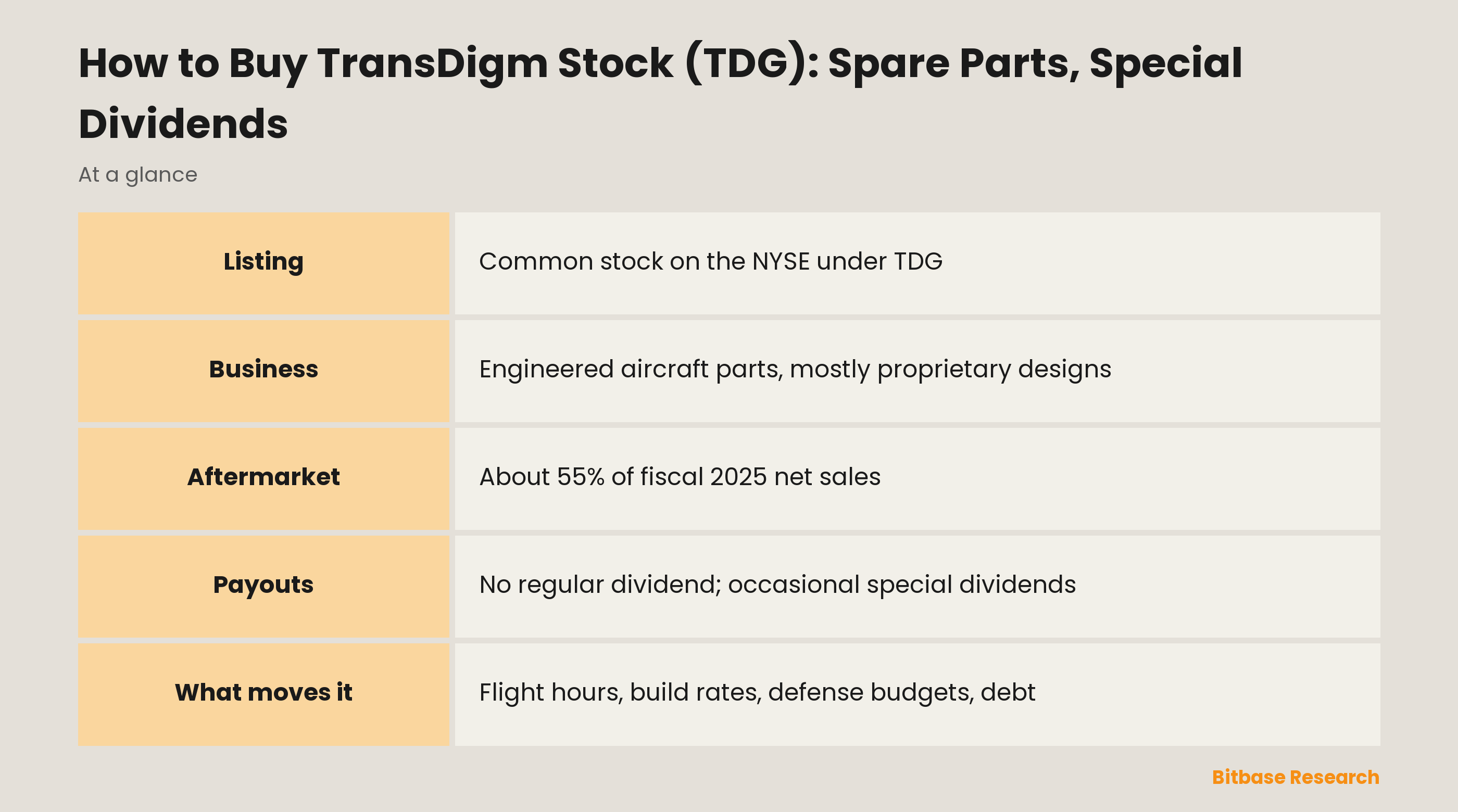
Your TransDigm order goes through any brokerage account that can trade on the New York Stock Exchange, where TransDigm Group's common stock is listed as TDG. The Cleveland company makes aircraft components, mostly to its own proprietary designs, and roughly 55% of fiscal 2025 net sales came from the aftermarket: replacement parts and repairs bought long after an aircraft is delivered. It pays no regular dividend, yet its board declared special cash dividends in November 2023, September 2024 and August 2025, the last two funded partly with new debt. This guide covers the business, the order steps for buyers outside the US and the risks its filings name.
What Does TransDigm Do?
TransDigm designs, produces and supplies engineered components for aircraft. Its annual report says the products "are represented in nearly every commercial and military aircraft in service today," and gives a sense of the range: seatbelts and cockpit security systems, parachutes for military personnel, and specialized equipment for NASA's space telescopes. Most of it is built to the company's own designs; about 90% of fiscal 2025 net sales came from proprietary products.
The listed company, TransDigm Group Incorporated, is a Delaware holding company based in Cleveland, Ohio. It owns all of TransDigm Inc., and the work is done by subsidiaries the filings call operating units: about 16,500 employees and roughly 120 manufacturing facilities in 25 US states and 14 other countries as of 30 September 2025. The fiscal year ends on 30 September, so "fiscal 2025" means October 2024 through September 2025, and every annual figure below uses that calendar.
The business is reported in three segments.
Power & Control makes systems that "predominately provide power to or control power of the aircraft": actuators, ignition systems, pumps and valves, power conditioning devices, motors and generators, batteries, sensors, hoists and winches, cargo-handling systems and microwave electronic components. Its customers include engine and power-system suppliers, airlines, maintenance providers and military buying agencies.
Airframe covers the structure and the cabin: latches and locking devices, rods, connectors and seals, cockpit security systems and displays, audio and antenna systems, lavatory components, seat belts, interior surfaces, insulation, lighting and parachutes, plus flight, wind tunnel and jet engine testing services.
Non-aviation is the small remainder: seat belts for ground vehicles, actuators for space applications and gas turbines, refueling systems for mining and construction equipment, and turbine controls for energy markets.
Acquisitions built this portfolio. TransDigm Inc. was formed in July 1993 to buy certain companies from IMO Industries, and the 10-K counts 95 businesses and various product lines acquired since then. The holding company was set up in July 2003 as TD Holding Corporation at the direction of the private equity firm Warburg Pincus, took its present name in January 2006 and listed on the NYSE that March. Deals completed since mid-2024 include CPI's Electron Device Business and Raptor Scientific in 2024, Servotronics in July 2025, Simmonds Precision Products in October 2025, Jet Parts Engineering and Victor Sierra Aviation in April 2026, and Prince & Izant, a Cleveland maker of brazing alloys, on 28 September 2026.
How TransDigm Makes Money
TransDigm sells to aircraft and engine makers, system suppliers, airlines, distributors, repair shops and armed forces. The economic core is the aftermarket. Once a part is designed into a new aircraft, the company keeps selling replacements over that aircraft's working life, which it puts at roughly 25 to 30 years, and it estimates a product life cycle "in excess of 50 years." Historically, the 10-K says, these aftermarket revenues "have produced a higher gross profit and have been more stable than net sales to original equipment manufacturers."
Pricing is the other half of the model. The company says its focus on engineered, value-added products "has generally enabled us to price our products to fairly reflect the value we provide and the resources required to do so." In fiscal 2025 gross profit came to 60.1% of net sales and income from operations to 47.2%, while net sales grew 11.2%: 7.7% organic and 3.5% from acquisitions.
The segment note in the 10-K breaks net sales down by market channel:
| Market channel | Share of fiscal 2025 net sales | Change from fiscal 2024 |
|---|---|---|
| Defense, OEM and aftermarket | 42.6% | Up 19.5% |
| Commercial and non-aerospace aftermarket | 31.8% | Up 11.8% |
| Commercial and non-aerospace OEM | 23.8% | Down 0.7% |
| Non-aviation | 1.8% | Down 3.0% |
Shares and changes are calculated from the fiscal 2025 segment note and rounded to one decimal.
Defense is now the largest channel. Its share rose to 42.6% from 39.6% in fiscal 2024, above the "approximately 35% to 40%" the 10-K describes as typical. The company credits the aftermarket gain to "higher flight hours and utilization of passenger and freight aircraft," while commercial OEM sales slipped as aircraft production rates, in the filing's words, "remain well below pre-pandemic levels."
By segment, Power & Control brought in 51.6% of fiscal 2025 net sales after growing 15.0%, and Airframe 46.6% after growing 8.0%. No single customer reached 10% of net sales, but the top ten together accounted for about 40%, and customers outside the United States about 37.3%.
Growth picked up in fiscal 2026. In the 39 weeks to 27 June 2026 net sales rose 18.4%, of which 10.5% was organic and the rest came from recently acquired businesses. Counting those, commercial OEM sales rose about 15.1%, commercial aftermarket about 19.8% and defense about 19.3%. On the third quarter, chief executive Mike Lisman said: "Commercial aftermarket growth of 17% remained strong this quarter."
TDG Stock at a Glance
| Item | Detail |
|---|---|
| Exchange | New York Stock Exchange (NYSE) |
| Ticker | TDG |
| Security | Common stock, the only exchange-registered security on the fiscal 2025 10-K cover |
| Listed since | Initial public offering in March 2006 |
| CUSIP and ISIN | 893641100 and US8936411003 |
| Sector | Aerospace and defense parts |
| Index membership | S&P 500 |
| Headquarters | Cleveland, Ohio |
| Incorporated | Delaware |
| Fiscal year | Ends on 30 September |
| Dividend policy | No regular dividend; occasional special cash dividends at the board's discretion |
| Chief executive | Mike Lisman, since 1 October 2025 |
| SEC identifier | CIK 1260221 |
Prices, market value and volume move all session and have no place in a table meant to last. For live figures, open the TransDigm stock page on Bitbase.
How to Buy TransDigm Stock
TransDigm is a US company, and its NYSE listing is the common stock itself, with no depositary receipt in between. Buying it takes a brokerage account and seven short steps:
1. Find a broker that reaches the NYSE. Many local brokers outside the US route orders to New York, and international brokers do the same; before opening an account, confirm which company would hold your shares and under which regulator.
2. Open the account and file the tax form. Brokers usually ask non-US individuals for Form W-8BEN, and the IRS tells foreign beneficial owners to "Submit Form W-8 BEN when requested by the withholding agent or payer whether or not you are claiming a reduced rate of, or exemption from, withholding."
3. Fund it. If your savings are in another currency, compare the conversion rate as well as the commission.
4. Look up TDG and confirm the issuer. The line you want is TransDigm Group Incorporated common stock, NYSE. The subsidiary TransDigm Inc. issues notes, but those are debt sold in private offerings, not the listed shares.
5. Pick an order type. FINRA explains that a market order "provides the most certainty that your order will be executed," though "you might not get the price you saw or were originally quoted," while a limit order fills only "at or better than a specified price," if at all.
6. Decide on the size. If a whole share is more than you want to commit, ask about fractions, bearing in mind FINRA's points that "the availability of fractional share trading varies by brokerage firm" and that "as a fractional share owner, you might not have shareholder voting rights."
7. Keep the confirmations. They record what you paid and, if a special dividend arrives, what was withheld.
Special dividends and withholding. For a non-US holder a special dividend is still US-source income. The IRS states that "most types of U.S. source income received by a foreign person are subject to U.S. tax of 30%," and that a reduced rate, including exemption, may apply under a tax treaty. Tax at home may apply on top of that.
Through an index fund. TransDigm appears in the holdings report the SPDR S&P 500 ETF Trust filed with the SEC for 30 June 2026, so S&P 500 funds give indirect exposure, as one small holding among hundreds.
What Moves TDG Stock
Flight hours. The 10-K says the commercial business "is sensitive to the number of flight hours that our customers' planes spend aloft, the size and age of the worldwide aircraft fleet and our customers' profitability," and names revenue passenger kilometers and the share of the fleet out of warranty among the drivers. Replacement-part demand follows how much existing aircraft fly, not how many new ones are ordered. GE Aerospace also earns most of its revenue from servicing equipment already in use, so both respond to many of the same traffic signals.
Boeing and Airbus build rates. OEM shipments "generally run ahead of aircraft delivery schedules," and fiscal 2025 shipments were set partly by the estimated 2025 and 2026 production rates for Boeing and Airbus. Commercial OEM sales dipped 0.7% that year, then rose about 15.1% in the first nine months of fiscal 2026, acquisitions included. Changes in the two manufacturers' plans show up in TransDigm's shipments before they show up in deliveries.
Defense budgets and order timing. Defense grew 19.5% in fiscal 2025. The company warns that this business "fluctuates from year-to-year" and depends, "to a degree, on government budget constraints, the timing of orders" and Defense Department procurement policy, so a quarter can swing on when contracts are placed.
The next acquisition. Each deal shifts the mix. Simmonds Precision, bought from RTX, added fuel and proximity sensing to Power & Control. Jet Parts Engineering and Victor Sierra brought PMA parts, alternatives to original-manufacturer parts, and "nearly all" of their sales come from the commercial aftermarket. Prince & Izant, added in the last days of fiscal 2026, sells mainly into aerospace and defense, aeroderivative turbines and transportation.
Payouts and interest rates. The company ranks its uses of excess cash: "(1) capital spending at existing businesses, (2) acquisitions of businesses, (3) payment of a special dividend and/or repurchases of our common stock and (4) prepayment of indebtedness or repurchase of debt." Special dividends and buybacks are possibilities rather than a calendar; the board enlarged the repurchase authorization in November 2025. Net interest expense equalled 17.8% of fiscal 2025 net sales and the term loans pay variable rates tied to Term SOFR, so credit markets feed straight into earnings.
What Debt and Defense Audits Mean for TDG Holders
Among the risk factors in the fiscal 2025 10-K, these follow most directly from how TransDigm is built:
One industry. "Our business focuses almost exclusively on the aerospace and defense industry," so a disruption there "may disproportionately disrupt our business compared to more diversified peer companies."
Debt. "We have a significant amount of indebtedness and may be able to incur substantial additional indebtedness in the future." At 30 September 2025 total debt was larger than total assets, and the balance sheet showed a stockholders' deficit. Covenants limit some actions, and swaps, caps and collars hedge only part of the variable-rate debt.
Pricing audits. Subsidiaries are "periodically subject to pricing reviews," and the Defense Department audits prices paid for some of their products. An audit could lead to prices "based on costs approved by the auditor, plus a nominal fee," or to the department seeking other suppliers, and the 10-K warns that "negative publicity relating to the results of any audit, inquiry or subsequent hearing or the like could negatively impact our stock price." The US government can also end its contracts "at its convenience without cause or significant notice."
Acquisitions and goodwill. "A significant portion of our growth has occurred through acquisitions," and future deals "could result in margin dilution" and more borrowing. Goodwill made up 46% of total assets at the end of fiscal 2025 and identifiable intangible assets another 15%, which "may never generate the returns we expect."
Fixed prices. Under multi-year fixed-price contracts the company absorbs cost increases, a risk it calls "greater in a high inflationary environment," and "most of our contracts do not permit us to recover increases in raw material prices, taxes or labor costs."
The share itself. Holders "should not rely on special dividends with any regularity or at all," and a single stock ties your money to one company. Any payout depends on the board and on what the debt agreements and Delaware law allow.
How to Research TDG Yourself
Every TransDigm filing sits on EDGAR under CIK 1260221, and transdigm.com posts the same reports at no cost. Because the fiscal year closes in September, the 10-K arrives in November (9 November 2023, 7 November 2024 and 12 November 2025), and 10-Qs follow in February, May and August, each alongside an earnings 8-K on the same day. The report for fiscal 2026, which ended on 30 September 2026, is the next 10-K.
In the 10-K, Item 1 describes segments, products and customers; Item 1A the risks; Item 5 the special dividends and a performance graph against the S&P 500 Index and the S&P Aerospace & Defense Select Industry Index; Note 2 the acquisitions; and Note 15 sales by market channel. The 10-Qs cover "thirteen week" quarters ending on Saturdays, and sales are generally lower in the first fiscal quarter, which has fewer working days, so compare like with like. Acquisitions, special dividends and debt offerings appear in 8-Ks.
The headline profit measure, EBITDA As Defined, is not a GAAP figure; the filings reconcile it to net income, so read both. Live prices are on the TDG page linked in the at-a-glance section, and the Bitbase US stock directory covers other companies.
TransDigm Stock FAQ
Does TransDigm pay a dividend?
Not a regular one. The 10-K says the company does "not anticipate declaring regular cash dividends, whether quarterly or annual," but its board has declared special cash dividends: on 9 November 2023, paid 27 November 2023; on 19 September 2024, paid 18 October 2024; and on 20 August 2025, paid 12 September 2025. Each was a separate decision.
Can I buy TransDigm stock with crypto?
Only in two steps. A TDG purchase settles in US dollars, so the crypto is sold first and the proceeds moved to a brokerage account; in many countries that sale is taxable in its own right. How to buy stocks with crypto walks through the conversion. What you end up with is an ordinary TDG share.
Is TDG in the S&P 500?
Yes. TransDigm Group is listed in the 30 June 2026 holdings report that the SPDR S&P 500 ETF Trust filed with the SEC. Constituents are revised from time to time, so confirm against a current list.
When did TransDigm go public?
In March 2006. The prospectus, dated 14 March 2006, said there had been no public market for the stock and that it had been approved for NYSE listing under TDG. Existing holders sold all the shares, so TransDigm itself received no proceeds.
Does TransDigm have negative shareholders' equity?
Yes, on its balance sheet. At 30 September 2025 the 10-K showed a TD Group stockholders' deficit, and total debt exceeded total assets. The 10-Ks for fiscal 2024 and 2025 record that the September 2024 and August 2025 special dividends were funded partly with new debt. The debt note and the MD&A liquidity section show what is owed and when it falls due.
Conclusion
The mechanics of a TDG purchase are routine: an account that reaches the NYSE, the correct listing and a considered order type. Judging it takes longer: one share holds a parts maker that lives on flight hours, defense orders and acquisitions, owes more than its book assets, and returns cash through occasional special dividends and buybacks rather than a quarterly payment. Start with Item 1A and Note 15 of the latest 10-K, then the newest 10-Q, and size any position knowing the next special dividend is never promised.
Related reading
Other Bitbase articles on this topic:
- How to Buy Grainger Stock (GWW): Dividend, Zoro and MonotaRO
- How to Buy Honeywell Stock (HON): Spin-Off and Reverse Split
- How to Buy Illinois Tool Works Stock (ITW): Seven Segments, 80/20
Disclaimer: This article is educational content from Bitbase Academy, provided for information only. It explains what a company or fund does and how the instruments referenced here differ from one another; it does not constitute investment, trading, tax, or financial advice, and it is neither a recommendation nor an endorsement of any security, token, or trading strategy. A tokenized stock is issued by a third party and is designed to give economic exposure to an underlying asset: it is not a share, it carries no shareholder rights, and it depends on the issuer's structure, eligibility rules, and redemption terms, which the issuer can change. Perpetual futures are leveraged derivatives that hold no underlying asset and can be liquidated, and trading hours, product availability, and eligibility differ by instrument and by jurisdiction and can change at any time. Written as of October 2026; verify everything yourself through company filings, the issuer's own documentation, and the product pages of the venue you trade on.
References
[1] TransDigm Group Form 10-K for fiscal 2025 (SEC EDGAR) www.sec.gov
[2] TransDigm Group Form 10-Q, quarter ended 27 June 2026 (SEC EDGAR) www.sec.gov
[3] TransDigm fiscal 2026 third-quarter results release (SEC EDGAR) www.sec.gov
[4] TransDigm Form 8-K, 6 October 2025: Simmonds acquisition completed (SEC EDGAR) www.sec.gov
[5] TransDigm Form 8-K, 7 April 2026: Jet Parts Engineering and Victor Sierra deal completed (SEC EDGAR) www.sec.gov
[6] TransDigm Form 8-K, 28 September 2026: Prince & Izant deal completed (SEC EDGAR) www.sec.gov
[7] TransDigm Form 8-K, 1 October 2025: Mike Lisman appointed chief executive (SEC EDGAR) www.sec.gov
[8] TransDigm Group IPO prospectus, 14 March 2006 (SEC EDGAR) www.sec.gov
[9] TransDigm Group Form 10-K for fiscal 2024: special dividends (SEC EDGAR) www.sec.gov
[10] SPDR S&P 500 ETF Trust, Form N-PORT-P holdings for 30 June 2026 (SEC EDGAR) www.sec.gov
[11] FINRA, Order Types www.finra.org
[12] FINRA, Investing in Fractional Shares www.finra.org
[13] IRS, NRA Withholding www.irs.gov
[14] IRS, About Form W-8 BEN www.irs.gov





