
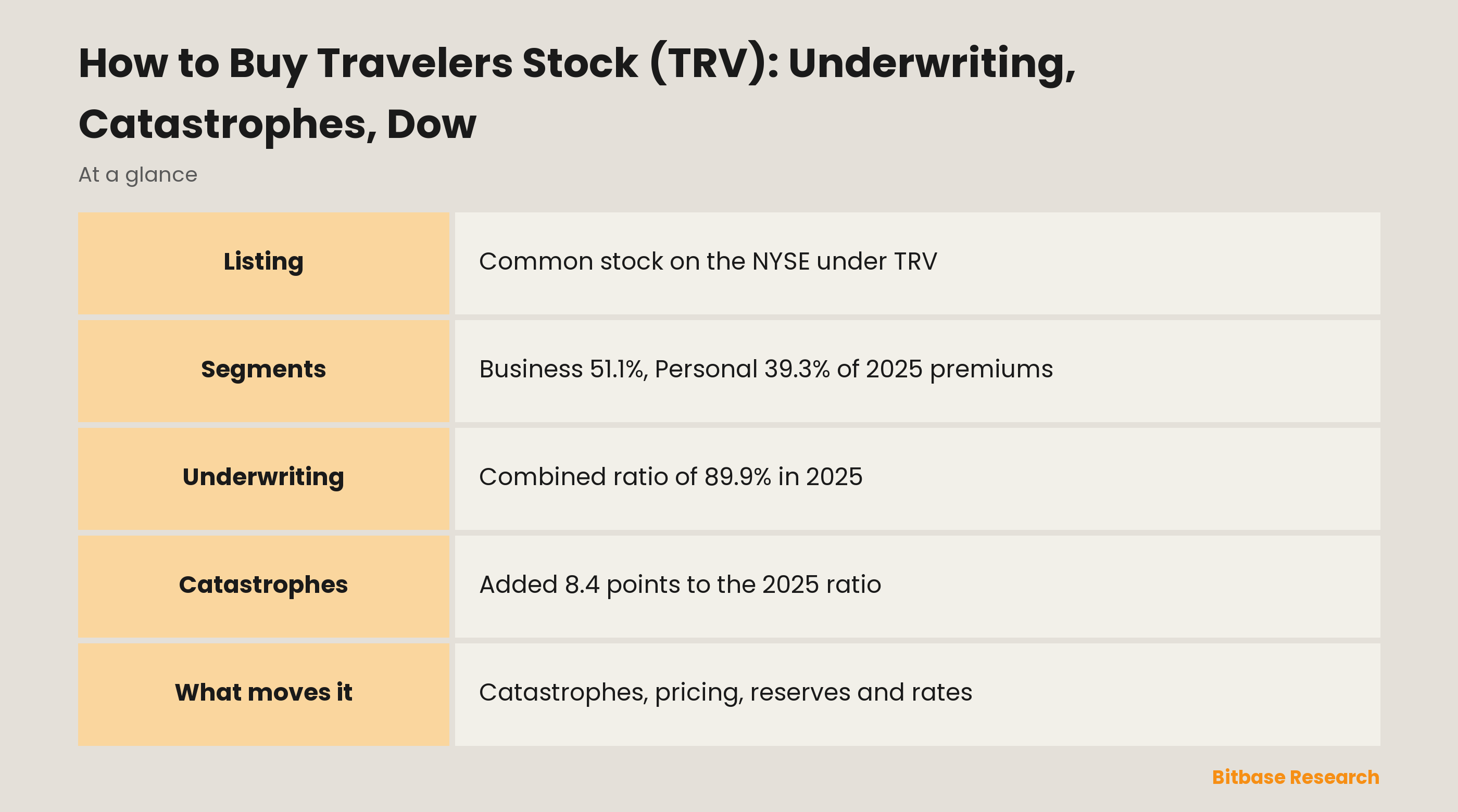
Everybody who has a broker able to reach the New York Stock Exchange can buy common stock in The Travelers Companies, listed there under the ticker TRV. The share is a stake in a property and casualty insurer that traces its roots to 1853 and sells mainly through independent agents and brokers: in 2025, Business Insurance wrote about 51.1% of its net written premiums, Personal Insurance about 39.3% and Bond & Specialty Insurance about 9.6%. Its combined ratio, the basic test of underwriting profit, improved to 89.9% that year even though catastrophes, led by the California wildfires of January, added 8.4 points.
What Does Travelers Do?
The Travelers Companies, Inc. is a holding company whose subsidiaries provide "a wide range of commercial and personal property and casualty insurance products and services to businesses, government units, associations and individuals." It is incorporated in Minnesota, has its principal executive offices in New York and calls itself "one of the oldest insurance organizations in the United States, dating back to 1853."
Today's company took shape in a 2004 merger. On 1 April 2004, Travelers Property Casualty Corp. merged with a subsidiary of The St. Paul Companies, and the group took the name The St. Paul Travelers Companies, trading on the NYSE as STA. In February 2007 it agreed with Citigroup to reacquire the red umbrella trademark long associated with Travelers, and on 26 February 2007 it became The Travelers Companies and began trading as TRV. The umbrella logo is still among its material trademarks.
The business has three reporting segments.
Business Insurance covers companies of almost every size. Select Accounts serves small businesses, generally with fewer than 50 employees; Middle Market serves firms with 50 to 1,000 employees and specialist industries such as construction and energy; National Accounts sells casualty programs and claims services to large companies. The segment also writes business in the United Kingdom and Ireland, underwrites at Lloyd's through Syndicate 5000 and owns Simply Business, which sells small business policies mainly in the UK. A run-off unit inside it holds the company's asbestos liabilities.
Bond & Specialty Insurance writes surety bonds that guarantee construction and other contract performance, fidelity cover against embezzlement by employees, and management and professional liability insurance such as directors' and officers' cover. In Brazil it works through Junto, a surety joint venture in which Travelers owns 49.5%.
Personal Insurance sells car and homeowners insurance to individuals, plus smaller lines for boats and yachts, jewelry, umbrella liability, and weddings and special events. It had about 8.4 million active US policies at the end of 2025. Most of it is sold through independent agents, and since 1995 Travelers has also underwritten part of the homeowners business of GEICO's agency affiliate.
One piece of the map changed at the start of 2026: the sale of the Canadian personal insurance business and most of the Canadian commercial business to Definity Financial, agreed in May 2025, closed on 2 January 2026. Only the Canadian surety business stayed.
How Travelers Makes Money
An insurer earns in two ways: it charges premiums for taking on risk, and it invests that money until claims are paid. In 2025, premiums made up about 90% of Travelers' revenue and net investment income about 8%; fees and other revenue made up the rest.
Underwriting is judged by the combined ratio: claims, claim handling costs and underwriting expenses as a share of earned premiums. In the words of the 10-K, "a combined ratio under 100% generally indicates an underwriting profit." Travelers' consolidated ratio was 97.0% in 2023, 92.5% in 2024 and 89.9% in 2025. The segments contribute unevenly:
| Segment | Share of 2025 net written premiums | 2025 combined ratio | Share of 2025 segment income | Largest lines |
|---|---|---|---|---|
| Business Insurance | 51.1% | 91.7% | 55.2% | Commercial multi-peril, commercial auto, property, general liability, workers' compensation |
| Bond & Specialty Insurance | 9.6% | 81.9% | 14.2% | Fidelity and surety, management and professional liability |
| Personal Insurance | 39.3% | 89.5% | 30.7% | Homeowners and other, automobile |
Shares are calculated from the 2025 10-K segment tables; segment income leaves out interest expense and other corporate items.
Bond & Specialty is the smallest segment but had the lowest combined ratio, so its share of income exceeds its share of premiums. Personal Insurance is the swing factor: its combined ratio was 104.8% in 2023, an underwriting loss, then 94.4% in 2024 and 89.5% in 2025. The 10-K credits the 2025 gain in its underlying ratio mainly to lower automobile losses, earned pricing and fewer non-catastrophe weather losses in homeowners.
Inside Business Insurance, Middle Market wrote 55.3% of premiums, and commercial multi-peril, which bundles property and liability cover in one policy, was the largest line at 26.1%. Inside Personal Insurance, homeowners and other lines made up 51.9% and automobile 44.4%.
The book is overwhelmingly American: 95.2% of 2025 direct written premiums came from the United States, led by California at 10.6% and by Texas and New York at 8.3% each. Fixed maturities and short-term securities made up 94% of investments at the end of 2025, and as the average pre-tax yield rose from 3.2% in 2023 to 3.8% in 2025, net investment income grew 10% in 2025.
TRV Stock at a Glance
| Feature | TRV |
|---|---|
| Listing | NYSE, the New York Stock Exchange |
| Ticker | TRV |
| Security | Common stock without par value, the only security registered on the 2025 10-K cover |
| Sector | Property and casualty insurance |
| Index membership | Dow Jones Industrial Average and S&P 500 (State Street holdings files, 29 October 2026) |
| Headquarters | New York; executive offices also in Hartford and St. Paul |
| Incorporated | Minnesota |
| Former name and ticker | The St. Paul Travelers Companies, NYSE: STA, until February 2007 |
| Dividend | Paid quarterly; raised 14% in April 2026 |
| Fiscal year | Calendar year, ending 31 December |
| SEC identifier | CIK 86312 |
Prices, market value and dividend yield change with every trade; the live TRV page on Bitbase shows them.
How to Buy Travelers Stock
Travelers is a Minnesota company whose common stock is registered on the NYSE, so what you buy there is the ordinary share itself; no depositary receipt or second share class is involved. The purchase runs through a broker:
1. Choose a broker with NYSE access. Outside the United States, that can be a local firm with a gateway to US markets or an international broker; find out which legal entity keeps your account and which regulator oversees it.
2. Open the account and declare your tax status. The IRS tells a foreign person to "give Form W-8 BEN to the withholding agent or payer," usually the broker.
3. Fund it. If your savings are in another currency, the exchange rate is a cost alongside the commission.
4. Check the line on the order ticket. Search TRV and confirm the result reads The Travelers Companies common stock on the NYSE.
5. Pick the order type. A market order fills at the best price available when it reaches the exchange, which in a fast market can differ from the quote you saw; a limit order sets the worst price you will accept and may not fill at all.
6. Decide the amount. Buying a fraction of a share lets you put in a set amount of money, but "the availability of fractional share trading varies by brokerage firm," FINRA notes, and "as a fractional share owner, you might not have shareholder voting rights."
Tax on dividends. The IRS states that "most types of U.S. source income received by a foreign person are subject to U.S. tax of 30%," while "a reduced rate, including exemption, may apply" where the tax code or a treaty provides for one. Your home country may tax the dividend again.
Through a fund. Index funds are the indirect route: State Street's DIA and SPY, which track the Dow and the S&P 500, both hold TRV among their members.
What Moves TRV Stock
Catastrophe seasons. Catastrophes added 8.4 points to the combined ratio in 2025 and 8.0 points in 2024, led by the Palisades and Eaton wildfires in January 2025 and by Hurricane Helene in 2024. Personal Insurance takes the heavier blow: 14.9 points in 2025, against 4.8 points in Business Insurance. In the first nine months of 2026 catastrophes cost 5.6 points, down from 11.0 points a year earlier, and the combined ratio fell to 86.3% from 93.2%. Travelers buys a corporate catastrophe excess-of-loss treaty covering North America and has catastrophe-bond protection through Long Point Re IV, but the treaty pays only above a retention the company keeps. Storm and fire losses arrive irregularly and in size, as the Berkshire Hathaway profile also notes for its insurance arm.
Commercial pricing. Renewal premium change, the estimated change in average premium on renewing policies, is the figure to follow. In the third quarter of 2026 it was 4.1% across Business Insurance and 7.0% excluding property, with retention at 86%; the chief executive said the segment grew "in every line other than Property." In each domestic market of the segment, the 10-Q adds, renewal premium changes were lower than a year earlier. Personal lines also answer to regulators: "approximately one-half of the states require prior approval of most rate changes."
Reserves and the courts. Results depend too on whether old claims cost more or less than reserved. Net favorable prior year reserve development improved the 2025 combined ratio by 2.4 points, but the 10-K says the ratio "continues to be impacted by the tort environment, including more aggressive attorney involvement in insurance claims." Asbestos is the long tail: Travelers added to asbestos reserves in the third quarter of both 2025 and 2026.
Interest rates. Higher yields lift investment income; the average pre-tax yield reached 4.0% in the third quarter of 2026. They also lower the value of bonds already held. At 30 September 2026, book value per share was 6% below its end-2025 level, which the company tied to unrealized losses "driven by higher interest rates," while adjusted book value per share, excluding those losses, was 9% higher.
Buybacks. Travelers repurchased 14.3 million shares in the first nine months of 2026, about 6.6% of the shares outstanding in early February, and its diluted share count in the third quarter was 7% lower than a year before, so earnings per share can outpace profit. The company expects that "generally over time, the combination of dividends to common shareholders and common share repurchases will likely not exceed net income."
A smaller footprint after Canada. With Canada sold, Personal Insurance net written premiums were 8% lower in the first nine months of 2026 and its international premiums fell to zero, so comparisons with 2025 mix the sale with underlying growth. Bond & Specialty went the other way, with net written premiums up 12% in the third quarter of 2026 and surety up 21%.
How Losses Can Reach a TRV Shareholder
Of the risk factors in Item 1A of the 10-K, five bear most directly on the share:
Catastrophes. "High levels of catastrophe losses" could "materially and adversely affect our results of operations, our financial position and/or liquidity," and the modeling tools used to estimate those exposures "are subject to error and mis-estimation."
Reserves. "If actual claims exceed our claims and claim adjustment expense reserves," for instance because the legal or tort environment shifts, "our financial results could be materially and adversely affected."
Asbestos and mass torts. "Our business could be harmed because of our continued exposure to asbestos claims and related litigation." The filing separately flags mass tort claims over potentially harmful products or substances.
Ratings. "A downgrade in our claims-paying and financial strength ratings could adversely impact our business volumes," and would make capital harder and costlier to raise.
The holding company. Dividends and buybacks are funded by payments from insurance subsidiaries, which state rules cap without regulatory approval. A shortfall "would harm our ability to meet our obligations, pay future shareholder dividends and/or make future share repurchases."
Above the business sit the risks of the share itself. Owning one stock ties your outcome to one company. A run of dividend increases is a record, not a promise. And if your money is not in dollars, price and dividend are both converted at whatever the exchange rate happens to be.
How to Research TRV Yourself
Travelers' filings sit on SEC EDGAR under CIK 86312: the annual 10-K, quarterly 10-Qs and 8-Ks for events in between. Each earnings release, filed as an 8-K exhibit and posted on investor.travelers.com, gives the combined ratio, underlying combined ratio, catastrophe losses, reserve development and renewal premium change by segment.
In the 10-K, Item 1 holds the segment premium tables and the reinsurance program, Item 1A the risks, and the management discussion a table of significant catastrophes by Property Claim Services serial number plus a section on asbestos. When comparing years, remember that 2025 includes Canada and 2026 does not, and that income from private equity and hedge fund partnerships is generally booked a quarter late.
The performance graph in Item 5 is a quick benchmark check. Over the five years to the end of 2025, Travelers' total shareholder return was 128.5%, against 96.0% for the S&P 500 and 128.8% for the S&P 500 Property & Casualty Insurance Index, whose members include Chubb, Progressive, Allstate and The Hartford. Live prices are on the TRV page linked above, and Bitbase's US stock list covers other companies.
Travelers Stock FAQ
Does Travelers pay a dividend?
Yes, quarterly. In April 2026 the board raised it by 14%, which the chief executive said marked "22 consecutive years of dividend increases with a compound annual growth rate of 8% over that period." Future dividends are at the board's discretion; amounts and dates are in each earnings release.
Can I buy Travelers stock with crypto?
Not directly. A broker sells you TRV for US dollars, the currency NYSE trades settle in, so any crypto would first have to be converted to cash and sent to the brokerage, and that conversion may count as a taxable sale where you live. Owning the stock gives you dividend and voting rights, one way a share differs from a crypto asset; the crypto sale and the share purchase are best judged as two decisions.
Is TRV in the Dow Jones Industrial Average?
Yes. State Street's holdings file for DIA, its Dow fund, listed Travelers on 29 October 2026, as did the file for SPY, its S&P 500 trust. The Dow weights members by share price rather than company size, which also shapes how Dow futures track the average.
Is Travelers the same company as St. Paul Travelers?
Yes. The St. Paul Travelers Companies was the name taken after the 2004 merger, and it traded as STA until 26 February 2007, when it became The Travelers Companies and switched to TRV. The Minnesota incorporation and SEC file number carried over.
Does Travelers still sell insurance in Canada?
Only surety. Its Canadian personal insurance business and most of its Canadian commercial business went to Definity Financial in a sale that closed on 2 January 2026.
Conclusion
The mechanics of buying TRV are short: an account that reaches the NYSE, the correct security on the ticket and a market or limit order. Understanding it takes more: a Travelers share is a claim on underwriting results that swing with catastrophes, courts and pricing, and on a bond portfolio whose value moves with interest rates. Start with the combined ratio, catastrophe points and renewal premium change in each quarterly release, and read the latest 10-K before deciding how much of one insurer belongs in your portfolio.
Related reading
Other Bitbase articles on this topic:
- How to Buy Arthur J. Gallagher Stock (AJG): Broker, Not Insurer
- How to Buy Chubb Stock (CB): Swiss Shares, Dividend, Catastrophes
- How to Buy Manulife Stock (MFC): One Share on Four Exchanges
Disclaimer: This article is educational content from Bitbase Academy, provided for information only. It explains what a company or fund does and how the instruments referenced here differ from one another; it does not constitute investment, trading, tax, or financial advice, and it is neither a recommendation nor an endorsement of any security, token, or trading strategy. A tokenized stock is issued by a third party and is designed to give economic exposure to an underlying asset: it is not a share, it carries no shareholder rights, and it depends on the issuer's structure, eligibility rules, and redemption terms, which the issuer can change. Perpetual futures are leveraged derivatives that hold no underlying asset and can be liquidated, and trading hours, product availability, and eligibility differ by instrument and by jurisdiction and can change at any time. Written as of October 2026; verify everything yourself through company filings, the issuer's own documentation, and the product pages of the venue you trade on.
References
[1] Travelers Form 10-K for 2025: business, segments, results, risk factors (SEC EDGAR) www.sec.gov
[2] Travelers Form 10-Q for the quarter ended 30 September 2026 (SEC EDGAR) www.sec.gov
[3] Travelers third-quarter 2026 earnings release, 16 October 2026 (Form 8-K) www.sec.gov
[4] Travelers first-quarter 2026 earnings release, 16 April 2026: dividend increase (Form 8-K) www.sec.gov
[5] Travelers Form 10-K for 2007: the 2004 merger and the 2007 name change www.sec.gov
[6] St. Paul Travelers Form 10-K for 2006: the STA symbol and the umbrella trademark www.sec.gov
[7] State Street: DIA daily holdings, 29 October 2026 www.ssga.com
[8] State Street: SPY daily holdings, 29 October 2026 www.ssga.com
[9] FINRA: Investing in Fractional Shares www.finra.org
[10] IRS: NRA Withholding www.irs.gov
[11] IRS: About Form W-8 BEN www.irs.gov





