
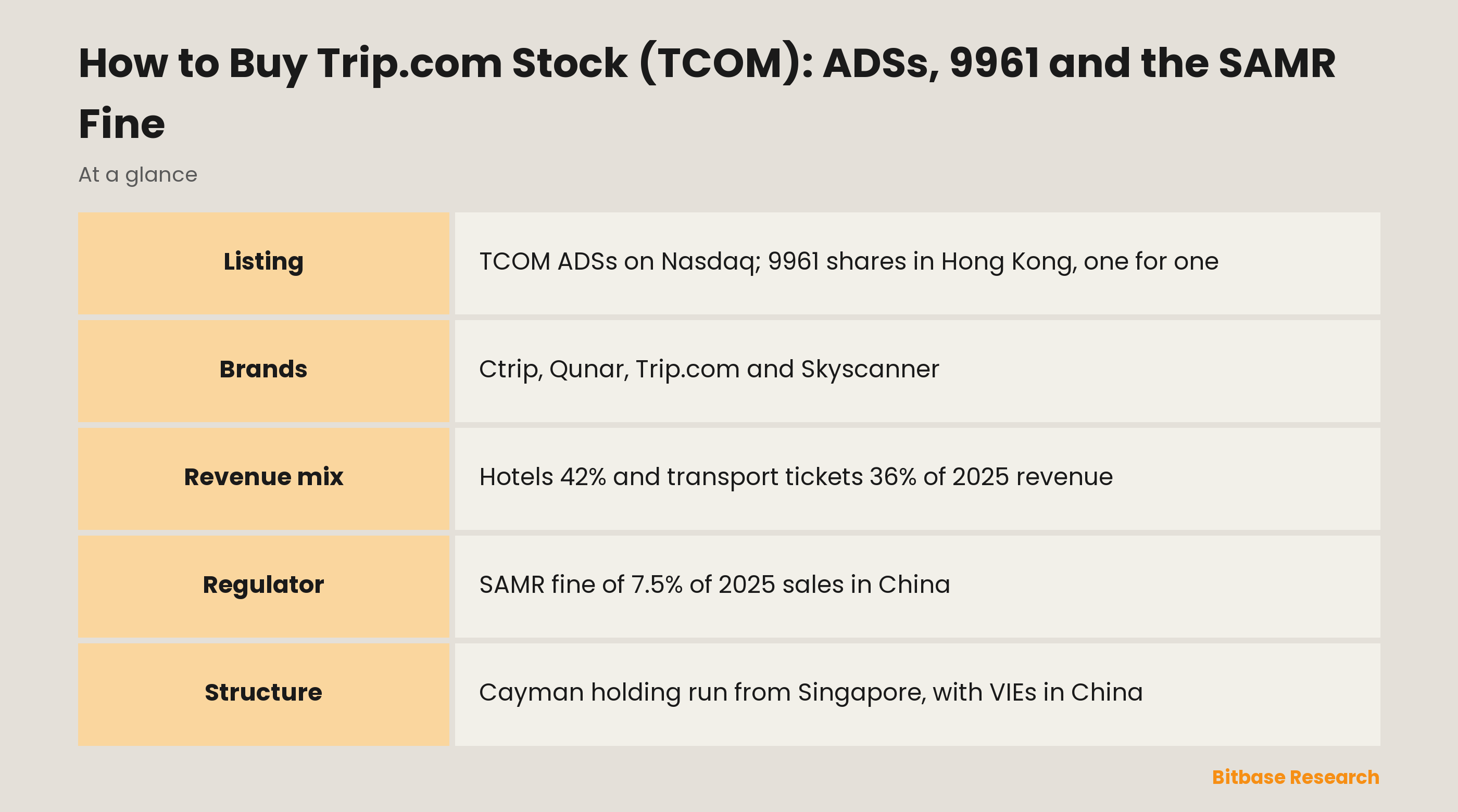
A single Nasdaq-enabled brokerage account is enough to buy Trip.com stock: search for TCOM, confirm the line belongs to Trip.com Group Limited, and send the order. Each TCOM American depositary share (ADS) stands for exactly one ordinary share, the same class that changes hands in Hong Kong under the code 9961, and both are claims on a Cayman Islands holding company run from Singapore that still earned 83% of its 2025 revenue through Greater China channels. In July 2026 China's market regulator fined the group 7.5% of its 2025 sales in China and confiscated gains, a penalty that pushed the second quarter into a net loss.
What Does Trip.com Do?
Trip.com Group sells travel. Its annual report on Form 20-F calls it "a leading global one-stop travel service provider", and the description is literal: hotel rooms, flights, train and bus tickets, car rental, packaged tours, local activities and business travel management are all booked through the same platform.
The group operates four brands. Ctrip is the original Chinese travel service. Qunar is another online travel agency in China, consolidated since December 2015. Trip.com is the online agency aimed at travellers worldwide. Skyscanner, a travel search engine consolidated since December 2016, compares fares across other sellers. At the end of 2025 Trip.com ran in 27 languages, 44 local currencies and 48 local sites, and Skyscanner in 43 languages across more than 50 countries and regions.
Behind the brands sits an open platform where hotels, airlines, transport operators and other agencies list their own products. As of 31 December 2025 it carried about 1.7 million accommodation listings and flights from more than 680 airlines. Phones dominate: over 90% of 2025 transaction orders came through mobile channels.
The company opened for business in June 1999 and set up its Cayman Islands holding company, then called Ctrip.com International, in March 2000. It renamed itself Trip.com Group Limited in October 2019, and the ADSs traded as CTRP until 5 November 2019. The 20-F still notes that "since our inception, we have conducted the majority of our operations in China," though the principal executive offices are now in Singapore. Co-founder James Liang is executive chairman and Jane Sun is chief executive.
Newer products lean on artificial intelligence: TripGenie, called WenDao in Chinese, answers itinerary questions, and Trip.Planner turns rough plans into bookable trips. The 20-F lists AI among its risks, since generated answers about fare rules or cancellation policies can be wrong.
How Trip.com Makes Money
Almost every line is a fee taken on someone else's product. For hotels, the 20-F says the group earns "substantially all" of its revenue "through commissions from hotel reservation partners," booked once a reservation can no longer be cancelled. Ticketing commissions are recognised when the ticket is issued, packaged tours pay referral fees on the departure date, and corporate clients pay service fees. The residual "Other" line is mostly online advertising and financial services.
| Revenue line, 2025 | Share of total revenue | Growth on 2024 | What drives it |
|---|---|---|---|
| Accommodation reservation | 42% | 21% | Hotel commissions; outbound and international hotel demand |
| Transportation ticketing | 36% | 11% | Air, rail and bus tickets; international air bookings |
| Packaged tours | 7% | 8% | Referral fees from tour partners |
| Corporate travel | 5% | 13% | Service fees from company travel programmes |
| Other | 10% | 38% | Advertising and financial services |
Total revenue rose 17% in 2025. The two big lines have swapped places: in 2023 ticketing brought in 41% of revenue and hotels 39%, but from 2024 accommodation took the lead. Revenue also grew faster than the bookings behind it: accommodation gross merchandise value (GMV), the total value booked, rose 17%, against 21% for accommodation revenue, and in ticketing GMV grew 6% while revenue grew 11%.
Geography explains most of the story. The 20-F splits revenue by where the online channel sits: Greater China accounted for 83% in 2025 and all other countries 17%, up from 14% a year earlier. The fastest-growing piece is international. Bookings on the international online platform increased by around 60% in 2025, and the group says it served about 20 million inbound travellers visiting China that year.
The 2025 bottom line was flattered by a one-off. Net income rose 94%, which the 20-F attributes primarily to "the partial disposal of MakeMyTrip," the Indian travel company. In July 2025 Trip.com sold part of its stake back to MakeMyTrip for cancellation and booked an investment gain, while remaining its "largest minority shareholder." That gain will not repeat.
Results also follow the calendar. The third quarter "generally contributes the highest portion of our annual net revenues," driven by summer travel, so a quarter-on-quarter comparison says more about the season than about the trend.
TCOM Stock at a Glance
| Feature | TCOM |
|---|---|
| US listing | Nasdaq Global Select Market |
| Ticker | TCOM (CTRP until 5 November 2019) |
| Security | American depositary shares, each representing one ordinary share |
| Hong Kong listing | Ordinary shares on the Hong Kong Stock Exchange, code 9961, since April 2021 |
| Depositary | The Bank of New York Mellon |
| Business | Online travel: hotels, transport tickets, tours, corporate travel |
| Brands | Ctrip, Qunar, Trip.com, Skyscanner |
| Incorporated | Cayman Islands |
| Principal executive offices | Singapore |
| Fiscal year | Calendar year, ending 31 December |
| Reporting currency | Renminbi, under US GAAP |
| SEC filings | Form 20-F annual report, Form 6-K current reports; CIK 1269238 |
| Shareholder returns | Board-discretion policy: annual buybacks, annual cash dividend or both |
Prices, valuation and yield move with every trade; for live data, open the Trip.com stock page on Bitbase.
How to Buy Trip.com Stock
TCOM is the US-dollar line of a foreign company, but the order works like any other Nasdaq purchase:
1. Find a broker that reaches Nasdaq. Outside the United States that may be a domestic broker with a US market service or an international one; check which entity holds your account and who regulates it.
2. Open and verify the account. Expect identity checks and tax-residency forms.
3. Fund it. If your money is in euros, rupees, pesos or another currency, converting into dollars is a cost, so compare exchange rates as well as commissions.
4. Search for TCOM. The result should read Trip.com Group Limited American depositary shares on Nasdaq.
5. Choose the order type. According to FINRA, a market order gives the best chance of being filled but not a fixed price, while a limit order sets the worst price you will accept and may not fill at all.
6. Decide on size. One ADS is one share. Some brokers sell fractions of an ADS, others do not; ask whether fractional holdings receive dividends and votes.
TCOM or 9961. The 20-F calls ADSs and ordinary shares "fully fungible": shares deposited with the depositary become ADSs, and ADSs can be cancelled to take delivery of shares in Hong Kong. At one to one, the two prices should sit close together once Hong Kong dollars are converted into US dollars. The depositary charges for issuing and cancelling ADSs and deducts its fees from dividends it passes on, and the 20-F says "there is uncertainty" over whether Hong Kong stamp duty applies to trading ADSs or moving shares in and out of the ADS facility.
Before 2021 the ratio was different. Eight ADSs represented one ordinary share until March 2021, when each share was split into eight and the ratio became one to one; later filings restate older per-share data on the new basis.
Taxes. The 20-F says the Cayman Islands "currently levies no taxes" on individuals or corporations based on profits, income or gains, but warns that if another jurisdiction treated the company as a tax resident, holders "may be subject to tax" on dividends or on gains from selling. Your own country's rules apply too; this is background, not tax advice.
Through funds. Whether a fund owns TCOM or 9961 depends on the index it follows and its rules on foreign companies, so read the holdings file before assuming it carries Trip.com shares.
What Moves TCOM Stock
The antitrust aftermath. On 14 January 2026 the company disclosed that the State Administration for Market Regulation (SAMR) had opened an investigation under China's Anti-Monopoly Law. On 25 July 2026 the regulator found that, while holding a dominant market position, the company had restricted business partners through exclusive arrangements and imposed unreasonable trading terms without justification. It ordered the conduct stopped and compulsorily deducted hotel security deposits refunded in full, confiscated gains, and fined the company 7.5% of its 2025 sales revenue in China. The 20-F notes that the law allows fines of up to 10% of prior-year sales. Trip.com said it "sincerely accepts the Decision and will adopt rectification measures."
How deep the changes go. The penalty was charged in the second quarter of 2026, and that quarter's accommodation revenue was also reduced by a contra-revenue item imposed by SAMR. The company added that revenue fell from the first quarter partly because of "operational adjustments the Company implemented to align with evolving industry standards and compliance frameworks." How far those adjustments reshape commissions and hotel terms in China is the open question.
International and inbound growth. In the second quarter of 2026 total net revenue was 6% higher than a year earlier, while revenue on the international platform rose by over 50% and inbound travel revenue grew at a high double-digit rate.
Flights, fuel and conflict. Transportation ticketing revenue fell 1% year on year in the same quarter, which the company put down to "macro headwinds such as elevated energy prices and geopolitical volatility."
The capital return policy. Since November 2023 the board has followed a policy of "discretionary annual share repurchases, discretionary annual cash dividend declarations, or a combination thereof." It approved a cash dividend in February 2025 and a new buyback programme in August 2025.
TCOM Risks from Beijing, New York and the Travel Cycle
These items from the 20-F's risk factors bear most directly on someone holding the ADS:
Antitrust scrutiny. "Regulatory actions or claims under anti-monopoly and competition laws against us may result in penalties such as fines, constraints on our business, or reputational harm." Beyond the SAMR decision, a homestay association in Yunnan province announced in December 2025 an anti-monopoly effort against online travel platforms that named the company, though the 20-F knew of no lawsuit arising from it.
A US class action. In March 2026 a putative securities class action, De Wilde v. Trip.com Group Limited, was filed in the federal court for the Eastern District of New York, alleging that statements in the 2023 and 2024 annual reports were false or misleading in light of the investigation. The company says it cannot predict the outcome.
The holding structure. "Trip.com Group Limited is not an operating company but a Cayman Islands holding company with no equity ownership in the VIEs." Licensed internet and travel agency businesses in China run through variable interest entities controlled by contract; they contributed 19% of 2025 net revenues and held 5% of total assets. If Chinese authorities found the contracts out of line with foreign-investment rules, the company "could be subject to severe penalties or be forced to relinquish our interests in those operations." Our Alibaba stock guide covers the same type of structure.
US listing rules. Under the Holding Foreign Companies Accountable Act, ADSs can be barred from US trading if the audit regulator cannot inspect the auditor for two consecutive years. Trip.com has not been identified since the PCAOB regained access in December 2022; if a ban ever came, the company cannot promise an active market for the Hong Kong shares.
Travel shocks. "General declines or disruptions in the travel industry may materially and adversely affect our business and results of operations." The filing lists war and terrorism, contagious diseases, oil-driven price rises, accidents and political unrest among the events that cut bookings.
Currency. Accounts are kept in renminbi while TCOM trades in dollars, so exchange-rate moves change what reported earnings are worth to a dollar holder.
Finally, one stock ties you to one company, and payouts are optional: the board "has complete discretion" over dividends.
How to Research TCOM Yourself
As a foreign private issuer, Trip.com files a Form 20-F each year and Form 6-K for news and quarterly results, all on SEC EDGAR under CIK 1269238. The 2025 annual report was filed on 28 April 2026 and the second-quarter 2026 results on 16 September 2026. Hong Kong versions appear on the Hong Kong exchange's website, and results webcasts are archived at investors.trip.com.
In the 20-F, the business overview covers brands and partners; the risk factors cover the VIE contracts, antitrust and US listing rules; the operating review explains each revenue line; and the notes give revenue by geography and the status of the SAMR case and the class action. The January and July 2026 6-Ks give the regulator's notice and decision in the company's words.
Figures are in renminbi, with US-dollar translations at a single year-end rate, so local-currency growth rates are the cleaner comparison, and the strong third quarter means each quarter is best compared with the same one a year earlier. For a US peer that reports in dollars, see our Booking Holdings stock guide; for other companies, use Bitbase's list of US stock pages.
Trip.com Stock FAQ
Can I buy Trip.com stock with crypto?
Not directly. TCOM ADSs are bought through a brokerage account in US dollars, and 9961 shares through a broker with Hong Kong access, so crypto must first be sold for cash and transferred, which may be a taxable sale where you live. An ADS gives you a claim on a company's shares and dividends, which is how a share differs from a crypto asset.
How does TCOM relate to the 9961 shares in Hong Kong?
They are the same ordinary shares in two wrappers. One TCOM ADS represents one ordinary share held by The Bank of New York Mellon as depositary, and the two can be converted back and forth, subject to depositary fees.
Does Trip.com pay a dividend?
Sometimes, at the board's discretion. Under the policy adopted in November 2023 the board chooses each year between buybacks, a cash dividend or both, and it approved a cash dividend in February 2025. ADS holders receive dividends in US dollars through the depositary, net of its fees.
Is Trip.com the same company as Ctrip?
Yes. Ctrip is the group's original Chinese brand, and the listed company was called Ctrip.com International until October 2019; the ticker changed from CTRP to TCOM the following month.
What did China's regulator penalise Trip.com for?
In July 2026 SAMR found that the company, holding a dominant market position, had restricted partners through exclusive arrangements and imposed unreasonable terms. It ordered refunds of hotel deposits, confiscated gains and imposed a fine of 7.5% of the company's 2025 sales revenue in China.
Conclusion
Trip.com is two businesses under one ticker: a dominant Chinese booking platform now adjusting to a regulator's decision, and a fast-growing international agency that is still the smaller part of revenue. Which of the two sets the pace, and what the new rules in China do to hotel commissions, will show up in the quarterly 6-Ks first. Read the 2025 20-F, the SAMR decision and the latest results, then decide how much weight one travel company with a VIE structure and two listings deserves in your portfolio.
Related reading
Other Bitbase articles on this topic:
- How to Buy Expedia Stock (EXPE): Vrbo, B2B and Class B Votes
- How to Buy Ford Stock (F): One Letter, Family Votes and EV Reset
- How to Buy Honda Stock (HMC): Motorcycle Profits and an EV Reset
Disclaimer: This article is educational content from Bitbase Academy, provided for information only. It explains what a company or fund does and how the instruments referenced here differ from one another; it does not constitute investment, trading, tax, or financial advice, and it is neither a recommendation nor an endorsement of any security, token, or trading strategy. A tokenized stock is issued by a third party and is designed to give economic exposure to an underlying asset: it is not a share, it carries no shareholder rights, and it depends on the issuer's structure, eligibility rules, and redemption terms, which the issuer can change. Perpetual futures are leveraged derivatives that hold no underlying asset and can be liquidated, and trading hours, product availability, and eligibility differ by instrument and by jurisdiction and can change at any time. Written as of November 2026; verify everything yourself through company filings, the issuer's own documentation, and the product pages of the venue you trade on.
References
[1] Trip.com Group Form 20-F for 2025 (SEC EDGAR) www.sec.gov
[2] Trip.com Group 2025 Form 20-F, XBRL cover page (SEC EDGAR) www.sec.gov
[3] Trip.com Group announcement of the SAMR investigation, January 2026, Form 6-K (SEC EDGAR) www.sec.gov
[4] Trip.com Group fourth-quarter and full-year 2025 results, Form 6-K (SEC EDGAR) www.sec.gov
[5] Trip.com Group report on the SAMR administrative penalty decision, July 2026, Form 6-K (SEC EDGAR) www.sec.gov
[6] Trip.com Group second-quarter 2026 results, Form 6-K (SEC EDGAR) www.sec.gov
[7] FINRA: Order Types www.finra.org





