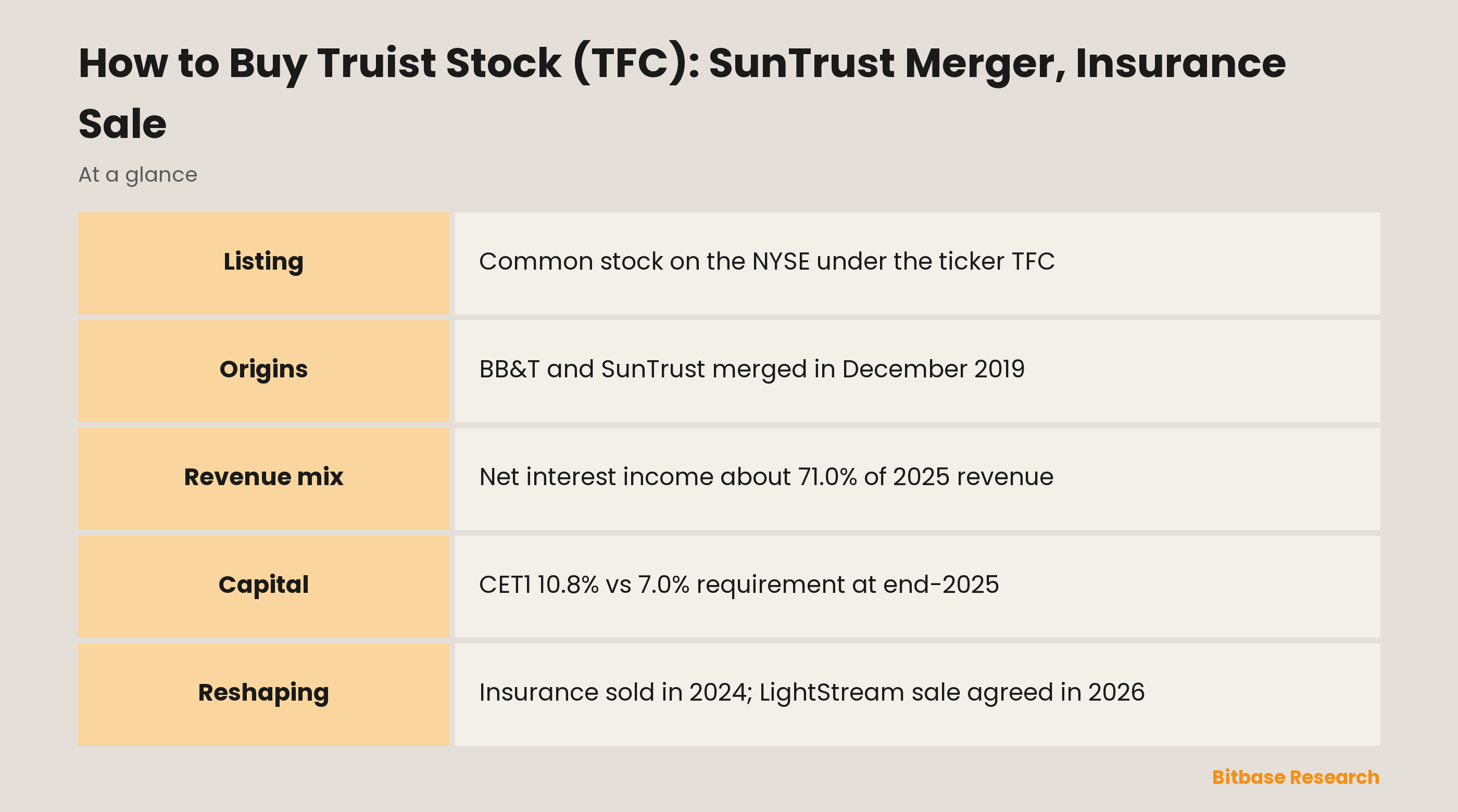
Every Truist common share trades on the New York Stock Exchange under the ticker TFC, and a standard brokerage account that reaches that market is enough to buy one. The listed company is older than its name: BB&T Corporation became Truist Financial when SunTrust merged into it in December 2019, and it sold the last of its insurance brokerage in May 2024. What is left is a Charlotte bank whose 2025 revenue was about 71.0% net interest income.
What Does Truist Do?
Truist Financial Corporation, headquartered in Charlotte, North Carolina, is a bank holding company. Its largest subsidiary, Truist Bank, was chartered in 1872 and is, in the 10-K's words, "the oldest bank headquartered in North Carolina." At the end of 2025 the bank ran 1,927 branches, concentrated in the Southeast and Mid-Atlantic; using FDIC data from June 2025, the annual report places 22% of deposits in Florida and 21% in Georgia, ahead of Virginia at 14% and North Carolina at 13%.
The present company dates from 2019. BB&T Corporation, then based in Winston-Salem, agreed on 7 February 2019 to combine with SunTrust Banks and closed what its filings call a merger of equals on 6 December. SunTrust merged into BB&T Corporation, which renamed itself Truist Financial Corporation and swapped the ticker BBT for TFC; each SunTrust share became 1.295 shares of the surviving company.
Two segments do the work. Consumer and Small Business Banking serves retail, premier and small business clients with deposits, cards, mortgages and point-of-sale loans for cars and home improvement. Wholesale Banking serves commercial, corporate, institutional and wealth clients with credit, payments, investment banking and wealth advice. Other, Treasury and Corporate holds the securities portfolio and central functions.
The perimeter keeps shrinking: Truist sold a 20% stake in Truist Insurance Holdings in April 2023 and the rest on 6 May 2024. In the third quarter of 2026 it sold loans from Regional Acceptance Corporation, its nonprime and near-prime auto lender, and on 14 October 2026 it agreed to sell substantially all assets of LightStream, its national unsecured lending platform, to Carlyle, with closing expected in the fourth quarter.
How Truist Makes Money
In 2025 net interest income, which is what loans and securities yield after paying depositors and other creditors, accounted for about 71.0% of revenue; fees and other noninterest income supplied about 29.0%. Net interest income rose about 2.4%, and the taxable-equivalent margin held at 3.03%.
Earlier years compare badly: after the insurance sale, Truist sold lower-yielding securities and booked losses large enough to make its 2024 noninterest income negative; 2023 included a goodwill impairment and ended in a net loss.
| Segment | Portion of 2025 segment revenue | Portion of 2025 segment profit | Revenue vs 2024 |
|---|---|---|---|
| Consumer and Small Business Banking | 51.9% | 38.1% | Down 3.0% |
| Wholesale Banking | 48.1% | 61.9% | Up 3.1% |
Segment revenue is net interest income plus noninterest income, from the 10-K segment note.
Consumer banking brings in slightly more revenue, the wholesale side far more profit, and the loan book leans commercial: at 2025 year-end commercial and industrial loans were about 51.1% of loans held for investment, commercial real estate about 7.2% and consumer lending about 39.3%. Among fees, wealth management was the largest line, at roughly 7% of total revenue.
TFC Stock at a Glance
| Feature | Truist |
|---|---|
| Ticker | TFC (BBT before December 2019) |
| Listing venue | New York Stock Exchange (NYSE) |
| Share class | Common stock |
| Preferred listings | Four, with TFC-based symbols: TFC.PI, TFC.PJ, TFC.PO, TFC.PR |
| Sector | Financials: banking |
| Index membership | S&P 500 and KBW Nasdaq Bank Index; not in the Dow |
| Headquarters | Charlotte, North Carolina |
| Regulatory tier | Category III banking organization |
| Fiscal year | Ends 31 December |
| Dividend | Quarterly; declarations expected in January, April, July and October |
| SEC identifier | CIK 92230 |
Live price, market capitalisation and yield sit on the TFC quote page on Bitbase.
How to Buy Truist Stock
No depositary receipt sits in between: the security listed in New York is Truist's common stock. Six steps:
1. Find a broker with NYSE access. From abroad, a domestic broker that offers US shares or a global platform will do; check who regulates it.
2. Open the account and file your tax form. Non-US individuals generally complete Form W-8BEN; the IRS says a foreign person gives it "to the withholding agent or payer."
3. Deposit money. Currency conversion into dollars costs extra on top of commission.
4. Search for TFC and read the line. It should say Truist Financial Corporation common stock; the TFC-based preferred symbols are different securities.
5. Choose market or limit. A market order fills at whatever price is available, which may differ from the quote you saw; a limit order caps the price but may never fill.
6. Set the amount. Some brokers sell fractions of a share; that is each broker's own policy.
Dividend tax abroad. According to the IRS, "most types of U.S. source income received by a foreign person are subject to U.S. tax of 30%," though a treaty may reduce it.
Through funds. On 29 October 2026 TFC appeared in the holdings of State Street's SPY, an S&P 500 tracker, the sector fund XLF and the bank fund KBE.
What Moves TFC Stock
Rates, now hedged harder. At the end of 2024, Truist's simulation showed a gradual 200 basis point rise lifting net interest income over the next twelve months by 1.1% and a gradual fall cutting it by 2.1%. A year later both tests showed small declines, 0.9% and 0.3%, a change the 10-K says was "primarily driven by the addition of interest rate hedging instruments."
Capital and payouts. At year-end 2025 the common equity tier 1 (CET1) ratio was 10.8%, compared with a 7.0% requirement in the same 10-K: a 4.5% floor plus a 2.5% stress capital buffer, the lowest the formula allows. The third-quarter 2026 10-Q gave a preliminary 10.7% at 30 September against the same 7.0%. Management targets a dividend payout ratio "between 30% and 50% during normal economic conditions"; in 2025 it was 54%, and with buybacks the total payout ratio reached 104%.
New management, smaller balance sheet. Michael P. Lyons, formerly chief executive of Fiserv and before that president of PNC, succeeded William H. Rogers Jr. as CEO at the end of August 2026. The third quarter brought the Regional Acceptance sale and a securities repositioning that produced a pre-tax loss, then came the LightStream agreement; the 10-Q says such steps "simplify the Company" and reduce "credit risk, interest rate risk, and wholesale funding."
Credit costs. The net charge-off ratio was 0.54% in 2025. Selling nonprime auto loans changes that mix; the third-quarter release said asset quality "improved as a result of the RAC loan sale."
The Risk Side of a TFC Share
Of the 2025 10-K's risk factors, five fit Truist especially closely:
Rates. "Changes in interest rates have affected our net interest income and other financial results in the past and could in the future adversely affect us."
Deposits. "Our inability to retain and grow deposits or a change in deposit costs or mix could negatively impact our funding strategy and financial results." The section adds that deposits could be disrupted by wider use of "digital assets, stablecoins, cryptocurrencies, tokenization," and similar technologies.
Cash from the bank. "The Parent Company relies on dividends from Truist Bank for its liquidity needs, the payment of which is limited by statutes and regulations."
Goodwill. Weak share prices and economic conditions "may require the Company to write down all or some portion of the Company's goodwill," which 2023 showed is not hypothetical.
Execution. "Ineffective execution of strategic initiatives could adversely affect investor sentiment," a pointed warning in a year of asset sales.
The share adds its own risks: one bank stock ties your money to one balance sheet, dividends are declared by the board quarter by quarter, and exchange rates change what it is worth outside the dollar.
How to Research TFC Yourself
Truist files under CIK 92230, the record BB&T Corporation used and, until 1997, Southern National Corporation. SunTrust filed its own reports before the merger, so they sit outside that list.
In the 10-K, Item 1 shows deposits by state, Item 1A the risk factors and Item 5 the dividend policy; management's discussion holds the rate table and capital ratios. Quarterly results arrive as 8-K exhibits, most recently on 16 October 2026, and ir.truist.com carries the same documents.
For comparison with larger lenders, see the Bank of America guide and the Wells Fargo guide; Bitbase's list of US stocks covers other banks.
Truist Stock FAQ
Does Truist pay a dividend?
Yes, quarterly. Dividends declared per common share were the same in 2025 as in 2024, and the same in the first nine months of 2026 as a year earlier. Each payment depends on earnings and capital; the latest 8-K gives amount and dates.
Can I buy Truist stock with crypto?
Not directly. TFC trades in US dollars through brokers, so crypto must first be sold for cash, and that sale can create a tax bill in your country. Owning TFC means owning part of a regulated bank holding company, with votes and dividends attached; the difference between a stock and a crypto asset goes deeper.
Is Truist the same company as BB&T and SunTrust?
It is the former BB&T Corporation under a new name. When the merger closed on 6 December 2019, SunTrust merged into it and SunTrust shareholders received 1.295 shares for each share; BB&T's own shares were not converted.
Does Truist still own an insurance business?
No. Truist Insurance Holdings was sold in two steps, a 20% stake in April 2023 and the rest on 6 May 2024, and the 2025 10-K reports no discontinued operations.
Is TFC in the S&P 500?
Yes. The 2025 10-K describes Truist as a component of the S&P 500 and the KBW Nasdaq Bank Index. It is not a Dow stock: DIA, State Street's Dow fund, did not hold it on 29 October 2026.
Conclusion
Placing a TFC order takes little: an NYSE-capable broker, the right security line and a choice between market and limit. The judgement is harder: the company keeps changing shape, most recently through 2026 loan sales under a new CEO, while about 71.0% of revenue still comes from net interest income. Check the latest 10-K and 10-Q before you decide what share of your money one bank should carry.
Related reading
Other Bitbase articles on this topic:
- How to Buy ING Stock (ING): ADS, Dutch Dividend Tax and Payouts
- How to Buy Itaú Unibanco Stock (ITUB): Preferred ADS and JCP Tax
- How to Buy Lloyds Banking Group Stock (LYG): ADS, LLOY and Halifax
Disclaimer: This article is educational content from Bitbase Academy, provided for information only. It explains what a company or fund does and how the instruments referenced here differ from one another; it does not constitute investment, trading, tax, or financial advice, and it is neither a recommendation nor an endorsement of any security, token, or trading strategy. A tokenized stock is issued by a third party and is designed to give economic exposure to an underlying asset: it is not a share, it carries no shareholder rights, and it depends on the issuer's structure, eligibility rules, and redemption terms, which the issuer can change. Perpetual futures are leveraged derivatives that hold no underlying asset and can be liquidated, and trading hours, product availability, and eligibility differ by instrument and by jurisdiction and can change at any time. Written as of October 2026; verify everything yourself through company filings, the issuer's own documentation, and the product pages of the venue you trade on.
References
[1] Truist Financial Form 10-K for 2025: business, segments, capital, risk factors (SEC EDGAR) www.sec.gov
[2] Truist Financial Form 10-Q for the third quarter of 2026 (SEC EDGAR) www.sec.gov
[3] Truist third-quarter 2026 earnings release, filed with Form 8-K on 16 October 2026 www.sec.gov
[4] Truist Financial Form 8-K of 9 December 2019: completion of the SunTrust merger www.sec.gov
[5] Truist Financial Form 8-K of 10 May 2024: sale of Truist Insurance Holdings completed www.sec.gov
[6] Truist Financial Form 8-K of 15 June 2026: chief executive transition www.sec.gov
[7] BB&T Corporation Form 10-K for 2018: Winston-Salem headquarters, NYSE symbol BBT (SEC EDGAR) www.sec.gov
[8] SEC EDGAR filer page for CIK 92230, with former names BB&T Corp and Southern National Corp www.sec.gov
[9] State Street: SPY, with XLF, KBE and DIA holdings as of 29 October 2026 www.ssga.com
[10] IRS: NRA withholding www.irs.gov
[11] IRS: About Form W-8 BEN www.irs.gov





