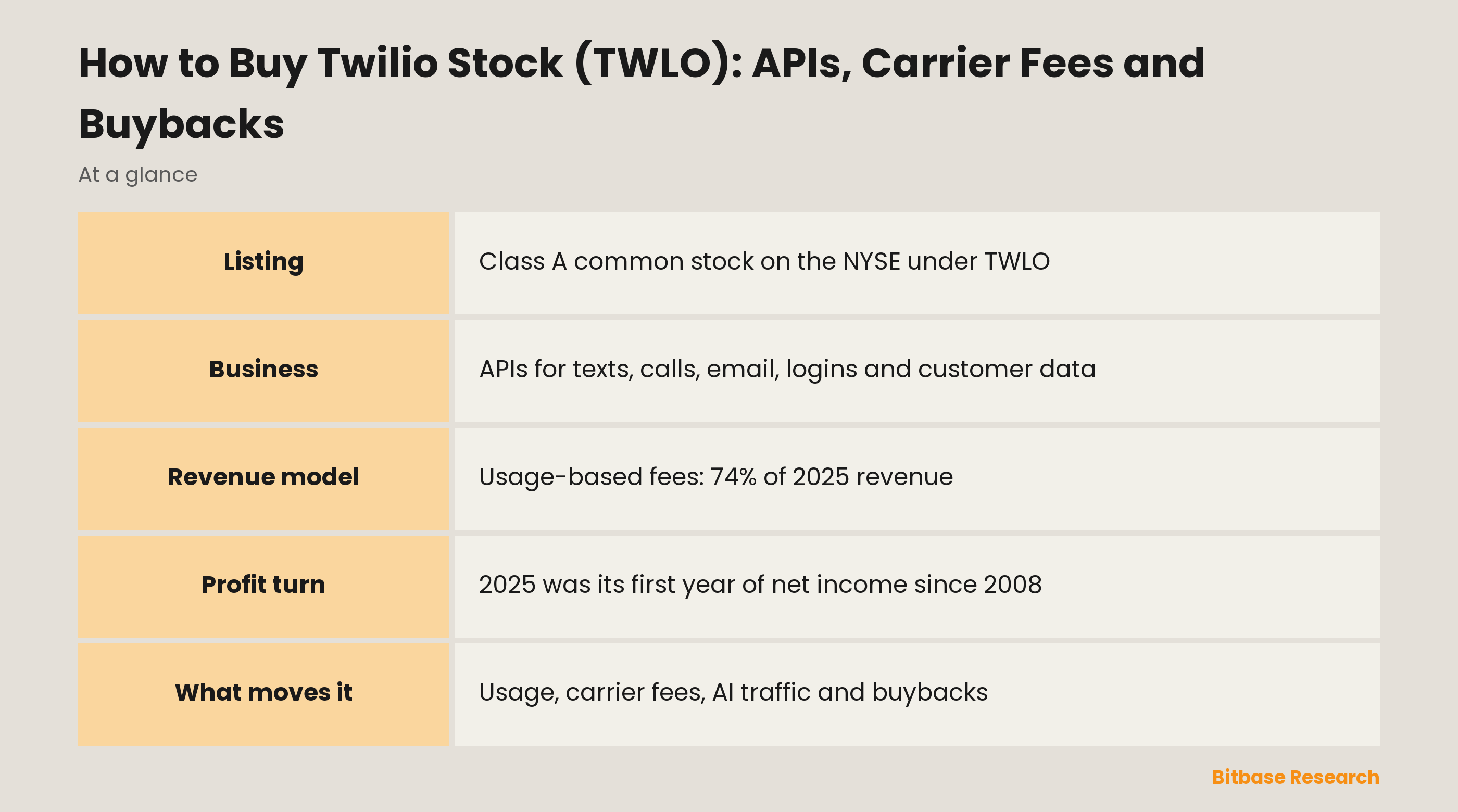
A regular brokerage account with access to the New York Stock Exchange is all you need to buy Twilio stock, which trades there as TWLO, a Class A common share and the company's only listed class. Twilio sells the plumbing behind text messages, phone calls, emails and login codes that other companies send, and 74% of its 2025 revenue came from usage-based fees rather than fixed subscriptions. 2025 was also the first year since its founding in 2008 that Twilio reported net income. This guide covers the business, the purchase, and what the filings say moves the shares.
What Does Twilio Do?
Twilio is a San Francisco software company that lets developers put communications inside their own apps. A delivery app texting that the driver is outside, a bank calling with a one-time passcode, a shop emailing a receipt: messages like these are what Twilio's APIs are built to send. The company was incorporated in Delaware in March 2008, and its IPO prospectus says it "launched our first product in 2008."
Its pitch has widened since then. The 2025 Form 10-K describes the aim as combining "our leading communications capabilities with rich contextual data and artificial intelligence" so that businesses can engage customers "at scale." The 10-K names five key products. Messaging is an API for SMS, MMS, RCS and over-the-top apps such as WhatsApp and Facebook Messenger, used for account alerts, marketing, order confirmations and customer care. Voice is an API to make, receive and manage phone calls, including links to AI-based virtual agents, call recording, conferencing and contact centers.
Email, sold under the Twilio SendGrid name, is an email delivery API with a no-code Marketing Campaigns tool on top. User Authentication and Identity is led by Twilio Verify for one-time passwords and passkeys; it includes Fraud Guard, which blocks fake traffic known as SMS pumping, and Lookup, which checks phone numbers in real time. Segment is a customer data platform that merges what a business knows about each customer into one profile and feeds it to other tools.
Underneath sits what Twilio calls its Super Network, a software layer that connects the platform to phone carriers and inbox providers worldwide and supplies phone numbers and SIP trunking.
Customers reach Twilio in three ways. Developers sign up on their own and prepay or subscribe; larger organisations work with a direct sales team; and independent software vendors build Twilio into products they resell. At the end of 2025 the company counted over 402,000 Active Customer Accounts, defined as accounts billed at least five dollars in the final month. It stopped reporting that figure as a key metric in 2026, saying it had become "less informative" because many small accounts add little revenue.
Two changes in the past two years reshaped the company. In January 2024 Jeff Lawson, named in the 2016 prospectus as co-founder, resigned as chief executive, and Khozema Shipchandler, previously president of Twilio Communications and before that chief financial officer, took over. Then on 1 January 2025 Twilio folded its business units into one organisation, and from the third quarter of 2025 it has reported a single segment. In November 2025 it bought Stytch, which the 10-K calls "an identity platform for AI agents." The company had 5,587 employees at the end of 2025.
How Twilio Makes Money
Twilio earns most of its money per message, per minute or per verification, not per seat. The 10-K explains that Messaging, Voice and the authentication products are "primarily recognized on a usage basis," while Email and Segment are "primarily recognized on a subscription basis." Messaging is billed largely by the number of texts and Voice by call minutes. Many large customers sign contracts of at least 12 months, often with minimum revenue commitments.
| Measure from the 2025 10-K | 2025 | 2024 |
|---|---|---|
| Revenue growth | 14% | 7% |
| Share of revenue from usage-based fees | 74% | 72% |
| Dollar-Based Net Expansion Rate | 108% | 104% |
| Revenue from US customers | 64% | 65% |
| Revenue from the 10 largest customer accounts | 9% | 10% |
| GAAP gross margin | 49% | 51% |
| GAAP operating margin | 3% | -1% |
| Free cash flow margin | 19% | 15% |
The Dollar-Based Net Expansion Rate compares what last year's customer accounts spend now with what they spent a year earlier, so 108% means that group spent about 8% more. The 10-K attributes most of 2025's growth to existing customers using more, with new accounts adding the rest.
Gross margin sits near half of revenue for a structural reason: cost of revenue is "primarily" fees paid to network service providers, the carriers that deliver each text and call. Twilio passes some of those fees straight through. In June 2025 a major US mobile carrier raised its fees on application-to-person (A2P) messages, other US carriers followed with increases effective in January and April 2026, and Twilio bills them to customers at cost. That adds equal amounts to revenue and cost of revenue, so it leaves gross profit unchanged but lowers gross margin. By the company's figures, the new fees accounted for about 8% of the 2025 revenue increase.
Profitability turned in 2025. The risk factors state that the company "achieved net income" that year after it had "incurred net losses in each preceding year since our inception." Stock-based compensation remained large, equal to about 12% of 2025 revenue, which is the main gap between GAAP results and the non-GAAP operating margin of 18% that management also reports.
One more line affects the bottom of the income statement. In 2022 Twilio bought a 44.6% stake in Syniverse, a company that processes and routes A2P messages between Twilio's customers and mobile operators. Twilio records its share of Syniverse's losses and took an impairment on the stake in 2025.
TWLO Stock at a Glance
| Feature | TWLO |
|---|---|
| Exchange | New York Stock Exchange |
| Ticker | TWLO |
| Security | Class A common stock, the only class registered under Section 12(b) |
| Sector | Cloud communications software: messaging, voice, email, identity and customer data |
| Index membership | S&P 500 (in State Street's SPY holdings on 9 November 2026) |
| Headquarters | San Francisco, California |
| Incorporated | Delaware, March 2008 |
| Listed since | June 2016 initial public offering |
| Fiscal year | Calendar year, ending 31 December |
| Dividend | None ever declared; buyback program authorized in January 2025 |
| SEC identifier | CIK 1447669 |
Prices and valuation figures change by the second, so for live numbers open the Twilio stock page on Bitbase.
How to Buy Twilio Stock
Because Twilio is a Delaware company listed in New York, what you buy is the share itself, not a depositary receipt. The steps:
1. Find a broker that routes orders to the NYSE. Outside the US, compare a local broker that offers American shares with a global one, and check which legal entity holds your account and who regulates it.
2. Open the account and pass identity checks. Non-US residents are normally asked for IRS Form W-8BEN; the IRS tells account holders to submit it "when requested by the withholding agent or payer."
3. Fund it. If your money is in another currency, the conversion spread can cost more than the commission, so look at both.
4. Search for TWLO. The result should read Twilio Inc. Class A common stock on the NYSE. The "Class A" label is a leftover from the company's old two-class structure, explained in the FAQ below.
5. Choose the order type. FINRA calls a market order the type that "provides the most certainty that your order will be executed," and a limit order one that fills only "at or better than a specified price." The 10-K warns that swings in quarterly results can move the share price significantly, and a limit order caps what you pay.
6. Decide on whole or fractional shares. Fractional shares let you invest a fixed amount, but FINRA notes that "you can't transfer fractional shares to another brokerage firm," so moving brokers later may mean selling first.
7. Keep records. Confirmations and monthly statements show your cost basis, which you will need when you sell.
Tax for non-US investors. The IRS says "most types of U.S. source income received by a foreign person are subject to U.S. tax of 30%," with lower rates possible under a tax treaty. Twilio pays no dividend, so that withholding has nothing to bite on for now; how a gain on sale is taxed depends on where you live.
Indirect ownership. TWLO was in the SPY holdings file dated 9 November 2026, so S&P 500 index funds carry it, though as a small slice of a 500-company basket.
What Moves TWLO Stock
Usage, not seats. Because most revenue rises and falls with traffic, the 10-K warns that most usage-based customers "do not have long-term contractual financial commitments to us" and can cut back at any time. Usage revenue is also "more immediately impacted by changes in consumer spending and macroeconomic conditions" than subscription revenue, and the fourth quarter usually benefits from higher consumer activity.
Carrier fees and the organic growth figure. The A2P fee increases inflate reported revenue growth without adding profit. That is why Twilio now reports "organic" growth, which strips out the pass-through fees and acquisitions. In the third quarter of 2026 reported revenue rose 20% and organic revenue 16%; the incremental fees supplied roughly a fifth of that quarter's increase. Comparing the two growth rates each quarter tells you how much of the headline is carriers.
AI traffic. Management is pitching Twilio as infrastructure for AI agents that talk, text and verify. After the third quarter of 2026, Shipchandler said "consumer AI has accelerated AI development, and its adoption demands fast, reliable infrastructure built for AI speed." The Dollar-Based Net Expansion Rate rose to 114% from 109% a year earlier.
Buybacks and share count. Twilio repurchased 36.8 million shares in 2024 and 8.0 million in 2025, and by 30 September 2026 had used about two-thirds of the authorization granted in January 2025, which runs to the end of 2027. The average basic share count fell about 8% between 2024 and 2025. When Class B stock converted in June 2023 there were about 181 million Class A shares; the 10-K cover counted 151.5 million in February 2026.
One-off tax gains. In the second quarter of 2026 Twilio released a significant portion of the valuation allowance on its US deferred tax assets, booking a large tax benefit. GAAP net income for the first nine months of 2026 equalled 30% of revenue, but most of that came from the tax item, not from operations, whose margin was 8%.
Usage, Carriers and AWS Top the Risks Twilio Discloses
These risk factors in the 10-K bear most directly on the shares:
Customers can leave quickly. "If our customers terminate or reduce their usage of our products, our business, results of operations and financial condition would be adversely affected." Twilio also cautions that results "have fluctuated in the past and may continue to do so," and a large share of its operating costs is fixed.
Dependence on carriers. "To deliver our products, we rely on network service providers and internet service providers," and in some markets their fees "change daily or weekly," faster than Twilio can always reprice. Phone numbers, which the filing calls Numbering Resources, can be scarce or tightly regulated, and number transfers can take "up to 15 business days or longer."
Dependence on AWS. Twilio outsources "a substantial majority of our cloud infrastructure to Amazon Web Services," which "hosts our products and platform," and it says it has experienced and expects interruptions.
Rules on calls, texts and email. US law such as the Telephone Consumer Protection Act restricts automated calls and texts, other countries add licensing rules, and spam filters from Apple, Google, Yahoo and others "may inadvertently filter desired messages or calls." Fraud on the platform is listed as its own risk.
Competition. Rivals range from other communications platform-as-a-service companies to regional carriers, CRM and customer experience vendors, and standalone customer data platforms, in markets the 10-K calls "intensely competitive and rapidly evolving."
Profit and debt. Twilio has a "history of losses and may not achieve or sustain profitability," and its 3.625% notes due 2029 and 3.875% notes due 2031 come with covenants that limit some activities.
Then there is the stock itself. The 10-K says "you could lose all or part of your investment," buybacks may not deliver "the anticipated long-term stockholder value," and owning one company concentrates your money in a single business.
How to Research TWLO Yourself
Twilio's filings live on SEC EDGAR under CIK 1447669. The 10-K for 2025 was filed on 24 February 2026; quarterly reports and earnings releases followed, the releases arriving as 8-Ks on 12 February, 30 April, 6 August and 29 October 2026. The company says it also uses its investor relations website, its X feed and its LinkedIn page to disclose material information.
Three places repay a close read. The key metrics section of each filing gives the Dollar-Based Net Expansion Rate and, since 2026, organic growth. The revenue discussion states in dollars how much of each period's increase came from A2P fees. And the related-party and equity investment notes track Syniverse.
Watch for two traps. Filings before the third quarter of 2025 report two segments, Communications and Segment, so segment trends before 2025 do not carry over. And do not compare 2026 GAAP earnings per share with earlier years without removing the tax benefit. For other US-listed software companies, see our Cloudflare stock guide and Datadog stock guide, and the Bitbase stock pages list quotes for other listed companies.
Twilio Stock FAQ
Can I buy Twilio stock with crypto?
Not directly. TWLO shares are bought in US dollars through a brokerage account, so you would first sell crypto for cash, a step that can trigger tax where you live, and then fund the broker. Owning the share gives you a vote and a claim in a regulated company, which is different from holding a crypto asset.
Does Twilio pay a dividend?
No. The 10-K says Twilio has "never declared or paid any cash dividends" and does not expect to "in the foreseeable future." It returns cash through share repurchases instead.
Why is Twilio stock called Class A?
At the 2016 IPO Twilio had two classes: Class A with one vote per share and Class B with ten. On 28 June 2023, seven years after the charter took effect, every Class B share converted automatically into one Class A share. Class A is now the only class, and each share carries one vote.
Is TWLO in the S&P 500?
Yes. Twilio Inc. Class A appeared in State Street's daily holdings file for SPY, the S&P 500 fund, dated 9 November 2026. Index weights change daily.
When did Twilio go public?
Twilio sold 10,000,000 Class A shares in an initial public offering under a prospectus dated 22 June 2016, listing on the NYSE as TWLO. It also had a dual listing on the Long-Term Stock Exchange, withdrawn in December 2022; that change did not affect the NYSE listing.
Conclusion
Twilio's shares now rest on two claims at once: that a usage-priced communications business can stay profitable after 2025's first full year of net income, and that AI agents will send it more traffic. Reported growth flatters both claims a little, because carrier fees and a one-off tax benefit inflate the totals. The organic growth rate, the net expansion rate and the operating margin each quarter are better tests. Read the latest 10-K and quarterly release before deciding how much of a portfolio one communications platform should take up.
Related reading
Other Bitbase articles on this topic:
- How to Buy Global Payments Stock (GPN): After the Worldpay Swap
- How to Buy Infosys Stock (INFY): 1:1 ADS, Dividends and H-1B Risk
- How to Buy MSCI Stock (MSCI): Indexes, ETF Fees and BlackRock
Disclaimer: This article is educational content from Bitbase Academy, provided for information only. It explains what a company or fund does and how the instruments referenced here differ from one another; it does not constitute investment, trading, tax, or financial advice, and it is neither a recommendation nor an endorsement of any security, token, or trading strategy. A tokenized stock is issued by a third party and is designed to give economic exposure to an underlying asset: it is not a share, it carries no shareholder rights, and it depends on the issuer's structure, eligibility rules, and redemption terms, which the issuer can change. Perpetual futures are leveraged derivatives that hold no underlying asset and can be liquidated, and trading hours, product availability, and eligibility differ by instrument and by jurisdiction and can change at any time. Written as of November 2026; verify everything yourself through company filings, the issuer's own documentation, and the product pages of the venue you trade on.
References
[1] Twilio Form 10-K for 2025 (SEC EDGAR) www.sec.gov
[2] Twilio 2025 Form 10-K, XBRL cover page (SEC EDGAR) www.sec.gov
[3] Twilio Form 10-Q for the third quarter of 2026 (SEC EDGAR) www.sec.gov
[4] Twilio third-quarter 2026 results release, filed with Form 8-K (SEC EDGAR) www.sec.gov
[5] Twilio Form 8-K of 28 June 2023: Class B conversion (SEC EDGAR) www.sec.gov
[6] Twilio Form 8-K of 8 January 2024: CEO transition (SEC EDGAR) www.sec.gov
[7] Twilio initial public offering prospectus, June 2016 (SEC EDGAR) www.sec.gov
[8] Twilio Form 25, December 2022: Long-Term Stock Exchange withdrawal (SEC EDGAR) www.sec.gov
[9] State Street: SPDR S&P 500 ETF Trust (SPY) holdings www.ssga.com
[10] FINRA: Order Types www.finra.org
[11] FINRA: Investing in Fractional Shares www.finra.org
[12] IRS: NRA Withholding www.irs.gov
[13] IRS: About Form W-8 BEN www.irs.gov





