
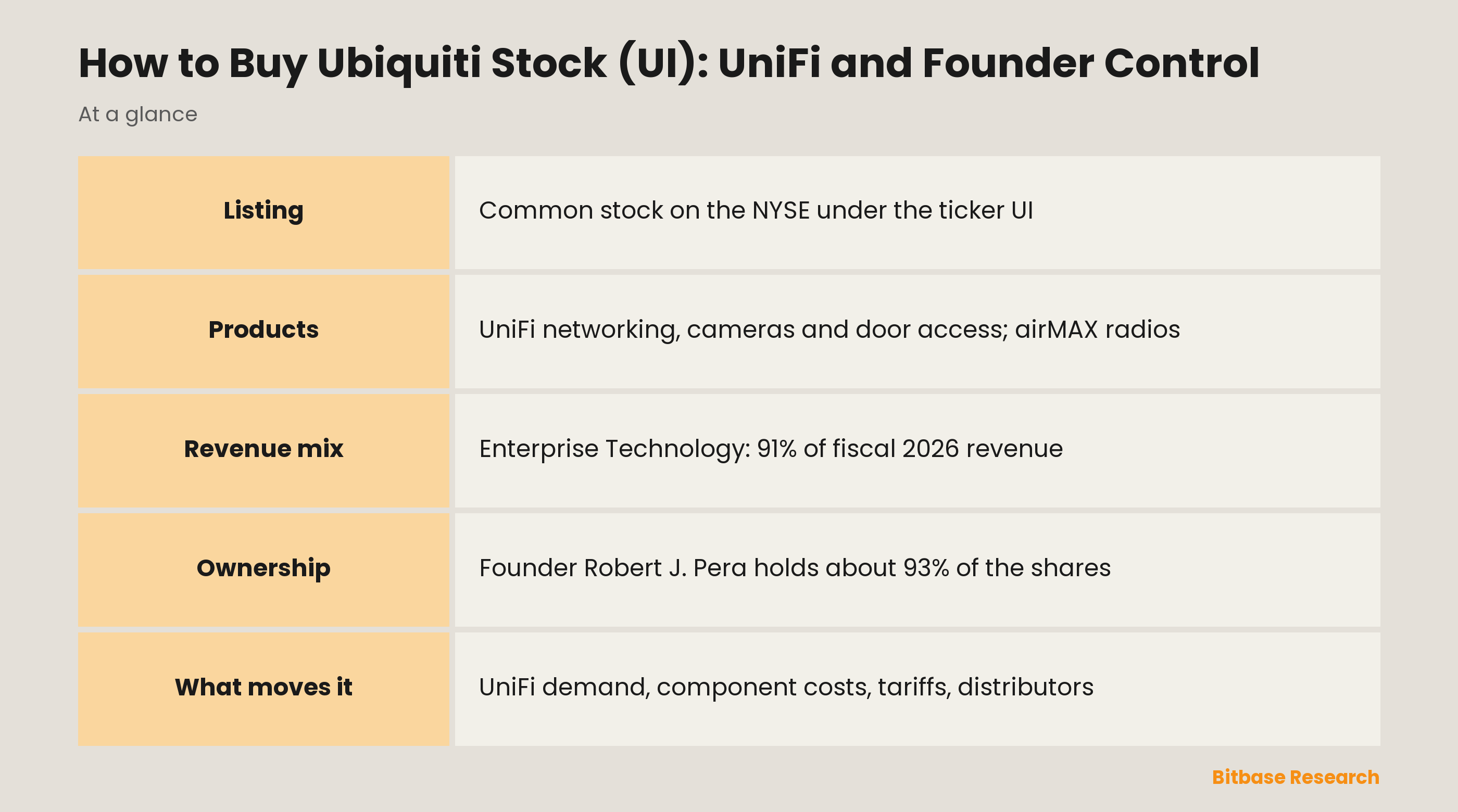
You order Ubiquiti shares through any broker that reaches the New York Stock Exchange by searching for UI, which here is the two-letter ticker of Ubiquiti Inc., not shorthand for "user interface." The unusual part is ownership: founder and chief executive Robert J. Pera held about 93% of the common stock in the October 2026 proxy statement, so only a thin slice trades freely. Below: the products, the order steps and what that ownership means for other shareholders.
What Does Ubiquiti Do?
Robert Pera founded Ubiquiti in 2005 to design networking equipment and the software that manages it. It went public on Nasdaq in October 2011 as Ubiquiti Networks, Inc., ticker UBNT, and on 20 August 2019 moved to the NYSE, dropping "Networks" from its name and taking the ticker UI.
The 10-K sorts the products into two groups. Enterprise Technology is built around UniFi: gateways, WiFi access points, switches, UniFi Protect cameras, UniFi Access door-entry systems and UniFi Talk business phones, all run from one software layer, UniFi OS. Service Provider Technology serves wireless internet operators: airMAX base stations and customer radios, airFiber point-to-point links, UFiber fibre gear and Wave radios, managed through the UISP platform.
"We do not employ a traditional direct sales force," the 10-K says; brand awareness comes from online reviews, distributors and a user forum it calls the Ubiquiti Community. Of 1,818 full-time-equivalent staff on 30 June 2026, 1,321, or about 73%, worked in research and development. Products reach buyers through over 100 distributors, online retailers and the company's own webstores.
Production is outsourced to contract manufacturers "primarily located in Vietnam and China," and several components, chipsets among them, come from one supplier or a small group of them. In enterprise WiFi and switching, the 10-K names Cisco, Fortinet, Hewlett Packard Enterprise and Ruckus as rivals; Cisco has its own entry in our Cisco stock guide.
How Ubiquiti Makes Money
Ubiquiti reports a single segment and splits its revenue between the two product categories:
| Product category | Share of fiscal 2024 revenue | Share of fiscal 2026 revenue | Change in fiscal 2026 |
|---|---|---|---|
| Enterprise Technology | 84% | 91% | Up 32% |
| Service Provider Technology | 16% | 9% | Down 5% |
The fiscal year closes on 30 June, so fiscal 2026 ran from July 2025 to June 2026. Total revenue grew 27% that year, and gross margin widened to 46% from 43%, which the company credits to "favorable product mix, and lower other indirect costs, offset in part by higher tariff costs."
By ship-to destination, North America took 53% of fiscal 2026 revenue, the United States alone about 48%, while Europe, the Middle East and Africa took 36%. Those are delivery addresses, not end users: distributors resell across borders, and the company says it lacks visibility on "the location or extent of purchases of our products by individual network operators."
No single customer reached 10% of revenue in fiscal 2024, 2025 or 2026, yet two customers each held at least 10% of receivables on 30 June 2026.
UI Stock at a Glance
| Feature | UI |
|---|---|
| Exchange | New York Stock Exchange since 20 August 2019; Nasdaq as UBNT before |
| Ticker | UI |
| Security | Common stock, the only class registered under Section 12(b) |
| Controlling holder | Robert J. Pera, about 93% (October 2026 proxy) |
| Index membership | Not in State Street's S&P 500, MidCap 400 or Composite 1500 ETFs on 6 November 2026 |
| Headquarters | New York, New York |
| Incorporated | Delaware |
| Fiscal year | Ends 30 June |
| Payouts | Quarterly cash dividend |
| SEC identifier | CIK 1511737 |
Live figures are on the Ubiquiti stock page on Bitbase.
How to Buy Ubiquiti Stock
UI is plain common stock, with no depositary receipt or second share class to choose between. The steps:
1. Find a broker that offers NYSE stocks. Abroad, check which legal entity holds your account and who supervises it.
2. Pass the account checks. Non-US residents usually complete IRS Form W-8BEN, which the IRS says to submit "when requested by the withholding agent or payer."
3. Deposit money. Unless you fund in US dollars, currency conversion is a cost on top of commissions.
4. Search for UI and read the name. Two-letter tickers are easy to mistype; the line you want reads Ubiquiti Inc. common stock on the NYSE.
5. Choose market or limit. A market order fills at the going price; a limit order fills only at your price or better. That matters here, because the 10-K says the limited float "may contribute to greater volatility."
6. Expect street-name holding. The 10-K counted only six holders of record on 20 August 2026, because "most of our shares are held by brokers and other institutions on behalf of stockholders."
Tax for investors abroad. The IRS says "most types of U.S. source income received by a foreign person are subject to U.S. tax of 30%," and a tax treaty may reduce that. The rule covers UI dividends, which your home country may tax again.
Through index funds. On 6 November 2026, UI did not appear in the daily holdings of State Street's SPY, MDY or SPTM, which track the S&P 500, MidCap 400 and Composite 1500. If you want it through a fund, read that fund's holdings list rather than assuming.
What Moves UI Stock
Enterprise demand. With Enterprise Technology at 91% of revenue, UniFi sales set the pace. In the quarter to 30 September 2026, the first of fiscal 2027, revenue rose 39.9% from a year earlier, with both product categories growing.
Component costs. The same earnings release warned that "component costs may continue to rise, and availability may remain constrained." Gross margin was 47.3% that quarter, and the company flagged possible "near-term pressure on our gross profit margins."
Tariffs. The 10-K says recent US tariff changes "have increased our product costs" and that past margins "may not be indicative" of future ones.
Distributor ordering. Distributors keep their own stock, make no long-term purchase commitments and "do not typically provide us with information about market demand," so a few large ones restocking or destocking can swing a quarter.
Payouts. The board raised the quarterly dividend in August 2025 and again in August 2026. A repurchase program approved in August 2025 went unused in fiscal 2026 and now runs to 30 September 2027.
Founder Control, Thin Float and Other UI Risks
From Item 1A of the 10-K, these bear most directly on a UI share:
One controlling holder. Mr. Pera "has the ability to control the outcome of matters submitted to our stockholders for approval, including the election of directors and any merger," and he "is entitled to vote his shares in his own interests, which may not always be in the interests of our stockholders generally."
Pledges and sales. He may pledge shares for loans, enter derivative transactions or sell; after a loan default, "the lender could sell the pledged shares into the market without limitation on volume or manner of sale." He has said he intends to keep at least a majority.
Thin float and key person. Because one holder owns so much, "our public float is relatively limited." Growth also depends on "the skills, working relationships and continued services" of Mr. Pera.
Supply and counterfeits. Component lead times are "usually much longer than the lead time from our customers' orders to the expected delivery date," and the company has found "counterfeit goods being sold as our products."
Governance. Since a director died in November 2025, the audit committee has had two members, one short of the NYSE minimum; the October 2026 proxy statement still reported the shortfall.
Beyond these, a single stock concentrates your money in one company.
Checking UI in Ubiquiti's Own Filings
Ubiquiti files on SEC EDGAR under CIK 1511737: a 10-K each August for the year to 30 June, 10-Qs for the other quarters, and an 8-K with each earnings release, which in 2026 came on 6 February, 8 May, 21 August and 6 November.
In the 10-K, Item 1 names competitors by market, Note 14 splits revenue by product category and region, and the section headed "Risks Related to Our Common Stock" sets out the founder's control.
For ownership, read the proxy statement (DEF 14A) filed each October; the 2026 annual meeting is set for 3 December 2026. Mr. Pera's share count has not moved since the fiscal 2019 10-K, and his percentage rose as shares outstanding fell. Quotes are on the stock page linked earlier, and Bitbase's US stock pages cover other companies.
Ubiquiti Stock FAQ
Can I buy Ubiquiti stock with crypto?
Not directly. UI shares are bought in US dollars at a broker, so crypto must first be sold for cash, a sale that may be taxable where you live. What you end up holding is a registered share with voting and dividend rights, which is how a share differs from a crypto asset.
Does Ubiquiti pay a dividend?
Yes, quarterly in cash. The board raised it in August 2025 and August 2026, though the 10-K notes that "any future dividends will be subject to the approval of the Board."
Who controls Ubiquiti?
Robert J. Pera, its founder, chairman and chief executive, beneficial owner of about 93% of the common stock in the October 2026 proxy statement. He cut his base salary to zero in July 2013 and has received no equity awards since fiscal 2011, because he is the majority stockholder.
Is UI in the S&P 500?
No. UI was not among the holdings of State Street's SPY, the S&P 500 tracker, on 6 November 2026, nor in the firm's MidCap 400 and Composite 1500 funds. Index membership can change.
Why did the ticker change from UBNT to UI?
In August 2019 the company moved from Nasdaq to the NYSE and renamed itself from Ubiquiti Networks, Inc. to Ubiquiti Inc.; NYSE trading under UI began on 20 August 2019. EDGAR file names still carry "ubnt."
Conclusion
Owning UI means holding a minority stake in a company one person controls: the founder who runs Ubiquiti has about 93% of the votes, and the market trades the thin remainder. Behind it sits a business now dominated by UniFi and exposed to tariffs and component costs. Read the latest 10-K and proxy statement, follow the margin commentary each quarter, and size any position knowing that the big decisions rest with Mr. Pera.
Related reading
Other Bitbase articles on this topic:
- How to Buy Everpure Stock (P): Formerly Pure Storage, PSTG
- How to Buy Flex Stock (FLEX): Singapore Shares, Axiom Spin-Off
- How to Buy HP Stock (HPQ): PCs, Ink and the 2015 Split
Disclaimer: This article is educational content from Bitbase Academy, provided for information only. It explains what a company or fund does and how the instruments referenced here differ from one another; it does not constitute investment, trading, tax, or financial advice, and it is neither a recommendation nor an endorsement of any security, token, or trading strategy. A tokenized stock is issued by a third party and is designed to give economic exposure to an underlying asset: it is not a share, it carries no shareholder rights, and it depends on the issuer's structure, eligibility rules, and redemption terms, which the issuer can change. Perpetual futures are leveraged derivatives that hold no underlying asset and can be liquidated, and trading hours, product availability, and eligibility differ by instrument and by jurisdiction and can change at any time. Written as of November 2026; verify everything yourself through company filings, the issuer's own documentation, and the product pages of the venue you trade on.
References
[1] Ubiquiti Form 10-K for fiscal 2026 (SEC EDGAR) www.sec.gov
[2] Ubiquiti fiscal 2026 Form 10-K, XBRL cover page (SEC EDGAR) www.sec.gov
[3] Ubiquiti fiscal 2026 Form 10-K, XBRL revenue by product (SEC EDGAR) www.sec.gov
[4] Ubiquiti fiscal 2026 Form 10-K, XBRL revenue by geography (SEC EDGAR) www.sec.gov
[5] Ubiquiti first-quarter fiscal 2027 earnings release, filed with Form 8-K (SEC EDGAR) www.sec.gov
[6] Ubiquiti 2026 proxy statement, DEF 14A (SEC EDGAR) www.sec.gov
[7] Ubiquiti Form 10-K for fiscal 2019: NYSE listing and name change (SEC EDGAR) www.sec.gov
[8] Ubiquiti Networks IPO prospectus, October 2011 (SEC EDGAR) www.sec.gov
[9] Ubiquiti Form 8-K filings list (SEC EDGAR) www.sec.gov
[10] State Street SPDR S&P 500 ETF Trust (SPY): fund page and daily holdings www.ssga.com
[11] State Street SPDR S&P MidCap 400 ETF (MDY): daily holdings file www.ssga.com
[12] State Street SPDR Portfolio S&P 1500 Composite Stock Market ETF (SPTM): daily holdings file www.ssga.com
[13] IRS: NRA Withholding www.irs.gov
[14] IRS: About Form W-8 BEN www.irs.gov





