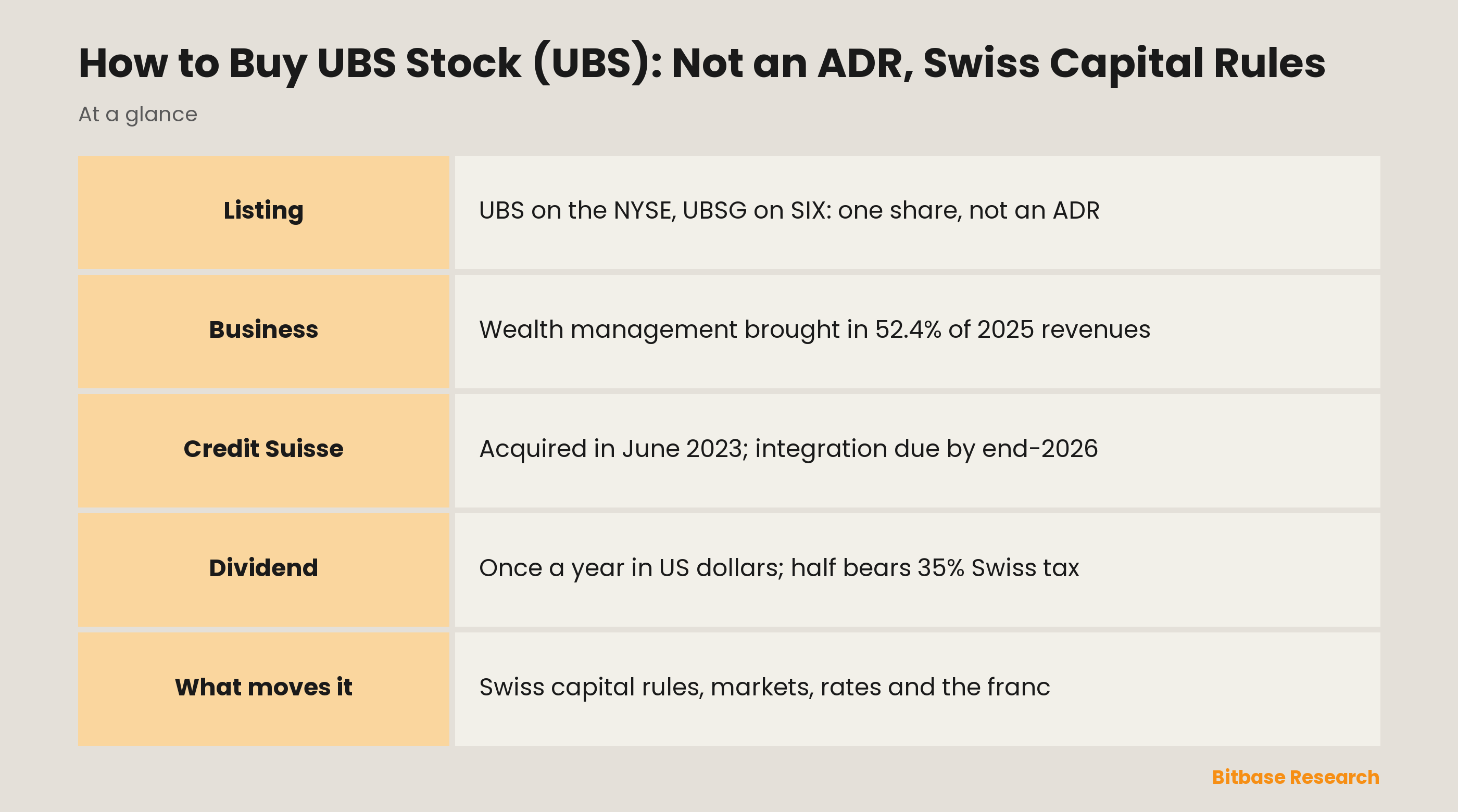
At the New York Stock Exchange, UBS stock is bought like any other listed share, through a broker and under the ticker UBS, but what lands in your account is not a depositary receipt: it is the same registered share of UBS Group AG that trades in Zurich as UBSG. The bank behind it absorbed Credit Suisse in 2023 and earned 52.4% of its 2025 revenues from wealth management. This guide covers how UBS makes money, how to place the order, how Swiss tax reaches the dividend, and why a capital proposal now before the Swiss Parliament matters to shareholders.
What Does UBS Do?
UBS is a Swiss bank, and the company whose shares you buy is UBS Group AG, its holding company. Incorporated on 10 June 2014 and based in Zurich, it owns 100% of UBS AG, through which it conducts substantially all of its operations. The annual report on Form 20-F describes "a global financial services firm operating in more than 50 countries."
The firm itself is much older: the modern UBS was formed in 1998, when Union Bank of Switzerland and Swiss Bank Corporation merged, and in 2000 it bought the US brokerage PaineWebber, which made it a significant player in the United States.
It reports five business divisions:
Global Wealth Management serves "high and ultra high net worth individuals, as well as select institutional clients" with advice, mandates and lending; UBS calls it "the world's only truly global wealth manager." The 20-F lists its rivals in two groups: firms strong in the Americas such as Morgan Stanley, JPMorgan Chase, Bank of America and Wells Fargo, and international players such as Julius Baer, BNP Paribas, Deutsche Bank and HSBC.
Personal & Corporate Banking is the domestic Swiss bank. With around 190 branches, it serves "more than one-third of Swiss households and more than 90% of large Swiss companies," competing with the cantonal banks, Raiffeisen and PostFinance.
Asset Management runs funds and mandates. The Investment Bank pairs advisory and capital-raising work with trading, derivatives and financing. Non-core and Legacy was formed in mid-2023 to run down former Credit Suisse positions that do not fit UBS's strategy.
On 12 June 2023 UBS Group AG acquired Credit Suisse Group AG, founded in 1856, after the Swiss Federal Department of Finance, the Swiss National Bank and the supervisor FINMA asked both banks to consider the deal in order "to restore necessary confidence in the stability of the Swiss economy and banking system." The last Swiss client accounts moved to UBS systems in March 2026, and by 30 September 2026 about 98% of the legacy applications in scope were no longer in use; UBS expects to substantially complete the integration by the end of 2026.
How UBS Makes Money
Group revenues grew 2.0% in 2025. The segment note shows where they came from:
| Division | Share of 2025 total revenues | Change on 2024 | Main income sources |
|---|---|---|---|
| Global Wealth Management | 52.4% | Up 5.9% | Fees on managed and advised assets, brokerage, lending, deposits |
| Investment Bank | 24.9% | Up 12.7% | Advisory and underwriting fees, trading, financing |
| Personal & Corporate Banking | 18.5% | Down 1.9% | Swiss mortgages, loans and deposits; payments, cards, FX |
| Asset Management | 6.4% | Down 0.8% | Management fees on funds and mandates |
Shares are calculated from each division's 2025 revenues and rounded to one decimal. Non-core and Legacy added 0.3%, while Group Items, which hold centrally retained items such as group hedging, reduced the total by 2.4%, so the four divisions sum to slightly more than 100%.
Fees, not lending margins, carry the group. Net fee and commission income made up 56.3% of 2025 revenues, other income from instruments measured at fair value 28.3%, and net interest income only 15.6%. Portfolio management and fund fees brought in about 64% of gross fee income, and in wealth management recurring fees are "primarily linked to the value of the fee-generating assets," so market levels feed straight into revenue. The Swiss bank is the exception: there, net interest income is "more than half of total revenues."
By region, with client revenues attributed to the client's domicile, the Americas brought in 36% of 2025 revenues, Switzerland 32%, the rest of Europe, the Middle East and Africa 17%, and Asia Pacific 16%. Switzerland alone, in other words, brings in nearly a third.
UBS Stock at a Glance
| Item | Detail |
|---|---|
| US listing | UBS on the New York Stock Exchange (NYSE) |
| Home listing | UBSG on the SIX Swiss Exchange |
| What the NYSE share is | An ordinary registered share of UBS Group AG, listed as a global registered share; not an ADR |
| ISIN | CH0244767585, shared by both listings |
| Trading currency | US dollars in New York, Swiss francs in Zurich |
| Sector | Financials: wealth management and banking |
| Index funds | Not in the S&P 500; held by international ex-US funds (October 2026 holdings) |
| Headquarters | Zurich, Switzerland |
| Incorporated | Switzerland, 2014, as the group holding company |
| Fiscal year | Ends 31 December |
| Reporting | IFRS in US dollars; annual report on Form 20-F, quarterly reports on Form 6-K |
| Dividend policy | One annual dividend, declared in US dollars and approved by the general meeting |
| SEC identifier | CIK 1610520 |
Prices move all day in two currencies; the live quote and chart are on the UBS stock page on Bitbase.
How to Buy UBS Stock
UBS has one class of shares and two places to trade it. The New York listing consists of global registered shares that "can be traded and transferred across applicable borders, without the need for conversion": the US register is kept by the transfer agent Computershare, the Swiss one by UBS. So the first decision is market and currency.
1. Choose the market. NYSE access means buying in US dollars, SIX access in Swiss francs; check who regulates your broker.
2. Open and verify the account. State your tax residence accurately; it decides how much Swiss withholding tax you can reclaim.
3. Fund it in the trading currency. If you convert first, compare the exchange rate as well as the commission.
4. Find the right line. Search UBS on the NYSE or UBSG on SIX and confirm it reads UBS Group AG.
5. Set the order type. A market order "guarantees that the order will be executed, but does not guarantee the execution price"; a limit order executes only "at a specific price or better."
6. Decide on the size. Fractional shares let you invest a cash amount, but "not every brokerage firm offers fractional share investing," some allow only market orders for them, and you "may not have voting rights" on a fraction.
7. Keep the records. Confirmations and dividend statements document your cost and any tax withheld.
Where the price is set. Zurich leads. In 2025 SIX handled 93.3% of the shares traded on the two exchanges, and the 20-F expects SIX "to remain the main venue for determining the movement in our share price." While both are open, market makers are likely to arbitrage away differences, so the NYSE price typically tracks Zurich at the dollar-franc rate; after Zurich closes, volumes are typically lower, though the NYSE specialist must keep an orderly market. Outside regular hours, quotes from regular and extended sessions can diverge; a limit order sets your ceiling.
Dividends and Swiss tax. UBS declares its dividend in US dollars. Shares held through SIX SIS AG are paid in Swiss francs, those held through the Depository Trust Company or Computershare in dollars. Listed Swiss companies may repay capital contribution reserves free of withholding tax only if they distribute at least as much in taxable dividends, so UBS pays 50% of each dividend from retained earnings and the rest from those reserves. Only the retained-earnings half bears the 35% Swiss withholding tax. A qualifying US resident can reclaim tax withheld above the 15% treaty rate, and residents of other treaty countries may reclaim part of it. Trades through a Swiss or Liechtenstein bank or dealer may also attract stamp duty of up to 0.15%, and your home country may tax the dividend again.
Through an index fund. Funds tracking the S&P 500 do not hold UBS: it is absent from State Street's SPY holdings for 28 October 2026. Two of State Street's international ETFs, SPDW (Portfolio Developed World ex-US) and CWI (MSCI ACWI ex-US), carry the UBS Group AG registered share under UBSG in their files for that day.
What Moves UBS Stock
Swiss capital rules. In June 2025 the Swiss Federal Council proposed, among other measures, that systemically important banks deduct their investments in foreign subsidiaries from common equity tier 1 (CET1) capital. In April 2026 it finalized ordinance changes, effective from 2027 and for capitalized software from 2029, and sent Parliament its proposal for UBS AG to deduct those investments in full, phased in over seven years from 65% to 100%. In September 2026 the Council of States, the upper house, backed a different version: a 90% deduction, taken entirely from CET1. The proposal now goes to the National Council; if enacted in that form, it would phase in from 2028 at the earliest. UBS calls the full deduction "excessive," and its letter to shareholders says the process "negatively impacted the relative performance of our share price compared to our peers."
Capital returns. UBS intends to pursue "a progressive dividend, complemented by share repurchases," and its third-quarter 2026 report ties buybacks to "further visibility on the deliberations by the Swiss Parliament."
Markets and client activity. With most wealth fees tied to the value of client assets, market swings move revenue directly, while trading and deal flow drive the Investment Bank, whose revenues rose 12.7% in 2025.
Swiss interest rates. In the 20-F's words, "the return to a zero policy rate by the Swiss National Bank in 2025 has and, UBS expects, will continue to adversely affect our net interest income." The domestic bank relies on interest income for more than half of its revenue, and its revenues slipped 1.9% in 2025.
The dollar and the franc. UBS reports in US dollars, but much of its balance sheet is in other currencies, and "it is not possible to simultaneously fully hedge both CET1 capital and the CET1 capital ratio." For NYSE holders there is a second layer: the dollar price follows the franc-denominated Zurich market.
Integration and legacy. The last phase is retiring Credit Suisse's old IT systems, and Non-core and Legacy is nearly wound down, but "incremental costs or losses may arise" as positions are reduced.
Risks to Weigh Before Buying UBS Stock
The 20-F lists the most material risks first within each group. These bear most directly on a UBS share:
Regulation. "Substantial changes in regulation may adversely affect our businesses and our ability to execute our strategic plans," the capital proposal being the leading case.
Credit Suisse. The acquisition "exposes UBS to heightened litigation risk and regulatory scrutiny." Holders of written-down Credit Suisse additional tier 1 (AT1) instruments are challenging FINMA's order; as of the 2025 annual report, the Swiss Federal Administrative Court had found it unlawful in a partial ruling, and FINMA and UBS had appealed to the Federal Supreme Court. UBS considers the claims without merit but says an adverse final decision "could be material."
Markets. "Performance in the financial services industry is affected by market conditions and the macroeconomic climate."
Resolution powers. In severe financial difficulty, FINMA "has the power to open restructuring or liquidation proceedings or impose protective measures," with possibly "a material adverse effect on our shareholders and creditors."
Holding company structure. UBS Group AG's dividends depend on distributions from subsidiaries, "which may be subject to restrictions."
Beyond the bank, a single stock ties your result to one company, and each dividend is a yearly shareholder decision, not a promise.
How to Research UBS Yourself
UBS Group AG files with the SEC under CIK 1610520, using Form 20-F for the annual report and Form 6-K for quarterly reports and other announcements. One trap: UBS AG, the main operating subsidiary, files its own 20-F under a separate CIK, 1114446, and the NYSE symbols on that record are not UBS Group AG shares.
The 20-F is the full annual report, with a cross-reference table mapping each SEC item to its pages; start with "Our businesses," "Regulatory and legal developments," the risk factors, the segment note, the "UBS shares" section and the taxation section. UBS reports both IFRS and "underlying" results, which exclude items such as purchase price allocation effects and other integration items, so compare like with like. The quarterly reports carry the latest status of the Swiss capital debate.
For quotes, use the stock page above; for other companies, browse more stock pages on Bitbase.
UBS Stock FAQ
Is UBS stock an ADR?
No. UBS trades on the NYSE as a global registered share: the same ordinary share of UBS Group AG that is listed on SIX, with the same ISIN, held in a US register kept by Computershare. There is no depositary bank and no conversion ratio.
Does UBS pay a dividend?
Yes, annually. It is declared in US dollars and approved at the annual general meeting; the dividend for 2025 was approved on 15 April 2026 and paid on 23 April 2026. Half comes from capital contribution reserves free of Swiss withholding tax; the other half bears the 35% rate.
Can I buy UBS stock with crypto?
Not directly. A broker sells you UBS shares for US dollars on the NYSE or Swiss francs on SIX, not for crypto. Converting crypto into fiat money comes first, then a transfer to the brokerage account, and depending on where you live that conversion can itself trigger tax. Selling the crypto and buying the shares are two separate decisions.
Is UBS in the S&P 500?
No. UBS Group AG does not appear in the 28 October 2026 holdings of SPY, State Street's S&P 500 fund. As a Swiss company it shows up in international funds instead, such as SPDW and CWI, which hold the Zurich line, UBSG.
What happened to Credit Suisse shares?
They were exchanged. When UBS Group AG acquired Credit Suisse Group AG on 12 June 2023, Credit Suisse shareholders received one UBS share for every 22.48 Credit Suisse shares, and UBS took over all its assets and liabilities.
Conclusion
Buying UBS takes a broker with NYSE or SIX access and no ADR mechanics: the New York share and the Zurich share are the same security, with Zurich setting most of the price. What you own is a fee-driven wealth manager with a Swiss bank and an investment bank attached, finishing the Credit Suisse integration and waiting on Switzerland's capital rules. Follow the National Council's deliberations, read the latest 20-F and quarterly 6-K, and decide how much of your portfolio one bank should carry.
Related reading
Other Bitbase articles on this topic:
- How to Buy Lloyds Banking Group Stock (LYG): ADS, LLOY and Halifax
- How to Buy Mizuho Stock (MFG): Five ADSs Equal One Share
- How to Buy NatWest Stock (NWG): Two Shares per ADS, No State Stake
Disclaimer: This article is educational content from Bitbase Academy, provided for information only. It explains what a company or fund does and how the instruments referenced here differ from one another; it does not constitute investment, trading, tax, or financial advice, and it is neither a recommendation nor an endorsement of any security, token, or trading strategy. A tokenized stock is issued by a third party and is designed to give economic exposure to an underlying asset: it is not a share, it carries no shareholder rights, and it depends on the issuer's structure, eligibility rules, and redemption terms, which the issuer can change. Perpetual futures are leveraged derivatives that hold no underlying asset and can be liquidated, and trading hours, product availability, and eligibility differ by instrument and by jurisdiction and can change at any time. Written as of October 2026; verify everything yourself through company filings, the issuer's own documentation, and the product pages of the venue you trade on.
References
[1] UBS Group AG Form 20-F (Annual Report 2025): businesses, segment and revenue notes, UBS shares, risk factors and taxation (SEC EDGAR) www.sec.gov
[2] UBS Group first quarter 2026 report, 29 April 2026: Swiss capital ordinance and Banking Act proposal, client migration, 2025 dividend (Form 6-K) www.sec.gov
[3] UBS Group third quarter 2026 report, 28 October 2026: Council of States vote, integration status, share repurchases (Form 6-K) www.sec.gov
[4] UBS AG Form 20-F for 2025, filed separately under CIK 1114446 (SEC EDGAR) www.sec.gov
[5] Investor.gov (SEC): Types of Orders www.investor.gov
[6] Investor.gov (SEC): Investor Bulletin, Fractional Share Investing www.investor.gov
[7] State Street: SPDR S&P 500 ETF Trust (SPY), daily holdings as of 28 October 2026 www.ssga.com
[8] State Street: SPDR Portfolio Developed World ex-US ETF (SPDW), daily holdings as of 28 October 2026 www.ssga.com
[9] State Street: SPDR MSCI ACWI ex-US ETF (CWI), daily holdings as of 28 October 2026 www.ssga.com





