
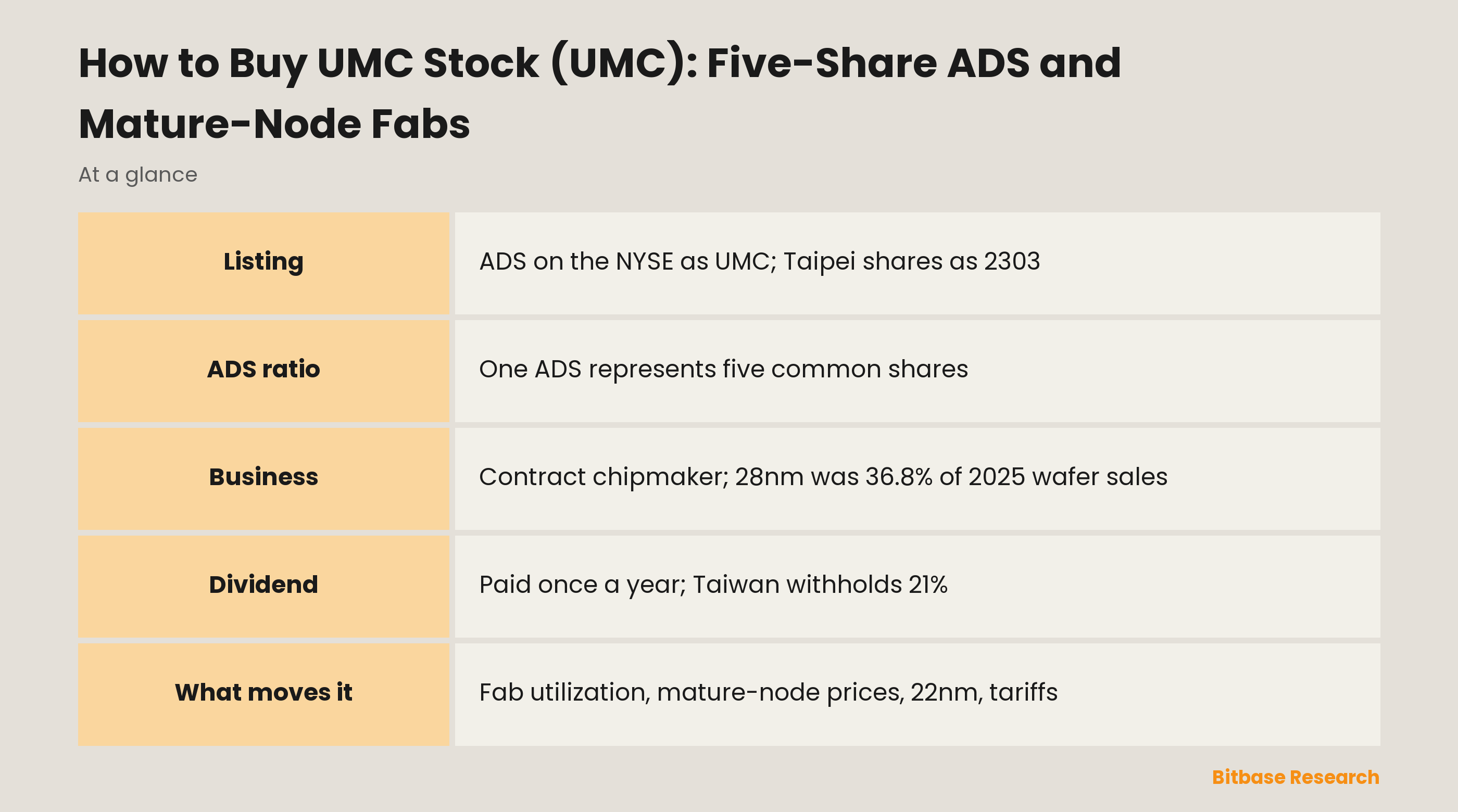
As a Taiwanese chipmaker listed in New York, UMC is bought through any brokerage account with US market access: you order the American depositary share (ADS) under the ticker UMC on the New York Stock Exchange, and each ADS stands for five common shares listed in Taipei. The company makes chips that other companies design, and it earns most of that money on mature process nodes: in 2025, 28-nanometer wafers were its largest technology at 36.8% of wafer sales, while the line for 14nm and below rounded to zero.
What Does UMC Do?
United Microelectronics Corporation was incorporated in Taiwan in May 1980. Its common shares have traded on the Taiwan Stock Exchange (TWSE) under the code 2303 since July 1985, and its ADSs joined the NYSE on September 19, 2000. The annual report on Form 20-F calls it "one of the world's largest independent semiconductor foundries": it does not sell chips under its own brand, but manufactures them "to the design specifications of our many customers."
Customers come in two kinds. Fabless design companies, which create chips but own no factories, bought 80.9% of UMC's wafers in 2025; integrated device manufacturers, which run fabs of their own and outsource part of their output, took 19.1%. The 20-F names Texas Instruments and Intel among the second group and MediaTek, Realtek and Novatek among the first; our Texas Instruments stock guide describes one of those customers from the other side of the order.
The work happens in twelve fabs. Wavetek runs 6-inch wafers in Hsinchu; seven 8-inch fabs sit in the Hsinchu Science Park and, in one case, in Suzhou, China; and four 12-inch fabs operate in Tainan, Singapore, Xiamen and Mie, Japan. "All of our fabs operate 24 hours per day, seven days per week," the company says.
UMC began large-scale 28nm production in 2014, shipped its first 14nm FinFET wafers in March 2017 and put 22nm into volume production in 2021. Then it stopped chasing the most advanced nodes. The 20-F says it will "defer investment in premature equipment needed to claim the earliest advanced technology" and instead buy proven, cheaper tools once demand for a node "reaches sustainable volume levels."
So the company competes on specialty versions of mature nodes. Its catalogue includes embedded high-voltage processes for display driver chips, embedded memory for microcontrollers and cars, RF-SOI for radio components, BCD for power management and backside-illuminated image sensors. Newer lines sit in packaging and optics: it has shipped 2.5D silicon interposers for AI and cloud computing, and in December 2025 it licensed imec's iSiPP300 silicon photonics process for a 12-inch platform.
How UMC Makes Money
UMC prices wafers "on either a per die or a per wafer basis," weighing technology, order size, the customer relationship and how full its fabs are, and reviews prices every quarter. Wafer sales by process technology, as shares of each year's total:
| Process technology | 2023 | 2024 | 2025 |
|---|---|---|---|
| 28nm (including 22nm) | 30.7% | 33.7% | 36.8% |
| 40nm | 13.7% | 13.8% | 16.1% |
| 65nm | 19.2% | 16.0% | 17.0% |
| 90nm to 0.13 micron | 20.2% | 20.9% | 15.0% |
| 0.15 micron and larger | 16.2% | 15.6% | 15.1% |
| 14nm and under | 0.0% | 0.0% | 0.0% |
The table has no separate 22nm row: the 20-F says that 28nm and below contributed 36.8% of foundry revenue in 2025, the same figure as the 28nm line, so 22nm sits inside it. The two older groups sum the 20-F's finer rows. The shift is the clearest trend in the business: the most advanced line UMC sells in volume gained six points in two years, while 90nm to 0.13 micron lost more than a quarter of its share in 2025 alone.
By application, communication chips accounted for 41.4% of 2025 wafer sales, consumer electronics for 30.6%, computers for 11.6% and other uses for 16.4%. By the location of customer headquarters, Taiwan produced 38.6% of operating revenue, the United States 22.0%, China including Hong Kong 15.8%, Korea 10.7%, Europe 8.5% and Japan 4.4%.
In 2025, shipments rose from about 3.45 million to 3.87 million 12-inch equivalent wafers, roughly 12% more, yet operating revenue grew only 2.3%. The average selling price fell 5.4%, after a 5.0% fall in 2024, and the New Taiwan dollar strengthened 2.9% against the US dollar. Gross margin slipped to 29.0% from 32.6%, and operating margin to 18.5% from 22.2%.
Fixed costs make utilization decisive. Depreciation, license amortization, indirect labor, utilities and part of indirect materials were 70.8% of manufacturing costs in 2025, so every extra wafer spreads them thinner. Average utilization was 68.5% in 2023, 68.7% in 2024 and 75.2% in 2025. Research and development took 7.5% of revenue in 2025.
UMC Stock at a Glance
| Feature | UMC |
|---|---|
| Legal name | United Microelectronics Corporation, a Taiwanese company formed in May 1980 |
| New York line | ADSs traded on the NYSE as UMC since September 19, 2000 |
| Shares per ADS | Five common shares |
| Taipei line | TWSE code 2303, listed since July 1985 |
| Depositary bank | JPMorgan Chase Bank, N.A.; deposit agreement of October 21, 2009 |
| Headquarters | Hsinchu Science Park, Hsinchu, Taiwan |
| Industry | Semiconductor foundry (contract chip manufacturing) |
| Fiscal year | Calendar year, ending December 31 |
| Accounting | IFRS in the 20-F |
| Ownership | No controlling shareholder; the largest listed holders are Taiwanese dividend ETFs |
| Dividends | Annual; the board proposes, shareholders decide at the general meeting |
| SEC reports | Form 20-F yearly, Form 6-K in between; CIK 1033767 |
On the 20-F's list of holders above 2% on March 29, 2026, two Taiwanese high-dividend ETFs led at 5.17% and 4.31%; the company says no corporation, government or person controls it.
New York holds a small part of the share base. On March 31, 2026, the depositary's nominee held 748,914,080 common shares, about 6% of the 12,588,156,344 shares outstanding at the end of 2025, and 149,782,816 ADSs were listed on the NYSE. For the current price, volume and chart, open the UMC stock page on Bitbase.
How to Buy UMC Stock
For most readers outside Taiwan the ADS is the simpler route, priced in dollars and traded during New York hours.
1. Choose a broker with NYSE access. Check which legal entity holds your account and who regulates it, then complete its identity and tax forms.
2. Deposit dollars. If your money starts in another currency, the conversion rate is part of the cost, alongside commissions.
3. Search for UMC. Confirm that the result is the ADS of United Microelectronics Corporation on the NYSE.
4. Choose an order type. A market order takes whatever price is offered at that moment; a limit order caps your price and can be left unfilled.
5. Size the position in ADSs. To compare with Taipei, take five times the TWSE price and translate it into dollars. Fractional ADSs are offered by some brokers, not all.
Moving between the ADS and the Taipei share is restricted. Taiwanese law bars any deposit of common shares into the ADS program, by investors or by UMC itself, without specific approval from Taiwan's Financial Supervisory Commission, with a few narrow exceptions. As a result, the ADS price "may differ from the prevailing market price of the equivalent number of our common shares" in Taipei. Withdrawing is allowed, but a holder outside Taiwan must then appoint a local agent and a qualified custodian to sell on the TWSE.
Voting runs through the depositary. ADS holders cannot vote individually; the shares behind the ADSs are cast as one block, as instructed only if holders of at least 51% agree. Otherwise the chairman may vote all the shares behind the ADSs "at his sole discretion," a result the 20-F says may not serve you.
Taxes. For non-residents, Taiwan keeps 21% of each cash dividend drawn from retained earnings. Gains from selling ADSs are not treated as Taiwan-source income for those holders, and the 0.3% securities transaction tax on sales of common shares does not apply to sales of ADSs. For US investors, the company says it does not believe it was a passive foreign investment company for 2025.
Indirect exposure. Taiwanese or emerging-market funds may hold UMC; check each fund's published holdings.
What Moves UMC Stock
How full the fabs are. Utilization rose from 75.2% across 2025 to 92% in the third quarter of 2026, when shipments reached a record of more than 1.2 million 12-inch equivalent wafers and gross margin was 34.0%, against 29.0% for the whole of 2025. Third-quarter revenue rose 25.6% from a year earlier.
Wafer prices on mature nodes. Average selling prices fell in both 2024 and 2025. The 20-F warns that new foundries "are likely to initiate a trend of competitive pricing and create potential overcapacity in legacy technology," and that some companies, "including our largest competitors," plan to raise capacity spending significantly.
The 22nm ramp. In the third quarter of 2026, 22nm reached a record 18.3% of wafer sales and 22/28nm together about 35% of revenue. Chief executive Jason Wang tied the growth to customers taping out new products, "including display driver, automotive radar, and Wi-Fi ICs."
New capacity and new businesses. A greenfield fab next to Fab 12i in Singapore is designed for 30,000 wafers a month in its first phase, using 28nm and 22nm, with production expected to begin in the second half of 2026. On October 28, 2026, the board approved an additional capital budget that Wang said would "accelerate our expansion schedule," and he described a "dual track expansion plan in Singapore and Tainan." He added that some existing capacity is being converted for advanced packaging and silicon photonics.
Intel and the United States. In January 2024 UMC and Intel agreed to develop a 12nm FinFET process together; the contract runs to January 2034. Intel finished the technology transfer in 2025, qualification at its Arizona fab is expected to be completed in 2026, and production is expected to begin in 2027. Our Intel guide covers the partner. In December 2025 UMC also signed a memorandum of understanding with Polar Semiconductor to explore US-based 8-inch production.
Tariffs and export controls. The US set its tariff on imports from Taiwan at 20% in August 2025 and in April 2025 opened investigations that may lead to tariffs on imported chips. In January 2025, US export rules added due diligence requirements for foundries, which the 20-F says could raise compliance costs and "restrict the customers we may be able to serve."
Currency. More than half of revenue is in other currencies, mainly US dollars, while more than half of labor, materials and overhead costs are in New Taiwan dollars, so a stronger New Taiwan dollar squeezes margins.
Monthly sales. UMC files each month's revenue on Form 6-K; October 2026 sales were about 18% higher than a year earlier.
Cycles, Customers and Cross-Strait Tension at UMC
The chip cycle. "The semiconductor industry has historically been highly cyclical," and since most customers sit in that industry, their order swings move UMC's revenue. Demand is usually seasonally weakest in the first half of the year, when customers correct inventory.
Overcapacity. If supply outruns demand, UMC "may have to lower the prices we charge our customers" or run "significantly less than full capacity."
A few large customers. The single largest took 11.8% of 2025 revenue, customers "generally do not have long-term agreements with us to purchase wafers," and losing a big one "would result in significant declines in our operating revenues."
Taiwan and the PRC. Most of UMC's assets and operations are in Taiwan, and the 20-F warns that relations with the PRC could hurt "the market price and the liquidity of our securities." Its fabs in China add exposure to US-China tension.
Energy and supply. The 20-F says the closure of the Strait of Hormuz from March 2026 "could threaten the semiconductor industry overall by limiting the supplies of natural gas."
The ADS itself. Beyond the price gap and collective voting, the depositary will not offer rights to ADS holders unless they are registered under the US Securities Act or exempt, so a rights offering can dilute them.
Beyond the company, owning one stock means one company's problems are all yours. Dividends also hinge on profits: UMC may distribute them "if we have earnings," after reserves, and the per-share cash dividend paid in 2024 and in 2025 was lower than the year before.
How to Research UMC Yourself
Search EDGAR for CIK 1033767 to reach every UMC filing. The 20-F for 2025 was filed on April 30, 2026. Form 6-K carries monthly revenue, quarterly results and reports, board resolutions and annual meeting results, such as the May 27, 2026 vote that approved the 2025 earnings distribution.
Inside the 20-F, the most useful tables show wafer sales by process technology, application and customer type, revenue by customer region, capacity and output for each fab, and cash dividends per share by year.
One caution: the 20-F converts New Taiwan dollar figures at one year-end exchange rate for convenience, so compare growth rates in New Taiwan dollars before you compare them in US dollars. For a Taiwanese peer with an NYSE listing, also based in the Hsinchu Science Park, our TSMC guide is a useful comparison. Quotes for UMC sit on its Bitbase stock page above; for other listed names, browse all US stock pages on Bitbase.
UMC Stock FAQ
Can I buy UMC stock with crypto?
Not directly. Brokers sell the UMC ADS for US dollars, so any crypto must first be converted to cash and transferred in, and converting it may create a tax bill in your country.
How many UMC shares does one ADS represent?
Five. The underlying common shares are listed in Taipei as 2303. Because new deposits into the ADS program need approval, the ADS can trade at a different price from five Taipei shares.
Does UMC pay a dividend?
Yes, annually. The board proposes a distribution from the previous year's earnings and shareholders vote on it at the annual meeting; on May 27, 2026, they approved the distribution for 2025. Cash dividends per share were lower in 2024 and in 2025 than in the year before. Taiwan withholds 21% for holders outside Taiwan, and the depositary may deduct fees before paying ADS holders.
Who are UMC's biggest customers?
The 20-F names Texas Instruments and Intel among integrated device manufacturers, and MediaTek, Realtek and Novatek among fabless design companies. Together the ten largest accounted for 57.0% of 2025 operating revenue.
Does UMC make chips in the United States?
Not in its own fabs, which are in Taiwan, Singapore, China and Japan. US production is planned through partners: a 12nm process developed with Intel, expected to begin production at Intel's facilities in 2027, and an exploratory agreement with Polar Semiconductor on 8-inch wafers.
Conclusion
UMC's results depend less on reaching the next node than on keeping mature-node fabs full at prices that hold, and 2025 showed how a 5.4% price decline and a stronger currency can absorb most of a 12% rise in shipments. The ADS adds its own terms: five Taipei shares per unit, collective voting and a 21% Taiwanese tax on dividends. Before deciding, go through the newest 20-F tables on process mix and utilization, follow the monthly 6-K revenue reports, and decide how much one foundry, exposed to Taiwan and to the chip cycle, should weigh in your portfolio.
Related reading
Other Bitbase articles on this topic:
- How to Buy Astera Labs Stock (ALAB): Retimers, Switches and Perps
- How to Buy Coherent Stock (COHR): From II-VI to AI Optics
- How to Buy Microchip Stock (MCHP): MCUs, Analog and MCHPP
Disclaimer: This article is educational content from Bitbase Academy, provided for information only. It explains what a company or fund does and how the instruments referenced here differ from one another; it does not constitute investment, trading, tax, or financial advice, and it is neither a recommendation nor an endorsement of any security, token, or trading strategy. A tokenized stock is issued by a third party and is designed to give economic exposure to an underlying asset: it is not a share, it carries no shareholder rights, and it depends on the issuer's structure, eligibility rules, and redemption terms, which the issuer can change. Perpetual futures are leveraged derivatives that hold no underlying asset and can be liquidated, and trading hours, product availability, and eligibility differ by instrument and by jurisdiction and can change at any time. Written as of November 2026; verify everything yourself through company filings, the issuer's own documentation, and the product pages of the venue you trade on.
References
[1] UMC Form 20-F for 2025 (SEC EDGAR) www.sec.gov
[2] UMC Form 6-K: third-quarter 2026 results (October 28, 2026) www.sec.gov
[3] UMC Form 6-K: October 2026 revenue (November 5, 2026) www.sec.gov
[4] UMC Form 6-K: 2026 annual general meeting resolutions (May 27, 2026) www.sec.gov





