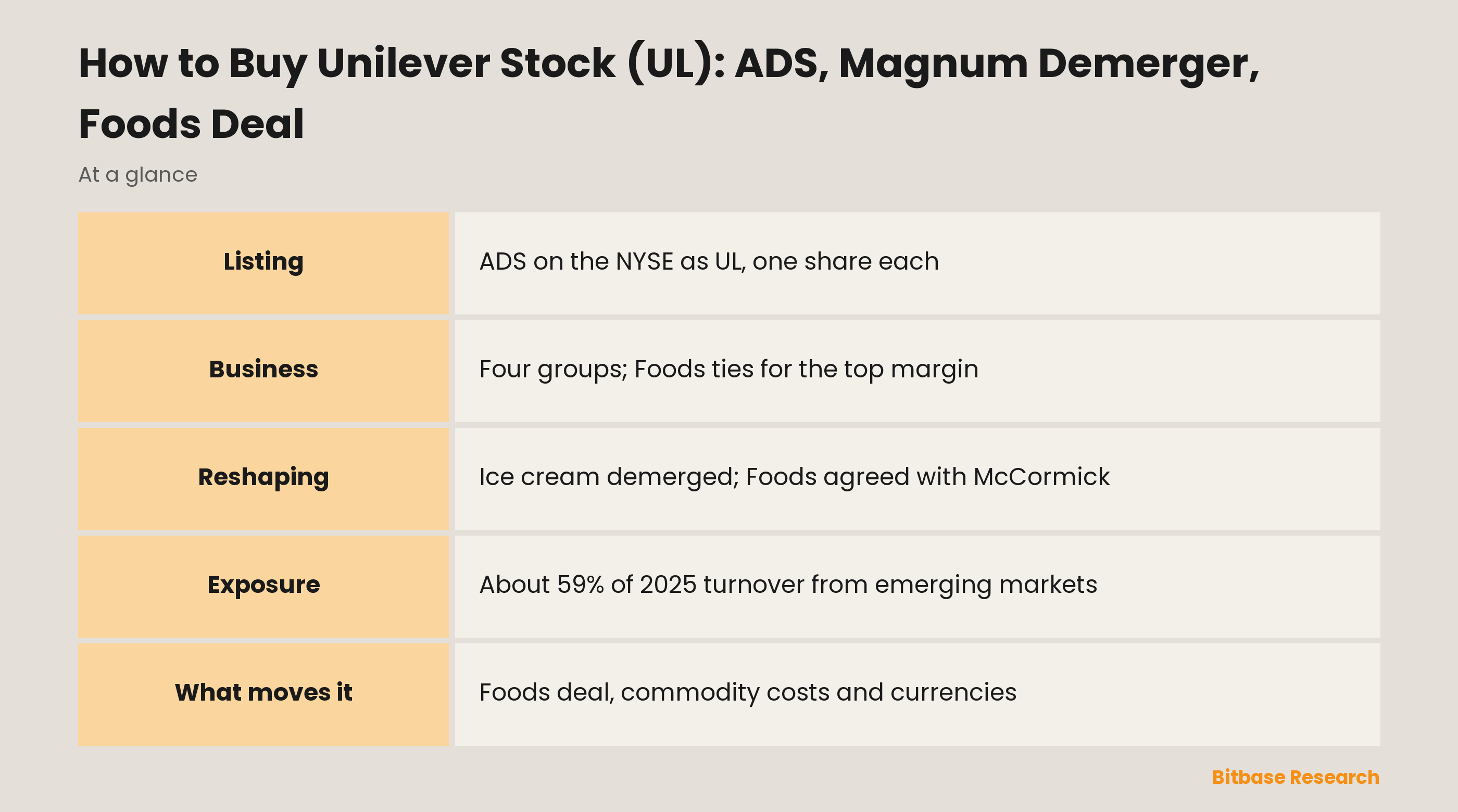
In New York, Unilever trades as UL, an American depositary share (ADS) that stands for exactly one ordinary share, so any broker that reaches the New York Stock Exchange can buy it; the same shares are also listed in London and Amsterdam. The company behind the ticker is being rebuilt: ice cream left as The Magnum Ice Cream Company in December 2025, and in March 2026 Unilever agreed to combine most of its Foods business with McCormick. Below: how the business earns its money, how to buy, what the ADS changes and what the filings flag.
What Does Unilever Do?
Unilever makes everyday consumer goods: shampoo and skin cream, deodorant and soap, laundry detergent and cleaners, mayonnaise and stock cubes. The company says its products are sold in 190 countries and used by 3.7 billion people every day. The parent, Unilever PLC, was incorporated in England and Wales in 1894 and is based in London.
For most of its history the group had two heads. From its formation in 1930 until 29 November 2020, it ran under two parent companies, the Dutch Unilever N.V. and the British Unilever PLC. The 2020 unification left PLC as the only parent: each NV share became one PLC ordinary share, still tradable on Euronext Amsterdam in euros.
The business has four Business Groups. Beauty & Wellbeing covers hair care, skin care, prestige beauty and wellbeing, with brands such as Dove, Vaseline, Sunsilk, TRESemmé, Dermalogica, K18, Nutrafol and Liquid I.V. Personal Care sells deodorants, skin cleansing and oral care under Dove, Rexona, Axe, Lux, Lifebuoy and Closeup. Home Care makes laundry and household cleaning products under Dirt Is Good, Surf, Comfort, Domestos and Cif. Foods spans condiments, cooking aids and Unilever Food Solutions, led by Hellmann's and Knorr.
Two separations are reshaping that list. Ice cream was demerged on 6 December 2025 as The Magnum Ice Cream Company (TMICC), incorporated and headquartered in the Netherlands. Holders received one TMICC share for every five Unilever shares or ADSs, and TMICC began trading in Amsterdam, London and New York on 8 December under the ticker MICC. Unilever kept a 19.85% stake, to be "sold down in an orderly and considered manner to pay demerger costs and maintain capital flexibility."
Foods is next. In March 2026 Unilever agreed to combine its Foods business with McCormick through a Reverse Morris Trust, a structure intended to be tax free in the US. Under the terms Unilever presented, its shareholders would own 55.1% of the combined company and Unilever itself 9.9%, alongside a cash payment to Unilever; Foods in India stays with Unilever. Closing is expected by mid-2027 and still needs McCormick shareholder approval and regulatory clearances; the October 2026 trading statement called the deal "on track." Unilever describes what would remain as a "pureplay HPC company", meaning home and personal care.
Unilever benchmarks its shareholder returns against a peer group that includes Procter & Gamble, Colgate-Palmolive, L'Oréal, Reckitt and Nestlé.
How Unilever Makes Money
Unilever reports in euros. On a continuing basis, without ice cream, 2025 turnover split almost evenly across the four groups, but profitability did not:
| Business Group | Share of 2025 turnover | Underlying sales growth 2025 | Underlying operating margin 2025 |
|---|---|---|---|
| Personal Care | 26.1% | 4.7% | 22.6% |
| Foods | 25.6% | 2.5% | 22.6% |
| Beauty & Wellbeing | 25.4% | 4.3% | 19.2% |
| Home Care | 22.9% | 2.6% | 14.9% |
| Group | — | 3.5% | 20.0% |
Shares are calculated from the 20-F's turnover by Business Group; underlying sales growth excludes currency, acquisitions and disposals.
Foods grew slowest but ties for the highest margin, so its move to McCormick changes the shape of what remains, not just its size. A handful of large brands carry the total: Power Brands such as Dove, Vaseline and Knorr made up 78% of 2025 turnover.
Asia Pacific Africa produced about 44% of 2025 turnover, the Americas about 37% and Europe about 19%, and emerging markets as a whole about 59%. The US is the largest single market at about 21%, followed by India at about 12%, while the UK, the home country, contributed about 4%. In India Unilever works through Hindustan Unilever, in which it holds 61.9%.
No single retailer or distributor dominates the customer list: the 20-F states that the group "does not receive 10% or more of its turnover from transactions with any single customer."
UL Stock at a Glance
| Item | Detail |
|---|---|
| Exchange | New York Stock Exchange (ADS); London Stock Exchange and Euronext Amsterdam (ordinary shares) |
| Ticker | UL in New York · ULVR in London · UNA in Amsterdam |
| Security | American depositary share, each representing one ordinary share |
| Depositary | Deutsche Bank Trust Company Americas |
| Sector | Consumer goods: beauty, personal care, home care and foods |
| Index membership | FTSE 100 constituent |
| Headquarters | London, United Kingdom |
| Incorporated | England and Wales, 1894 |
| Fiscal year | Calendar year, ending 31 December |
| Reporting | IFRS, in euros; annual report on Form 20-F, interim results on Form 6-K |
| Dividend policy | Quarterly interim dividends, declared in euros since 2025 |
| SEC identifier | CIK 217410 |
Quotes, market value and yield move all day, so they are not in this table; the Unilever stock page on Bitbase shows them live.
How to Buy Unilever Stock
For most investors outside the UK and the Netherlands, the ADS is the simplest route because it trades in US dollars on a US exchange:
1. Find a broker that offers NYSE stocks. To hold the ordinary shares instead, check whether it reaches London or Amsterdam.
2. Open and verify the account. Expect identity checks and tax forms for your dividends.
3. Fund it. If your money starts in another currency, compare the broker's exchange rate, not only its fees.
4. Find the right line. Search UL and confirm it reads Unilever PLC ADS on the NYSE. The 20-F cover also registers the ordinary shares as ULVR, but only "in connection with the registration of the American Depositary Shares", and EDGAR lists a separate over-the-counter symbol, UNLYF.
5. Set the order. In SEC investor guidance, a market order buys "at the best available price," though that price "is not guaranteed," while a limit order fills only "at a specific price or better."
6. Decide on size. FINRA notes that "the availability of fractional share trading varies by brokerage firm" and that "as a fractional share owner, you might not have shareholder voting rights."
London and Amsterdam open hours before New York, so mind the gap between sessions when reading a UL quote; a limit order sets the most you will pay.
ADS or ordinary share. In the SEC's words, an ADR "represents shares of non-U.S. companies that are held by a U.S. depositary bank," and ADRs "trade in U.S. dollars and clear through U.S. settlement systems." Here the ratio is one-for-one, so one UL equals one ULVR or UNA share in economic terms. The depositary may charge fees for issuing and cancelling ADSs and for handling cash distributions. Unilever estimates that about 42% of its ordinary shares, including those behind ADSs, were held in the United States in 2025.
Stamp duty. Buying ordinary shares usually carries UK stamp duty or stamp duty reserve tax of 0.5%, normally paid by the buyer; for existing ADSs the 20-F says "no UK stamp duty should in practice be payable."
Dividends and tax. Dividends are declared in euros, paid to ordinary shareholders in sterling and converted into US dollars for ADS holders. The UK takes nothing at source: "income tax is not withheld from dividends paid by most United Kingdom companies, including PLC." Your home country may still tax the income.
Through an index fund. As a FTSE 100 constituent, Unilever sits in any fund that fully replicates that index; check other funds' holdings lists before assuming.
What Moves UL Stock
The Foods separation. Hellmann's and Knorr are still Unilever's until the McCormick deal closes. A McCormick shareholder vote, regulatory approvals and works council consultations decide the timetable, and the terms would leave Unilever holders with a 55.1% interest in the food company. Foods was also the weakest group in the third quarter of 2026, with underlying sales growth of 0.1% as US condiments faced "increased competition."
Volume, price and commodity costs. Unilever calls volume growth from its Power Brands a key priority. In 2025 underlying sales grew 3.5%, made of 1.5% volume and 2.0% price. In the third quarter of 2026 growth reached 5.2%, with 2.9% from volume and 2.3% from price, the price part "in response to higher commodity costs." How much of a cost rise can be passed on without losing shoppers decides margins.
Emerging markets and currencies. With about 59% of turnover in emerging markets and results in euros, exchange rates bite. In 2025 currency-related items took 5.9% off turnover, so reported turnover fell 3.8% even though underlying sales grew.
The TMICC stake and portfolio deals. The 19.85% holding in the ice cream company is meant to be sold over time. Smaller deals shift the mix towards beauty and personal care: Dr. Squatch, Minimalist and Wild were bought in 2025 and the supplement maker Grüns in June 2026, while Graze and an Indonesian tea business were sold in 2026.
Capital returns. The third-quarter 2026 dividend was 3.0% higher than a year earlier, and a share buyback announced in February 2026 was completed in the first half.
Risks Unilever Flags for UL Holders
Of the 20-F's principal risks, these bear most directly on a UL holder:
Brands and channels. "Our success depends on the value and relevance of our brands and products to consumers around the world, and on our ability to innovate and remain competitive."
Portfolio choices. "Unilever's strategic investment choices will affect the long-term growth and profitability of our business." The 20-F, filed before the Foods deal was announced, marks this risk as increased.
Costs and supply. Product costs follow commodities and materials, and "fluctuations in these costs cannot always be passed on to the consumer through pricing."
Emerging-market exposure. "Unilever has more than half of its turnover in emerging markets, which exposes us to related economic and political volatility, such as foreign exchange or price controls."
Cyber security. "While we have been subject to cyber-attacks in the past, none have resulted in a material impact," the report says, rating the risk as rising.
Deal execution. The deal materials name "the risk that the proposed transaction may not be completed on the terms or in the time frame expected by the parties, or at all."
Above the business, owning one company ties your result to that company alone, however many brands it sells, and the ADS adds a currency layer: earnings in rupees, reais and euros reach you in dollars.
How to Research UL Yourself
Unilever files with the SEC under CIK 217410. Form 20-F is the annual report; the one for 2025 was filed on 12 March 2026. Form 6-K carries quarterly trading statements, half-year results, dividends and deal announcements, and the McCormick transaction also produces Rule 425 filings. Its full terms sit in a Form S-4 registration statement from McCormick and a Form 10 for the Unilever Foods entity.
In the 20-F, "Our principal risks" lists the risk headings, the segment note gives turnover by Business Group and by country, and the "Additional information for US listing purposes" section covers the ADS, its fees and taxation. Two checks help. Figures for 2024 and 2023 were re-presented without ice cream, so compare against the restated numbers, not older reports. And the December 2025 consolidation of eight new shares for every nine was meant to keep the share price and per-share figures comparable before and after the demerger, so check which basis a chart uses. Quotes for other listed companies are in the US stock list on Bitbase.
Unilever Stock FAQ
Is UL the same as Unilever shares in London and Amsterdam?
Economically, yes. Each UL ADS represents one Unilever PLC ordinary share, the same shares that trade as ULVR in London and UNA in Amsterdam. The ADS simply trades in US dollars during New York hours, pays dividends in dollars and may carry depositary fees.
Does Unilever pay a dividend?
Yes, quarterly. Dividends have been declared in euros since 1 January 2025, and the third-quarter 2026 dividend was 3.0% above the same quarter of 2025. The 6-K published with each set of results gives the amount and dates.
Can I buy Unilever stock with crypto?
Not directly. UL is a brokerage product priced and settled in US dollars, so the crypto has to be converted into fiat and transferred to the broker before any order goes in, and selling crypto can be a taxable event where you live. What you end up holding is a claim on Unilever's earnings, with dividends and votes, which the comparison of shares and crypto assets explains.
What happened to Unilever's ice cream business?
It became The Magnum Ice Cream Company, listed on 8 December 2025 under the ticker MICC. Holders received one TMICC share for every five Unilever shares or ADSs; Unilever then consolidated its own shares, eight new for every nine, keeping the ADS ratio at one-for-one.
Is Unilever selling Hellmann's and Knorr?
It has agreed to combine its Foods business, those brands included, with McCormick rather than sell it outright: Unilever shareholders would hold 55.1% of the combined company and Unilever 9.9%. Closing is expected by mid-2027, subject to approvals, and Foods in India stays with Unilever.
Is Unilever British or Dutch?
British. Unilever PLC is incorporated in England and Wales and has been the group's only parent since the 2020 unification ended the Anglo-Dutch dual structure. What remains Dutch is the Amsterdam listing, where the shares trade as UNA.
Conclusion
The mechanics are simple: a broker that offers NYSE stocks, the UL line rather than ULVR or UNLYF, and a market or limit order. The harder question is which Unilever you are buying: ice cream is gone, Foods is due to leave by mid-2027, and what stays leans on emerging markets and on pricing against commodity costs. Read the latest 20-F and 6-Ks, and the McCormick deal documents as they are filed, before deciding how much of a portfolio belongs in one consumer goods stock.
Related reading
Other Bitbase articles on this topic:
- How to Buy Monster Beverage Stock (MNST): Coca-Cola and the Split
- How to Buy Target Stock (TGT): Quarterly Dividends Since 1967
- How to Buy Anheuser-Busch InBev Stock (BUD): ADS, Brussels, Corona
Disclaimer: This article is educational content from Bitbase Academy, provided for information only. It explains what a company or fund does and how the instruments referenced here differ from one another; it does not constitute investment, trading, tax, or financial advice, and it is neither a recommendation nor an endorsement of any security, token, or trading strategy. A tokenized stock is issued by a third party and is designed to give economic exposure to an underlying asset: it is not a share, it carries no shareholder rights, and it depends on the issuer's structure, eligibility rules, and redemption terms, which the issuer can change. Perpetual futures are leveraged derivatives that hold no underlying asset and can be liquidated, and trading hours, product availability, and eligibility differ by instrument and by jurisdiction and can change at any time. Written as of October 2026; verify everything yourself through company filings, the issuer's own documentation, and the product pages of the venue you trade on.
References
[1] Unilever PLC Form 20-F for 2025: business groups, turnover, principal risks, ADS and taxation (SEC EDGAR) www.sec.gov
[2] Unilever PLC Form 20-F for 2025, XBRL cover page R1.htm (SEC EDGAR) www.sec.gov
[3] Unilever Form 20-F for 2020: the unification under Unilever PLC (SEC EDGAR) www.sec.gov
[4] Unilever shareholder circular on the ice cream demerger and share consolidation, 2 October 2025 (Form 6-K) www.sec.gov
[5] Unilever, completion of the ice cream demerger and TMICC listing, 8 December 2025 (Form 6-K) www.sec.gov
[6] Unilever, update on the share consolidation and the ADS ratio, 8 December 2025 (Form 6-K) www.sec.gov
[7] Unilever investor presentation on combining Unilever Foods with McCormick, 31 March 2026 (Rule 425 filing) www.sec.gov
[8] Unilever first-half 2026 results, 28 July 2026 (Form 6-K) www.sec.gov
[9] Unilever trading statement for the third quarter of 2026, 28 October 2026 (Form 6-K) www.sec.gov
[10] SEC Investor Bulletin: American Depositary Receipts www.sec.gov
[11] SEC Investor Bulletin: Trading Basics, market and limit orders www.sec.gov
[12] FINRA Investor Insights: Investing in Fractional Shares, 26 June 2025 www.finra.org
[13] SEC EDGAR company record for Unilever PLC (CIK 217410) data.sec.gov





