
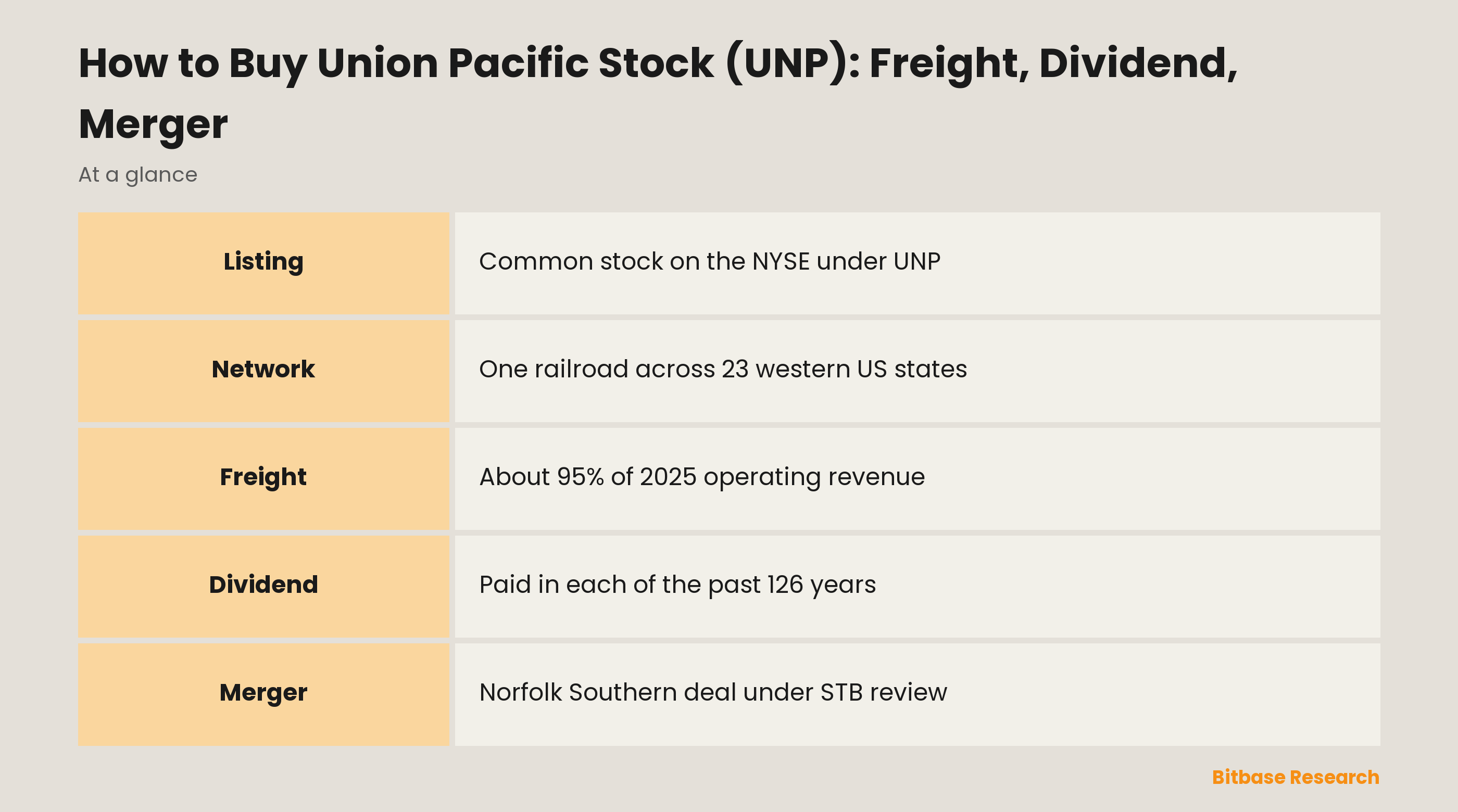
For a stake in Union Pacific, you need a brokerage account that can trade NYSE-listed shares, since the company's common stock is listed there under the ticker UNP. The share is a claim on one railroad, which runs through 23 western states and is, by the company's account, the only railroad serving all six major Mexico gateways. Union Pacific is also the buyer in a pending acquisition of Norfolk Southern that federal rail regulators are still reviewing. This guide walks through the revenue, the buying steps and the risks the filings highlight.
What Does Union Pacific Do?
Union Pacific Corporation is a holding company, and its principal operating company is Union Pacific Railroad. The corporation was incorporated in Utah in 1969 and is based in Omaha, Nebraska; the railroad dates its founding to 1 July 1862, the day President Lincoln signed the Pacific Railway Act.
It is a Class I railroad with 32,889 route miles across the western two-thirds of the US, linking Pacific Coast and Gulf Coast ports with the Midwest, eastern gateways, Canada's rail systems and the Mexican border. Because the network runs as one system, the 10-K reports a single operating segment and splits revenue into three commodity groups.
Bulk covers grain, fertilizer, food and refrigerated goods, and coal, with Wyoming's Powder River Basin its largest source. Industrial carries chemicals, plastics, forest products, metals, construction materials, petroleum and specialized products such as waste and salt. Premium means finished vehicles, auto parts and intermodal containers; the company calls itself the largest automotive carrier west of the Mississippi River.
Its main rail competitor is BNSF Railway, which runs parallel routes in many of the same corridors; trucks compete in all three groups, and barges for grain.
How Union Pacific Makes Money
Freight brought in about 95% of 2025 operating revenue; most of the rest came from logistics, commuter rail and accessorial charges. Bulk contributed 32.7% of freight revenue, Industrial 37.1% and Premium 30.3%. By business line:
| Business line | Group | Share of 2025 freight revenue | Change from 2024 |
|---|---|---|---|
| Intermodal | Premium | 19.9% | Down 2% |
| Grain and grain products | Bulk | 16.9% | Up 3% |
| Energy and specialized markets | Industrial | 11.2% | Down 3% |
| Industrial chemicals and plastics | Industrial | 10.8% | Up 7% |
| Automotive | Premium | 10.3% | Down 2% |
| Metals and minerals | Industrial | 9.4% | Up 5% |
| Coal and renewables | Bulk | 7.7% | Up 20% |
| Forest products | Industrial | 5.6% | Down 3% |
| Food and refrigerated | Bulk | 4.4% | Down 6% |
| Fertilizer | Bulk | 3.7% | Up 6% |
Shares are calculated from the 10-K's commodity revenue; the changes are its own figures.
Freight revenue depends on carloads and on average revenue per car, which moves with price, traffic mix and fuel surcharges. In 2025 it rose 2% on core pricing and 1% more volume, held back by mix: more coal and rock, which earn less per car, and less lumber, which earns more. Fuel surcharges generated about 10% of freight revenue, and shipments to and from Mexico about 12%, down 1% from 2024.
Efficiency shows up in the operating ratio, "operating expenses reflected as a percentage of operating revenues", where lower is better. The company's strategy aims for "an industry leading operating ratio"; the 2025 figure was 59.8%, a tenth of a point better than 2024.
UNP Stock at a Glance
| Feature | UNP |
|---|---|
| Listing venue | New York Stock Exchange (NYSE) |
| Ticker | UNP |
| Security | Common stock, the only security registered on the 10-K cover |
| Sector | Industrials, freight rail; held by State Street's Industrial Select Sector SPDR ETF (XLI) |
| Index membership | S&P 500 |
| Headquarters | Omaha, Nebraska |
| Incorporated | Utah, 1969 |
| Fiscal year | Calendar year, ending 31 December |
| Dividends | Paid quarterly in cash; the fiscal 2025 report counts 126 consecutive years of payments |
| Share buybacks | Paused since the Norfolk Southern agreement |
| Stock splits | Two-for-one in May 2008 and in June 2014 |
| SEC identifier | CIK 100885 |
Live price, market value and yield are on the UNP quote page on Bitbase.
How to Buy Union Pacific Stock
Union Pacific is a US company with its common stock on the NYSE, so no depositary receipt is involved. The steps:
1. Open an account with a broker that trades NYSE stocks. Investors abroad can use a local firm offering US shares or an international one, and should confirm which regulator supervises it.
2. Complete the identity and tax checks. Non-US residents usually submit IRS Form W-8BEN to establish foreign status, and the broker relies on it when applying a treaty rate to dividends.
3. Deposit money. Currency conversion costs money too, so compare spreads as well as commissions.
4. Search for the ticker. Enter UNP and check that the listing shows Union Pacific common stock on the NYSE; Norfolk Southern is a separate listing under NSC.
5. Set the order. According to FINRA, a market order "generally will execute at or near the current bid or ask prices," although "you might not get the price you saw"; a limit order fills only "at or better than a specified price."
6. Choose whole or fractional shares. Fractions let you put in a fixed sum, but FINRA notes that their availability "varies by brokerage firm" and that "as a fractional share owner, you might not have shareholder voting rights."
7. Place it and file the confirmation, which documents your cost basis.
Orders placed before the open or after the close carry extra risk: FINRA cautions that news can move the price sharply then, and session and after-hours prices need not match.
Investors outside the US face withholding on dividends. Per the IRS, "most types of U.S. source income received by a foreign person are subject to U.S. tax of 30%," and "a reduced rate, including exemption, may apply" where a tax treaty exists. Dividends may be taxed at home as well.
Index funds offer indirect exposure: Union Pacific is one holding among hundreds in S&P 500 trackers, and State Street's SPY and its industrials fund XLI both listed it on 16 October 2026. What an S&P 500 index fund actually holds explains the trade-off.
What Moves UNP Stock
The Norfolk Southern merger. On 28 July 2025 Union Pacific agreed to acquire Norfolk Southern, an eastern railroad listed on the NYSE as NSC. Each Norfolk Southern share would become one Union Pacific share plus cash, funded partly with new debt. The companies describe the result as "America's first transcontinental railroad that spans over 50,000 miles across 43 states." It needs approval from the Surface Transportation Board (STB); the steps so far:
| Date | Step |
|---|---|
| 28 July 2025 | Merger agreement signed |
| 14 November 2025 | Union Pacific shareholders approve the share issuance; Norfolk Southern shareholders approve the merger agreement |
| 19 December 2025 | Joint application filed with the STB |
| 16 January 2026 | The STB finds the application incomplete; the proceeding itself is not dismissed |
| 30 April 2026 | Revised application filed |
| 28 May 2026 | The STB accepts the revised application, pauses the proceeding and asks for more information |
| 18 August 2026 | The STB adopts a procedural schedule and lifts the pause |
| 18 September 2026 | The STB denies motions seeking summary denial, without ruling on the merits |
Union Pacific's latest quarterly report says completion is currently expected in 2027. The STB can approve, attach conditions or refuse, and either company may terminate the agreement if the deal is not done by 28 January 2028, a date that can extend automatically.
Commodities and trade. In 2025 higher natural gas prices pushed power generators toward coal, and coal and renewables freight revenue rose 20%. International intermodal followed trade policy: volumes rose 17% in the first half as imports surged on trade-policy uncertainty, then fell 24% in the second half, ending the year down 6%. Automotive shipments slipped 4%. The 10-K says import tariffs "adversely affected demand for our services" in 2025, and trade with Mexico, Canada and Southeast Asia, including the USMCA, is a named risk.
Fuel. Surcharges recover much of the diesel bill but trail fuel prices by about two months, which the company calls "a significant source of quarter-over-quarter and year-over-year volatility."
Regulation and labor. The STB also has jurisdiction over rates on some regulated traffic and is weighing rules such as reciprocal switching. Thirteen major rail unions represent about 83% of the workforce, and under the Railway Labor Act their agreements are open to modification every five years.
Risks to Weigh Before Buying UNP
The 10-K's risk factors now include a section on the acquisition. The most relevant to a UNP share:
Merger completion. "The mergers are subject to conditions, some or all of which may not be satisfied or completed on a timely basis, if at all." If the deal fails, the filing lists a possible fall in the share price and, in some circumstances, substantial termination fees.
Regulatory conditions. In granting approval, regulators "may impose conditions that could have a significant adverse effect" on either company or on the combined one.
Debt after closing. The 10-K warns that "the level of indebtedness could also reduce dividend payments, share repurchases, and other activities."
Hazardous materials. Common carrier obligations require the railroad to move certain hazardous materials "regardless of risk or potential exposure to loss."
Labor. "Strikes or work stoppages could adversely affect our operations."
Beyond the business, owning one stock ties your outcome to one company, a long dividend record is history rather than a promise, and non-dollar investors also carry currency risk.
How to Research UNP Yourself
Union Pacific's filings sit on EDGAR under CIK 100885: the 10-K each year, 10-Qs each quarter and 8-Ks for events such as earnings and the November 2025 vote. For the merger, the S-4 and the proxy statement of 1 October 2025 set out the terms, and the STB lists every decision and filing under docket FD 36873.
The 10-K's results section gives carloads and revenue per car for each business line; read together, they show whether a change came from volume or from price and mix. The shareholder return comparison names the yardsticks management chose: a peer group of CSX and Norfolk Southern, the Dow Jones Transportation index and the S&P 500. Quote pages for other US companies are on Bitbase's stock list.
Union Pacific Stock FAQ
Does Union Pacific pay a dividend?
It does, every quarter. The fiscal 2025 10-K says the company has paid dividends to common shareholders in each of the past 126 years, and the latest 10-Q shows the quarterly payments continuing in 2026. The board declares each payment.
Can I buy Union Pacific stock with crypto?
Not directly. A broker sells you UNP for US dollars, so any crypto would first have to be converted to cash, a sale that can trigger tax depending on your country. A share is a registered ownership stake with dividend and voting rights; how stocks and cryptocurrencies differ covers the rest.
Is Union Pacific merging with Norfolk Southern?
It has agreed to acquire Norfolk Southern, and the deal is not complete. Shareholders of both companies approved their parts in November 2025, and the STB accepted the revised application in May 2026. The company currently expects completion in 2027; until then, UNP and NSC remain separate stocks.
Is UNP in the S&P 500?
Yes. State Street's daily holdings file for SPY, which tracks the S&P 500, listed Union Pacific on 16 October 2026. Weights change daily.
Has Union Pacific stock ever split?
Yes. Company filings record two-for-one splits completed on 28 May 2008 and 6 June 2014. Older per-share figures need adjusting.
Conclusion
The purchase itself is routine: an NYSE-capable broker, the UNP ticker and a market or limit order. The harder question is what you are buying into: a western railroad whose revenue rides on containers, grain, chemicals, cars and coal, and which could join a coast-to-coast network if the STB clears the Norfolk Southern deal. Read the latest 10-K, 10-Q and STB docket before sizing a position in one railroad.
Related reading
Other Bitbase articles on this topic:
- How to Buy Grainger Stock (GWW): Dividend, Zoro and MonotaRO
- How to Buy Honeywell Stock (HON): Spin-Off and Reverse Split
- How to Buy Illinois Tool Works Stock (ITW): Seven Segments, 80/20
Disclaimer: This article is educational content from Bitbase Academy, provided for information only. It explains what a company or fund does and how the instruments referenced here differ from one another; it does not constitute investment, trading, tax, or financial advice, and it is neither a recommendation nor an endorsement of any security, token, or trading strategy. A tokenized stock is issued by a third party and is designed to give economic exposure to an underlying asset: it is not a share, it carries no shareholder rights, and it depends on the issuer's structure, eligibility rules, and redemption terms, which the issuer can change. Perpetual futures are leveraged derivatives that hold no underlying asset and can be liquidated, and trading hours, product availability, and eligibility differ by instrument and by jurisdiction and can change at any time. Written as of October 2026; verify everything yourself through company filings, the issuer's own documentation, and the product pages of the venue you trade on.
References
[1] Union Pacific Corporation Form 10-K, fiscal 2025: business, freight revenue by commodity, risk factors and pending acquisition (SEC EDGAR) www.sec.gov
[2] Union Pacific Corporation Form 10-Q for the quarter ended 30 June 2026: status of the Norfolk Southern acquisition and quarterly dividends (SEC EDGAR) www.sec.gov
[3] Union Pacific Corporation Form 8-K: results of the 14 November 2025 special meeting of shareholders (SEC EDGAR) www.sec.gov
[4] Surface Transportation Board, press release 26-13, 28 May 2026: revised UP-NS merger application accepted, proceeding held in abeyance www.stb.gov
[5] Surface Transportation Board, press release 26-21, 18 August 2026: procedural schedule adopted for the UP-NS merger, proceeding removed from abeyance www.stb.gov
[6] Surface Transportation Board, press release 26-23, 18 September 2026: motions seeking summary denial of the UP-NS application denied www.stb.gov
[7] Surface Transportation Board: UP-NS merger resources, docket FD 36873 (decisions and filings) www.stb.gov
[8] Union Pacific Corporation Form 10-Q for the second quarter of 2008: two-for-one stock split completed on 28 May 2008 (SEC EDGAR) www.sec.gov
[9] Union Pacific Corporation Form 10-K, fiscal 2014: two-for-one stock split completed on 6 June 2014 (SEC EDGAR) www.sec.gov
[10] Union Pacific: company history (founded 1 July 1862) www.up.com
[11] State Street SPDR S&P 500 ETF Trust (SPY): fund page and daily holdings www.ssga.com
[12] State Street Industrial Select Sector SPDR ETF (XLI): fund page and daily holdings www.ssga.com
[13] FINRA: Order Types www.finra.org
[14] FINRA: Investing in Fractional Shares www.finra.org
[15] IRS: NRA Withholding www.irs.gov
[16] IRS: About Form W-8 BEN www.irs.gov





