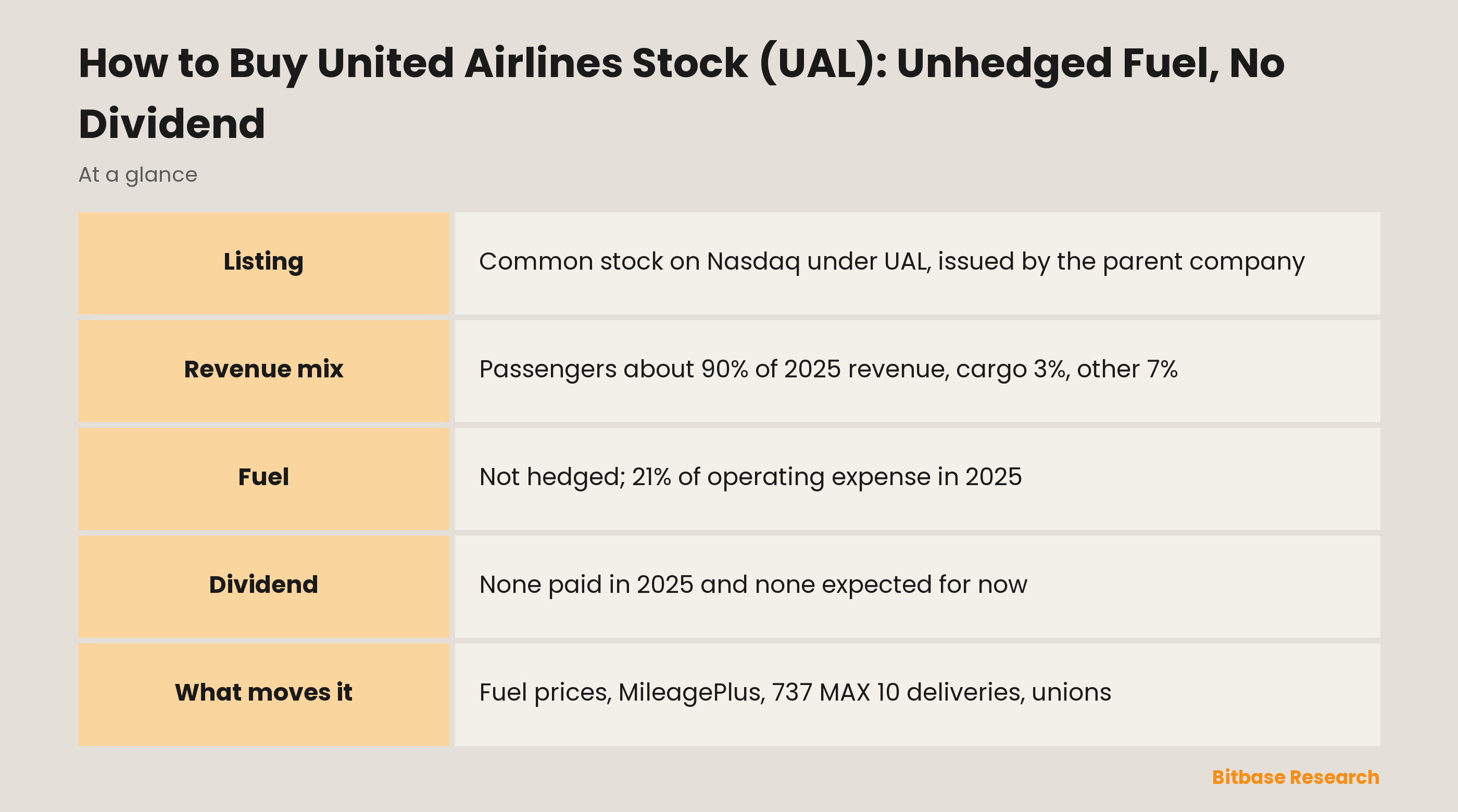
The holding company behind the carrier, United Airlines Holdings, Inc., lists its common stock on Nasdaq as UAL, so any broker that reaches the US market can take your order for United Airlines stock. Two facts from its filings shape what you are buying: United does not hedge the price of the jet fuel it burns, and it paid no cash dividend in 2025 and does not expect to pay one "in the foreseeable future." The sections below cover the business, the order, and the pressures its reports keep naming, from union contracts to late aircraft and a tax plan aimed at anyone building a 4.9% stake.
What Does United Airlines Do?
The company you buy is a holding company. United Airlines Holdings, Inc., a Delaware corporation with its head office at 233 South Wacker Drive in Chicago, owns all of United Airlines, Inc., the carrier itself, and the 10-K says the airline's operating revenues and expenses "comprise nearly 100%" of the parent's. The two companies file a single combined annual report, but only the parent's common stock is listed. EDGAR's record of former names shows the parent was called UAL Corp until 2010 and United Continental Holdings until 2019.
United carries passengers and cargo throughout North America and to Asia, Europe, Africa, the Pacific, the Middle East and Latin America. Its network runs through eight hubs: Chicago O'Hare, Denver, Houston George Bush Intercontinental, Los Angeles, Newark Liberty, San Francisco, Washington Dulles and A.B. Won Pat International on Guam. In 2025 it carried around 181 million passengers to more than 380 destinations on six continents, and it calls itself "the largest airline measured by available seat miles in the world."
At the end of 2025 the mainline fleet counted 1,066 aircraft with an average age of 15.3 years, ranging from Airbus A319s and A321neos to Boeing 737s, 777s and 787s. Another 424 regional jets flew as United Express under capacity purchase agreements with five operators: CommuteAir, GoJet, Mesa, Republic and SkyWest. Regional flying made up about 6.1% of total capacity in 2025.
Abroad, United relies on partners. It belongs to Star Alliance and takes part in four passenger joint business arrangements: a transatlantic one with Air Canada and the Lufthansa Group, a transpacific one with ANA, one with Air New Zealand and a transborder one with Air Canada.
The loyalty program, MileagePlus, lets members earn miles on flights and through non-airline partners such as card issuers, retailers, hotels and car rental firms. The biggest partner is JPMorgan Chase, which issues the MileagePlus credit card to US residents.
The growth plan is called United Next. Under it the company expects to take delivery of over 630 new narrowbody and widebody aircraft by the end of 2034, and it has been installing Starlink Wi-Fi, first on regional jets and then on mainline aircraft. J. Scott Kirby has been chief executive since May 2020, after almost four years as president.
How United Airlines Makes Money
Ticket sales dominate. Operating revenue grew 3.5% in 2025, and the 10-K reports it in three lines:
| Revenue line | What it includes | Share of 2025 operating revenue |
|---|---|---|
| Passenger | Fares, plus baggage, seat and other ancillary fees tied to travel | About 90% |
| Cargo | Freight and mail on passenger flights, charters and trucking | About 3% |
| Other operating | Miles sold to partners such as Chase, United Club memberships, third-party services | About 7% |
The shares are our own calculation from the 10-K's revenue table.
Inside the passenger line, ancillary fees for bags, premium seats, inflight amenities and similar extras came to about 9% in 2025. Miles feed that line too. When a member flies on an award ticket, the value set aside for those miles is recognized as passenger revenue on the day of travel. Members used about 10.9 million MileagePlus flight awards on United and United Express in 2025, and those trips made up about 10.3% of revenue passenger miles.
The 10-K calls the Chase agreement "United's most significant contract to sell MileagePlus miles." Chase buys the miles it awards to cardholders and pays for marketing access to United's customer list and brand. Other operating revenue grew 10.4% in 2025, which the company puts down mainly to more mileage revenue from non-airline partners, including card spending, and more United Club memberships.
The 10-K also breaks revenue down by region, based on where each flight segment starts and ends:
| Region | Share of 2025 operating revenue |
|---|---|
| Domestic (US and Canada) | 59% |
| Atlantic | 20% |
| Pacific | 12% |
| Latin America | 9% |
The Pacific has grown fastest, with revenue up about 31% between 2023 and 2025. In 2025 itself, capacity measured in available seat miles grew 6.1% while passenger revenue grew 3.1%, so each seat mile earned less; yield, the average passenger revenue per mile flown, slipped 1.9%.
Costs complete the picture. Salaries and related costs were the largest expense line at about 32% of operating expense in 2025, and fuel came next at 21%, down from 23% in 2024 and 26% in 2023.
UAL Stock at a Glance
| Item | UAL |
|---|---|
| Issuer | United Airlines Holdings, Inc., parent of United Airlines, Inc. |
| Exchange | Nasdaq Global Select Market |
| Ticker | UAL |
| Security | Common stock; preferred stock purchase rights under a tax plan are also registered on Nasdaq, with no ticker of their own |
| Business | Passenger airline, plus cargo and loyalty revenue |
| Index membership | S&P 500; also held by the Industrial Select Sector SPDR ETF (XLI) |
| Headquarters | Chicago, Illinois |
| Incorporated | Delaware |
| Fiscal year | Calendar year, ending 31 December |
| Dividend | None paid in 2025; none expected "in the foreseeable future" |
| Buyback | Program announced 15 October 2024, no stated expiration |
| SEC identifier | CIK 100517 (United Airlines, Inc. files as CIK 319687) |
Price, market value and volume change all day; the United Airlines stock page on Bitbase shows them live.
How to Buy United Airlines Stock
There is one listed security to look for. United Airlines, Inc. has 1,000 shares outstanding, all owned by the parent, so the way in is UAL common stock on Nasdaq. The parent is a US company, which means no depositary receipt sits between you and the shares.
1. Pick a broker that routes orders to Nasdaq. Check which legal entity holds your account and which regulator supervises it.
2. Open the account. Expect identity checks. Non-US individuals are usually asked for IRS Form W-8BEN; the IRS tells a foreign beneficial owner to give it "to the withholding agent or payer," which in practice means the broker.
3. Fund it. Outside the dollar, compare the broker's conversion rate as well as its commission.
4. Search for UAL. The match should read United Airlines Holdings, Inc. common stock on Nasdaq.
5. Choose how the order executes. FINRA warns that with a market order "you might not get the price you saw or were originally quoted, especially in fast-moving markets." A limit order caps what you pay, but "there's a chance your order doesn't get executed at all."
6. Mind the clock. Normal trading hours run from 9:30 a.m. to 4 p.m. Eastern Time, FINRA says, and for orders placed outside them "news events or other factors might significantly impact the price of the security when the market opens again."
7. Keep records. Trade confirmations document your cost basis; if you buy fractional shares, ask whether they can be moved to another broker.
Tax for non-US buyers. The IRS says "most types of U.S. source income received by a foreign person are subject to U.S. tax of 30%," and a tax treaty can lower the rate. With no UAL dividend, that withholding has little to apply to for now; how a gain is taxed depends on where you live.
The 4.9% line. United's tax benefits preservation plan protects its tax losses by discouraging big stakes: any non-exempt party that acquires 4.9% or more of the outstanding common stock "would suffer substantial dilution." The 10-K gives the plan's expiry as 4 December 2026. It explains the second line on the 10-K cover.
Through funds. State Street's daily holdings files dated 6 November 2026 list United Airlines Holdings inside SPY, the S&P 500 fund, and inside XLI, the industrials sector fund.
What Moves UAL Stock
Fuel, unhedged. "The Company's current strategy is to not enter into financial transactions to hedge the market price exposure of its expected fuel consumption," the 10-K says, and its purchase contracts are "generally indexed to various market price benchmarks." Those contracts "customarily do not provide material protection against changes in market prices." In the third quarter of 2026 the average price per gallon was 60% higher than a year earlier, fuel expense rose 62%, and fuel's share of operating expense climbed to 29% from 22%. The 10-Q ties the rise to conflicts in the Middle East and says United answered by "reducing capacity and adjusting fares and fees."
Fares keeping pace. In the same quarter total operating revenue rose 17% on capacity growth of only 1.3%, and the earnings release reported premium revenue up 17%, Basic Economy revenue up 16% and loyalty revenue up 17%. Pre-tax margin was 7.3% that quarter, so fares kept the airline profitable even as fuel jumped.
MileagePlus and Chase. Part of loyalty revenue comes from card spending rather than seats flown. The 10-K counts among the government actions it sees as most impactful "any legal requirement that would result in a reshaping of the benefits that we provide to our consumers through our loyalty program or the co-branded credit cards issued by our partner."
Aircraft deliveries. At the end of 2025 United had 167 Boeing 737 MAX 10s on firm order, and its fleet table expected none of them in 2026. The 10-K lists "delays in aircraft certification (especially relating to the 737 MAX 10 aircraft)" among its key government-related factors and says production delays at Boeing and Airbus have already forced it to rework its fleet plan. Our Boeing stock guide describes the manufacturer's side.
Union contracts. About 83% of employees are represented by unions. Flight attendants ratified a five-year agreement in May 2026, and the one-time ratification payment went out in September. The pilots' contract with the Air Line Pilots Association becomes amendable in October 2027. Under the Railway Labor Act such contracts do not expire but become "open for amendment," and strikes are unlawful until the Act's negotiation and mediation steps have run their course.
Hubs and government. In spring 2025, air traffic control staffing, technology outages and runway construction led to a concentrated number of delays and cancellations at Newark. During the federal government shutdown in late 2025, the FAA directed airlines to cut schedules at about 40 domestic airports. The latest 10-Q still flags rulings that "would require us to adjust our planned capacity at our hub locations."
Fuel, Debt and Strikes in United's Risk Factors
Of the risk factors in Item 1A, these bear most directly on a UAL holder:
Fuel supply, not only price. Fuel "has historically been the Company's most volatile operating expense," and United says it "can neither predict nor guarantee the continued timely or adequate availability of aircraft fuel throughout the Company's system."
Leverage. The company describes "a significant amount of financial leverage from fixed obligations," including aircraft leases and debt, and refers to its "non-investment grade credit ratings." Its debt agreements also limit, under certain circumstances, its ability to pay dividends or repurchase stock.
Labor. "United is a highly unionized company," and job actions "can cause significant harm to the Company's operations even if ultimately enjoined."
Loyalty competition. MileagePlus "faces significant and increasing direct competition" from other airlines' frequent flyer programs and from loyalty programs run by banks.
Litigation. Since July 2015, UAL and United have been defendants in consolidated class actions in Washington, D.C. alleging that US airlines colluded on capacity. The company says it is vigorously defending them.
The stock carries its own risks. The 10-K warns that "the price of our common stock may fluctuate significantly," naming fuel prices, other airlines' earnings and aircraft groundings among the triggers. Buybacks offer no floor: the program "does not obligate us to purchase any specific dollar amount," and the 10-Q shows no repurchases at all in the third quarter of 2026. And one airline is a concentrated position in a cyclical industry.
How to Research UAL Yourself
Search EDGAR for CIK 100517. The parent and the airline file joint reports, which ir.united.com also posts free of charge. Quarterly results arrive as 8-Ks with the earnings release attached; in 2026 they were filed on 20 January, 21 April, 15 July and 20 October.
In the 10-K, Item 1 holds the hubs, alliances, fuel table and the union table with each group's amendable date. Item 1A lists the risks. Item 2 holds the fleet and the firm-order table, with expected deliveries listed beside contractual ones. Item 5 covers dividend policy and recent buybacks, and the revenue note gives the regional split and the ancillary fee total.
Set the fuel price per gallon beside revenue per available seat mile, each against the same quarter a year earlier, to see whether fares are keeping up. When comparing United with a rival, check for structural differences: Delta owns an oil refinery, as our Delta Air Lines stock guide explains, while United generally buys fuel at prevailing market prices. Live quotes are on the stock page linked above, and Bitbase's list of US stock pages covers other listed companies.
United Airlines Stock FAQ
Can I buy United Airlines stock with crypto?
Not directly. UAL is bought through a brokerage account in US dollars, so crypto must first be sold for cash and the money sent to the broker, and that sale may be taxable where you live. What you hold afterwards is also a different kind of asset: a registered share with voting rights in a Delaware company, one of the ways stocks and crypto assets differ.
Does United Airlines pay a dividend?
No. The 10-K reports no cash dividend payments in 2025 and says the company does not expect to pay cash dividends "in the foreseeable future"; any change is up to the board. Cash has gone back to shareholders through buybacks instead, under the program announced in October 2024.
Is United Airlines, Inc. the same company as UAL?
Not quite. United Airlines, Inc. is the operating airline. United Airlines Holdings, Inc. owns all of it and is the company whose stock trades as UAL. The airline is a co-registrant on the same annual report but has no publicly traded shares.
Is UAL in the S&P 500?
Yes. State Street's SPY holdings file dated 6 November 2026 includes United Airlines Holdings, and the stock also appears in the industrials fund XLI. Its weight in each fund shifts daily.
Which airline alliance is United in?
Star Alliance, alongside Lufthansa, Air Canada, ANA, Singapore Airlines and others. With several of them United also runs joint business arrangements on transatlantic, transpacific and other routes.
Who runs United Airlines?
J. Scott Kirby, chief executive since May 2020. He became president of UAL and United in August 2016, after serving as president of American Airlines Group.
Conclusion
Owning UAL means owning an airline that leaves its fuel bill unhedged, tied to a loyalty business fed partly by card spending. Both showed in the third quarter of 2026, when fuel expense rose 62% and loyalty revenue 17%. Add an order book that waits on Boeing's 737 MAX 10, union contracts bargained under the Railway Labor Act and a stock with no dividend, and the questions before buying become specific: how much fuel volatility you can sit through, and how much of your portfolio one airline should take up. The latest 10-Q and earnings release are the place to start.
Related reading
Other Bitbase articles on this topic:
- How to Buy Honeywell Aerospace Stock (HONA): APUs and Avionics
- How to Buy Ingersoll Rand Stock (IR): Compressors and Spare Parts
- How to Buy L3Harris Stock (LHX): Rocket Motors, Radios, Satellites
Disclaimer: This article is educational content from Bitbase Academy, provided for information only. It explains what a company or fund does and how the instruments referenced here differ from one another; it does not constitute investment, trading, tax, or financial advice, and it is neither a recommendation nor an endorsement of any security, token, or trading strategy. A tokenized stock is issued by a third party and is designed to give economic exposure to an underlying asset: it is not a share, it carries no shareholder rights, and it depends on the issuer's structure, eligibility rules, and redemption terms, which the issuer can change. Perpetual futures are leveraged derivatives that hold no underlying asset and can be liquidated, and trading hours, product availability, and eligibility differ by instrument and by jurisdiction and can change at any time. Written as of November 2026; verify everything yourself through company filings, the issuer's own documentation, and the product pages of the venue you trade on.
References
[1] United Airlines Holdings Form 10-K for 2025 (SEC EDGAR) www.sec.gov
[2] United Airlines Holdings 2025 Form 10-K, XBRL cover page (SEC EDGAR) www.sec.gov
[3] United Airlines Holdings Form 10-Q for the third quarter of 2026 (SEC EDGAR) www.sec.gov
[4] United Airlines third-quarter 2026 earnings release, filed with Form 8-K (SEC EDGAR) www.sec.gov
[5] SEC EDGAR: United Airlines Holdings filings and former names www.sec.gov
[6] State Street SPDR S&P 500 ETF Trust (SPY): fund page and daily holdings www.ssga.com
[7] State Street Industrial Select Sector SPDR ETF (XLI): fund page and daily holdings www.ssga.com
[8] FINRA: Order Types www.finra.org
[9] IRS: NRA Withholding www.irs.gov
[10] IRS: About Form W-8 BEN www.irs.gov





