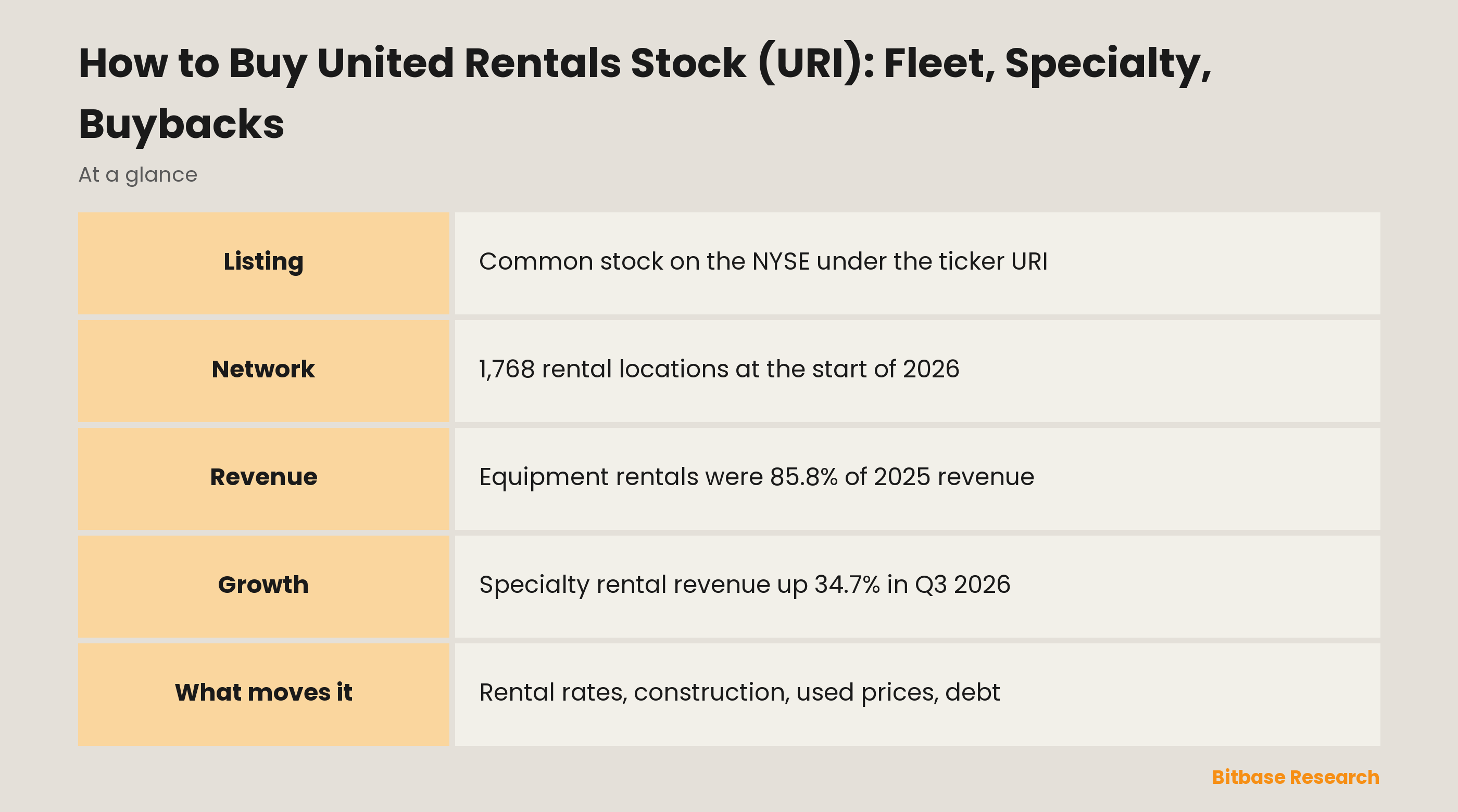
United Rentals is listed on the New York Stock Exchange under the ticker URI, so any brokerage account with access to US-listed shares can buy it. The Stamford, Connecticut company describes itself as the largest equipment rental company in the world; at the start of 2026 it ran 1,768 rental locations, most of them in the United States and Canada, renting out boom lifts and backhoes as well as trench shoring, generators and ground-protection mats. This guide explains where the revenue comes from, how to place the order, and why rental rates, construction activity, used-equipment prices and borrowing costs move the shares.
What Does United Rentals Do?
United Rentals owns a very large fleet of machines and tools and rents it out by the hour, day, week or month to contractors, manufacturers, utilities, municipalities and homeowners. The listed company, United Rentals, Inc., was incorporated in Delaware in 1997 and is "principally a holding company"; the operating business sits in its wholly owned subsidiary, United Rentals (North America), Inc. Its annual report calls the group "the largest equipment rental company in the world."
The network is concentrated in North America. Of the 1,768 rental locations it operated on 1 January 2026, 1,494 were in the United States, 169 in Canada, 41 in Europe and 64 in Australia and New Zealand. The North American branches cover 49 US states and every Canadian province, and branches in a region can draw on each other's equipment, so a machine idle in one yard can be rented out from another. By 30 September 2026 the count had reached 1,795 locations. At the end of 2025 the fleet held 1,095,000 equipment units with an average age of 49.5 months, and the company employed 28,500 people. Matthew Flannery is chief executive officer.
The business is reported in two segments:
General rentals is the core: backhoes, skid-steer loaders, forklifts and earthmoving equipment, aerial work platforms such as boom lifts and scissor lifts, and tools like pressure washers and water pumps. It is run as four geographic divisions, Central, Northeast, Southeast and West, across the United States and Canada.
Specialty rents equipment for particular jobs and usually sets it up: trench shields and aluminum hydraulic shoring, portable diesel generators and temperature control units, pumps and tanks for moving and treating fluids, mobile storage and modular offices, and surface protection mats. Its customers are mainly infrastructure contractors, municipalities and industrial companies, and it is the segment that also operates in Europe, Australia and New Zealand.
United Rentals also sells used machines from its own fleet, sells new equipment and contractor supplies, and repairs equipment that customers own. Key customers manage their rentals through Total Control, proprietary software that, in the 10-K's words, lets them "monitor and manage all their equipment needs."
How United Rentals Makes Money
Rent is almost everything. The 10-K splits fiscal 2025 revenue into five lines:
| Revenue line | What it covers | Share of 2025 revenue | Change from 2024 |
|---|---|---|---|
| Equipment rentals | Rental charges plus delivery, damage waiver, fuel and environmental fees | 85.8% | Up 6.0% |
| Sales of rental equipment | Used machines sold out of the fleet | 8.8% | Down 7.1% |
| Service and other revenues | Repairs and parts for customer-owned equipment | 2.3% | Up 3.1% |
| Sales of new equipment | New lifts, forklifts, compressors, generators | 2.2% | Up 23.4% |
| Contractor supplies sales | Consumables, tools, safety supplies | 1.0% | Up 5.2% |
Shares are calculated from the 10-K revenue table and rounded to one decimal; changes are as reported.
The fees on top of the rental charge add up: delivery, pick-up, damage protection, fuel and environmental charges made up about 18% of equipment rental revenue in 2025, with delivery and pick-up alone about 8%.
The two segments earn differently. General rentals produced 68.3% of 2025 revenue and specialty 31.7%, but specialty grew faster and kept more of each rental dollar: its equipment rental revenue rose 13.6% against 2.5% for general rentals, and its equipment rentals gross margin was 43.6% against 35.2%.
By equipment type, general construction and industrial machines brought in 39% of 2025 equipment rental revenue and aerial work platforms 22%, followed by power and HVAC at 11% and general tools at 9%. Surface protection mats rose to 4% from 2% the year before.
The customer base is broad. Industrial and other non-construction work accounted for about 48% of 2025 rental revenue, commercial construction for about 48% and residential building for about 4%. The largest single customer was about 1% of total revenue and the ten largest about 5%, while key accounts, each handled by one point of contact, generated 69% of equipment rental revenue. Foreign subsidiaries, mostly in Canada, contributed about 9% of revenue. Using American Rental Association industry estimates, the company puts its North American market share at about 15%.
URI Stock at a Glance
| Item | URI |
|---|---|
| Exchange | New York Stock Exchange |
| Ticker | URI |
| Security | Common stock of United Rentals, Inc., the only security on the 10-K's list of exchange registrations |
| Operating subsidiary | United Rentals (North America), Inc., wholly owned, with no public market for its shares |
| Sector | Equipment rental |
| Index membership | S&P 500 |
| Headquarters | Stamford, Connecticut |
| Incorporated | Delaware, 1997 |
| Fiscal year | Calendar year, ending 31 December |
| Dividend policy | Quarterly cash dividend, first paid in February 2023 |
| Share repurchases | Program authorized in January 2026 with no set expiration date |
| SEC identifier | CIK 1067701 |
| CUSIP | 911363109 |
Quotes, market value and yield change through the trading day; follow them on the United Rentals stock page on Bitbase.
How to Buy United Rentals Stock
United Rentals is a US company with a single listing in New York, so there is no depositary receipt or second share class to choose between. The route runs through a broker:
1. Open an account that can trade NYSE stocks. Outside the United States that may be a local broker with a US market connection or an international firm; check which legal entity holds your shares and which regulator supervises it.
2. Complete the tax paperwork. Non-US individuals usually file IRS Form W-8BEN, which the IRS says to give "to the withholding agent or payer if you are a foreign person and you are the beneficial owner of an amount subject to withholding."
3. Move money in. URI trades in US dollars, so a currency conversion may come first; its spread is a cost alongside the commission.
4. Look up URI and check the name. The result should read United Rentals, Inc. common stock on the NYSE; bonds issued by the subsidiary are not shares.
5. Pick an order type. With a market order, FINRA notes, "you might not get the price you saw or were originally quoted, especially in fast-moving markets," while "a buy limit order can be executed only at or below the limit price." It also suggests you "ask your brokerage firm what types of orders you can place and what they cost."
6. Decide on whole or fractional shares. "The availability of fractional share trading varies by brokerage firm," says FINRA, and "you often can't trade fractional shares outside of regular market hours."
7. File the confirmation. It records your purchase price; later statements show dividends and any tax withheld.
Pre-market and after-hours trades follow their own quotes, as this explainer on pre-market, after-hours and regular-session prices shows. FINRA's caution for orders placed outside normal hours is that "news events or other factors might significantly impact the price of the security when the market opens again."
For investors outside the United States, the IRS states that "most types of U.S. source income received by a foreign person are subject to U.S. tax of 30%," and that "the tax is generally withheld (NRA withholding) from the payment made to the foreign person." A tax treaty can lower the rate, which is what the W-8BEN claims, and the country where you live may levy its own tax on the same dividend.
Through an index fund, you can own URI indirectly. State Street's holdings file for the SPDR S&P 500 ETF Trust (SPY), dated 29 October 2026, includes United Rentals, so a fund tracking the S&P 500 holds it as one small position.
What Moves URI Stock
Construction and industrial activity. With rental revenue split almost evenly between industrial work and commercial construction, URI follows how much customers build and maintain. The risk factors name lower infrastructure spending, cuts by oil and gas producers and excess fleet in the rental industry among the conditions that can hurt revenue. When management raised its outlook in October 2026, Flannery said it "is supported by our customers' confidence, their backlogs, and the momentum we see across large projects."
Fleet productivity. This is the company's own measure of how hard the fleet works: "the combined impact of changes in rental rates, time utilization, and mix" on owned equipment rental revenue. It rose 2.2% in 2025 after 4.1% in 2024, then 6.5% in the third quarter of 2026, when average fleet size at original cost grew 7.9% and equipment rental revenue jumped 17.8%.
The specialty push. Specialty rental revenue rose 34.7% year on year in the third quarter of 2026, against 8.8% for general rentals, and supplied 39.5% of equipment rental revenue, up from 34.5% a year earlier. Its rental gross margin widened to 47.6%. Yak, acquired in March 2024, sits in this segment.
Used-equipment prices. The company keeps its fleet young by selling machines into the second-hand market. In 2025 those sales fell 7.1% and their gross margin slipped to 44.9% from 46.7%, which the 10-K ties to "the normalization of the used equipment market, including pricing." In the third quarter of 2026 used sales rose 4.5%, and the fleet sold fetched 51.4% of its original cost.
Interest rates and debt. Renting is capital-heavy, and the fleet is partly financed with borrowing. The weighted average rate on variable-rate debt was 1.4% in 2021, 6.3% in 2024, 5.4% in 2025 and 4.8% in the first nine months of 2026. Net leverage was 1.8x at the end of September 2026, against 1.9x nine months earlier, and the 10-Q reports an S&P upgrade to BBB-/stable. On 29 October 2026 the operating subsidiary sold senior notes due in 2029, 2031 and 2036 and used part of the proceeds to repay its term loan.
Buybacks and dividends. One repurchase program was completed in the first quarter of 2026 and a new one began in March; the diluted share count in the third quarter was about 3.1% lower than a year earlier. Dividends paid per share rose about 10% in 2024 and again in 2025.
Seasons and deals. "Our business is seasonal, with demand for our rental equipment tending to be lower in the winter months," so compare each quarter with the same quarter a year earlier. Portfolio moves count too: the Ahern Rentals asset purchase in December 2022, Yak in 2024, an abandoned bid for H&E Equipment Services in 2025 and the sale of part of the scaffolding business in 2026.
Reasons a URI Share Can Lose Value
The 10-K groups its risk factors under six headings. These connect most directly to the stock:
Competition. "Our industry is highly competitive, and competitive pressures have in the past led, and could lead again in the future, to a decrease in our market share or in the prices that we can charge." Rivals range from local outfits with one or two branches to national companies and dealers that both sell and rent.
Debt. "Our significant indebtedness exposes us to various risks." Substantially all assets secure existing borrowing, and covenant restrictions "may cause us to suspend or cease share repurchases or the payment of dividends."
Resale values. "Our rental fleet is subject to residual value risk upon disposition and may not sell at the prices or in the quantities we expect."
Fuel and weather. Moving equipment between branches is part of the model, so "increases in fuel costs or reduced supplies of fuel have in the past harmed, and could in the future again harm, our business," and "severe weather events or other natural occurrences may materially adversely impact our operations and markets."
Acquisitions. The growth strategy "may be unsuccessful if we are unable to identify and complete future acquisitions and successfully integrate acquired businesses or assets."
The share carries its own risk. The company warns that its stock price "has fluctuated significantly," that buybacks "could increase the volatility," and that it "cannot make any guarantees with respect to payment of dividends." One stock ties your result to one company, and for anyone whose savings are held in another currency, the dollar exchange rate adds a second source of gains or losses.
Where to Dig Into URI's Numbers
The SEC's EDGAR database holds every United Rentals filing under CIK 1067701, and unitedrentals.com posts the same annual, quarterly and current reports free of charge. Each quarter's results come out in an 8-K; the 2026 dates were 28 January, 22 April, 22 July and 21 October.
In the 10-K, start with the table at the top of Item 1: fleet size and age, branch counts, customer concentration and the rental mix by equipment type in one place. Item 1A holds the risk factors, Item 2 lists rental locations state by state, and the MD&A splits the change in rental revenue into fleet growth, inflation, fleet productivity and ancillary fees. The latest 10-Q refers back to the 10-K risk factors rather than repeating them.
One quirk: the 10-K is filed jointly by United Rentals, Inc. and United Rentals (North America), Inc., and the senior notes are issued by the subsidiary. Only the parent's common stock trades, and at the start of 2026 it had just 58 holders of record, because most shares sit in brokers' "street names."
The 10-K names no equipment suppliers. For the manufacturers' side of the same market, Caterpillar counts rental among the buyers of its construction machines, and Deere builds construction and forestry equipment alongside farm machinery; see the Caterpillar stock guide and the Deere stock guide. For other companies, browse more US stock pages on Bitbase.
United Rentals Stock FAQ
Does United Rentals pay a dividend?
Yes, quarterly. The board approved the company's "first-ever quarterly dividend program in January 2023," with the first payment in February 2023, and on 21 October 2026 it declared a dividend payable on 25 November 2026. Future dividends are at the board's discretion; the latest 8-K gives the current amount.
Can I buy United Rentals stock with crypto?
Not directly. URI shares are bought through a brokerage account and settle in US dollars, so crypto would first have to be sold and the cash moved to the broker; that sale may itself be a taxable disposal where you live. A separate guide covers the general steps of buying stocks with crypto.
Is URI in the S&P 500?
Yes. State Street's SPY holdings file for 29 October 2026 lists United Rentals under CUSIP 911363109, and the company's results release names the S&P 500 among its index memberships.
What happened to the United Rentals deal for H&E Equipment Services?
It did not go through. United Rentals signed a merger agreement with H&E on 13 January 2025 and launched a cash tender offer on 28 January. On 19 February 2025 the companies agreed to terminate the agreement, United Rentals withdrew the offer, and H&E paid it a termination fee.
Is United Rentals (North America) a separate stock?
No. United Rentals (North America), Inc. is the operating subsidiary that issues the group's senior notes, and the 10-K states there is no market for its common stock because United Rentals, Inc. owns all of it. Investors buy the parent, URI.
Conclusion
Buying URI needs a broker with NYSE access and a check that the line reads United Rentals, Inc. common stock. The harder part is the business behind it: a fleet partly financed with debt, rented mostly to industrial and commercial builders, with a faster-growing specialty arm and a steady flow of used machines into the resale market. The 10-K's first table and the quarterly rental revenue bridge show how rates, fleet growth and resale prices are trending; go through both before settling how large a position in one equipment renter makes sense for you.
Related reading
Other Bitbase articles on this topic:
- How to Buy Grainger Stock (GWW): Dividend, Zoro and MonotaRO
- How to Buy Honeywell Stock (HON): Spin-Off and Reverse Split
- How to Buy Illinois Tool Works Stock (ITW): Seven Segments, 80/20
Disclaimer: This article is educational content from Bitbase Academy, provided for information only. It explains what a company or fund does and how the instruments referenced here differ from one another; it does not constitute investment, trading, tax, or financial advice, and it is neither a recommendation nor an endorsement of any security, token, or trading strategy. A tokenized stock is issued by a third party and is designed to give economic exposure to an underlying asset: it is not a share, it carries no shareholder rights, and it depends on the issuer's structure, eligibility rules, and redemption terms, which the issuer can change. Perpetual futures are leveraged derivatives that hold no underlying asset and can be liquidated, and trading hours, product availability, and eligibility differ by instrument and by jurisdiction and can change at any time. Written as of October 2026; verify everything yourself through company filings, the issuer's own documentation, and the product pages of the venue you trade on.
References
[1] United Rentals Form 10-K for 2025 (SEC EDGAR) www.sec.gov
[2] United Rentals Form 10-Q for the quarter ended 30 September 2026 (SEC EDGAR) www.sec.gov
[3] United Rentals third-quarter 2026 results release, filed with Form 8-K on 21 October 2026 (SEC EDGAR) www.sec.gov
[4] United Rentals Form 8-K of 19 February 2025 on the terminated H&E merger agreement (SEC EDGAR) www.sec.gov
[5] United Rentals Form 8-K of 29 October 2026 on the senior notes offering and term loan repayment (SEC EDGAR) www.sec.gov
[6] State Street: SPY daily holdings, 29 October 2026 www.ssga.com
[7] FINRA: Order Types www.finra.org
[8] FINRA: Investing in Fractional Shares www.finra.org
[9] IRS: NRA Withholding www.irs.gov
[10] IRS: About Form W-8 BEN www.irs.gov





