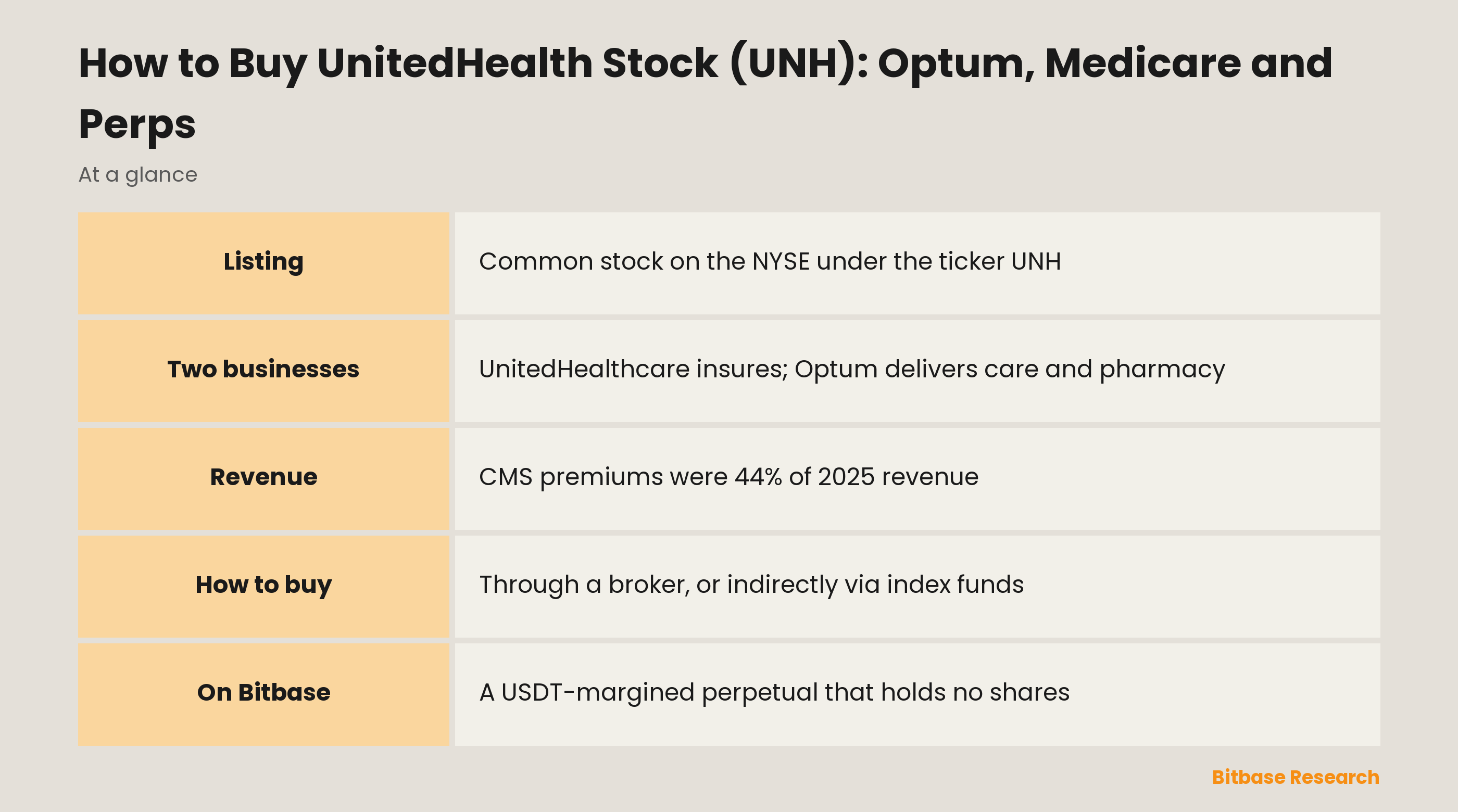
You buy UnitedHealth stock the way you buy any New York Stock Exchange share: through a brokerage account, under the ticker UNH. What the share holds is less ordinary: an insurer, UnitedHealthcare, joined to a services business, Optum, that sells much of its work back to that insurer, with premiums from CMS, the federal agency that runs Medicare, at 44% of 2025 revenue. Bitbase does not offer the shares themselves; its UNH product is a perpetual contract, margined in USDT, that follows the price and holds no stock.
What Does UnitedHealth Do?
UnitedHealth Group calls itself "a health care and well-being company" with "two distinct, yet complementary businesses." UnitedHealthcare pays for care; Optum delivers care, runs pharmacy services and sells data and technology across the health system. The annual report splits them into four segments: UnitedHealthcare, Optum Health, Optum Insight and Optum Rx.
UnitedHealthcare has three parts. Employer & Individual sells plans to employers and individuals; on risk-based plans it carries the medical cost for a monthly premium, while for self-funded employers it administers the plan and the employer keeps the risk. Medicare & Retirement sells Medicare Advantage, Part D drug plans and Medicare Supplement policies. Community & State serves Medicaid and other state programmes, in 32 states and the District of Columbia at the end of 2025.
Optum has three segments of its own. Optum Health delivers primary, specialty and surgical care in clinics, at home and online, and in "fully accountable value-based arrangements" it "assumes responsibility for health care costs in exchange for a monthly premium." Optum Insight sells data, analytics, technology and outsourced administration to hospitals, physicians, health plans, states and life sciences companies; its results still carry the effects of the February 2024 cyberattack on Change Healthcare. Optum Rx provides pharmacy care services, from pharmacy benefit management to home delivery and specialty pharmacy.
The company was incorporated in Minnesota in January 1977 as United HealthCare Corporation, moved its incorporation to Delaware in July 2015 and is based in Eden Prairie, Minnesota. On 1 January 2026, Optum Financial, including Optum Bank, moved from Optum Health to Optum Insight, with earlier periods recast. The 10-K names no rivals, describing competitors "ranging from startups to highly sophisticated Fortune 50 global enterprises."
How UnitedHealth Makes Money
Most of the money arrives as premiums. "Premium revenues from risk-based products constitute nearly 80% of our total consolidated revenues," the 10-K states. Premiums from CMS alone came to 44% of 2025 revenue, up from 40% in both 2024 and 2023, mostly earned by Medicare & Retirement. Products, almost all of them Optum Rx pharmacy sales, and service fees make up most of the rest.
| Business | What it sells | Share of 2025 revenue |
|---|---|---|
| UnitedHealthcare Medicare & Retirement | Medicare Advantage, Part D and Medicare Supplement plans | 38% |
| UnitedHealthcare Community & State | Medicaid and other state-run programmes | 21% |
| UnitedHealthcare Employer & Individual | Employer and individual plans, insured or self-funded | 18% |
| Optum, sales to outside customers | Care delivery, health technology and pharmacy services | 23% |
Shares are each line's 2025 revenue divided by consolidated revenue; Optum's investment income is the small remainder.
The table understates Optum: 62% of its 2025 revenue came from customers inside the group and disappears on consolidation. According to the 10-K, those internal sales are mainly Optum Rx pharmacy services for UnitedHealthcare customers, care from Optum Health and technology and consulting from Optum Insight, so much of Optum's business is tied to UnitedHealthcare's membership.
Profit is a thin margin on a very large flow of money. Consolidated revenue rose 12% in 2025, with UnitedHealthcare up 16% and Optum up 7%, yet earnings from operations fell 41%, and UnitedHealthcare's operating margin dropped to 2.7%, from 5.2%. The cause shows in the medical care ratio, medical costs divided by premium revenue: 89.1% in 2025, against 85.5% in 2024 and 83.2% in 2023. In the company's words, its 2025 "pricing trends and patient and member health status assumptions were well-short of the medical cost trends incurred." Optum Rx grew revenue by 16% and was the only Optum segment to raise operating earnings; Optum Health moved to an operating loss.
UNH Stock at a Glance
| Item | Detail |
|---|---|
| Exchange | New York Stock Exchange (NYSE) |
| Ticker | UNH |
| Share class | Common stock, the only security registered on the 10-K cover |
| Sector | Health care: health benefits (UnitedHealthcare) and health services (Optum) |
| Index membership | S&P 500 and Dow Jones Industrial Average, per SPY and DIA holdings on 16 October 2026 |
| Headquarters | Eden Prairie, Minnesota; a second executive office in Washington, DC |
| Incorporated | Minnesota in January 1977; Delaware since July 2015 |
| Fiscal year end | 31 December |
| Dividend policy | Quarterly since June 2010, annual before that; each payment at the board's discretion |
| Share buybacks | Programme adopted in November 1997, with no expiration date |
| Stock splits | Five 2-for-1 splits between 1992 and 2005 |
| SEC identifier | CIK 731766 |
Live prices are not in the filings; they are on the UnitedHealth stock page on Bitbase.
How to Buy UnitedHealth Stock
UNH is ordinary common stock of a US company, not a depositary receipt, so there is no conversion ratio to track. Through a broker:
1. Find a broker that offers NYSE stocks where you live. Confirm the firm is licensed in your country and which of its entities will hold your shares.
2. Complete the account checks. Non-US individuals are asked for IRS Form W-8BEN.
3. Move money in. A deposit in another currency is converted at the broker's rate, and that spread is part of your cost.
4. Confirm the security. The result for UNH should read UnitedHealth Group common stock on the NYSE.
5. Choose market or limit. A market order trades straight away at whatever price is available; a limit order names your maximum price and can go unfilled.
6. Check the calendar. Quarterly results arrive on Form 8-K a few weeks after each quarter ends; in 2026 they came on 27 January, 21 April, 16 July and 13 October.
Fractions of a share are sold by some brokers for a set cash amount, on terms each broker writes for itself.
Outside the United States, tax is the main difference. The IRS states that "Most types of U.S. source income received by a foreign person are subject to U.S. tax of 30%," and a tax treaty can lower the rate on dividends; Form W-8BEN is how you claim it. None of this is tax advice.
Index funds are a third route: as a member of the S&P 500 and the Dow, UnitedHealth sits in funds such as SPY and DIA as one position among many.
Trading UNH on Bitbase
Bitbase lists a UNH perpetual contract with USDT as both margin and settlement currency. It follows UnitedHealth's share price without being a share: no stock is held for you, no dividend reaches you and you have no vote. In exchange, you can go long or short with leverage on a contract that does not close when the NYSE does.
Two mechanics weigh more here than on a crypto perpetual. One is funding: the funding payment on a stock perpetual passes between longs and shorts at intervals to hold the contract near the share price, and it accumulates for as long as you hold. The other is the gap: the NYSE is shut overnight, at weekends and on holidays, so the contract can drift from the last share price and meet a different one when trading resumes.
Positions are liquidated on a mark price once margin runs out. How often funding settles, the margin tiers, the leverage cap and the reference price while the NYSE is shut are all in the contract's rules on Bitbase. Other US stocks and ETFs are listed in the TradFi section of Bitbase.
What Moves UNH Stock
Medicare Advantage rates. CMS sets each coming year's rates in an advance notice and then a final notice. UnitedHealth's filings say the notices "for numerous years have resulted in industry base rates well below the industry forward medical cost trend," and its mid-2026 quarterly report said the final notice for 2027 moved towards that trend but "remains below." Changes to the risk adjustment model, which scales payments to each member's health status, push the same way, and plans need four stars or higher for quality bonus payments.
Medical cost trend. On 13 May 2025 UnitedHealth suspended its 2025 outlook because care activity "continued to accelerate" and the costs of many Medicare Advantage members new to UnitedHealthcare "remained higher than expected"; the same release named Stephen Hemsley, chief executive from 2006 to 2017, as CEO again after Andrew Witty stepped down. Premiums and bids are set in advance, so costs above the assumptions reach earnings before they can be repriced.
Government investigations. In a July 2025 8-K, UnitedHealth said it had "begun complying with formal criminal and civil requests" from the Department of Justice about "certain aspects of the Company's participation in the Medicare program," and could not predict the outcome. A separate False Claims Act case over risk adjustment, which the DOJ joined in 2017, was still unresolved in mid-2026: a court-appointed Special Master recommended summary judgment for the company in March 2025, and the DOJ asked the court to reject that report a month later.
Membership and pricing. Medicare Advantage membership rose 8% in 2025, partly in markets where other plans had exited, and many of those members cost more than planned. After "benefit and pricing actions," the company expected that membership to contract in 2026, while Medicaid enrollment is falling with tighter eligibility and the exit from one state.
Optum's repair work. In late 2025 the company exited or put up for sale several businesses and reserved for losses it expects in 2026 at certain value-based care businesses in Optum Health. Optum Rx, the growing part, works in an industry where government agencies, the 10-K notes, "continue to conduct investigations and studies into certain PBM practices."
Risks UnitedHealth Flags in Its Filings
Pricing medical risk. "Relatively small differences between predicted and actual medical costs, or utilization rates as a percentage of revenues, have resulted and in the future may result in significant changes in our financial results." With nearly 80% of revenue from risk-based premiums, that covers most of the business.
Government programmes. Funding for Medicare Advantage, Part D and Medicaid can be cut or reallocated, and audits of risk adjustment coding by CMS and the HHS inspector general can lead to retrospective payment adjustments.
Legal actions and investigations. The company is "routinely subject to private party and governmental legal actions and investigations" and is "largely self-insured with regard to legal actions." In March 2026 it also received proposed IRS adjustments on intercompany transfer pricing for the 2017 to 2020 tax years, which it disputes.
Cyber and data. The Change Healthcare attack is still on the books: in late 2025 the group raised reserves against interest-free loans it had made to affected providers.
Holding-company structure. The parent depends on dividends from regulated subsidiaries that need state approval to pay out more than set amounts; in 2025 it put more capital into them than it took out, the reverse of 2024. Goodwill and other intangibles were 42% of total assets at the end of 2025, so an impairment would cut straight into equity.
The share and the perpetual. Holding a single stock ties your result to one company, and the 10-K's performance graph shows UNH's five-year total return to the end of 2025 trailing the S&P 500, the S&P 500 Health Care Index and the Dow. On the perpetual, leverage magnifies losses, funding accrues, and a gap at the NYSE open can carry a position past its liquidation price; read how a stock perpetual gets liquidated first.
How to Research UnitedHealth Yourself
UnitedHealth's SEC filings sit under CIK 731766. In the 10-K, Item 1 describes the segments, Item 1A the risks and Item 7 the medical care ratio and people served; Note 12 covers legal matters and government investigations, and Note 15 the segment figures, including Optum's sales to the rest of the group. 8-Ks carry quarterly results and other material events. Read the medical care ratio next to earnings, check the Medicare Advantage rates paragraph in each quarterly report, and remember that Optum figures from before 2026 are being recast. The investor site, unitedhealthgroup.com, carries the dividend history and split table.
UnitedHealth Stock FAQ
Does UnitedHealth pay a dividend?
It does, every quarter. The board set a dividend policy in August 1990 and paid annually at first, then moved to quarterly payments in 2010, the first on 21 June that year. It raised the quarterly dividend in June 2024, June 2025 and June 2026. Payments are at the board's discretion and "may be adjusted as business needs or market conditions change"; the current amount is in the latest 10-Q.
Can I buy UnitedHealth stock with crypto?
Not as shares. A broker sells UNH for US dollars, so any crypto must first be converted to cash and transferred, a sale that may itself be taxable. On Bitbase, USDT can trade the UNH perpetual, which tracks the price but is a derivative that pays no dividend, carries no vote and can be liquidated. The stablecoin routes are compared in how to buy US stocks with USDT.
Is UnitedHealth in the S&P 500 and the Dow?
It is in both. On 16 October 2026 the daily holdings files State Street publishes for SPY, which tracks the S&P 500, and DIA, which tracks the Dow Jones Industrial Average, each included UnitedHealth Group. Index committees can change membership, so check the file's date.
What is the difference between UnitedHealth Group, UnitedHealthcare and Optum?
UnitedHealth Group is the listed parent, and UNH is its common stock. UnitedHealthcare is its health-benefits business; Optum, made up of Optum Health, Optum Insight and Optum Rx, is the health-services business, and most of its revenue comes from within the group. Buying UNH gives you both.
Has UnitedHealth stock ever split?
Five times, each 2-for-1: September 1992, March 1994, December 2000, June 2003 and May 2005, according to the company's investor site. The 2005 split took effect on 27 May, per that year's 10-K, and is the last entry in the company's table.
Conclusion
Buying UNH takes a broker with NYSE access and a market or limit order; understanding it takes longer. The share is a claim on an insurer whose margin rests on the gap between premiums and medical costs, joined to a services business that earns most of its revenue from that insurer. Before sizing a position, check the medical care ratio, the yearly Medicare Advantage rate notice and the open Justice Department matters in each filing. The UNH perpetual on Bitbase is a different instrument altogether: a leveraged position on the price that owns no part of the company.
Related reading
Other Bitbase articles on this topic:
- How to Buy Edwards Lifesciences Stock (EW): TAVR, No Dividend
- How to Buy Elevance Health Stock (ELV): Anthem, BCBS, Carelon
- How to Buy HCA Healthcare Stock (HCA): Payers, Texas and Florida
Disclaimer: This article is educational content from Bitbase Academy, provided for information only. It explains what a company or fund does and how the instruments referenced here differ from one another; it does not constitute investment, trading, tax, or financial advice, and it is neither a recommendation nor an endorsement of any security, token, or trading strategy. A tokenized stock is issued by a third party and is designed to give economic exposure to an underlying asset: it is not a share, it carries no shareholder rights, and it depends on the issuer's structure, eligibility rules, and redemption terms, which the issuer can change. Perpetual futures are leveraged derivatives that hold no underlying asset and can be liquidated, and trading hours, product availability, and eligibility differ by instrument and by jurisdiction and can change at any time. Written as of October 2026; verify everything yourself through company filings, the issuer's own documentation, and the product pages of the venue you trade on.
References
[1] UnitedHealth Group fiscal 2025 Form 10-K (SEC EDGAR) www.sec.gov
[2] UnitedHealth Group Form 10-Q for the quarter ended 30 June 2026 (SEC EDGAR) www.sec.gov
[3] UnitedHealth Group Form 8-K, July 2025: Department of Justice requests (SEC EDGAR) www.sec.gov
[4] UnitedHealth Group press release, 13 May 2025: leadership transition and 2025 outlook (SEC EDGAR) www.sec.gov
[5] UnitedHealth Group Form 8-K, July 2015: reincorporation in Delaware (SEC EDGAR) www.sec.gov
[6] UnitedHealth Group fiscal 1999 Form 10-K: incorporation and former name (SEC EDGAR) www.sec.gov
[7] UnitedHealth Group investor relations: dividend history and stock splits www.unitedhealthgroup.com
[8] UnitedHealth Group Form 10-Q, second quarter 2010: move to quarterly dividends (SEC EDGAR) www.sec.gov
[9] UnitedHealth Group fiscal 2005 Form 10-K: 2005 stock split (SEC EDGAR) www.sec.gov
[10] State Street: SPY daily holdings, 16 October 2026 www.ssga.com
[11] State Street: DIA daily holdings, 16 October 2026 www.ssga.com
[12] IRS: NRA withholding www.irs.gov





