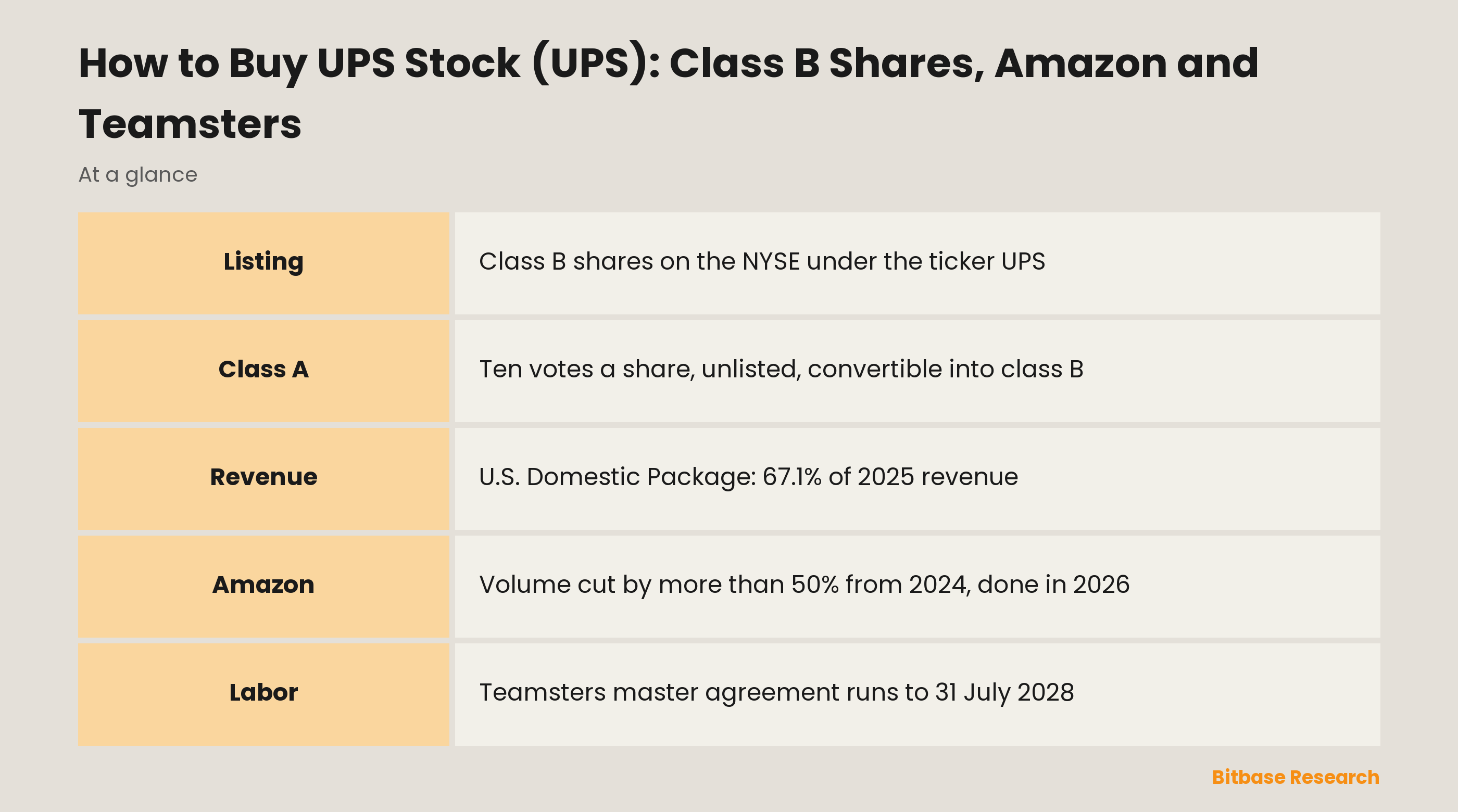
Inside a brokerage account that can trade on the New York Stock Exchange, buying UPS comes down to the ticker UPS, which belongs to the company's class B shares; the class A shares carry ten votes each, sit mainly with employees, retirees and the founders' descendants, and are not listed anywhere. The parcel network behind the ticker spent 2025 and the first half of 2026 shrinking on purpose, cutting deliveries for its largest customer, Amazon, by more than half from 2024 levels. This guide follows the revenue, the order and the risks UPS names in its own filings.
What Does UPS Do?
United Parcel Service, Inc. moves packages and freight for businesses and households. The company traces its founding to 1907, is incorporated in Delaware and has its headquarters in Atlanta, Georgia. Its 10-K calls it "a global package delivery and logistics provider" serving more than 200 countries and territories; in 2025 it delivered an average of 20.8 million packages a day.
Air and ground, domestic and international, business and residential parcels move through one pickup and delivery network unless a service commitment calls for something else. The principal air hub, Worldport, is in Louisville, Kentucky, and international air hubs sit in Germany, China, Hong Kong, Canada and Florida, the last serving Latin America and the Caribbean.
The 10-K reports two segments and a third group of businesses:
U.S. Domestic Package sells time-definite air services, from same-day to three-day, next to day-definite ground delivery that reaches substantially all business and residential zip codes in the contiguous US. Ground Saver, formerly SurePost, is the economy option for light, non-urgent residential parcels.
International Package runs small-package operations in Europe, the Middle East and Africa, in Canada and Latin America, and in Asia, with customs brokerage to clear cross-border shipments.
Supply Chain Solutions (SCS) gathers the operating segments that do not meet the criteria for separate reporting: air and ocean freight forwarding, contract logistics, the Roadie same-day platform, Happy Returns and UPS Capital's shipment insurance. The truckload brokerage Coyote was sold in September 2024, while healthcare logistics grew through the purchases of Frigo-Trans in January 2025 and Andlauer Healthcare Group in November 2025, toward a stated goal of becoming "the number one complex healthcare logistics provider in the world."
UPS had about 460,000 employees at the end of 2025, about 370,000 of them in the United States, and nearly 80% of its US employees are represented by unions, chiefly the International Brotherhood of Teamsters. Carol Tomé has been chief executive since 2020.
How UPS Makes Money
UPS earns most of its revenue one package at a time, and the 10-K explains each change through three levers: volume, rates and product mix, and fuel surcharges. Consolidated revenue fell 2.6% in 2025, and the operating margin slipped to 8.9% from 9.3%. By segment:
| Segment | What it sells | Share of 2025 revenue | Revenue vs 2024 | 2025 operating margin |
|---|---|---|---|---|
| U.S. Domestic Package | Next Day Air, deferred air, ground, air cargo | 67.1% | Down 1.4% | 6.6% |
| International Package | Parcels inside other countries, exports, cargo | 21.0% | Up 3.4% | 15.5% |
| Supply Chain Solutions | Forwarding, logistics, digital services | 11.9% | Down 17.0% | 10.1% |
Shares are calculated from segment revenue and rounded to one decimal; margins are GAAP figures from the 10-K.
Ground carries the domestic business, with 74.2% of U.S. Domestic Package revenue in 2025; UPS delivers about 15 million ground packages a day, most within one to three business days. The segment handled 8.6% fewer packages per day than in 2024, yet revenue per piece rose 7.1%, which the 10-K credits to an average 5.9% net increase in base and accessorial rates from December 2024 and a better customer and product mix. Business-to-consumer volume fell 12.5%, far more than business-to-business volume, and small and medium-sized businesses grew to more than 30% of total US volume. A fuel surcharge, reset weekly from US Department of Energy prices for jet fuel and diesel, sits on top of the rates.
International revenue leans on exports, which made up 77.9% of the segment in 2025. Tariffs and de minimis exclusions shifted volume between trade lanes that year, cut the China-to-US lane in particular and pulled the segment's margin down from 17.8% in 2024. SCS shrank mainly because Coyote left: forwarding revenue fell 38.3%, and Mail Innovations lost volume to UPS's own revenue quality initiatives, while healthcare logistics grew.
About 76.1% of 2025 revenue was earned in the United States. UPS served 1.6 million shipping customers a day, but one stands out: Amazon and its affiliates accounted for 10.6% of consolidated revenue in 2025, down from 11.8% in both 2024 and 2023, substantially all of it in U.S. Domestic Package.
UPS Stock at a Glance
| Item | Detail |
|---|---|
| Exchange | New York Stock Exchange (NYSE) |
| Ticker | UPS |
| Security you buy | Class B common stock, one vote per share |
| Class A common stock | Ten votes per share, not listed, convertible into class B at any time |
| Other NYSE listings | Two series of senior notes, symbols UPS28 and UPS32 |
| Public since | Initial public offering of class B shares, November 1999 |
| Sector | Transportation: package delivery and logistics |
| Index membership | S&P 500 |
| Headquarters | Atlanta, Georgia |
| Incorporated | Delaware; company founded 1907 |
| Fiscal year | Calendar year, ending 31 December |
| Dividend policy | Quarterly cash dividend declared by the board, same amount per share for both classes |
| SEC identifier | CIK 1090727 |
| CUSIP (class B) | 911312106 |
Anything quoted in dollars, from the UPS share price to its yield, moves with every trade; the UPS stock page on Bitbase shows the live figures.
How to Buy UPS Stock
UPS is incorporated in Delaware and listed in New York, so there is no depositary receipt to think about, and the share you can buy on the exchange is always class B. The proxy statement says class A shares are issued as incentive compensation and can only be held by current and former employees, directors and their spouses or children. At a broker, the purchase runs like this:
1. Open an account with a broker that offers NYSE stocks. Investors abroad can use a firm in their own country that routes orders to US exchanges or a broker operating internationally; find out which legal entity will hold your shares and which regulator supervises it.
2. Complete the identity checks. When the broker asks, a non-US individual submits IRS Form W-8BEN, which documents foreign status for withholding on US dividends.
3. Move money in. Funding in another currency adds a conversion cost, and the rate a broker applies can matter more than its commission.
4. Find the right line. Search for UPS and check that the result reads United Parcel Service class B common stock on the NYSE; UPS28 and UPS32 are bonds.
5. Choose an order type. In FINRA's words, a market order "provides the most certainty that your order will be executed," while "a buy limit order can be executed only at or below the limit price."
6. Set the size. Fractional shares, where offered, let you invest a round sum; FINRA cautions that "you can't transfer fractional shares to another brokerage firm" and that "you might not have shareholder voting rights" on them.
7. Keep the paperwork. Confirmations record your cost basis, and account statements list dividends received and withholding deducted.
Holding crypto rather than cash does not change the route, which still runs through dollars; the guide to buying stocks with crypto covers the conversion step.
Outside the United States, UPS dividends are US-source income. The IRS states that "most types of U.S. source income received by a foreign person are subject to U.S. tax of 30%," with a reduced rate possible under a tax treaty; Form W-8BEN is how that rate is claimed. Tax at home may come on top.
Through an index fund, you can own UPS without choosing it. SPY, State Street's S&P 500 trust, publishes its holdings every day, and the file dated 29 October 2026 lists United Parcel Service class B among hundreds of positions.
What Moves UPS Stock
The Amazon glide-down and what replaces it. UPS chose to shrink its biggest account. The 10-K set a plan to cut Amazon volume by more than 50% from 2024 levels by June 2026, and the report for the quarter ended June 2026 said the reduction was done. A release furnished with an 8-K on 31 August 2026 added that UPS had "shifted its focus to accelerating profitable growth." In the first full quarter afterwards, the third quarter of 2026, consolidated revenue grew 6.7%, with all three reporting units growing; U.S. Domestic Package revenue rose 4.5% on a 6.1% gain in revenue per piece.
Closing buildings and cutting jobs. The Network Reconfiguration and Efficiency Reimagined initiatives are the cost side of that decision. In 2025 UPS reduced its operational workforce by about 48,000 positions, 15,000 of them seasonal, and closed daily operations at 93 buildings, 85 of them permanently. In the first half of 2026 it closed 45 more and ran the Driver Choice Program, a voluntary separation offer to every full-time US driver. Efficiency Reimagined is not expected to conclude until the fourth quarter of 2027, and its costs, which UPS excludes from non-GAAP figures, keep reported and adjusted results apart until then.
Ground Saver and the Postal Service. In January 2025 UPS took its economy residential product in-house, replacing SurePost with Ground Saver, and the 10-K says the higher pickup and delivery costs pressured results. In December 2025 it partly reversed course, agreeing that the US Postal Service would handle final-mile delivery for a portion of Ground Saver and Mail Innovations volume from 2026; the second-quarter 2026 report shows higher fees paid to USPS and fewer labor hours.
Trade policy on the international lanes. International Package earns the highest margin of the three units, so trade rules matter more than its revenue share suggests. In the third quarter of 2026 its revenue grew 7.1% as revenue per piece climbed 15.0%, with an operating margin of 14.9%.
Pricing, fuel and aircraft. UPS applied another average 5.9% rate increase in December 2025 and expected it to lift revenue per piece in 2026. Fuel is passed on through the weekly surcharge, yet the 10-K warns that high surcharges have pushed customers "from our higher-yielding products to lower-yielding products." UPS also retired its MD-11 freighters in the fourth quarter of 2025, and the second-quarter 2026 report cites higher spending on third-party aircraft and on charters after network disruptions linked to the Middle East conflict.
Healthcare inside SCS. SCS revenue rose 18.2% in the third quarter of 2026, mainly on forwarding and logistics, including healthcare, but a goodwill impairment for a reporting unit within SCS cut the group's operating margin to 3.1%.
Headwinds That Come With a UPS Share
The risk factors in the 10-K run to many pages. Five of them bear directly on a UPS shareholder:
Customers. Beyond the planned Amazon reduction, customers "could choose, and have in the past chosen, to divert all or a portion of their business with us to one of our competitors," and some significant contracts let either side terminate without cause on advance notice.
Labor. "Strikes, work stoppages or slowdowns by our employees could materially adversely affect us." The Teamsters national master agreement expires on 31 July 2028; the pilots' agreement became amendable on 1 September 2025, and one covering about 2,000 airline mechanics becomes amendable on 1 November 2026. The 10-K also records volume diverted during the 2023 Teamsters negotiations.
Competition. Rivals include postal services, express carriers and freight forwarders, but also "e-commerce companies and other retailers that continue to make significant investments in their own technology and logistics capabilities, some of whom are currently our customers."
Executing the network changes. If UPS cannot adjust its assets and control the related costs, "our profitability could be materially impacted," and losing "experienced and motivated employees" during the consolidation is named as a risk too.
Costs that are hard to cut. Fuel, trade policy, which the 10-K calls "unpredictable," and employee health and pension costs each get a risk factor, and changing plans have led, and may lead again, to "substantial impairments" of assets.
Owning one stock adds its own exposure. A single holding ties your money to one company's results, class B owners vote alongside class A shares with ten votes apiece, and each dividend is declared by the board and reaches non-dollar investors through an exchange rate. The 10-Q for the second quarter of 2026 reported no material change to the risk factors since the 10-K.
How to Research UPS Yourself
EDGAR holds every UPS filing under CIK 1090727, and investors.ups.com posts the same reports under "Investors - SEC Filings." Annual detail is in the 10-K, quarterly results in each 10-Q, and 8-Ks flag events as they happen, from earnings releases to the August 2026 leadership changes and the May 2026 shareowner vote; the proxy statement sets out the voting rules for each class.
Three habits help. Track average daily volume and revenue per piece by product, which together show whether UPS is trading volume for price. Read both columns of the non-GAAP reconciliations. And check the comparisons: 2025 had one operating day fewer than 2024, Coyote appears in 2024 but not 2025, and since the fourth quarter of 2024 US air cargo has been reported inside U.S. Domestic Package rather than SCS.
The 10-K's performance graph sets class B returns beside the S&P 500 Index and the Dow Jones Transportation Average. For a freight business that runs on rails, the Union Pacific stock guide follows the same format, and the full list of US stocks on Bitbase covers other companies.
UPS Stock FAQ
Does UPS pay a dividend?
Yes. UPS has historically paid a dividend every quarter, each one declared by the board, and class A and class B shares receive the same amount per share. The dividends declared in the first two quarters of 2026 matched those of the same quarters of 2025, and the 10-K said UPS did not expect further share repurchases in 2026. Each quarterly report gives the latest amount.
Can I buy UPS stock with crypto?
Not directly. UPS shares trade on the NYSE in US dollars through a brokerage account, so any crypto has to be sold and the cash sent to the broker first, and that sale may be taxable where you live. Keep the decisions apart: a class B share is a registered stake that carries a dividend and a vote, and that is how a share differs from a crypto asset at its root.
What is the difference between UPS class A and class B shares?
Votes and tradability. Class A shares carry 10 votes each, are held mainly by UPS employees and retirees and by trusts and descendants of the founders, and are not listed; class B shares carry one vote and trade on the NYSE as UPS. Each class A share converts into one class B share at any time, and about 18 million were converted in 2025. Dividends and earnings per share are the same for both. At the annual meeting on 7 May 2026, a shareowner proposal to cut class A voting power to one vote per share did not pass.
Is UPS in the S&P 500?
Yes. The SPY holdings file for 29 October 2026 includes United Parcel Service class B, identified by CUSIP 911312106. Index weights change daily.
What was the UPS Amazon glide-down?
UPS's name for its planned reduction of Amazon volume. The 10-K set the target at more than 50% below 2024 levels by June 2026, and UPS reported it complete in the second quarter of 2026. Amazon had accounted for 10.6% of 2025 revenue, substantially all in U.S. Domestic Package, so building closures and job cuts followed.
Conclusion
The mechanics are short: an NYSE-capable broker, the class B line marked UPS, then a market or limit order; class A shares are not open to outside investors. The harder question is what the share now represents: a smaller parcel network built for higher revenue per piece, whose results turn on Teamsters contracts, fuel and trade policy, and on whether healthcare and smaller customers fill the space Amazon left. The latest 10-K, 10-Q and earnings release are the place to test that before putting money into one delivery company.
Related reading
Other Bitbase articles on this topic:
- How to Buy Illinois Tool Works Stock (ITW): Seven Segments, 80/20
- How to Buy Johnson Controls Stock (JCI): Tyco, Irish Tax, Cooling
- How to Buy Keysight Stock (KEYS): Spirent, AI Networks, Buybacks
Disclaimer: This article is educational content from Bitbase Academy, provided for information only. It explains what a company or fund does and how the instruments referenced here differ from one another; it does not constitute investment, trading, tax, or financial advice, and it is neither a recommendation nor an endorsement of any security, token, or trading strategy. A tokenized stock is issued by a third party and is designed to give economic exposure to an underlying asset: it is not a share, it carries no shareholder rights, and it depends on the issuer's structure, eligibility rules, and redemption terms, which the issuer can change. Perpetual futures are leveraged derivatives that hold no underlying asset and can be liquidated, and trading hours, product availability, and eligibility differ by instrument and by jurisdiction and can change at any time. Written as of October 2026; verify everything yourself through company filings, the issuer's own documentation, and the product pages of the venue you trade on.
References
[1] United Parcel Service, Inc. Form 10-K, fiscal 2025 (SEC EDGAR) www.sec.gov
[2] UPS Form 10-Q for the quarter ended 30 June 2026 (SEC EDGAR) www.sec.gov
[3] UPS release on Form 8-K, 27 October 2026: third quarter 2026 results (SEC EDGAR) www.sec.gov
[4] UPS release on Form 8-K, 31 August 2026: leadership changes and operating model (SEC EDGAR) www.sec.gov
[5] UPS proxy statement for the 2026 annual meeting (SEC EDGAR) www.sec.gov
[6] UPS Form 8-K, May 2026: annual meeting vote results (SEC EDGAR) www.sec.gov
[7] UPS final prospectus, November 1999: initial public offering of class B shares (SEC EDGAR) www.sec.gov
[8] State Street SPDR S&P 500 ETF Trust (SPY): fund page and daily holdings www.ssga.com
[9] FINRA: Order Types www.finra.org
[10] FINRA: Investing in Fractional Shares www.finra.org
[11] IRS: NRA Withholding www.irs.gov
[12] IRS: About Form W-8 BEN www.irs.gov





