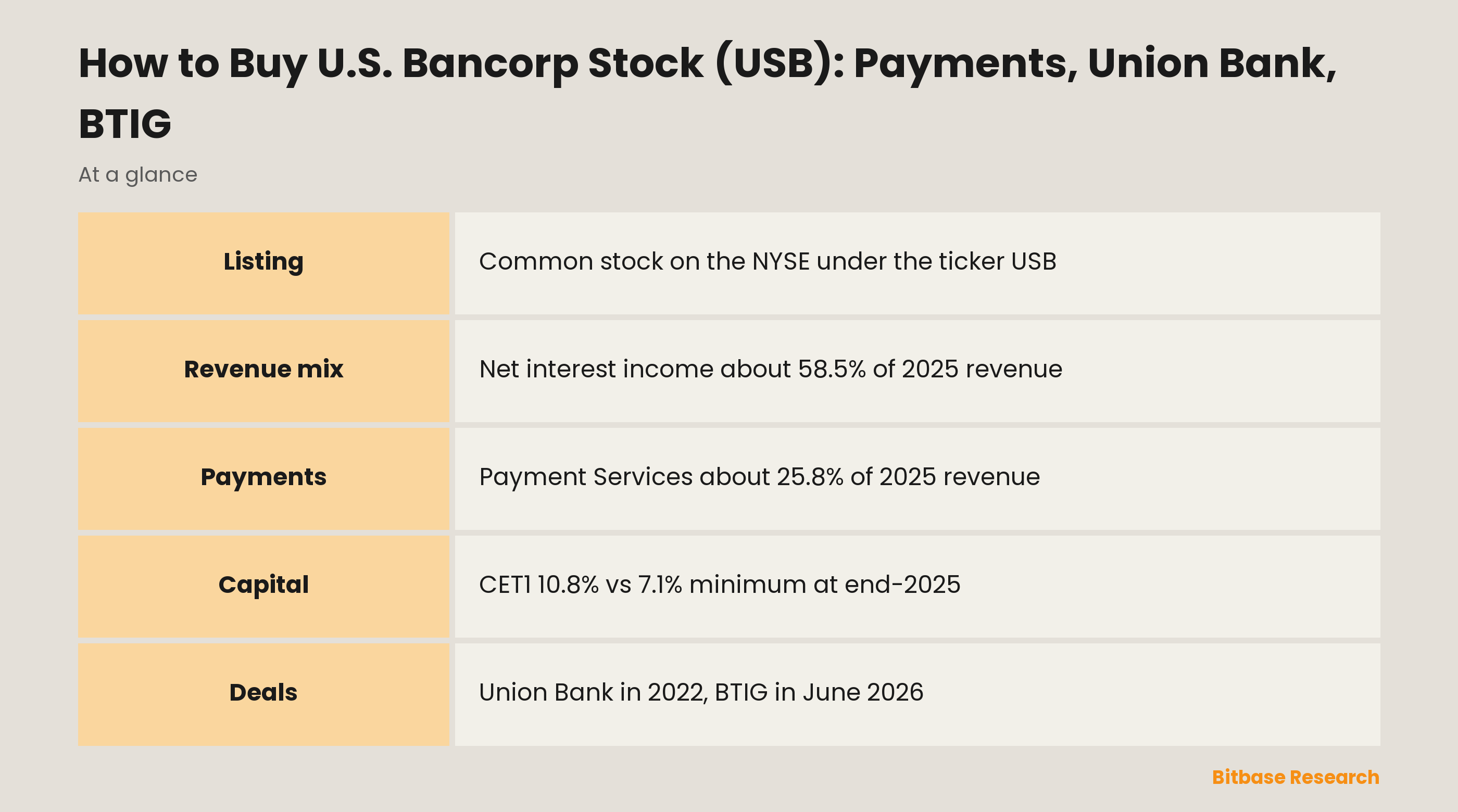
You buy into U.S. Bancorp the ordinary way: open a brokerage account that reaches the New York Stock Exchange and order the common stock under its NYSE ticker, USB. Behind the ticker is the parent of U.S. Bank, a Minneapolis lender that is also, by its own account, one of the largest providers of corporate and purchasing cards in the United States; its Payment Services segment brought in about 25.8% of 2025 total net revenue.
What Does U.S. Bancorp Do?
U.S. Bancorp is a financial services holding company headquartered in Minneapolis, registered as a bank holding company and treated as a financial holding company. Its banking subsidiary, U.S. Bank National Association, holds all of the group's deposits and at the end of 2025 ran 2,075 branches across 26 states, "primarily in the Midwest and West regions."
The registrant, which says it was incorporated in Delaware in 1929, appears on EDGAR as First Bank System until 1997. On 1 August 1997 First Bank System acquired U.S. Bancorp of Portland, Oregon, and took its name; in February 2001 Firstar Corporation completed its acquisition of that company, and "the new Company retained the U.S. Bancorp name." The ticker was USB then too.
The largest recent addition came on 1 December 2022, when U.S. Bancorp completed its purchase of MUFG Union Bank's core regional banking franchise from Mitsubishi UFJ Financial Group, bringing in customers across California, Washington and Oregon. On 1 June 2026 it added BTIG, "a global financial services firm specializing in institutional trading, investment banking, research and related brokerage services." Gunjan Kedia is chairman and chief executive.
How U.S. Bancorp Makes Money
Lending margins still pay most of the bills. In 2025, net interest income, measured on a taxable-equivalent basis, made up about 58.5% of total net revenue and noninterest income about 41.5%, against roughly 62.3% from interest two years earlier. After a 6.4% drop in 2024, net interest income recovered 2.2% in 2025, while noninterest income grew 7.6%.
| Segment | Main clients and products | Share of 2025 total net revenue | Change vs 2024 |
|---|---|---|---|
| Wealth, Corporate, Commercial and Institutional Banking | Affluent, corporate, commercial property, public-sector and institutional clients | 42.2% | Down 0.6% |
| Consumer and Business Banking | Consumers and small businesses, including loans through auto dealers | 31.0% | Down 3.9% |
| Payment Services | Consumer and corporate cards, merchant processing | 25.8% | Up 5.4% |
| Treasury and Corporate Support | Investment portfolio, funding, capital management | 1.0% | Not meaningful |
Shares are calculated from the segment table in the 2025 annual report.
Payment Services earns two ways. Card revenue, corporate payment products and merchant processing together supplied about 15.0% of total net revenue, and most of the rest of the segment's revenue was net interest income on its loans. Merchant processing, up 4.6%, serves merchants in the United States, Canada and parts of Europe.
The largest single fee line is trust and investment management, about 10.0% of total net revenue after a 7.9% rise. The 10-K counts the company among the largest providers of corporate trust services in the United States. Capital markets revenue rose 7.2%, and since mid-2026 BTIG has added to it.
USB Stock at a Glance
| Item | Detail |
|---|---|
| Exchange | New York Stock Exchange (NYSE) |
| Ticker | USB |
| Security | Common stock |
| Also on the NYSE | Six preferred depositary share series (USB PrA, PrH and PrP to PrS on the 10-K cover) and two note series (USB/28, USB/32) |
| Index membership | S&P 500 member; absent from the Dow (State Street holdings files, 29 October 2026) |
| Headquarters | Minneapolis, Minnesota |
| Incorporated | Delaware, 1929 |
| Regulatory status | Financial holding company; Category III under the federal tailoring rules |
| Fiscal year | Calendar year, closing 31 December |
| Dividend policy | Paid quarterly; raised about 3.8% in the third quarter of 2026 |
| Stock split | Three-for-one, paid 18 May 1998 |
| SEC identifier | CIK 36104 |
Price, market value and yield change with every trade; for those, open the U.S. Bancorp stock page on Bitbase.
How to Buy U.S. Bancorp Stock
Because U.S. Bancorp is incorporated in the United States and listed on the NYSE, the share you buy is the common stock itself, not a depositary receipt:
1. Choose a broker with NYSE access. Investors abroad can use a domestic broker with US market access or a global one; check which regulator supervises it.
2. Open and verify the account. Non-US individuals are asked for IRS Form W-8BEN, which a foreign person gives "to the withholding agent or payer."
3. Fund it. Converting into dollars has its own cost, so compare the exchange rate as well as the commission.
4. Search for USB and check the line. It should read U.S. Bancorp common stock on the NYSE. The preferred series carry USB-based symbols that brokers display differently (USB PrA on the 10-K cover, USB-PA on EDGAR), so read the security name.
5. Pick the order type. With a market order, FINRA warns, "you might not get the price you saw or were originally quoted, especially in fast-moving markets"; with a limit order, "there's a chance your order doesn't get executed at all." Regular hours run from 9:30 a.m. to 4 p.m. Eastern Time.
6. Decide on the size. "The availability of fractional share trading varies by brokerage firm," and "at the moment, you can't transfer fractional shares to another brokerage firm."
7. Keep the records of what you paid and each dividend received.
Tax for non-US holders. According to the IRS, "most types of U.S. source income received by a foreign person are subject to U.S. tax of 30%," and a treaty between the United States and your country of residence may cut it or exempt you. Your home country may also tax it.
Through a fund. State Street's holdings files for 29 October 2026 show U.S. Bancorp inside SPY, its S&P 500 trust, and XLF, its Financial Select Sector fund.
What Moves USB Stock
Rates and deposit costs. A risk factor heading says it plainly: "Changes in interest rates have in the past reduced, and could in the future reduce, the Company's net interest income." The net interest margin slipped to 2.70% in 2024 from 2.90% in 2023, and average noninterest-bearing deposits, on which the bank pays nothing, were about 25.3% lower in 2025 than in 2023. The margin edged up to 2.72% in 2025, helped by a better asset mix and by older fixed-rate loans and securities repricing, a mechanic the Wells Fargo stock guide also covers.
Capital, and the next size threshold. U.S. Bancorp closed 2025 with a common equity tier 1 (CET1) ratio of 10.8%; its minimum was 7.1%, including a 2.6% stress capital buffer that had been 3.1% a year earlier. In June 2026 the company said the buffer would stay at 2.6% until 1 October 2027, after the Federal Reserve kept current buffers in place; the ratio was still 10.8% at the end of September 2026. There is also a size question. As a Category III institution, U.S. Bancorp could be reclassified through growth, "including assets obtained in acquisitions," the 10-K warns, which would bring stricter capital rules. Year-end 2025 total assets were about 1.1% short of the trigger level, though the test uses a four-quarter average.
Payments. In 2025 Payment Services was the only one of the three business lines whose revenue grew. Card and merchant fees tie it to how much consumers and companies spend, and card loans tie it to credit: its provision for credit losses was larger than that of the other two combined.
Credit quality. Net charge-offs were 0.57% of average loans in 2025, 0.58% in 2024 and 0.51% in the third quarter of 2026. The risk factors warn that "a concentration of credit and market risk in the Company's loan portfolio could increase the potential for significant losses."
BTIG. In the third quarter of 2026 the company said BTIG "drove an increase of 69.3% year-over-year in capital markets revenue." Integration is the open question: the expected benefits, it cautions, "may take longer than anticipated to achieve or may not be achieved in entirety or at all."
Stablecoins. The GENIUS Act of July 2025 lets the subsidiary of an insured bank such as U.S. Bank issue payment stablecoins. The annual report sees both sides: customers "may view payment stablecoins as a substitute for traditional bank deposits," and if U.S. Bank cannot meet that demand with its own technology, it "could experience reduced deposit levels." The Bank of America stock guide raises the same question.
Where USB Shareholders Are Exposed
These risk factor headings bear most directly on the stock:
Capital rules. "The Company is subject to stringent requirements related to capital and liquidity that may limit the Company's ability to return earnings to shareholders or operate or invest in its business."
Funding. "Loss of customer deposits could increase the Company's funding costs." Among the causes it names: customers holding "cryptocurrencies, stablecoins or other digital assets" instead of deposits.
The holding company. "The Company relies on dividends from its subsidiaries for its liquidity needs, and the payment of those dividends is limited by laws and regulations."
Systems. A breach or "a critical technology failure could disrupt the Company's businesses."
Above these sit the risks of the share itself. A dividend record is not a promise: during the financial crisis U.S. Bancorp declared about 88% less per share in 2009 than in 2008, and in June 2009 it redeemed the preferred stock it had sold to the US Treasury. And exchange rates change what both price and dividend are worth in another currency.
How to Research USB Yourself
U.S. Bancorp's SEC filer number (CIK) is 36104, and EDGAR lists it as US BANCORP, without the periods and with a Delaware tag. The 10-K itself is brief: most of its content, risk factors and financial statements included, is incorporated from the Annual Report to Shareholders filed alongside it.
10-Qs update each quarter, and 8-Ks carry results, June stress test comments and deals. From 1 January 2026 the company regrouped several income statement and balance sheet lines; an 8 April 2026 filing gives reclassified quarterly history to compare 2026 figures against. For quotes, use the stock page above; for other companies, browse more US stock pages on Bitbase.
U.S. Bancorp Stock FAQ
Does U.S. Bancorp pay a dividend?
Yes, quarterly. In June 2026 the company announced a planned 3.8% increase, subject to board approval, and the third-quarter dividend reflected it. Each payment depends on the board and on capital requirements; 2009 showed it can also fall.
Can I buy U.S. Bancorp stock with crypto?
Not directly. USB trades on the NYSE in US dollars, so crypto has to be sold for cash and moved to a brokerage account first; depending on where you live, that sale may be taxable. A USB share gives you a piece of the company, with dividend and voting rights, which is what separates a stock from a crypto asset.
Is USB in the S&P 500?
Yes. State Street's daily holdings for SPY, its S&P 500 fund, included U.S. Bancorp on 29 October 2026, as did those for XLF; its Dow Jones Industrial Average fund, DIA, did not.
What did U.S. Bancorp buy from MUFG?
The core regional banking franchise of MUFG Union Bank, completed on 1 December 2022. Part of the price was paid in USB shares, leaving MUFG with about 2.9% of the shares outstanding at closing, and the excess capital Union Bank held then is due back to MUFG by 1 December 2027.
Has U.S. Bancorp stock ever split?
Yes. The 1998 annual report records a three-for-one split, carried out as a 200% stock dividend payable on 18 May 1998. In the 2001 merger, each share of the former U.S. Bancorp became 1.265 shares, so check how a data source adjusts old prices.
Conclusion
Placing the order is the easy part: any broker with NYSE access will do, as long as you pick the common stock rather than a preferred line. What the share holds takes more reading: a regional lender across the Midwest and West, a payments business whose revenue grew in 2025 while both banking segments' fell, and, since June 2026, a broker-dealer. Check each of them in the latest filings before sizing a position in one bank.
Related reading
Other Bitbase articles on this topic:
- How to Buy Lloyds Banking Group Stock (LYG): ADS, LLOY and Halifax
- How to Buy Mizuho Stock (MFG): Five ADSs Equal One Share
- How to Buy NatWest Stock (NWG): Two Shares per ADS, No State Stake
Disclaimer: This article is educational content from Bitbase Academy, provided for information only. It explains what a company or fund does and how the instruments referenced here differ from one another; it does not constitute investment, trading, tax, or financial advice, and it is neither a recommendation nor an endorsement of any security, token, or trading strategy. A tokenized stock is issued by a third party and is designed to give economic exposure to an underlying asset: it is not a share, it carries no shareholder rights, and it depends on the issuer's structure, eligibility rules, and redemption terms, which the issuer can change. Perpetual futures are leveraged derivatives that hold no underlying asset and can be liquidated, and trading hours, product availability, and eligibility differ by instrument and by jurisdiction and can change at any time. Written as of October 2026; verify everything yourself through company filings, the issuer's own documentation, and the product pages of the venue you trade on.
References
[1] U.S. Bancorp Form 10-K for 2025: business and regulation (SEC EDGAR) www.sec.gov
[2] U.S. Bancorp 2025 Annual Report, filed with the 10-K: segments, capital, risk factors www.sec.gov
[3] U.S. Bancorp Form 10-Q for the quarter ended 30 June 2026 (SEC EDGAR) www.sec.gov
[4] U.S. Bancorp press release, 24 June 2026: stress test results and capital plans (Form 8-K) www.sec.gov
[5] U.S. Bancorp third-quarter 2026 earnings release, 15 October 2026 (Form 8-K) www.sec.gov
[6] U.S. Bancorp Form 8-K, 8 April 2026: reclassified supplemental history www.sec.gov
[7] U.S. Bancorp Form 8-K, 1 December 2022: completion of the Union Bank acquisition www.sec.gov
[8] U.S. Bancorp press release, 1 December 2022: Union Bank acquisition completed www.sec.gov
[9] U.S. Bancorp annual report and Form 10-K for 1997 (SEC EDGAR) www.sec.gov
[10] U.S. Bancorp annual report and Form 10-K for 1998: three-for-one split www.sec.gov
[11] U.S. Bancorp annual report and Form 10-K for 2001: the Firstar merger www.sec.gov
[12] U.S. Bancorp 2009 Annual Report, filed with the 10-K: dividends and capital www.sec.gov
[13] State Street: SPDR S&P 500 ETF Trust (SPY), with XLF and DIA holdings as of 29 October 2026 www.ssga.com
[14] FINRA: Order Types www.finra.org
[15] FINRA: Investing in Fractional Shares www.finra.org
[16] IRS: NRA Withholding www.irs.gov
[17] IRS: About Form W-8 BEN www.irs.gov





