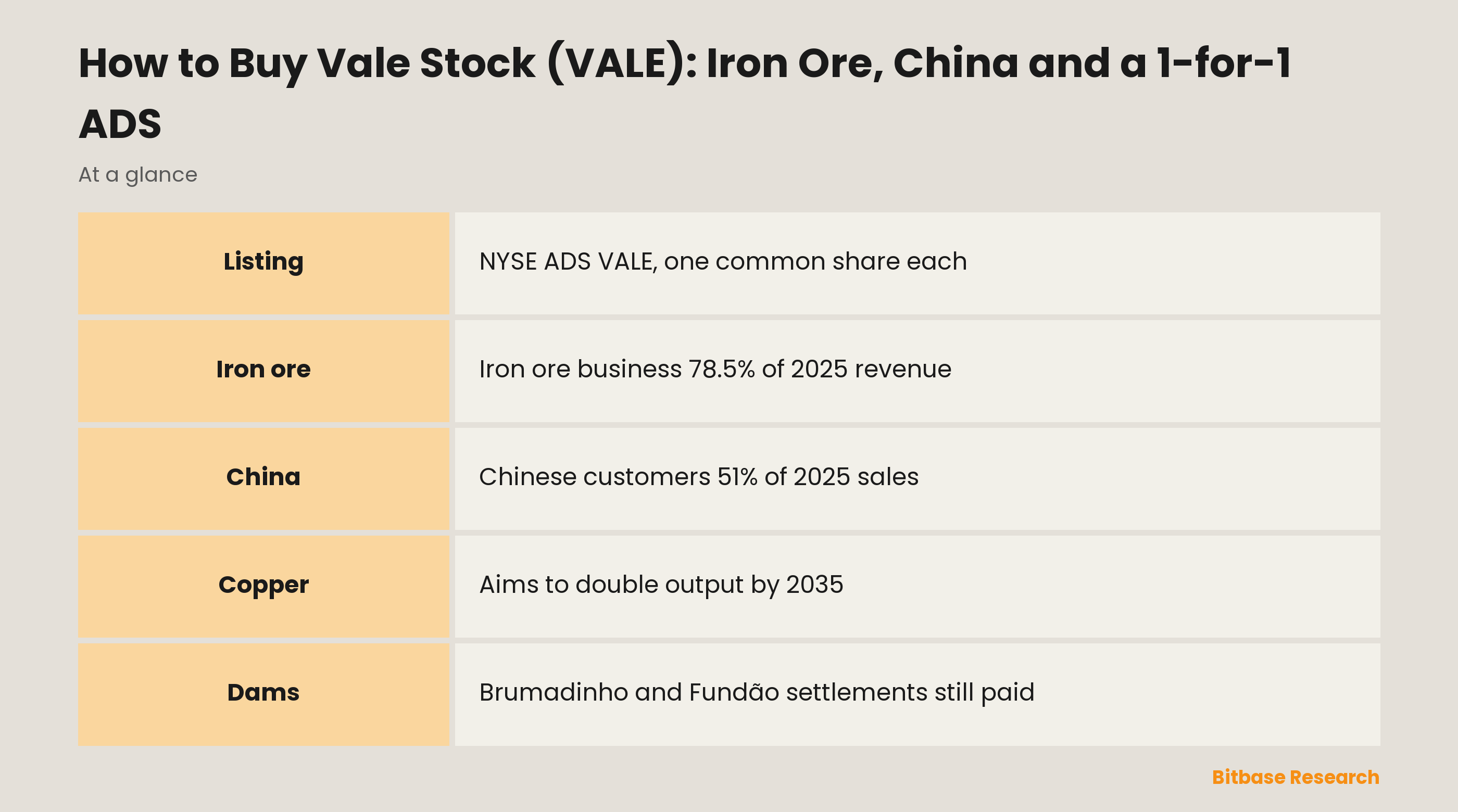
Your broker only needs access to the New York Stock Exchange to buy Vale: the ticker VALE is an American depositary share (ADS) that stands for exactly one common share of the Brazilian miner. That share mostly buys iron ore, since the iron ore business brought in 78.5% of Vale's 2025 revenue and customers in China accounted for 51% of all sales. Nickel and copper make up the rest, and copper is where Vale wants to grow.
What Does Vale Do?
Vale S.A. is a Brazilian mining company, organized on 11 January 1943, with its head office in Rio de Janeiro. SEC records list it as Companhia Vale do Rio Doce until 2009, and its privatization began in 1997. Its annual report calls it "one of the largest metals and mining companies in the world, based on market capitalization, and one of the world's largest producers of iron ore, iron ore pellets and nickel."
Iron Ore Solutions mines ore in three Brazilian systems. The Northern System around the Carajás mines in Pará and the Southeastern System each have their own mines, railway and maritime terminals; the Southern System has two mining complexes. Vale also makes pellets at eight plants in Brazil and two in Oman. Railways, ports and distribution centers sit in the same segment, because moving ore from inland Brazil to Asian steel mills is half the job.
Vale Base Metals (VBM) produces nickel and copper, with cobalt, platinum group metals, gold and silver as by-products. Nickel comes mainly from Canada and Brazil, with refineries in the United Kingdom and Japan; copper comes from Sossego and Salobo in Carajás and from the Canadian nickel mines. Vale owns 90% of VBM and Manara Minerals the other 10%.
The portfolio is being reshaped. In September 2025 Vale sold a 70% interest in its power generation company, Aliança Energia, and on 16 October 2026 VBM handed the Thompson nickel complex in Manitoba to a new owner, keeping an 18.9% stake. Copper is the growth target: Vale says it is "positioned to double our production by 2035, using 2024 levels as the baseline."
How Vale Makes Money
Vale sells bulk commodities whose prices it does not set, mostly to steelmakers. The 2025 revenue table shows how far iron dominates:
| Business line | Share of 2025 net operating revenue |
|---|---|
| Iron ore | 65.1% |
| Iron ore pellets | 11.4% |
| Other ferrous products and logistics | 1.9% |
| Nickel | 11.2% |
| Copper | 9.8% |
| Other base metals | 0.6% |
China took 63% of Vale's iron ore and pellet shipments in 2025 and Asia as a whole 80%, yet no single customer reached 10% of revenue.
Revenue rose only about 1% in 2025, but the mix moved: copper revenue grew about 34% and nickel about 17%, while pellets fell about 26%. Net income attributable to shareholders fell about 62%, in a year that included an impairment of the nickel operation in Newfoundland and Labrador and a full write-off of the goodwill allocated to Canadian nickel.
VALE Stock at a Glance
| Item | Detail |
|---|---|
| Ticker and exchange | VALE on the New York Stock Exchange, a Level 2 ADS programme |
| ADS ratio | One ADS represents one common share |
| Depositary | JPMorgan Chase Bank, N.A. |
| Home listing | VALE3 on B3's Novo Mercado in São Paulo; also XVALO on Madrid's LATIBEX |
| Share classes | Common shares, plus 12 golden shares held by the Brazilian government |
| Held as ADSs | 32.4% of share capital at 31 December 2025 |
| Headquarters | Rio de Janeiro, Brazil |
| Fiscal year | Calendar year, reported under IFRS |
| Payouts | Mix of dividends and interest on capital, set by a remuneration policy |
| SEC filer | CIK 917851; Form 20-F and Forms 6-K |
For quotes, charts and market value, see Vale's live stock page on Bitbase.
How to Buy Vale Stock
1. Pick the line. VALE trades in US dollars on the NYSE. If your broker reaches B3, VALE3 is the same share in reais.
2. Open a brokerage account that is available where you live and lists NYSE securities.
3. Deposit money. Expect a currency conversion margin if your cash is not already in dollars.
4. Check the listing. The search result should say Vale S.A. ADS; several Vale bonds also have tickers beginning with VALE.
5. Choose an order type. A market order fills at the next available price; a limit order caps your price and may not fill.
6. Decide the quantity. Fractional ADSs depend on the broker.
7. Save the paperwork. Payout statements show the Brazilian tax withheld.
ADS or B3 share. Vale pays distributions in reais to a custodian, which converts them into dollars for the depositary to pass on, net of fees. In the 20-F's words, "ADR holders do not have the rights of shareholders. They have only the contractual rights set forth for their benefit under the deposit agreement": they vote by instructing the depositary. Swap ADSs for the underlying shares and the custodian's central bank registration covers you for only five business days; after that you may need your own to send money abroad.
Tax on payouts. Interest on capital carried 15% Brazilian withholding for 2025 and 17.5% from 1 January 2026, or 25% in low-tax jurisdictions. Under a law enacted in November 2025, dividends paid abroad generally carry 10% from January 2026, while profits approved by the end of 2025 stay exempt. And "there is at present no treaty to avoid double taxation between Brazil and the United States." Ask a tax adviser about your own case.
Indirect exposure. Funds that track Brazilian or emerging-market shares may own Vale; their holdings lists will say.
What Moves VALE Stock
Iron ore and Chinese steel. Iron ore and pellets made up 76.6% of 2025 revenue, and China accounted for 76% of global seaborne iron ore demand that year, with its real estate and infrastructure sectors the biggest steel users. The same forces run through the guides to BHP and Rio Tinto.
Copper projects in Carajás. The Novo Carajás Program, launched in February 2025, pairs iron ore optimization with faster copper growth, so project dates are the checkpoints. In August 2026 the Salobo coarse particle flotation project moved into execution, with start-up expected in the first half of 2028, about a year early.
Nickel restructuring. The 2025 impairments fell on nickel, and the Thompson sale shows Vale trimming that business. More disposals or a nickel price recovery would both show up in profit.
The real against the dollar. Vale's functional currency is the Brazilian real, while much of the revenue and debt is in dollars, so exchange rates can push net income away from operating trends.
Payouts and buybacks. The remuneration policy sets a minimum of 30% of adjusted EBITDA minus sustaining capital investment, so payouts follow the commodity cycle. On 30 July 2026 the board also approved a buyback of up to 100 million shares, about 2.3% of those outstanding, running until 29 January 2028.
Dams, China and Brazil in Vale's Risk Factors
Tailings dams. On 25 January 2019 a tailings dam failed at the Córrego do Feijão mine in Brumadinho, killing 270 people. In November 2015 the Fundão dam of Samarco, a joint venture Vale owns equally with BHP Brasil, failed and killed 19; the settlement signed in October 2024 is paid over 20 years. In November 2025 an English court found BHP liable under Brazilian law, and Vale has agreed to share 50/50 any resulting compensation that does not duplicate payments in Brazil. A securities class action over Brumadinho is pending in New York.
China. "Adverse economic developments in China could have a negative impact on our revenues, cash flow and profitability."
Critical infrastructure. Almost all Northern System ore rides the Carajás railroad to the port of Ponta da Madeira, and the 20-F names its single-track bridge over the Tocantins River as a weak point.
Government and shareholders. The government's 12 golden shares carry limited vetoes, for example over Vale's name and headquarters. Vale has had no control group since 2020 but remains "exposed to significant influence of some shareholders or groups of shareholders." New mining taxes or royalties are a further risk.
The stock itself. ADS holders have contractual rather than shareholder rights, and a single-stock position concentrates you in one miner, one commodity and one country.
Following Vale Through Its SEC and CVM Filings
Vale files with the SEC under CIK 917851. The 2025 Form 20-F, filed on 27 March 2026, holds the risk factors, a section on dam reparation and the segment note that splits revenue and adjusted EBITDA by business and country. Between annual reports, Forms 6-K carry the quarterly production report, the results that follow it (third-quarter 2026 results came out on 29 October), payouts and asset sales; the same material goes to Brazil's regulator, the CVM. Tailings facility status is on vale.com/esg, and Bitbase's stock pages cover other listed miners.
Vale Stock FAQ
What is the difference between VALE and VALE3?
They are the same common share. VALE3 trades on B3 in reais; VALE is the NYSE ADS in dollars, each one backed by one VALE3 share held for the depositary.
Does Vale pay a dividend?
Yes. Brazilian law and the bylaws require at least 25% of the distributable amount each year, paid as dividends or interest on capital, and from 2021 to 2025 payments came around March and September. For the payout approved on 30 July 2026, the ADR record date was 13 August and payment was due on 10 September.
Can I buy Vale stock with crypto?
Not directly. Brokers settle VALE trades in US dollars, so you would first sell crypto for cash and transfer it to the brokerage account. Your tax residence decides whether that sale counts as a taxable event.
Who controls Vale?
No single shareholder. Vale has had no control group able to guarantee a majority of votes since 2020, and the government's golden shares give limited vetoes, not day-to-day control.
How did the dam disasters affect Vale?
Brumadinho in 2019 and Fundão in 2015 led to settlements Vale is still paying, an agreement to split any compensation from the UK case against BHP, and a US securities class action. Since 2019 Vale has also de-characterized 19 of its 30 upstream tailings dams.
Conclusion
Buying Vale is simple: one VALE ADS on the NYSE is one common share, the same share that trades as VALE3 in São Paulo. What you own is mostly iron ore sold to China, plus a nickel business being cut back and a copper business Vale wants to double by 2035. Before sizing a position, read the latest 20-F on dams, China and taxes, and the newest 6-Ks on payouts and projects.
Related reading
Other Bitbase articles on this topic:
- How to Buy Kinross Gold Stock (KGC): Paracatu, Tasiast and NYSE
- How to Buy Martin Marietta Stock (MLM): Quarries, Lime and Lhoist
- How to Buy Nutrien Stock (NTR): Potash, Ag Retail and Two Listings
Disclaimer: This article is educational content from Bitbase Academy, provided for information only. It explains what a company or fund does and how the instruments referenced here differ from one another; it does not constitute investment, trading, tax, or financial advice, and it is neither a recommendation nor an endorsement of any security, token, or trading strategy. A tokenized stock is issued by a third party and is designed to give economic exposure to an underlying asset: it is not a share, it carries no shareholder rights, and it depends on the issuer's structure, eligibility rules, and redemption terms, which the issuer can change. Perpetual futures are leveraged derivatives that hold no underlying asset and can be liquidated, and trading hours, product availability, and eligibility differ by instrument and by jurisdiction and can change at any time. Written as of November 2026; verify everything yourself through company filings, the issuer's own documentation, and the product pages of the venue you trade on.
References
[1] Vale S.A. Form 20-F for 2025: business, segments, ADSs, shareholder remuneration, taxation, dams and risk factors (SEC EDGAR) www.sec.gov
[2] Vale S.A. Form 20-F for 2025, XBRL cover page R1.htm (SEC EDGAR) www.sec.gov
[3] Vale S.A. 2025 revenue by business segment and geographic area, XBRL R103.htm (SEC EDGAR) www.sec.gov
[4] Vale S.A. consolidated income statement for 2025, XBRL R2.htm (SEC EDGAR) www.sec.gov
[5] Vale S.A. Form 6-K, 16 October 2026: Vale Base Metals completes the Thompson transaction (SEC EDGAR) www.sec.gov
[6] Vale S.A. Form 6-K, 30 July 2026: new share buyback programme (SEC EDGAR) www.sec.gov
[7] Vale S.A. Form 6-K, 30 July 2026: shareholder remuneration and ADR record and payment dates (SEC EDGAR) www.sec.gov
[8] Vale S.A. Form 6-K, 12 August 2026: Salobo coarse particle flotation project moves to execution (SEC EDGAR) www.sec.gov
[9] Vale S.A. Form 6-K: third-quarter 2026 results, released 29 October 2026 (SEC EDGAR) www.sec.gov
[10] SEC EDGAR company record for Vale S.A. (CIK 917851), including former names data.sec.gov





