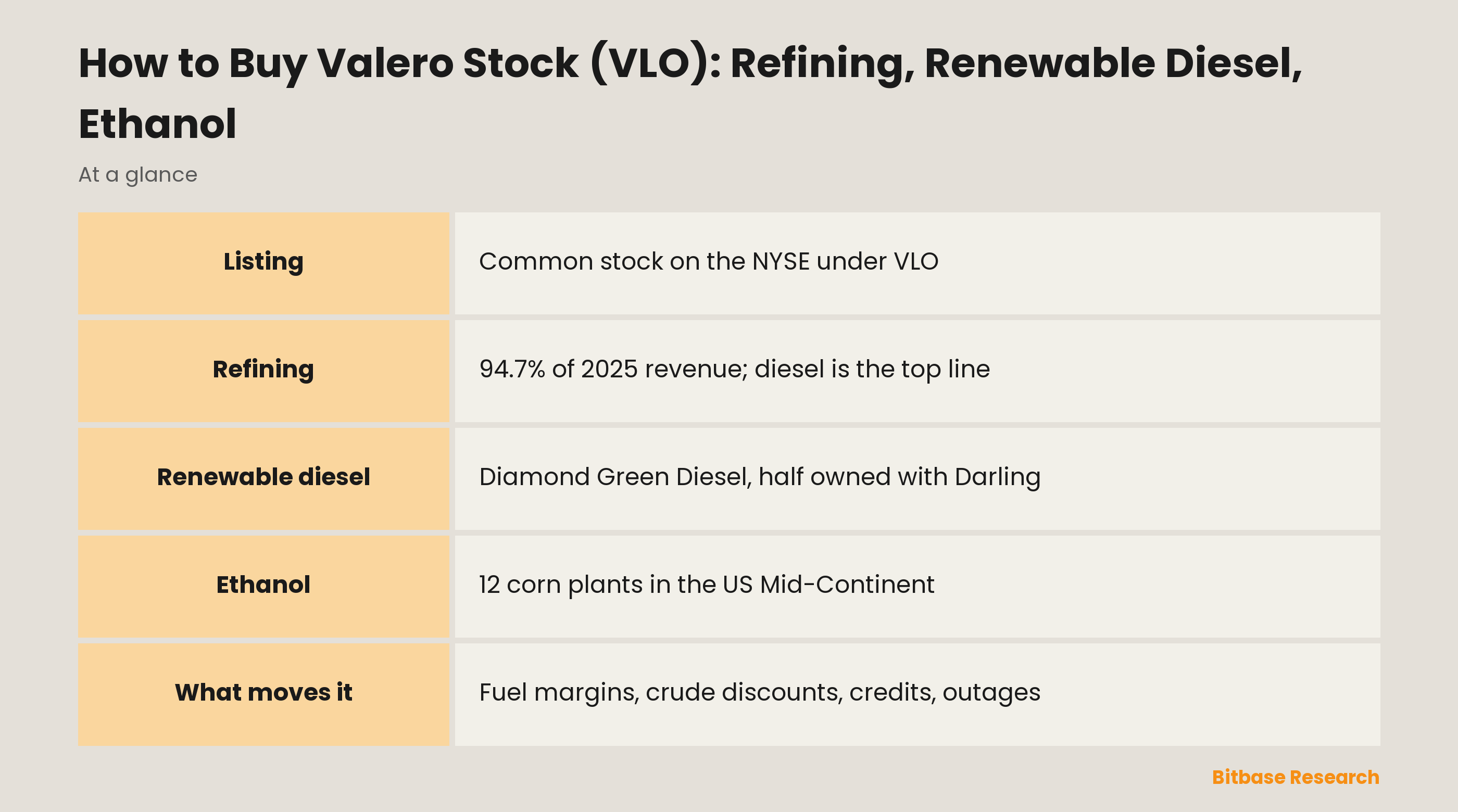
Buying a Valero share requires only a broker that offers US equities, since the common stock is listed on the New York Stock Exchange as VLO. The company produces none of the crude it refines and owns no gas stations, so its earnings rest on the gap between what its fuels sell for and what its feedstocks cost. Refining brought in 94.7% of 2025 revenue; the rest came from the Diamond Green Diesel joint venture and 12 corn ethanol plants. This guide covers each segment, the order itself and the forces the filings tie to the stock.
What Does Valero Do?
Valero Energy Corporation turns crude oil into transportation fuels and makes two kinds of low-carbon fuel alongside them. Its 10-K calls it "a multinational manufacturer and marketer of petroleum-based and low-carbon liquid transportation fuels and petrochemical products," selling mainly in the United States, Canada, the UK, Ireland and Latin America. Founded as a Delaware corporation named Valero Refining and Marketing Company in 1981, it adopted its current name in 1997 and is based in San Antonio, Texas.
Refining is the core. At the end of 2025 Valero owned 15 refineries: 13 in the United States, one at Lévis near Quebec City and one at Pembroke in Wales. The Texas plants hold 50.8% of total throughput capacity, Port Arthur is the largest single site, and several refineries, Port Arthur and St. Charles in Louisiana among them, are built to process sour or heavy crude.
Renewable Diesel is Diamond Green Diesel (DGD), a joint venture with a subsidiary of Darling Ingredients that Valero entered in 2011. Valero owns 50%, operates both plants and consolidates the venture. The plants stand next to the St. Charles and Port Arthur refineries and turn mostly waste fats and oils into renewable diesel, renewable naphtha and, since late 2024, neat sustainable aviation fuel (SAF).
Ethanol comes from 12 dry-mill plants across six Mid-Continent states that grind corn from local farmers and elevators into ethanol, distillers grains for animal feed and inedible corn oil. Valero entered this business in 2009 by buying its first plants.
The fuel is sold wholesale, at terminal truck racks and in bulk to oil companies, traders and users "such as railroads, airlines, and utilities." Most rack volume goes out unbranded. About 7,000 outlets carry its brands, including Valero, Diamond Shamrock and Beacon in the US, Ultramar in Canada and Texaco in the UK and Ireland, but those sites are independently owned.
Where Valero's Revenue Comes From
Refined petroleum products make up nearly all of it, and diesel, not gasoline, is the biggest line. The segment note splits 2025 revenue from external customers this way:
| Product line | Segment | Share of 2025 revenue | What it covers |
|---|---|---|---|
| Distillates | Refining | 44.9% | Mainly diesel |
| Gasolines and blendstocks | Refining | 41.5% | Gasoline and blending components |
| Other refined products | Refining | 8.3% | Products other than gasoline and distillates |
| Ethanol and distillers grains | Ethanol | 3.3% | Corn ethanol and animal feed |
| Renewable diesel, naphtha and neat SAF | Renewable Diesel | 2.0% | DGD's low-carbon fuels |
The percentages are derived from the note's dollar figures. Total revenue fell 5.5% from 2024, mainly on lower fuel prices.
Profit moved differently. Refining's operating income rose 1.7% in 2025 despite an impairment on two California refineries, and Ethanol's rose 29.9%. Renewable Diesel swung from a 2024 profit to a loss, squeezed by dearer feedstocks, partly from new US tariffs on imported renewable feedstocks, and by a less valuable federal tax credit.
Because Valero consolidates DGD, Renewable Diesel results include the whole venture; the part owned by others is deducted further down as noncontrolling interests. And by customer location, US buyers accounted for 71.6% of 2025 revenue and the UK and Ireland for 12.9%, with no single customer reaching 10%.
VLO Stock Basics
| Item | Valero |
|---|---|
| Listing | New York Stock Exchange (NYSE) |
| Ticker | VLO |
| Security | Common stock; no other class registered |
| Sector | Energy: petroleum refining, renewable diesel and ethanol |
| Index membership | S&P 500; also a holding of the Energy Select Sector SPDR ETF |
| Headquarters | San Antonio, Texas |
| Incorporated | Delaware, 1981 |
| Year-end | 31 December |
| Dividends | Paid in cash; the board considers them every quarter |
| Share buybacks | Board-authorized programs with no expiration date |
| EDGAR filer number | CIK 1035002 |
Price, market value and yield move all day and are left out here; the Valero stock page on Bitbase shows them live.
How to Buy Valero Stock
No depositary receipt is involved: Valero is a US company, and what trades as VLO is its common stock itself.
1. Pick a broker offering NYSE stocks. Many brokers outside the US route orders to New York; check which legal entity will hold the shares and which authority supervises it.
2. Complete the account checks. Non-US individuals usually file Form W-8BEN, so the broker can withhold tax on US dividends at any treaty rate that applies.
3. Move money in. Converting into US dollars has its own cost, so compare the exchange spread as well as the fee.
4. Confirm the listing. Search VLO and check that the match is Valero Energy's common stock on the NYSE.
5. Set the order. A market order "guarantees that the order will be executed, but does not guarantee the execution price"; a limit order executes only "at a specific price or better."
6. Settle on an amount. Some firms sell fractions of a share, but "not every brokerage firm offers fractional share investing," and holders of fractions "may not have voting rights."
7. File the paperwork. Trade confirmations and account statements show what you paid and which dividends arrived.
Orders placed outside regular hours can fill away from the main session's price, as the guide to regular and extended-hours stock prices explains; a limit order caps that risk.
Dividends for non-US holders. The IRS notes that "most types of U.S. source income received by a foreign person are subject to U.S. tax of 30%," a rate a tax treaty may reduce. Tax at home may apply on top.
Through a fund. As an S&P 500 constituent, VLO sits in funds that replicate that index, and in sector funds such as the Energy Select Sector SPDR ETF (XLE); either way, the fund spreads your money across many other companies.
What Drives VLO Shares
Fuel prices against crude costs. The 10-K says Refining segment margin is "primarily affected by the prices for the petroleum-based transportation fuels that we sell and the cost of crude oil and other feedstocks that we process." Markets track that gap through crack spreads, a benchmark fuel price minus a benchmark crude price, and Valero's MD&A publishes regional versions for the US Gulf Coast, Mid-Continent, North Atlantic and West Coast, such as diesel less Brent. Higher diesel margins added more to the 2025 refining margin than any other item. Because Valero buys feedstocks "long before" it processes them, price moves in between also reach results.
Crude discounts. Many of its refineries are configured for sour or heavy grades, and "a significant portion of our profitability is derived from the ability to purchase and process crude oil feedstocks that historically have been cheaper than benchmark crude oils." When those differentials narrow, margin shrinks; in 2025 their decline was the largest drag.
Credits and tax rules. Under the federal Renewable Fuel Standard, the refining business must blend renewable fuel or buy credits called RINs, while the renewable diesel and ethanol plants generate RINs. California, Canada and the UK run comparable programs. From 2025 the blender's credit gave way to the Section 45Z clean fuel production credit, later extended through 2029 and, for fuel made from 2026, limited to feedstocks from the US, Mexico or Canada. That transition and the feedstock tariffs pushed Renewable Diesel into a 2025 loss; in the first nine months of 2026 it was profitable again on higher prices.
California. Valero finished idling all processing units at its Benicia refinery near San Francisco in April 2026 and expects to meet its contracts with Northern California customers through imports or other supply arrangements. It also wrote down its Wilmington refinery near Los Angeles and is still weighing options for its remaining California operations, citing state legislation that brings "potential increased operational restrictions and new reporting requirements."
Outages and seasons. On 23 March 2026 a fire in a distillate hydrotreater forced a full shutdown at Port Arthur; the plant was back at normal rates within the second quarter. Gasoline, diesel and asphalt demand peaks in spring and summer and ethanol follows gasoline, while renewable diesel demand "has not significantly fluctuated by season."
Buybacks and the share count. Repurchase programs without expiration dates have shrunk the share count: shares outstanding on filing covers fell about 32% between February 2022 and October 2026. Earnings, the source of that cash, swing widely: in the first nine months of 2026, Refining operating income was 6.4 times its year-earlier level, mainly on higher gasoline and distillate margins.
Risks Valero Lists in Its 10-K
The latest 10-Q reports no material changes to the annual report's risk factors. These stand out for a shareholder:
Margin volatility. "Our financial results are affected by volatile margins, which are dependent upon factors beyond our control, including the prices we pay to acquire feedstocks and the market prices at which we can sell our products."
No crude production, no retail. "Differences in competitors' businesses or resources may at times provide them a competitive advantage." Some rivals produce their own crude or run station networks and can at times offset weak refining results; integrated groups such as Chevron, which produces oil and gas as well as refining it, fit that description.
Plant interruptions. "We are subject to risks arising from an interruption in any of our refineries or plants." The filing also flags that the real-time market structure of the largest Texas grid operator exposes many of its Texas operations to "scarcity pricing" for electricity.
Demand for liquid fuels. "Industry, market, and other developments could decrease the demand for our products," including better fuel efficiency and electric and hybrid vehicles.
Low-carbon fuel rules and shared control. Valero names risks "arising from the Renewable and Low-Carbon Fuel Programs" and warns that "our investments in joint ventures and other entities limit our ability to manage risk," DGD's other half being owned by Darling's subsidiary.
Two risks sit with the share itself. A single refiner concentrates your money on one set of margins. And Valero states that "there can be no assurance that we will pay a dividend in the future at the rates we have paid historically, or at all." Holders whose home currency is not the dollar also carry exchange-rate risk.
Where to Verify Valero's Numbers
Everything Valero reports to the SEC sits on EDGAR under CIK 1035002: the 10-K once a year, a 10-Q for each quarter and 8-Ks for events such as results and dividend declarations. The investor section of valero.com posts the same documents.
In the 10-K, the business and properties section lists every refinery, with the crude grades it runs, and every ethanol plant; Note 17 breaks revenue down by segment, product and customer location; Note 2 covers California and Note 12 the DGD structure. The MD&A table of market reference prices and differentials shows which margins the company itself follows. Read segment results beside the reconciliation of "adjusted" figures, since 2025 carried the California impairment. Live prices are on the stock page linked earlier, and other listed companies are on Bitbase's US stock pages.
Valero Stock FAQ
Does Valero own the gas stations that carry its name?
No. The 10-K describes the branded sites as independently owned and supplied under multi-year contracts, and Valero has no company-owned retail network. It stopped running a retail business on 1 May 2013, when it spun off 80% of CST Brands as a separate public company.
Can I buy Valero stock with crypto?
Only indirectly. VLO is purchased via a broker and paid for in US dollars, which means selling the crypto first and moving the cash to the broker; in some countries that sale is itself a tax event. A share is also a registered stake in Valero with dividend and voting rights, one of the points covered in how stocks and cryptocurrencies differ.
Does Valero pay a dividend?
Yes, quarterly in cash, with the board deciding each payment. Dividends declared per share rose 4.9% in 2024 and 5.6% in 2025, and the latest declaration came on 27 October 2026; the newest 10-Q or 8-K gives the amount and dates.
What is Diamond Green Diesel?
It is Valero's 50%-owned joint venture with a subsidiary of Darling Ingredients and the business behind its Renewable Diesel segment. Its two plants in Louisiana and Texas make a fuel the 10-K calls "interchangeable with petroleum-based diesel," and the Port Arthur plant can shift about 50% of its renewable diesel capacity to SAF.
Has Valero stock ever split?
Yes. Valero's quarterly reports record two two-for-one splits paid as stock dividends, distributed on 7 October 2004 and 15 December 2005. Adjust earlier per-share figures before comparing.
Is VLO in the S&P 500?
It is. Valero Energy appeared in the 28 October 2026 holdings of State Street's SPY, the S&P 500 fund, and of XLE; the DIA fund, which tracks the Dow Jones Industrial Average, did not hold it that day. Weights change daily.
Conclusion
The mechanics of a VLO purchase are ordinary: an account that reaches the NYSE, the correct security on screen, a market or limit order. What the share represents takes more reading. Most of its earnings come from refining margins and crude discounts, the renewable diesel and ethanol businesses lean on credits and tax rules, and California decisions and plant outages can move all of it. The annual report, the newest quarterly filing and the regional margin table are the places to check before deciding how large a position in one refiner should be.
Related reading
Other Bitbase articles on this topic:
- How to Buy Marathon Petroleum Stock (MPC): 13 Refineries and MPLX
- How to Buy MPLX Stock (MPLX): Marathon's MLP, Units and K-1
- How to Buy Occidental Petroleum Stock (OXY): Warrants, Berkshire
Disclaimer: This article is educational content from Bitbase Academy, provided for information only. It explains what a company or fund does and how the instruments referenced here differ from one another; it does not constitute investment, trading, tax, or financial advice, and it is neither a recommendation nor an endorsement of any security, token, or trading strategy. A tokenized stock is issued by a third party and is designed to give economic exposure to an underlying asset: it is not a share, it carries no shareholder rights, and it depends on the issuer's structure, eligibility rules, and redemption terms, which the issuer can change. Perpetual futures are leveraged derivatives that hold no underlying asset and can be liquidated, and trading hours, product availability, and eligibility differ by instrument and by jurisdiction and can change at any time. Written as of October 2026; verify everything yourself through company filings, the issuer's own documentation, and the product pages of the venue you trade on.
References
[1] Valero Energy Form 10-K, fiscal 2025: business, refineries, segments, risk factors (SEC EDGAR) www.sec.gov
[2] Valero Energy Form 10-Q for the quarter ended 30 September 2026 (SEC EDGAR) www.sec.gov
[3] Valero Energy Form 10-K, fiscal 2021: cover page with shares outstanding (SEC EDGAR) www.sec.gov
[4] Valero Energy Form 10-K, fiscal 2013: separation of the retail business as CST Brands (SEC EDGAR) www.sec.gov
[5] Valero Energy Form 10-Q for the quarter ended 30 September 2004: two-for-one stock split (SEC EDGAR) www.sec.gov
[6] Valero Energy Form 10-Q for the quarter ended 31 March 2006: 2005 two-for-one stock split (SEC EDGAR) www.sec.gov
[7] State Street SPDR S&P 500 ETF Trust (SPY): fund page and daily holdings www.ssga.com
[8] State Street Energy Select Sector SPDR ETF (XLE): fund page and daily holdings www.ssga.com
[9] State Street SPDR Dow Jones Industrial Average ETF Trust (DIA): fund page and daily holdings www.ssga.com
[10] Investor.gov (SEC): Types of Orders www.investor.gov
[11] Investor.gov (SEC): Investor Bulletin on fractional share investing www.investor.gov
[12] IRS: NRA Withholding www.irs.gov





