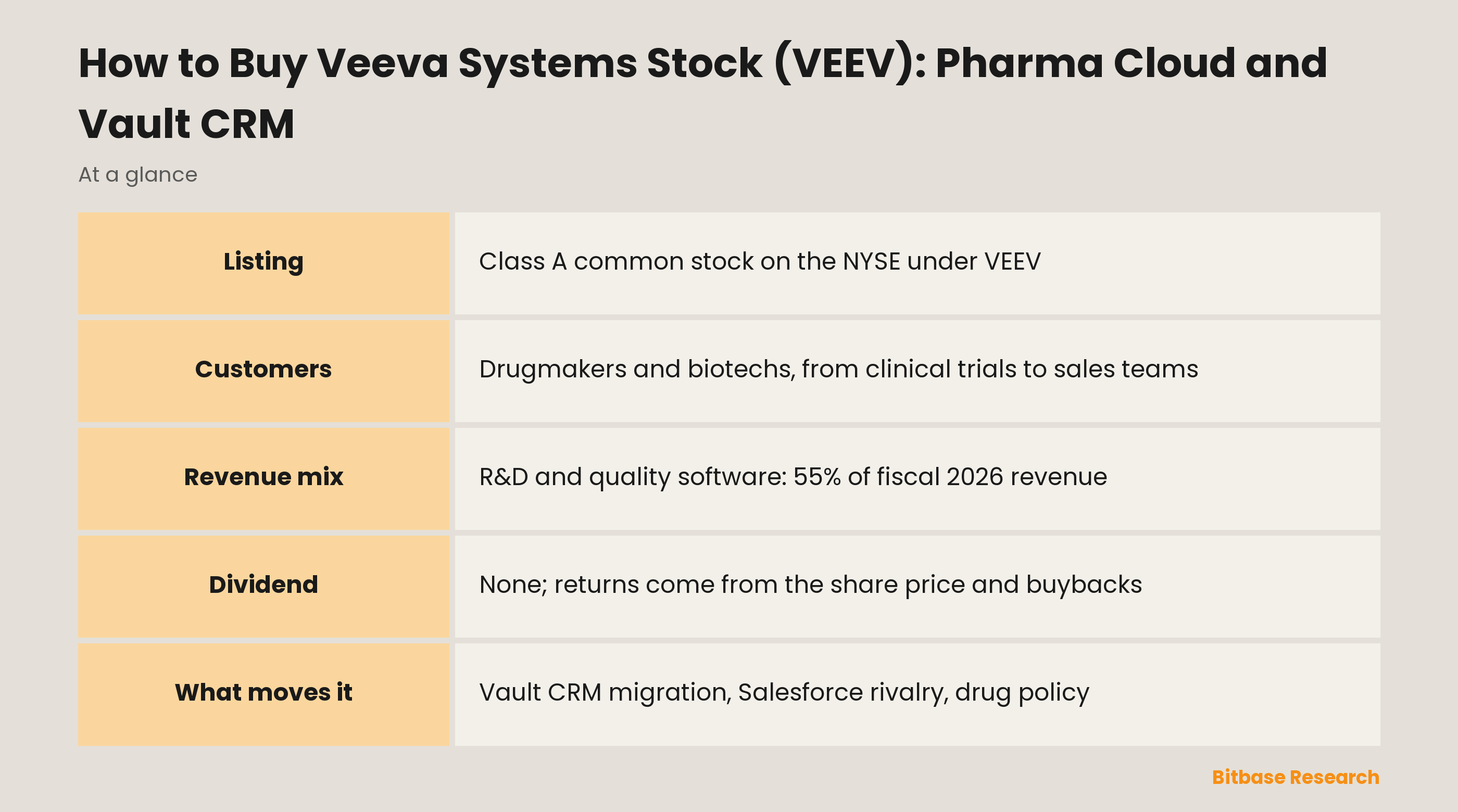
Buying into Veeva Systems takes a brokerage account that reaches the New York Stock Exchange, where the company's Class A common stock trades as VEEV, and an ordinary buy order. Behind the ticker is a software company that sells almost only to drugmakers and other life sciences firms, and in fiscal 2026 its clinical, regulatory and quality software brought in 55% of revenue, more than the sales and marketing tools it started with. Below: what Veeva sells, how an order works, and the issues its filings keep returning to, from the break with Salesforce to its status as a public benefit corporation.
What Does Veeva Systems Do?
Veeva builds cloud software and data products for pharmaceutical, biotechnology and medical device companies. Its annual report opens with "Veeva is the leading provider of industry cloud solutions for the global life sciences industry," and the product list follows a medicine through its life: clinical trials, safety reporting, regulatory submissions, manufacturing quality, and the sales and medical teams that talk to doctors once a drug is approved.
Veeva started out in January 2007 as Verticals onDemand, Inc., a Delaware corporation, and took the Veeva Systems name in April 2009. Its first product, released in 2007, was Veeva CRM, a customer relationship management application for drug company sales forces. Co-founder Peter Gassner, previously senior vice president of technology at salesforce.com, has been chief executive since January 2007. Veeva listed on the New York Stock Exchange in October 2013 and owns its headquarters in Pleasanton, California.
The 10-K sorts the products into four clouds:
| Product group | What it covers | Products named in the 10-K |
|---|---|---|
| Veeva Development Cloud | Clinical trials, drug safety and regulatory submissions | Veeva EDC, eTMF, CTMS, Veeva Safety, Veeva RIM |
| Veeva Quality Cloud | Quality processes, controlled documents, labs and training | Veeva QMS, Veeva Quality Docs |
| Veeva Commercial Cloud | Sales, marketing and medical affairs | Vault CRM, Veeva Medical, PromoMats, Crossix |
| Veeva Data Cloud | Data on healthcare professionals, organizations and de-identified patients | Veeva OpenData, Veeva Link, Veeva Compass, HCP Access |
Most of these applications, and now the CRM as well, run on Veeva Vault, the company's own platform for regulated documents and data. Veeva AI adds AI agents inside them; the 10-K says the agents use large language models from Anthropic and Amazon, hosted on Amazon Bedrock. Around the software, Veeva sells implementation and managed services, plus strategy work through a separate Veeva Business Consulting team.
On 31 January 2026 Veeva counted 1,552 customers, from large drugmakers such as Bayer, Boehringer Ingelheim, Eli Lilly, Gilead Sciences, Merck Sharp & Dohme and Novartis to younger biotechs such as Alnylam and Idorsia. It sells through its own direct sales organization and had 7,928 employees.
The 10-K also names the competition. In CRM the main rival is Salesforce, which has built its own life sciences CRM; IQVIA, which once sold a competing CRM, has licensed that software to Salesforce. In data, Veeva meets IQVIA, Ipsos and Definitive Health, and in clinical and quality software IQVIA, Dassault Systèmes, OpenText, Oracle and Honeywell.
How Veeva Systems Makes Money
Customers pay for access to software and data, usually billed annually or quarterly in advance, and Veeva recognizes each fee evenly over the subscription term. In fiscal 2026, which ended on 31 January 2026, subscriptions made up 84% of total revenue and professional services and other revenue the remaining 16%.
Instead of business segments, Veeva reports revenue in two product families:
| Revenue family, fiscal 2026 | Share of total revenue | Share of subscription revenue | Products included |
|---|---|---|---|
| R&D and Quality Solutions | 55% | 53% | Development Cloud and Quality Cloud |
| Commercial Solutions | 45% | 47% | Commercial Cloud and Data Cloud |
The balance keeps tilting toward research. A year earlier the split of total revenue was 53% to 47%, in the six months to 31 July 2026 it was 56% to 44%, and the 10-K expects R&D and Quality to keep gaining share. About 62% of the fiscal 2026 increase in subscription revenue came from that family. The company credits growth mainly to existing customers using more products and, to a lesser extent, to an annual inflation adjustment that raises prices at renewal by the lower of 4% or the US consumer price index.
Total revenue grew 16% in fiscal 2026, the same rate as a year earlier; subscription revenue rose 17% and services 11%. The subscription gross margin was 87% and the services margin 18%, for 76% overall. Profit grew faster than revenue: the GAAP operating margin widened to about 29% from about 25%, and net income rose 27%. Part of that profit does not come from software at all, since other income, mostly interest on Veeva's cash and investments, equalled about 23% of pre-tax income.
By region, 60% of fiscal 2026 subscription revenue came from North America, 28% from Europe and 12% from elsewhere, mainly Asia Pacific. The customer list is long but top-heavy: the ten largest customers accounted for 28% of total revenue in each of fiscal 2024, 2025 and 2026.
VEEV Stock at a Glance
| Feature | VEEV |
|---|---|
| Exchange | New York Stock Exchange |
| Ticker | VEEV |
| Security | Class A common stock, the only class registered under Section 12(b); every Class B share converted into Class A on 15 October 2023 |
| Sector | Cloud software, data and consulting for life sciences |
| Index membership | S&P 500 |
| Corporate form | Delaware public benefit corporation since 1 February 2021 |
| Headquarters | Pleasanton, California |
| History | Founded in 2007; listed on the NYSE in October 2013 |
| Fiscal year | Ends on 31 January |
| Payouts | No dividend; a two-year share repurchase program announced on 5 January 2026 |
| SEC identifier | CIK 1393052 |
Price, market value and valuation ratios move all session long; the Veeva Systems stock page on Bitbase shows them live.
How to Buy Veeva Systems Stock
Veeva is a Delaware company listed in New York, so no depositary receipt stands between you and the issuer: the shares that trade as VEEV are its Class A common stock. At most brokers the purchase runs in seven steps:
1. Pick a broker with NYSE access. Outside the United States, that can be a local broker that offers US shares or an international one; check which legal entity holds your account and who regulates it.
2. Complete the account checks. Non-US individuals usually certify their status on IRS Form W-8BEN, which the IRS says to submit "when requested by the withholding agent or payer."
3. Fund it. Money sent in another currency has to be converted first, so the exchange rate matters as much as the commission.
4. Search for VEEV. Confirm that the result reads Veeva Systems Inc. Class A common stock on the NYSE. The "Class A" is a leftover from the old two-class structure, so there is no second line to choose between.
5. Choose an order type. In FINRA's description, a market order "provides the most certainty that your order will be executed," while a limit order fills only "at or better than a specified price." Around earnings releases, when the price can move quickly, a limit order sets the worst price you accept.
6. Size the position. Fractional shares let you invest a fixed sum, but some firms offer them only for "large-cap stocks or ETFs" or not at all, and "as a fractional share owner, you might not have shareholder voting rights."
7. Keep the records. Contract notes and monthly statements show what you paid, which you will need on the day you sell.
Taxes for investors abroad. The IRS states that "most types of U.S. source income received by a foreign person are subject to U.S. tax of 30%," and a tax treaty may lower that rate. Veeva has never paid a dividend, so that rule has had no payout to apply to; how a gain on sale is taxed depends on where you live.
Through index funds. VEEV is a member of the S&P 500, so funds that track that index, State Street's SPY among them, hold it as one position among hundreds.
What Moves VEEV Stock
The CRM migration and Salesforce. Veeva CRM was built on Salesforce's platform, and the agreement between the two companies expired on 1 September 2025. Under its wind-down terms Veeva may not sell Salesforce-based applications to new customers, an existing customer can add seats only up to 150% of what it used on 1 September 2025, and after 1 September 2030 those sales stop altogether. Veeva will support Veeva CRM until 31 December 2029 and is moving customers to Vault CRM. Salesforce is now its main CRM rival and, the 10-K says, "has announced that certain large Veeva CRM customers have committed to purchasing its CRM solutions." Veeva's side of the tally: by its August 2026 results release, more than 180 customers were live on Vault CRM, five of them among the top 20 biopharmas, and 12 of the top 20 had committed to it.
Clinical and quality software. R&D and Quality Solutions are now the larger family, and products there, from clinical data management to safety and quality, compete for budgets with IQVIA, Oracle, Dassault Systèmes and smaller vendors. In the second quarter of fiscal 2027, which ended on 31 July 2026, total revenue grew 18% and subscription revenue 16%, and Peter Gassner said that "Vault CRM had its best quarter ever and Veeva Falcon accelerated rapidly."
AI products. Veeva Falcon, which the company calls "the agentic labor platform for clinical, regulatory, and safety," had five early adopters by August 2026, and Veeva bought a company called Copli that quarter. AI cuts both ways: the 10-K warns that rivals could gain through "new or better use of evolving AI technologies," and that adding AI to its own products "may result in reputational harm and increased liability."
Drug industry policy. Because "nearly all of our revenues are generated by sales to customers in the life sciences industry," demand follows drugmakers' budgets. The 10-K lists drug pricing reforms, including the Inflation Reduction Act, reduced funding and staffing at agencies such as the FDA and NIH, and possible limits on direct-to-consumer drug advertising, which "could negatively impact certain of our product offerings, including our Crossix business."
Buybacks and a lawsuit closed. With no dividend, returns to holders run through the share price and repurchases; a two-year buyback program was announced on 5 January 2026, and repurchased shares are retired. On 13 August 2025 Veeva and IQVIA settled all their litigation, which dated back to 2017. Neither side paid damages, and the two signed agreements giving mutual customers access to each other's data and software.
What Could Hurt Veeva Shareholders
A difficult migration. The 10-K says moving CRM customers to Vault is complex and "we cannot be certain that we will be successful," and that a surge of migrating users could cause outages.
A few large customers. "Our revenues are relatively concentrated within a small number of key customers," the 10-K states. Mergers between customers, or tougher scrutiny when large contracts come up for renewal, have cut subscriptions or prices before and can again.
Slower growth that shows up late. The company expects that "over the longer term our revenue growth rates are likely to fluctuate from year to year and may decline." Because subscription revenue is spread over contract terms, "our short-term results of operations may not reflect a decline in sales," so weaker orders can take quarters to appear.
Sensitive data. Veeva holds clinical, safety and marketing data for its customers, and Crossix and Compass process third-party health and non-health data about US patients. A breach could bring liabilities and lost customers.
The public benefit structure. Veeva's board must balance shareholders' financial interests against those of customers, employees, partners and communities and against its stated public purpose, and the 10-K is blunt: "there is no guarantee that a conflict would be resolved in favor of our stockholders."
The stock itself. One company's shares carry more risk than an index, and the 10-K's performance graph shows how far the two can diverge: over the five years to 31 January 2026, VEEV's cumulative total return was about −26%, against about +101% for the S&P 500 and +25% for the S&P 1500 Application Software index.
Reading Veeva's Filings Before You Buy
Veeva files with the SEC under CIK 1393052. The fiscal 2026 10-K was filed on 20 March 2026, quarterly reports follow on Form 10-Q, and earnings releases come attached to 8-Ks; the second-quarter fiscal 2027 release was filed on 26 August 2026. An 8-K after the 5 November 2026 investor day repeated that third-quarter results were expected to meet or exceed the August guidance.
In the 10-K, Item 1 lists the clouds, customers and competitors, Item 1A the risks, including the Salesforce wind-down terms, and the MD&A the revenue split, customer counts and regional mix; Item 5 holds the dividend policy and the performance graph.
Two habits help. Mind the fiscal year: Veeva's fiscal 2027 ends on 31 January 2027, so "fiscal 2026" is mostly calendar 2025. And treat the customer count with care: Veeva counts each master subscription agreement as one customer, so when related companies merge their orders under one agreement, the count falls without any lost business. For another subscription software company, see our ServiceNow stock guide; for one of the drugmakers among Veeva's customers, see our Merck stock guide. Quotes for other companies are on Bitbase's index of US stocks.
Veeva Systems Stock FAQ
Can I buy Veeva Systems stock with crypto?
Not directly. Brokers sell VEEV shares for US dollars, so crypto has to be sold for cash and the money moved to the broker first, and that sale may be taxable where you live. A share is also a different thing: a claim on a registered company with voting rights, the point covered in our explainer on how a share differs from a crypto asset.
Does Veeva pay a dividend?
No. The 10-K says "we have never declared or paid any cash dividends on our capital stock" and that the company does not expect to pay any "for the foreseeable future." It returns cash through share repurchases instead.
Is VEEV in the S&P 500?
Yes. The SPY holdings list that State Street publishes each day for its S&P 500 fund showed Veeva Systems Class A shares as of 5 November 2026. Index weights change every day.
What does it mean that Veeva is a public benefit corporation?
Since 1 February 2021 Veeva has been a Delaware public benefit corporation, and the 10-K says it was the first publicly traded company to convert to that form. Its charter sets a public purpose, "to provide products and services that are intended to help make the industries we serve more productive, and to create high-quality employment opportunities in the communities in which we operate," which directors must weigh alongside shareholders' financial interests.
Does Veeva still have Class A and Class B shares?
No. On 15 October 2023 every outstanding Class B share converted automatically into one Class A share under the company's charter, and no more Class B shares will be issued. The Class A stock kept the VEEV ticker and its CUSIP, so holders had nothing to do.
Conclusion
Veeva sells subscription software to a single industry, life sciences, and almost every question about the VEEV share comes back to that choice. It earns more each year from clinical and quality software while it moves its CRM customers off Salesforce's platform, and it is governed as a public benefit corporation that pays no dividend. Go through the newest 10-K and the latest quarterly release, follow the Vault CRM numbers from quarter to quarter, and decide how much weight one life sciences software company deserves in your portfolio.
Related reading
Other Bitbase articles on this topic:
- How to Buy Global Payments Stock (GPN): After the Worldpay Swap
- How to Buy Infosys Stock (INFY): 1:1 ADS, Dividends and H-1B Risk
- How to Buy MSCI Stock (MSCI): Indexes, ETF Fees and BlackRock
Disclaimer: This article is educational content from Bitbase Academy, provided for information only. It explains what a company or fund does and how the instruments referenced here differ from one another; it does not constitute investment, trading, tax, or financial advice, and it is neither a recommendation nor an endorsement of any security, token, or trading strategy. A tokenized stock is issued by a third party and is designed to give economic exposure to an underlying asset: it is not a share, it carries no shareholder rights, and it depends on the issuer's structure, eligibility rules, and redemption terms, which the issuer can change. Perpetual futures are leveraged derivatives that hold no underlying asset and can be liquidated, and trading hours, product availability, and eligibility differ by instrument and by jurisdiction and can change at any time. Written as of November 2026; verify everything yourself through company filings, the issuer's own documentation, and the product pages of the venue you trade on.
References
[1] Veeva Systems Form 10-K for fiscal 2026 (SEC EDGAR) www.sec.gov
[2] Veeva Systems fiscal 2026 Form 10-K, XBRL cover page (SEC EDGAR) www.sec.gov
[3] Veeva Systems Form 10-Q for the quarter ended 31 July 2026 (SEC EDGAR) www.sec.gov
[4] Veeva fiscal 2027 second-quarter results release, 26 August 2026 (SEC EDGAR) www.sec.gov
[5] Veeva Systems Form 8-K on the share repurchase program, 5 January 2026 (SEC EDGAR) www.sec.gov
[6] Veeva Systems Form 8-K on the IQVIA settlement, August 2025 (SEC EDGAR) www.sec.gov
[7] Veeva Systems Form 8-K on the Class B conversion, October 2023 (SEC EDGAR) www.sec.gov
[8] Veeva Systems Form 8-K on becoming a public benefit corporation, February 2021 (SEC EDGAR) www.sec.gov
[9] Veeva Systems IPO prospectus, October 2013 (SEC EDGAR) www.sec.gov
[10] Veeva Systems Form 8-K on the 2026 Investor Day, 5 November 2026 (SEC EDGAR) www.sec.gov
[11] State Street SPDR S&P 500 ETF Trust (SPY), fund page and daily holdings www.ssga.com
[12] FINRA: Types of Orders www.finra.org
[13] FINRA: Investing in Fractional Shares www.finra.org
[14] IRS: NRA Withholding www.irs.gov
[15] IRS: About Form W-8 BEN www.irs.gov





