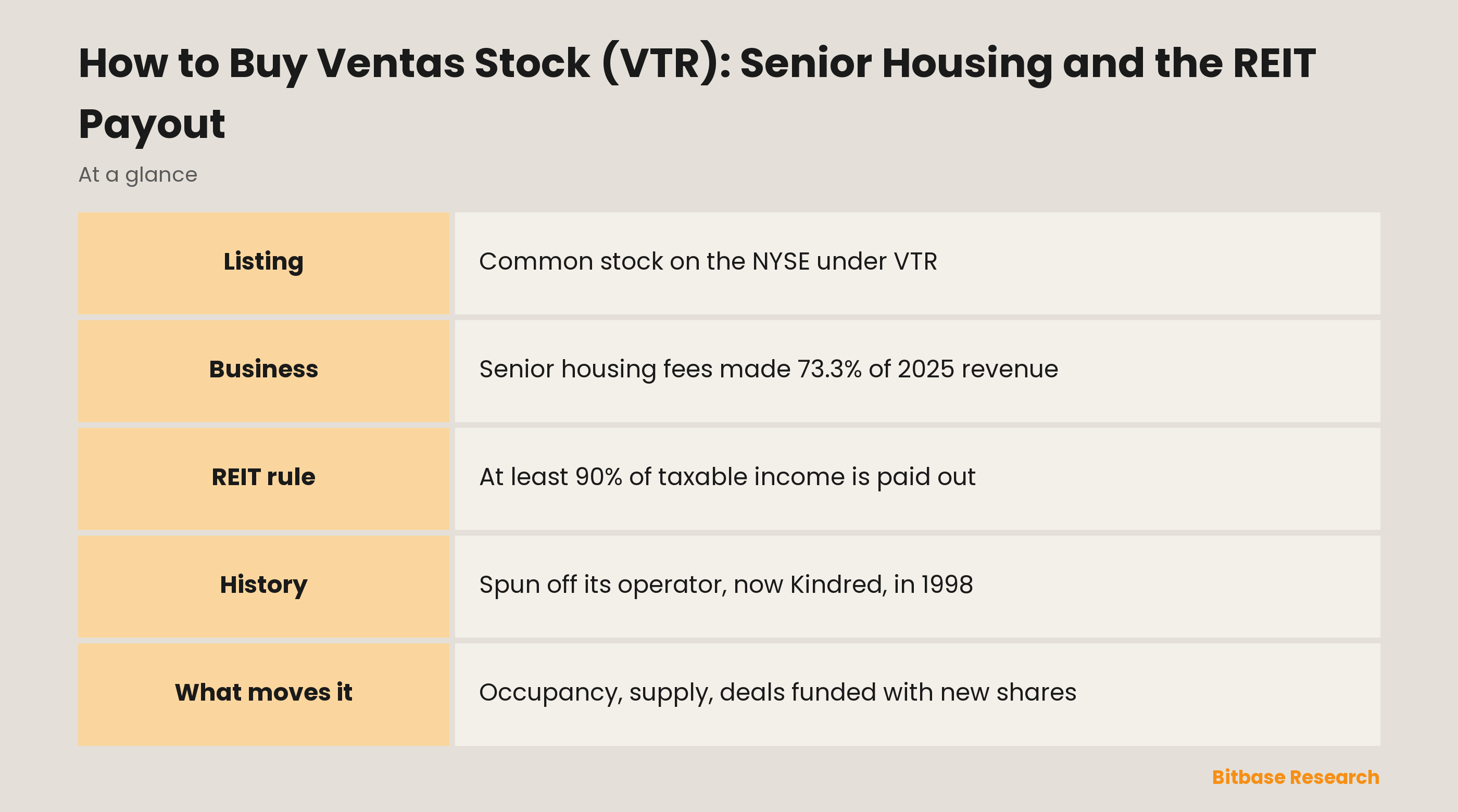
One order at a broker with New York Stock Exchange access is all it takes to buy Ventas stock, which trades under the ticker VTR as the common shares of Ventas, Inc. Ventas is a real estate investment trust, or REIT, whose senior housing communities, run on its behalf by 39 outside managers in 2025, produced 73.3% of that year's revenue, and it took its current shape in 1998 by spinning off the hospital and nursing home operator it had been until then. Below: what Ventas owns, how an order works, and what its own filings say about the forces behind the share price.
What Does Ventas Do?
Ventas owns buildings where older people live and where health care and medical research happen. Its 10-K opens by calling it "an S&P 500 company focused on delivering strong, sustainable shareholder returns by enabling exceptional environments that benefit a large and growing aging population." At the end of 2025 it owned or had investments in 1,409 properties in the United States, Canada and the United Kingdom. Headquarters are in Chicago, with further corporate offices in Louisville, Kentucky and New York.
The company reports three segments, and they work in very different ways.
Senior housing operating portfolio (SHOP). Here Ventas owns independent living, assisted living, memory care and continuing care retirement communities and keeps the operating result. Third-party managers run the buildings day to day, but Ventas is "generally responsible for all operational costs, expenses and other liabilities," and it usually holds the healthcare licences itself. At the end of 2025 there were 752 SHOP communities and 39 managers. The largest is Atria Senior Living, in which Ventas held a 34% stake, followed by Sunrise Senior Living and Le Groupe Maurice. Residents pay mostly from private sources, with "limited reliance on government reimbursement programs such as Medicaid."
Outpatient medical and research portfolio (OM&R). These are 409 medical office buildings, mostly on or next to hospital campuses, and research centres with laboratory space, often near universities and academic medical centres. Tenants pay rent under fixed-term leases, and through its Lillibridge subsidiary Ventas also sells property management and leasing services to hospitals, health systems and universities.
Triple-net leased properties (NNN). In this segment, 213 properties at the end of 2025, Ventas is a landlord in the narrowest sense: tenants such as Kindred Healthcare, Ardent Health and Brookdale Senior Living pay rent plus "all property-related expenses," including taxes, insurance and capital spending. The buildings include senior housing, skilled nursing facilities, long-term acute care hospitals, inpatient rehabilitation facilities and general hospitals, where revenue comes from a mix of government programmes and commercial insurance.
Outside the segments sits Ventas Investment Management, through which the company sponsors funds and joint ventures with institutional investors and earns fees, and stakes in operators, including about 6.6% of Ardent. A proprietary data platform, Ventas OI, feeds SHOP managers and the investment team with operating and market data.
The history explains the tenant list. The company was incorporated in Kentucky in 1983 as Vencare, began operating in 1985 and was renamed Vencor in 1989. On 1 May 1998 it split in two: a new company, which took the Vencor name and later became Kindred Healthcare, received the hospital and nursing home businesses, while the original company kept substantially all of the real estate, leased it to the new operator and renamed itself Ventas. It has been taxed as a REIT since 1999.
How Ventas Makes Money
Ventas collects two kinds of income: fees paid by residents of the SHOP communities, and rent paid by tenants in the other two segments. The first has grown much faster. Fees from residents brought in 73.3% of 2025 revenue, up from 68.5% in 2024 and 65.8% in 2023, and total revenues rose 18.5% in 2025.
| Segment | How it earns | Share of 2025 revenue | Share of 2025 NOI | Properties at end of 2025 |
|---|---|---|---|---|
| SHOP | Resident fees; Ventas pays operating costs | 73.3% | 49.4% | 752 |
| OM&R | Rent from health systems, practices and research tenants | 15.4% | 24.7% | 409 |
| NNN | Rent; the tenant pays operating costs | 10.3% | 24.6% | 213 |
The remaining revenue comes from fees, loans and other income outside the segments. NOI, net operating income, is the measure the company uses to judge each segment: revenue less property-level operating costs.
The two columns diverge for a reason. In SHOP, Ventas pays for staff, food, utilities and management fees out of the resident fees, so each dollar of revenue leaves less behind; in NNN the tenant carries those costs, so a small rent line turns into a large share of NOI. That trade-off is the core of the strategy. SHOP NOI rose 36.7% in 2025, helped by acquisitions and by communities moved over from NNN leases, while NNN NOI fell 3.0%. In 2025 Ventas converted 63 US senior housing communities from triple-net leases into SHOP, many of them after Brookdale leases expired, and it bought 52 more communities for the segment.
Occupancy is the other lever. Average occupancy across SHOP was 87.3% in 2025, against 84.5% a year earlier, and the 483 communities owned in both years lifted NOI by 15.4% on higher occupancy and higher revenue per occupied room.
By location, properties in California produced 12.3% of 2025 revenue, the only state above 10%. Canada accounted for 9.5% and the United Kingdom for 1.2%.
Reading REIT earnings. Ventas also publishes Nareit FFO (funds from operations): it starts from the net income that belongs to common stockholders, removes gains or losses on property sales and write-downs of depreciable real estate, then adds real estate depreciation back, since, in the 10-K's words, "real estate values historically have risen or fallen with market conditions." It also reports a company-defined Normalized FFO that removes further items, such as transaction costs and derivative gains. Both are non-GAAP figures, so compare like with like across companies.
VTR Stock at a Glance
| Item | VTR |
|---|---|
| Listing venue | NYSE (New York Stock Exchange) |
| Ticker | VTR |
| Security | Common stock, the only class registered under Section 12(b) |
| Tax status | Real estate investment trust since the 1999 tax year |
| Sector | Healthcare real estate: senior housing, outpatient medical, research centres |
| Index membership | S&P 500 |
| Headquarters | Chicago, Illinois |
| Incorporated | Delaware |
| Fiscal year | Calendar year, ending 31 December |
| Dividend policy | Regular quarterly cash dividend, set by the board each quarter |
| Former name | Vencor, Inc. (until 1998) |
| SEC identifier | CIK 740260 |
Price, yield and market value change through every session; live numbers are on the Ventas stock page on Bitbase.
How to Buy Ventas Stock
Ventas is a Delaware corporation listed in New York, so there is no depositary receipt in between: the NYSE line is the common stock itself. Seven steps cover it:
1. Pick a broker that reaches the NYSE. Outside the United States, that means a local broker selling US shares or an international one; check which legal entity holds your account and which regulator supervises it.
2. Open the account and prove your status. If you are not a US person, expect the broker to ask for IRS Form W-8BEN; the IRS tells filers to hand it over "when requested by the withholding agent or payer."
3. Fund it. If your money is in another currency, the exchange rate costs as much attention as the commission.
4. Search VTR and read the result. It should say Ventas, Inc. common stock on the NYSE. Bonds issued by the operating partnership, Ventas Realty, Limited Partnership, and guaranteed by Ventas are separate securities, not shares.
5. Choose the order type. In FINRA's description, a market order "provides the most certainty that your order will be executed"; a limit order trades "at or better than a specified price" or not at all.
6. Decide the size. Buying part of a share is possible at many firms, though FINRA notes that some restrict it, for example to "large-cap stocks or ETFs," and warns that "as a fractional share owner, you might not have shareholder voting rights."
7. Keep the paperwork. Confirmations and statements record your cost and every dividend, which matters for tax at home.
REIT dividends if you live abroad. What follows is a general outline; a tax adviser can apply it to your case. According to the IRS, "most types of U.S. source income received by a foreign person are subject to U.S. tax of 30%," and a treaty between your country and the US may cut that rate or remove it. REIT payouts carry one extra rule. IRS Publication 515 says the portion of a REIT distribution attributable to the sale of US real property is withheld at 21% as a real property gain; that rule does not apply when the stock is regularly traded on a US market and the shareholder held 10% or less at all times in the year before the distribution, and the payment is then treated as a dividend. Your own country may tax the same income again; ask your broker how it applies the treaty.
Through funds. State Street's holdings files dated 5 November 2026 include Ventas in two of its funds: SPY, which tracks the S&P 500, and XLRE, a real estate sector fund. In a fund, VTR is one position among many; for a comparison with another healthcare landlord, see our Welltower stock guide, and for a REIT that lets freestanding buildings mostly to retailers, the Realty Income stock guide.
What Moves VTR Stock
Occupancy and pricing in senior housing. Because SHOP carries most of the revenue, small moves in occupancy and in monthly fees change results quickly. In the third quarter of 2026, same-store SHOP cash NOI rose 16% year on year, with US communities up 17%; same-store average occupancy rose 290 basis points and revenue per occupied room 5%, and US occupancy passed 90%, according to the earnings release.
Demographics against new supply. The 10-Q says senior housing should benefit from "robust projected demand growth combined with low projected supply growth," with the US population aged 80 and over expected to grow 28% through 2030 and construction starts "at historically low levels." The 10-K adds the other side: there are "limited barriers to developing properties in our asset classes, particularly senior housing," so supply and demand "can change quickly."
Acquisitions paid for with new shares. In the first nine months of 2026 Ventas bought 101 senior housing communities and 13 more in October, financed largely by selling new stock through forward sales agreements. Each deal changes what a share owns, and the share count rises with it; chief executive Debra Cafaro said in October that the company is "aggressively expanding our SHOP business through attractive acquisitions."
Interest rates and debt. Ventas borrows through senior notes, term loans and commercial paper, and refinances regularly; in November 2026 its operating partnership priced new senior notes due 2033. Higher rates raise interest costs and, in the 10-K's words, could "adversely impact our ability to refinance existing debt, sell assets or engage in acquisition" activity.
The health of operators and tenants. Atria alone ran properties producing 17.7% of 2025 NOI. In the triple-net book, Brookdale leases on 56 properties expired by the end of 2025, and in June 2026 Ventas extended all its Kindred long-term acute care hospital leases to April 2039 under one master lease, with annual rent escalation of 2.75%.
Dividend decisions. Ventas declared a quarterly dividend in each of the first three quarters of 2026 that was about 8% higher than each 2025 quarterly payment. The board reviews the amount every quarter, and the 10-K warns it "cannot assure" the practice will continue.
The Risks Ventas Lists for Operators, Debt and Tax Status
Item 1A of the 10-K runs long; these passages bear most directly on a VTR share.
Operators hold the keys. The 10-K says outside managers and tenants run the day-to-day business of the properties they manage or lease, and that Ventas has "limited rights to direct or influence the business or operations of those properties." In SHOP, though, Ventas still carries the operating costs and liabilities.
Concentration. The 10-K names its dependence plainly: "A significant portion of our revenues and operating income is dependent on a limited number of tenants and managers, including Ardent, Kindred, Atria, Sunrise and Le Groupe Maurice."
Supply. If new building "outpaces demand in the markets in which our properties are located, those markets may become saturated and we could experience decreased occupancy, reduced operating margins and lower profitability."
REIT status. Losing it would bring "serious tax consequences that will substantially reduce the funds available to satisfy our obligations, to implement our business strategy and to make distributions to our stockholders."
Dilution. "Any additional future issuance of common stock will reduce the percentage of our common stock owned by existing investors," and in most cases holders "will not be entitled to vote" on such issuance.
Currency and policy. Properties in Canada and the United Kingdom expose results to the Canadian dollar and the British pound, and changes in US policy "could affect availability of government funding" that Ventas or its operators rely on, such as Medicare and Medicaid.
Above all of this sits a plain point: one stock ties your money to one company, and the 10-K itself says the share price "has been, and may in the future be, highly volatile."
How to Research VTR Yourself
Ventas files with the SEC under CIK 740260, where EDGAR lists Vencor Inc among its former names. In 2026 the quarterly results came out with 8-K filings on 5 February, 27 April, 29 July and 27 October.
In the 10-K, Item 1 describes the three segments and names the largest managers and tenants, Item 1A lists the risks, and Item 7 gives occupancy, revenue per occupied room and same-store NOI by segment, plus a concentration table that shows the share of revenue by operator and by state. The non-GAAP section reconciles net income to Nareit FFO, Normalized FFO and NOI. The structured cover of the 2025 annual report, R1.htm, shows one registered security, the common stock. The company's investor relations site posts a quarterly supplemental and earnings presentation alongside each release.
Two habits help. Check whether a growth rate is total or same-store, since acquisitions inflate the first and not the second. And read NOI shares next to revenue shares: SHOP's share of revenue is far larger than its share of NOI, and the gap says how much of the cost base Ventas carries itself. Pages for other listed companies sit in Bitbase's US stock directory.
Ventas Stock FAQ
Can I buy Ventas stock with crypto?
Not directly. A broker buys VTR with US dollars, so crypto has to be sold for cash and the money moved to the broker first, and that sale may be taxable where you live. The result is a share with dividend and voting rights in a registered company, something a token does not give you; the differences between stocks and crypto go further.
Is Ventas a REIT?
Yes. Ventas elected REIT taxation starting with its 1999 tax year. To keep the status it must distribute at least 90% of its REIT taxable income each year, excluding net capital gain, and it generally pays no US federal corporate income tax on the income it does distribute.
Does Ventas pay a dividend?
Yes, quarterly. The 10-K says it pays regular quarterly dividends "to comply with the provisions" of the tax code governing REITs, and the board decides the amount each quarter. The figures for each declaration appear in the 10-Q and 10-K filings.
Was Ventas once called Vencor?
Yes. Until 1998 the company was Vencor, Inc., a hospital and nursing home operator. In the 1998 reorganisation it handed those businesses to a new company that took the Vencor name and was later renamed Kindred Healthcare, and the original company became Ventas, the landlord. In 2001, Kindred supplied more than 98% of Ventas's rental revenue; in 2025, Kindred accounted for 2.4% of total revenues. A second spin-off followed in August 2015, when Ventas moved most of its skilled nursing portfolio into Care Capital Properties and gave holders one CCP share for every four Ventas shares.
Is VTR in the S&P 500?
Yes. The 10-K says Ventas is a member of the S&P 500, and State Street's SPY holdings file dated 5 November 2026 lists it.
Conclusion
Buying VTR is simple: open an account that reaches the NYSE, confirm the line reads Ventas, Inc. common stock, then place a market or limit order. Knowing what you hold takes more reading. Most of the revenue now comes from senior housing that Ventas operates through managers, so occupancy, labour costs and acquisitions funded with new shares move the results, while the REIT rules shape the dividend and its tax treatment abroad. Read the latest 10-K, 10-Q and earnings release, and decide how much one healthcare landlord should weigh in your portfolio.
Related reading
Other Bitbase articles on this topic:
- How to Buy CBRE Stock (CBRE): Deals, Buildings and No Dividend
- How to Buy Crown Castle Stock (CCI): A Tower REIT, Fiber Sold
- How to Buy Extra Space Storage Stock (EXR): Rent and Reinsurance
- How to Buy Iron Mountain Stock (IRM): From Boxes to Data Centers
Disclaimer: This article is educational content from Bitbase Academy, provided for information only. It explains what a company or fund does and how the instruments referenced here differ from one another; it does not constitute investment, trading, tax, or financial advice, and it is neither a recommendation nor an endorsement of any security, token, or trading strategy. A tokenized stock is issued by a third party and is designed to give economic exposure to an underlying asset: it is not a share, it carries no shareholder rights, and it depends on the issuer's structure, eligibility rules, and redemption terms, which the issuer can change. Perpetual futures are leveraged derivatives that hold no underlying asset and can be liquidated, and trading hours, product availability, and eligibility differ by instrument and by jurisdiction and can change at any time. Written as of November 2026; verify everything yourself through company filings, the issuer's own documentation, and the product pages of the venue you trade on.
References
[1] Ventas Form 10-K for 2025 (SEC EDGAR) www.sec.gov
[2] Ventas 2025 Form 10-K, XBRL cover page (SEC EDGAR) www.sec.gov
[3] Ventas Form 10-Q for the third quarter of 2026 (SEC EDGAR) www.sec.gov
[4] Ventas third quarter 2026 earnings release (SEC EDGAR) www.sec.gov
[5] Ventas Form 10-K for 1998 (SEC EDGAR) www.sec.gov
[6] Ventas Form 10-K for 2001 (SEC EDGAR) www.sec.gov
[7] Ventas Form 10-K for 2015 (SEC EDGAR) www.sec.gov
[8] Ventas Realty senior notes due 2033, pricing term sheet (SEC EDGAR) www.sec.gov
[9] State Street SPY fund page and daily holdings www.ssga.com
[10] State Street XLRE fund page and daily holdings www.ssga.com
[11] FINRA: Order types www.finra.org
[12] FINRA: Investing in fractional shares www.finra.org
[13] IRS: NRA withholding www.irs.gov
[14] IRS: About Form W-8 BEN www.irs.gov
[15] IRS Publication 515: Withholding of tax on nonresident aliens and foreign entities www.irs.gov





