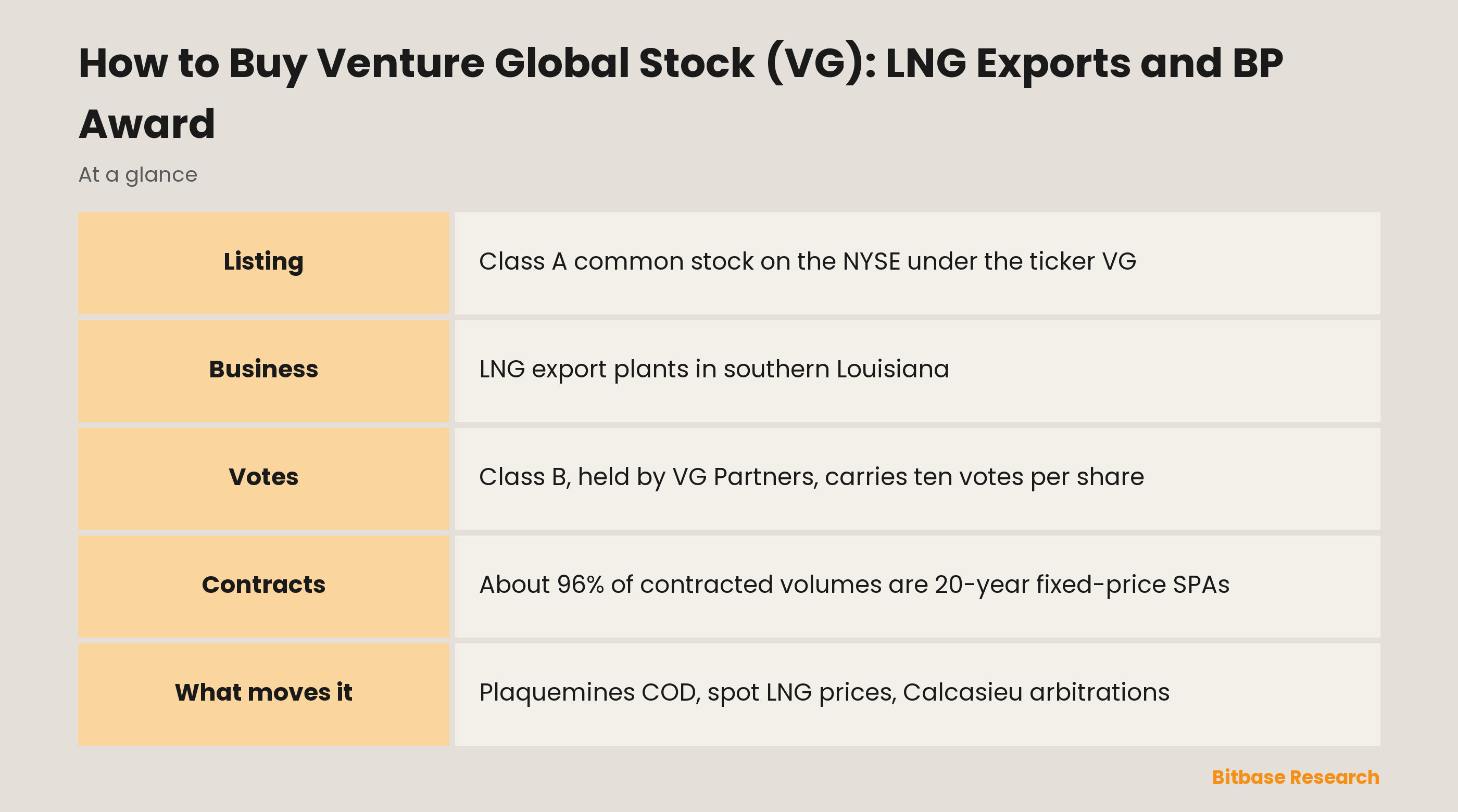
With the ticker VG, Venture Global's Class A common stock has traded on the New York Stock Exchange since January 2025, so a broker that offers US shares can fill the order; the Class B stock has no public market. Behind the ticker is a Louisiana exporter of liquefied natural gas whose revenue rose 177% in 2025 as its second plant ramped up, and whose first plant still faces customer arbitrations, one of them lost to BP. This guide covers the plants, the purchase, the share structure and what the filings flag.
What Does Venture Global Do?
Venture Global turns American natural gas into LNG and ships it abroad. The 10-K calls the company "a long-term, low-cost provider of U.S. LNG sourced from resource rich North American natural gas basins," with assets that "span the LNG supply chain, including LNG production, natural gas transportation, shipping and regasification." Chilling gas to about −260°F shrinks it to roughly 1/600th of its volume, small enough to ship.
Every liquefaction project it runs or plans sits in southern Louisiana, and it owns all or a majority of each one. Its method is a factory approach it calls "design-one, build-many": instead of two or three very large liquefaction trains, a plant uses many mid-scale, electric-motor-driven trains that are prefabricated in Italy and arrive fully assembled. Baker Hughes supplies the trains and power equipment under a long-term master agreement (see our Baker Hughes stock guide), and the 10-K notes these are "the first of such sized modules developed by us and Baker Hughes."
Calcasieu Pass, in Cameron Parish, has 18 trains and an expected annual output of 11.2 million tonnes (mtpa). It sold LNG during commissioning from early 2022 and declared its commercial operations date, or COD, on 15 April 2025. Plaquemines has 36 trains and an expected 28.0 mtpa; first LNG came in December 2024, Phase 1 declared COD on 31 October 2026, according to the third-quarter 10-Q, and Phase 2 is targeted for mid-2027. CP2, also in Cameron Parish, has 36 trains and an expected 29.0 mtpa. Its Phase 1 reached a final investment decision on 28 July 2025; the company targets first LNG in mid-2027 and COD for the two phases in late 2029 and mid-2030. Bolt-on expansions at Plaquemines and CP2 are in development, and a further project, CP3, had no filings with FERC or the Department of Energy as of the 10-K.
Around the plants sits the rest of the chain. The company contracted to buy nine LNG tankers, seven delivered when the 10-K was filed, holds regasification capacity at Alexandroupolis in Greece and, under construction, at Grain in the United Kingdom, and runs a marketing arm, VG Commodities, that resells output above the plants' guaranteed capacity.
The 10-K's competitor list runs from QatarEnergy to BP, Chevron, ConocoPhillips, ExxonMobil, Shell and Total, independents such as Cheniere and Freeport LNG, Sempra, and traders such as Glencore, Trafigura and Vitol, adding that "many of our competitors are also our customers." For a US peer with a longer record, see our Cheniere Energy stock guide.
In October 2026 the company floated a possible new line: an off-grid "AI Utility" that would power data centers from its own gas-fired power islands. It signed frame agreements with GE Vernova and Baker Hughes Energy Services for up to 16 new 720 MW units, and the 10-Q added a risk factor warning that the strategy "may not be successful."
How Venture Global Makes Money
Almost all revenue comes from selling LNG: more than 99% of the 2025 total. What a cargo earns depends on when in a plant's life it is sold:
| Sale type | When it happens | How it is priced |
|---|---|---|
| Commissioning sales | Before a plant or phase reaches COD | Spot, forward or short-term contracts at market levels |
| Contracted SPAs | After COD, or from a fixed start date | Fixed liquefaction fee plus a commodity fee of at least 115% of Henry Hub |
| Excess capacity sales | Output above guaranteed nameplate capacity | Resold by VG Commodities under contracts of various lengths |
The long-term contracts are the base. At the end of 2025 the company had signed 47.0 mtpa of sales and purchase agreements (SPAs) with third parties, and "approximately 96% of contracted volumes are under 20-year, fixed price sales and purchase agreements." Customers pay the fixed liquefaction fee "even if cargo deliveries are suspended or canceled," which is what makes the agreements bankable.
Commissioning is where the swings happen. A plant built from dozens of mid-scale trains is tested over a long stretch and can sell cargoes at market prices before its contracts start. The accounting has a twist: until assets are placed in service, proceeds from commissioning cargoes reduce construction cost on the balance sheet instead of counting as revenue.
That timing explains 2025. Revenue rose 177%, mainly because Plaquemines began producing in December 2024 and ramped up all year, with 380 cargoes exported against 141 in 2024. At Calcasieu, segment revenue fell 16% after the April 2025 COD moved its output from commissioning prices to contract prices, and Plaquemines' income from operations came out at more than three times Calcasieu's. The 10-K reports four segments, Calcasieu, Plaquemines, CP2 and Sales and Shipping, and a narrow customer base: three unnamed buyers accounted for 23%, 14% and 13% of 2025 revenue, together 50%.
The plants also aim past their rating. Calcasieu is rated at 10.0 mtpa and Plaquemines and CP2 at 20.0 mtpa each, yet the company says its facilities are designed to exceed nameplate "by as much as 40% annually," volume that VG Commodities can resell at market-linked prices.
Momentum carried into 2026: third-quarter revenue rose 43% from a year earlier and nine-month revenue 49%, which the results release credited "predominantly" to Plaquemines.
VG Stock at a Glance
| Feature | VG |
|---|---|
| Exchange | New York Stock Exchange |
| Ticker | VG |
| Listed security | Class A common stock, the only class registered under Section 12(b) |
| Unlisted class | Class B common stock, ten votes per share, all held by VG Partners |
| Business | US LNG export plants, gas pipelines, LNG tankers and regasification capacity |
| Listed since | 24 January 2025 (IPO completed 27 January 2025) |
| Index membership | Not in the S&P 500 |
| Headquarters | Arlington, Virginia |
| Incorporated | Delaware |
| Fiscal year | Calendar year, ending 31 December |
| Dividend | Cash dividends declared every quarter of 2026; amount and frequency not guaranteed |
| SEC identifier | CIK 2007855 |
For live price and market value, see the Venture Global stock page on Bitbase.
How to Buy Venture Global Stock
Venture Global is a Delaware company listed directly in New York, so no depositary receipt sits in between. Only one class is on offer: an order for VG buys Class A common stock, with one vote per share.
1. Find a broker that reaches the NYSE. Abroad, that means a local broker offering US shares or an international one; check which legal entity holds your account and who regulates it.
2. Open and verify the account. Brokers usually ask non-US individuals for IRS Form W-8BEN, which the IRS says to submit "when requested by the withholding agent or payer."
3. Fund it. Paying in another currency means a conversion, so the exchange rate counts as much as any commission.
4. Search VG. Confirm the line reads Venture Global, Inc. Class A common stock on the NYSE.
5. Choose the order. A market order fills at the going price; a limit order sets the worst price you accept and may not fill at all.
6. Decide the size. Fractional shares let you invest a fixed amount, but FINRA notes some firms offer them only for "large-cap stocks or ETFs" or not at all, and "as a fractional share owner, you might not have shareholder voting rights."
7. Keep the records. Confirmations and statements show your cost and any dividends paid.
Class A against Class B. The two classes share dividends equally per share, but voting is lopsided: as of 13 February 2026, VG Partners, through which founders Michael Sabel and Robert Pender control the company, held all of the roughly 2 billion Class B shares and about 97.6% of the combined voting power. A Class A buyer gets an economic stake and a very small say.
Tax outside the US. The IRS says "most types of U.S. source income received by a foreign person are subject to U.S. tax of 30%," and a tax treaty can lower that, which is why brokers collect the W-8BEN. Your home country may tax the same dividend again.
Through funds. VG was absent from State Street's SPY holdings file dated 9 November 2026, so an S&P 500 fund gives you none of it. Broader funds may hold it; only a fund's own holdings list can tell you.
What Moves VG Stock
Plaquemines moving onto contracts. Phase 1 reached COD on 31 October 2026 and began delivering under its long-term SPAs. Calcasieu showed in 2025 what that change does: revenue per cargo fell as contract pricing replaced commissioning prices. The same shift at Plaquemines changes both the size and the predictability of earnings.
Spot LNG prices. Commissioning cargoes and excess volume sell near market levels, so global gas prices, the spread between European and Asian benchmarks, weather and shipping all reach the results. The 10-K warns of "significant volatility in spot-market prices," and says Calcasieu, which "began producing LNG in a high-price environment," may not be a guide for later projects.
The Calcasieu arbitrations. Several long-term customers argued that Calcasieu took too long to declare COD, and the outcomes split. Tribunals found no breach in the Shell case in August 2025 and denied Repsol's claims in January 2026. In October 2025 a tribunal found against Venture Global in the BP case, with damages to be set at a hearing scheduled for May 2027; the company expects the final award to fall outside the contract's liability cap and calls BP's damages theory "without merit." In October 2026 a majority of the Galp tribunal also found a breach, over one dissent, in an award that will be subject to the contract's cap. One more customer case remained open in the 10-Q.
CP2 on time and on budget. First LNG is targeted for mid-2027. The cost estimate for both phases has already risen, which the 10-K ties to design changes and tariff contingencies, and costs "may increase further in the future, potentially materially."
Permits. The FERC and Department of Energy authorizations for CP2 are under appeal, and capacity increases and expansions need further approvals.
The data center plan. The AI Utility idea needs capital before it earns anything; the 10-Q warns of "a significant lag between capital investment and revenue generation."
Where Venture Global's Filings See the Risk
These items from the annual report bear most directly on a VG share:
One region. "Substantially all of our revenue is, and we expect will continue to be, dependent upon our LNG projects, all of which are currently located in southern Louisiana." A hurricane or a long outage would hit harder than at a company with assets spread out.
Few, large customers. Cash generation "is substantially dependent upon the performance by a limited number of our customers," and the 2025 split, three buyers at half of revenue, puts numbers to it.
Legal exposure. If the company loses customer disputes, "the amounts that we are required to pay may be substantial or certain of our post-COD SPAs may be terminated, which may lead to an acceleration of all our debt for the relevant project." The BP damages hearing is still ahead.
Capital and construction. "We will require significant additional capital to construct and complete certain of our projects," and estimated costs "have been, and continue to be, subject to change due to various factors."
Price competition later. When a contract ends or a new one is signed, the company faces "competition based upon the international market price for LNG."
Regulation. "We may fail to receive the required approvals and permits from governmental and regulatory agencies for our projects," and export licences can be appealed.
Founder control. "VG Partners has significant influence over us, including control over decisions that require their approval," and as a controlled company under NYSE rules, VG may opt out of some board independence requirements.
The share and the dividend. The 10-K flags "the possibility of significant fluctuations in the price of our Class A common stock." Venture Global is a holding company that depends on its subsidiaries for cash, and debt and preferred equity terms limit what they can pass up, so dividends could shrink or stop. A single-company position concentrates all of this in one holding.
How to Research VG Yourself
Venture Global files with the SEC under CIK 2007855. The 2025 annual report was filed on 2 March 2026, 10-Qs follow the first three quarters, and 8-Ks carry quarterly results and contract news; the third-quarter 2026 10-Q and results arrived on 10 November 2026.
In the 10-K, the business section holds the project table with trains, capacities and stages, plus the contract structure; the risk factors follow; the legal proceedings section lists the arbitrations case by case; and the segment note gives the figures for each plant and for Sales and Shipping. Each 10-Q's legal proceedings section shows which cases moved, which is how the Galp award and the October 2026 dismissal of the IPO securities class action became public.
When comparing periods, check whether a plant was in commissioning or under contract, since the same cargo count earns very different revenue in the two phases, and read "expected" and "nameplate" capacity separately: the gap is the excess volume VG Commodities sells.
Live quotes are on the stock page linked earlier, and the full list of US stock pages on Bitbase covers other listed companies.
Venture Global Stock FAQ
Can I buy Venture Global stock with crypto?
Not directly. VG shares are bought in US dollars through a brokerage account, so any crypto has to be sold first and the cash sent to the broker, a sale that can be taxable where you live. The two assets also give you different things, which is how a share differs from a crypto asset.
Does Venture Global pay a dividend?
Yes. The board declared a cash dividend in each quarter of 2026, paid equally on Class A and Class B shares, and declared another in November 2026. The 10-K says the company cannot assure "any dividend in the same amount or frequency as previous dividends, or at all," so check the latest release for the current amount.
What is the difference between VG Class A and Class B shares?
Class A is the listed stock, with one vote per share. Class B carries ten votes per share, has no public market and is held entirely by VG Partners, the founders' vehicle. Both share dividends equally per share.
Is Venture Global in the S&P 500?
No. It was not in State Street's SPY holdings file dated 9 November 2026.
What happened in the BP arbitration?
In October 2025 an ICC tribunal found that Venture Global's Calcasieu Pass subsidiary breached its obligations to declare COD in a timely manner and to act as a "Reasonable and Prudent Operator" under its contract with BP. Damages will be decided separately, at a hearing the 10-Q says is scheduled for May 2027.
Conclusion
Venture Global is a young listed company whose results depend on where each plant sits in its life cycle: commissioning cargoes at market prices, then contract volumes at fixed fees once a plant reaches COD. In late 2026 Plaquemines is making that switch, CP2 is still being built and the BP damages hearing lies ahead, while the founders keep nearly all the votes. Read the 10-K's project table and its legal proceedings section, follow each 10-Q for the arbitrations, and weigh how much of a portfolio one Louisiana LNG business should carry.
Related reading
Other Bitbase articles on this topic:
- How to Buy Cheniere Energy Partners Stock (CQP): Sabine Pass Units
- How to Buy Ecopetrol Stock (EC): One ADS, 20 Colombian Shares
- How to Buy EQT Stock (EQT): Range Deal, Marcellus Gas and Perps
- How to Buy Suncor Stock (SU): Oil Sands to Petro-Canada Pumps
Disclaimer: This article is educational content from Bitbase Academy, provided for information only. It explains what a company or fund does and how the instruments referenced here differ from one another; it does not constitute investment, trading, tax, or financial advice, and it is neither a recommendation nor an endorsement of any security, token, or trading strategy. A tokenized stock is issued by a third party and is designed to give economic exposure to an underlying asset: it is not a share, it carries no shareholder rights, and it depends on the issuer's structure, eligibility rules, and redemption terms, which the issuer can change. Perpetual futures are leveraged derivatives that hold no underlying asset and can be liquidated, and trading hours, product availability, and eligibility differ by instrument and by jurisdiction and can change at any time. Written as of November 2026; verify everything yourself through company filings, the issuer's own documentation, and the product pages of the venue you trade on.
References
[1] Venture Global Form 10-K for 2025 (SEC EDGAR) www.sec.gov
[2] Venture Global 2025 Form 10-K, XBRL cover page (SEC EDGAR) www.sec.gov
[3] Venture Global 2025 Form 10-K, XBRL segment data (SEC EDGAR) www.sec.gov
[4] Venture Global Form 10-Q for the third quarter of 2026 (SEC EDGAR) www.sec.gov
[5] Venture Global third-quarter 2026 results release, filed with Form 8-K (SEC EDGAR) www.sec.gov
[6] State Street SPDR S&P 500 ETF Trust (SPY): fund page and daily holdings www.ssga.com
[7] FINRA: Investing in Fractional Shares www.finra.org
[8] IRS: NRA Withholding www.irs.gov
[9] IRS: About Form W-8 BEN www.irs.gov





