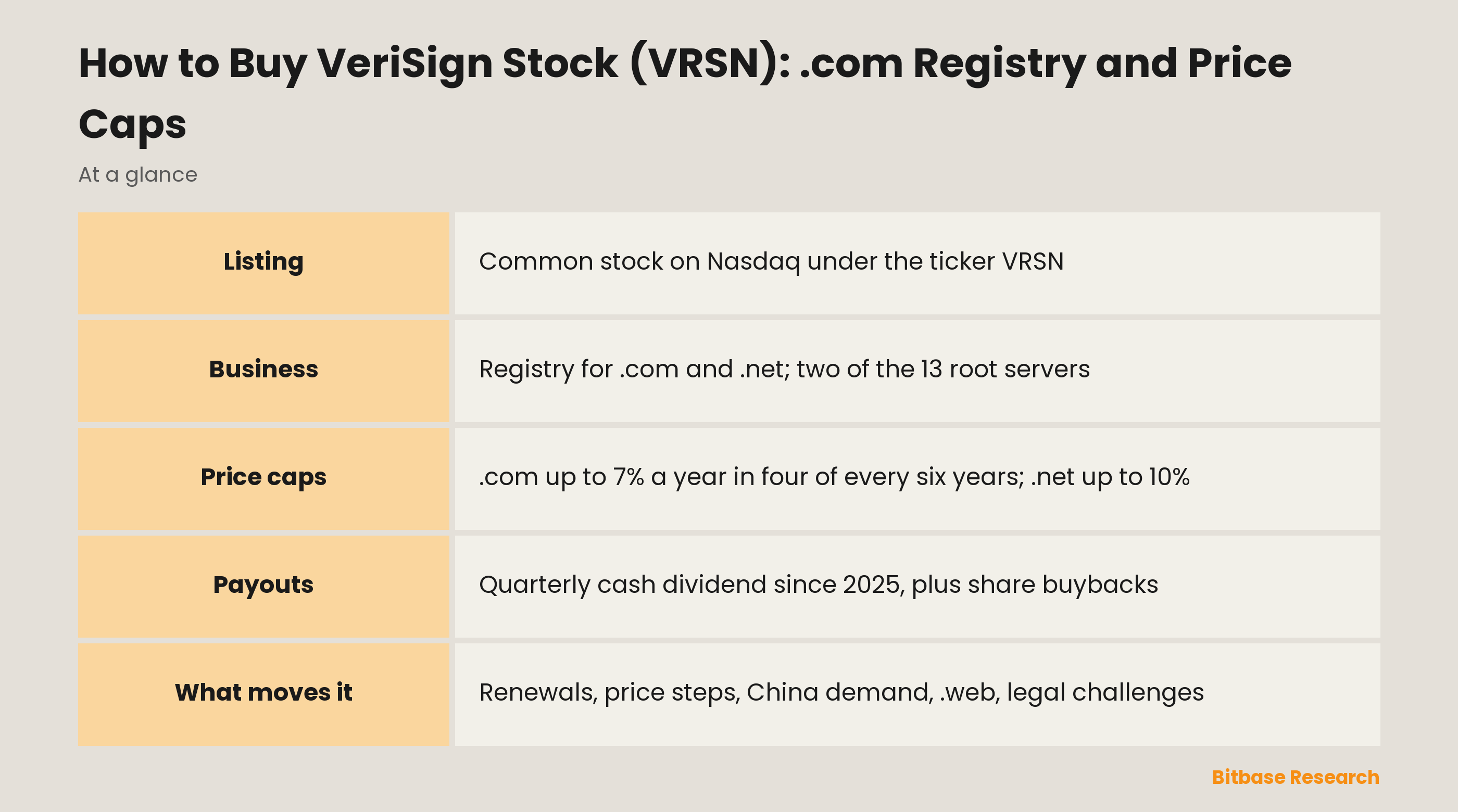
A Nasdaq-enabled brokerage account is all it takes to buy VeriSign stock, which trades there under the ticker VRSN. The company runs the central registries for .com and .net, operates two of the internet's 13 root servers, and in 2025 kept 67.7% of its revenue as operating income. Below: what VeriSign actually sells, how an order goes through, and why the price caps written into its ICANN contracts shape the stock more than almost anything else.
What Does VeriSign Do?
VeriSign calls itself "a global provider of critical internet infrastructure and domain name registry services." It was incorporated in Delaware on 12 April 1995 and is based in Reston, Virginia.
The easiest way to see the business is to follow one domain name. When a shop registers a .com address, it pays a registrar, one of the retailers that sell domain names to the public. The registrar then enters the name into VeriSign's central directory, the Shared Registration System, and pays VeriSign a fixed annual fee for it. The shop never deals with VeriSign directly. Registrations can run from one to 10 years, and VeriSign's servers answer the lookups that point browsers and email systems to the right address, which the 10-K puts at "hundreds of billions of transactions daily."
Besides .com and .net, VeriSign runs .name, versions of .com and .net written in other scripts, and the .cc country code under an agreement with the Cocos (Keeling) Islands, and it operates the back-end systems for .edu. It also works one level higher. As Root Zone Maintainer under a contract with ICANN, it publishes the root zone file that sits at the top of the Domain Name System, and it operates two of the 13 root servers that hold that data.
The infrastructure is concentrated. Its main data centers are in Dulles and Ashburn, Virginia, and New Castle, Delaware, with more than 200 other points of presence worldwide. The company points to a record of "more than 28 years of 100% DNS uptime" for .com and .net in the 10-K, and in July 2026 chief executive Jim Bidzos said the record had reached 29 years. All of this is run by a small staff: 928 employees at the end of 2025, about 93% of them in the United States.
Two newer projects sit next to the core. The .web top-level domain, which VeriSign pursued through an agreement with the applicant Nu Dotco and through challenges from a losing bidder that began in 2018, was delegated into the root zone in July 2026 with VeriSign as registry operator. And by October 2026 the company had opened a limited beta of Verisign Informed, which it describes as a high-assurance validation service. Its 10-Q also mentions an application for a .pki domain.
How VeriSign Makes Money
VeriSign reports a single business segment, and the 10-K is blunt about where the money comes from: "Substantially all of our revenues are derived from our operation of the .com gTLD" and of .net. Revenue therefore moves with three things: how many new names registrars sign up, how many existing names are renewed, and the wholesale price per name.
The price is the unusual part. Under the .com Registry Agreement, VeriSign may raise the annual .com fee by up to 7% in each of the final four years of each six-year period; the current period began on 26 October 2024. The .net agreement allows up to 10% a year. The company has used both: .com rose by about 7% in September 2024 and rose by a further 6.9% or so effective 1 November 2026, while .net rose by 10% in February 2024 and is scheduled for another 10% increase from 1 March 2027. Unlike other generic top-level domains, .com, .net and .name have prices capped by contract.
Registrars pay upfront, but VeriSign books the fee gradually over the registration term. Cash arrives before revenue, and the unrecognized part sits on the balance sheet as deferred revenue, some of which, the 10-K says, will be recognized "up to ten years" later.
| 2025 measure | Reading | Source |
|---|---|---|
| Revenue growth | 6%, mainly from .com and .net price increases and a larger domain name base | 10-K |
| Operating income as a share of revenue | 67.7% (67.9% in 2024) | 10-K |
| Net income as a share of revenue | 49.8% | 10-K |
| .com and .net domain name base, 31 December | 173.5 million, up 2.6% | 10-K |
| New .com and .net registrations | 41.7 million, against 37.4 million in 2024 | 10-K |
| Revenue from US-based registrars | about 66% (EMEA about 17%, Asia Pacific about 11%, other about 6%) | 10-K revenue note |
| Largest customer | about 31% of revenue | 10-K revenue note |
The regional split follows where registrars are domiciled, not where the people buying names live, so a US registrar selling to customers abroad still counts as US revenue. The largest customer is not named. VeriSign says losing it would not have a material adverse effect, because its end-users "would transfer to the Company's other existing customers."
The cost base is light: cost of revenues was 11.8% of revenue in 2025. Most of the cash goes back to shareholders. VeriSign bought back 6.6 million of its own shares in 2024 and 3.4 million in 2025, and in April 2025 it began paying a quarterly cash dividend. Years of buybacks have left the balance sheet with a total stockholders' deficit, meaning recorded liabilities exceed recorded assets. Shares outstanding fell from 95.0 million to 91.9 million during 2025.
VRSN Stock at a Glance
| Feature | VRSN |
|---|---|
| Exchange | Nasdaq Global Select Market |
| Ticker | VRSN |
| Security | Common stock, the only class registered under Section 12(b) |
| Business | Domain name registry and DNS infrastructure (.com, .net, .name, .cc, .web) |
| Index membership | S&P 500 |
| Headquarters | Reston, Virginia |
| Incorporated | Delaware, 1995 |
| Fiscal year | Calendar year, ending 31 December |
| Payouts | Quarterly cash dividend since 2025; share repurchase program with no expiration date |
| SEC identifier | CIK 1014473 |
Prices, market value and yield change through the trading day. For live figures, open the VeriSign stock page on Bitbase.
How to Buy VeriSign Stock
VeriSign is a US company filing a 10-K, so there is no depositary receipt in the picture: the shares on Nasdaq are the common stock itself. A purchase usually looks like this:
1. Find a broker that reaches Nasdaq. Outside the United States this can be a local firm with a US-shares service or an international broker. Check which legal entity holds your account and who regulates it.
2. Complete the account checks. Brokers verify identity, and investors who are not US persons are normally asked for IRS Form W-8BEN; the IRS tells people to submit it "when requested by the withholding agent or payer."
3. Fund the account. If your money is in a currency other than US dollars, the conversion rate and fee can cost more than the commission.
4. Search for VRSN. Confirm the match reads VeriSign, Inc. common stock on Nasdaq; the 10-K cover registers no other class.
5. Choose the order. FINRA explains that a market order is the type most likely to be filled, while a limit order only executes "at or better than a specified price." A limit protects you when the price moves quickly.
6. Decide the amount. Some brokers sell fractional shares, which let you invest a fixed sum, though FINRA warns that a fractional owner "might not have shareholder voting rights."
Keep your trade confirmations. They are the record of what you paid and of each dividend you receive.
Tax outside the US. Dividends from a US company paid to a foreign investor generally face 30% US withholding under IRS rules, unless a tax treaty between your country and the United States lowers it. That is why brokers ask for the W-8BEN. Your home country may tax the same dividend again.
The fund route. VRSN is an S&P 500 member, so funds that track that index, such as State Street's SPY, hold it as a small slice of a much larger basket.
What Moves VRSN Stock
Registrations and renewals. The domain name base fell 2% in 2024, then grew 2.6% in 2025, and by 30 September 2026 it stood at 182.5 million names, 6.1% more than a year earlier. New registrations in the third quarter of 2026 reached 13.1 million, against 10.6 million a year before. The renewal rate matters just as much. It was 75.2% for the second quarter of 2026 against 75.5% a year earlier, and the company only reports it with a lag, since renewals are "not fully measurable until 45 days after the end of the quarter."
Each price step. Because the contracts cap increases, every announced change is a known event: the August 2026 .net increase was announced in an 8-K, and the 10-Q records both. A price rise lifts revenue per name but, the 10-K warns, "there could be a decrease in the demand and/or renewal rates."
China. The 10-K says demand "substantially declined in China during 2023 and 2024," partly because of Chinese regulatory mandates that made it harder to register a domain name, and that registries and China-based registrars need a government license for each top-level domain they operate there.
Capital returns. Buybacks shrink the share count each year, which raises earnings per share even when net income is flat. That is visible in the third quarter of 2026: net income was unchanged from a year earlier, while diluted earnings per share rose. The board can change either payout.
New names and new products. .web gives VeriSign a new extension to sell through the same registrars; in October 2026 Bidzos said its rollout was "on track." Verisign Informed and the .pki application are earlier still. The 10-Q warns that for new products "the size and extent of the demand" is "not precisely known."
Past returns. VeriSign's own performance graph shows what this mix has delivered: from the end of 2020 to the end of 2025, its cumulative total return was 13%, against 96% for the S&P 500 and 158% for the S&P 500 Information Technology Index.
Where VeriSign's Registry Model Is Exposed
These points from Item 1A of the 10-K, and the latest 10-Q, matter most to a VRSN holder:
The contracts themselves. "Any loss or modification of our right to operate the .com and .net gTLDs could have a material adverse impact on our business." The .com agreement runs to 30 November 2030 and the .net agreement to 30 June 2029, both with a "presumptive" right of renewal, but ICANN can refuse renewal in specified cases, and renewal terms can be pulled toward those of the five largest gTLDs.
Challenges to pricing. The .com contracts and their pricing terms "have been challenged, and could face challenges in the future." On 4 September 2026 a putative class action was filed against VeriSign and ICANN in federal court in California, raising antitrust claims over the .com agreement and .com pricing. VeriSign says it will defend the case and cannot estimate any loss.
Attacks and outages. As an operator of critical infrastructure, the company says it faces "a high rate of cyber-attacks," including DDoS attacks that AI tools are making larger, and it does "not maintain specific reserves" for such events. An error in the root zone or the .com zone could knock names off the internet.
Fewer people typing addresses. The 10-K lists social media, apps, search, AI and "blockchain namespaces" as possible substitutes for domain names. Crypto readers will recognize the last one: names that live outside the single authoritative DNS root, which VeriSign treats as a demand risk.
Registrars hold the customer. "All of the domain name registrations and renewals for the registries we operate occur through registrars." When those registrars push new extensions or their own services, .com loses shelf space.
Rules and governance. New laws, ICANN policies or a weakening of the multi-stakeholder model of internet governance could add costs. Rules that forced VeriSign to collect registrants' personal data would bring GDPR-type obligations it does not carry today.
The payout. "There is no assurance that the Board will declare and thus that we will pay, any dividends." And a single stock ties your money to one company's contracts.
How to Research VRSN Yourself
VeriSign files with the SEC under CIK 1014473: the 10-K each February, 10-Qs for the first three quarters and 8-Ks for events. In 2026 the quarterly results came on 5 February, 23 April, 23 July and 22 October. Copies are also on investor.verisign.com.
In the 10-K, Item 1 describes the .com, .net and root zone agreements, Item 1A lists the risks, Item 3 covers legal proceedings, and the MD&A gives the domain name base, new registrations and renewal rates. The revenue note discloses the regional split and the largest-customer share. Between filings, the company publishes zone counts for .com and .net that it updates at least once a day, so you can follow the domain name base yourself.
Two checks help. First, read the price announcements as dates, not as revenue: an increase takes effect on a set day and is booked gradually, so it shows up in revenue over the following years. Second, compare the renewal rate quarter by quarter, keeping in mind it trails by one quarter. If you want to compare VeriSign with another listed internet infrastructure company, our Cloudflare stock guide covers one. Live quotes are on the stock page linked above, and all US stock pages on Bitbase list many more listed companies.
VeriSign Stock FAQ
Can I buy VeriSign stock with crypto?
Not directly. VRSN shares are bought through a brokerage account in US dollars, so crypto has to be sold for cash and moved to the broker first, and that sale may be taxable where you live. The two are different assets: a share is a registered claim on the company, which is how a stock differs from a crypto asset.
Does VeriSign pay a dividend?
Yes, since April 2025. VeriSign pays a quarterly cash dividend and raised it by 5.2% in February 2026. The 10-K says it intends to keep paying quarterly, subject to market conditions and board approval, and the board "may, in its discretion, decrease the level of cash dividends." Check the latest earnings release for the current amount and dates.
Is VRSN in the S&P 500?
Yes. VeriSign Inc appeared in State Street's daily holdings file for SPY on 10 November 2026. Although it trades on Nasdaq, it did not appear in Invesco's holdings data for QQQ, the fund that tracks the Nasdaq-100, on the same date.
Does VeriSign own the .com domain?
No. It operates the .com registry under a registry agreement with ICANN and a Cooperative Agreement with the US Department of Commerce, which requires it to run .com in a "content-neutral manner." The .com agreement runs to 30 November 2030 with a presumptive right of renewal.
Why did Berkshire Hathaway sell VeriSign shares in 2025?
In July 2025, two Berkshire Hathaway-affiliated pension trusts sold 4.3 million VRSN shares in an offering that VeriSign said was sized to bring Berkshire's beneficial ownership "below the ten percent threshold that triggers additional regulatory obligations." Berkshire affiliates had held the stock since 2012. VeriSign received none of the proceeds.
Conclusion
VeriSign is a toll collector on two of the internet's oldest addresses, with prices set by contract, costs that barely move and most of its cash returned to shareholders. That makes the stock a bet on a few specific things: how many .com names people keep renewing, whether regulators and courts leave the pricing terms alone, and whether the contracts are renewed on similar terms in 2029 and 2030. Read the 10-K's agreement sections and the quarterly renewal rates before you decide how much of your portfolio one registry should be.
Related reading
Other Bitbase articles on this topic:
- How to Buy MSCI Stock (MSCI): Indexes, ETF Fees and BlackRock
- How to Buy Nebius Stock (NBIS): AI Cloud, Ex-Yandex and Perps
- How to Buy Okta Stock (OKTA): Auth0, AI Agents and Class B Votes
Disclaimer: This article is educational content from Bitbase Academy, provided for information only. It explains what a company or fund does and how the instruments referenced here differ from one another; it does not constitute investment, trading, tax, or financial advice, and it is neither a recommendation nor an endorsement of any security, token, or trading strategy. A tokenized stock is issued by a third party and is designed to give economic exposure to an underlying asset: it is not a share, it carries no shareholder rights, and it depends on the issuer's structure, eligibility rules, and redemption terms, which the issuer can change. Perpetual futures are leveraged derivatives that hold no underlying asset and can be liquidated, and trading hours, product availability, and eligibility differ by instrument and by jurisdiction and can change at any time. Written as of November 2026; verify everything yourself through company filings, the issuer's own documentation, and the product pages of the venue you trade on.
References
[1] VeriSign Form 10-K for 2025 (SEC EDGAR) www.sec.gov
[2] VeriSign 2025 Form 10-K, XBRL cover page (SEC EDGAR) www.sec.gov
[3] VeriSign 2025 Form 10-K, XBRL revenue by region (SEC EDGAR) www.sec.gov
[4] VeriSign 2025 Form 10-K, XBRL customer concentration (SEC EDGAR) www.sec.gov
[5] VeriSign Form 10-Q for the third quarter of 2026 (SEC EDGAR) www.sec.gov
[6] VeriSign third-quarter 2026 earnings release, filed with Form 8-K (SEC EDGAR) www.sec.gov
[7] VeriSign second-quarter 2026 earnings release, filed with Form 8-K (SEC EDGAR) www.sec.gov
[8] VeriSign Form 8-K of 27 August 2026: .net price change (SEC EDGAR) www.sec.gov
[9] VeriSign Form 8-K of July 2025: secondary offering by Berkshire-affiliated trusts (SEC EDGAR) www.sec.gov
[10] State Street SPDR S&P 500 ETF Trust (SPY): fund page and daily holdings www.ssga.com
[11] Invesco QQQ: fund overview www.invesco.com
[12] FINRA: Order Types www.finra.org
[13] FINRA: Investing in Fractional Shares www.finra.org
[14] IRS: NRA Withholding www.irs.gov
[15] IRS: About Form W-8 BEN www.irs.gov