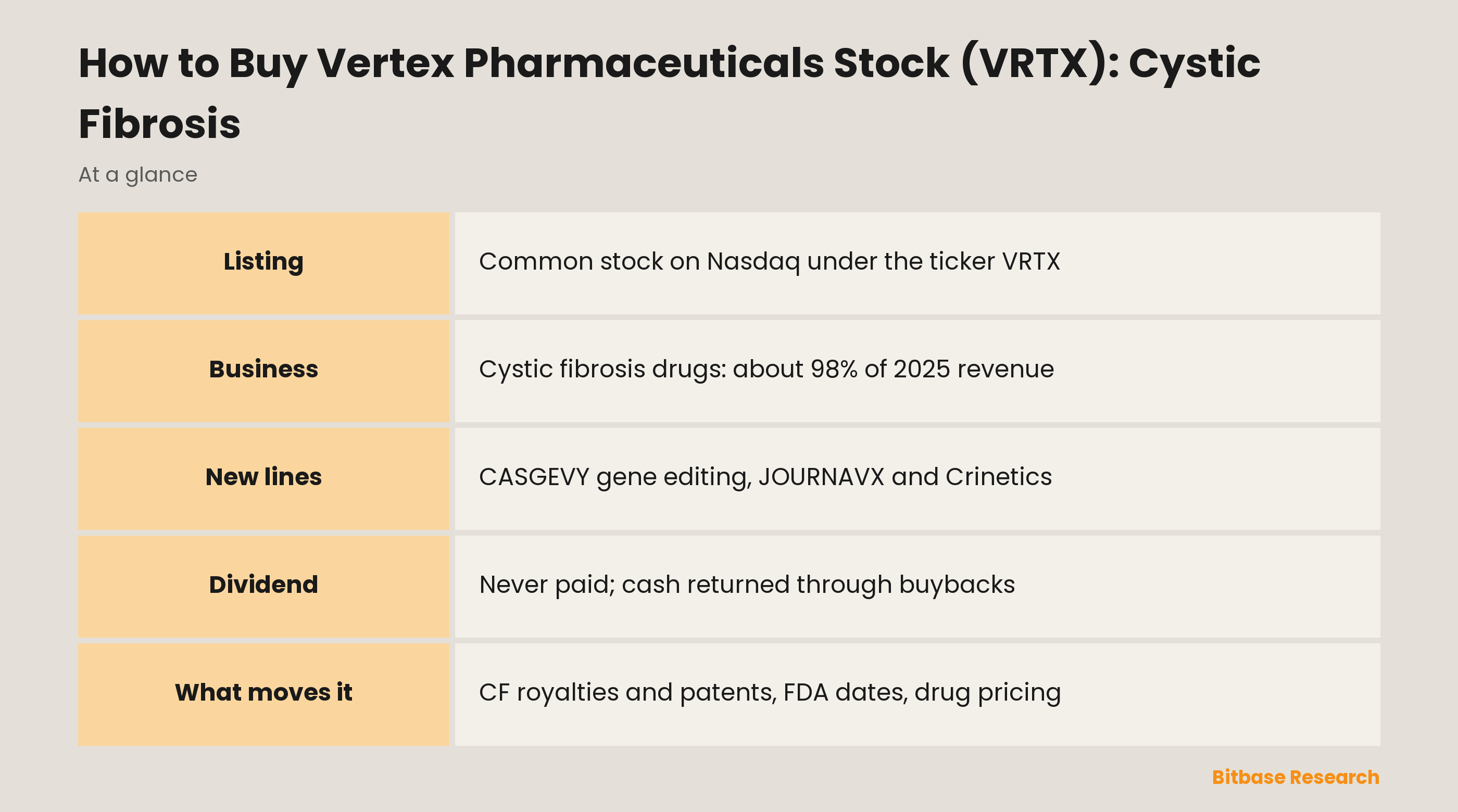
You place an order for Vertex Pharmaceuticals stock with any broker that can trade on the Nasdaq Global Select Market, where the company's common stock is listed as VRTX. What the ticker buys is a concentrated business: cystic fibrosis medicines brought in about 98% of Vertex's 2025 revenue, and the company has been building other lines around them, from a CRISPR gene-editing therapy and a non-opioid pain pill to the endocrine medicines that arrived with Crinetics in September 2026. This guide explains where Vertex's revenue comes from, walks through the purchase and points to the dates in its filings worth watching, from the CF patent table to the FDA review of its kidney drug povetacicept.
What Does Vertex Pharmaceuticals Do?
Vertex Pharmaceuticals is a drugmaker that discovers, develops and markets prescription medicines. In its 10-K it calls itself "a global biotechnology company that invests in scientific innovation to create transformative medicines for people with serious diseases, with a focus on specialty markets." The company was incorporated in Massachusetts in 1989, has its headquarters in Boston and reports a single segment, pharmaceuticals. Reshma Kewalramani has been chief executive since April 2020.
Cystic fibrosis (CF) is the core of the business. CF is an inherited disease: mutations in the CFTR gene leave the CFTR protein defective or missing, and mucus builds up in the lungs and other organs. Vertex sells five CF medicines, all CFTR modulators that act on that protein. KALYDECO, the earliest of the five, was approved by the FDA in January 2012. ORKAMBI and SYMDEKO (sold as SYMKEVI in Europe) came next, then TRIKAFTA (KAFTRIO in Europe), approved in the US in October 2019. ALYFTREK, a once-daily triple combination, was approved by the FDA in December 2024. The 10-K says the five reach nearly three quarters of people with CF in the US, Europe, Australia and Canada, and expects "the majority of people with CF will transition to ALYFTREK over time."
Two newer medicines sit outside CF. CASGEVY is a gene-editing therapy for severe sickle cell disease (SCD) and transfusion-dependent beta thalassemia (TDT), two inherited blood disorders. The FDA first approved it in December 2023, for SCD, and Vertex develops it with CRISPR Therapeutics. Treatment is a sequence rather than a prescription: a patient's blood stem cells are collected at an authorised treatment centre, edited with CRISPR/Cas9 at a manufacturing site and infused after conditioning that clears space in the bone marrow. In 2025, 147 people had a first cell collection and 64 received infusions. Vertex's August 2026 results release added that the FDA had approved CASGEVY for children aged 2 and older.
JOURNAVX (suzetrigine) is an oral, non-opioid pain medicine that selectively inhibits a sodium channel the 10-K describes as playing an important role in pain. The FDA approved it in January 2025 for moderate-to-severe acute pain in adults, and it reached US pharmacies that March.
Acquisitions supply the rest. Alpine Immune Sciences, bought in 2024, brought povetacicept, a candidate for the kidney disease IgA nephropathy. On 1 September 2026 Vertex completed its purchase of Crinetics Pharmaceuticals, which became a wholly owned subsidiary and left Nasdaq. Crinetics added PALSONIFY (paltusotine), a once-daily oral treatment for adults with acromegaly, a rare condition caused by a pituitary tumour that secretes excess growth hormone, and atumelnant, a Phase 3 candidate for congenital adrenal hyperplasia. While the deal was pending, the chief executive described it as adding rare endocrine diseases "as our fifth pillar."
How Vertex Pharmaceuticals Makes Money
Nearly all of the money still comes from CF medicines. Total revenue rose about 9% in 2025, and the product revenue note divides it like this:
| Product line | What it treats | Share of 2025 revenue |
|---|---|---|
| TRIKAFTA/KAFTRIO | Cystic fibrosis | 85.9% |
| ALYFTREK | Cystic fibrosis | 7.0% |
| KALYDECO, ORKAMBI, SYMDEKO/SYMKEVI | Cystic fibrosis | 5.4% |
| CASGEVY | Sickle cell disease and beta thalassemia | 1.0% |
| JOURNAVX | Acute pain | 0.5% |
| Other revenues | Upfront payments from licensing partners | 0.3% |
Percentages are worked out from the 10-K's fiscal 2025 figures and rounded, so the column does not sum exactly.
The table hides a handover inside CF. TRIKAFTA/KAFTRIO grew about 1% in 2025, while ALYFTREK, approved at the end of 2024, reached about 7.0% of revenue in its first full year on sale.
Vertex sells mainly to a small number of specialty pharmacies and specialty distributors, and to certain major US wholesalers, which resell to patients, pharmacies and hospitals. McKesson accounted for 22% of gross product revenue in 2025 and Accredo for 12%. Outside the United States, reimbursement is negotiated country by country.
About 63% of 2025 revenue came from the United States and about 37% from the rest of the world, Europe alone accounting for about 29%. US revenue grew 13% and international revenue 3%. The 10-K attributes part of the weaker international figure to Russia, "where we are continuing to experience a violation of our intellectual property rights."
Cost of sales consists mainly of royalties on CF sales rather than manufacturing. Under a 2004 agreement with the Cystic Fibrosis Foundation, Vertex pays tiered royalties on its CF medicines. The 10-K puts the royalty burden on TRIKAFTA/KAFTRIO at 9.33%, and Vertex's position is that ALYFTREK carries 4%. On 10 October 2025 Royalty Pharma, to which the foundation assigned its rights, began a confidential arbitration claiming the ALYFTREK rate is about 8%. Vertex calls that position contrary to the plain terms of the agreement, and the 10-Q for the second quarter of 2026 described the dispute in the same terms.
CASGEVY has different economics: net profits and losses on it are allocated 60% to Vertex and 40% to CRISPR Therapeutics, subject to adjustments, and Vertex leads its development, manufacturing and commercialisation.
The 2026 filings show the same shape. Second-quarter revenue rose 12% from a year earlier and CASGEVY revenue 151%. JOURNAVX prescriptions passed 550,000 from launch to the end of 2025, and about 900,000 were filled in the first half of 2026 alone.
VRTX Stock at a Glance
| Item | Detail |
|---|---|
| Exchange | Nasdaq Global Select Market |
| Ticker | VRTX |
| Security | Common stock; the 10-K cover registers no other security |
| Sector | Biotechnology: medicines for specialty markets |
| Index membership | S&P 500 and Nasdaq-100 |
| Benchmark in the 10-K | NASDAQ Biotechnology Index |
| Headquarters | Boston, Massachusetts |
| Incorporated | Massachusetts, 1989 |
| Fiscal year | Calendar year, ending 31 December |
| Dividend policy | No cash dividend has ever been paid; shares are repurchased under a 2025 programme |
| SEC identifier | CIK 875320 |
Price, market value and trading volume change with every trade; for live figures, open the Vertex Pharmaceuticals stock page on Bitbase.
How to Buy Vertex Pharmaceuticals Stock
Vertex is a US company and VRTX is its common stock, so no depositary receipt or second share class is involved. The route goes through a broker:
1. Find a broker that offers Nasdaq stocks. Investors outside the US can use a home-market broker with a US trading service or an international firm; confirm which legal entity keeps your account and which regulator oversees it.
2. Complete the identity checks. A non-US individual typically signs IRS Form W-8BEN to certify foreign status for US tax purposes.
3. Deposit funds. When your money starts in another currency, the FX spread is a fee in its own right, next to the commission.
4. Search VRTX and check the result. It should read Vertex Pharmaceuticals common stock on Nasdaq. Crinetics shares no longer trade, so the deal leaves nothing separate to buy.
5. Pick the order type. A market order "guarantees that the order will be executed, but does not guarantee the execution price"; a limit order fills only "at a specific price or better."
6. Decide on the amount. Fractional shares allow a fixed-cash purchase, but "not every brokerage firm offers fractional share investing," some firms take only market orders for fractions, and "you may not have voting rights if you own fractional shares."
7. Keep the confirmations. Trade confirmations and statements record what you paid, which you will need when you sell.
If your broker accepts orders before the open or after the close, keep in mind that regular-hours and extended-hours prices may not match, and a limit order caps your price when few shares are changing hands.
Outside the United States, there is no dividend to withhold tax from. The IRS states that "most types of U.S. source income received by a foreign person are subject to U.S. tax of 30%," and that "a reduced rate, including exemption, may apply" under a tax treaty; a VRTX holding currently pays nothing for that rule to reach. How a gain is taxed when you sell depends on where you live.
Through an index fund, the exposure comes without picking the stock. Vertex belongs to both the S&P 500 and the Nasdaq-100, so a fund that fully replicates either one owns it among many other holdings; SPY, State Street's S&P 500 trust, listed it in holdings dated 28 October 2026.
What Moves VRTX Stock
The switch to ALYFTREK and its royalty. Moving patients from TRIKAFTA to ALYFTREK changes what Vertex owes on each sale: 9.33% on the older medicine, 4% on the newer one in Vertex's reading of the agreement. The Royalty Pharma arbitration challenges that reading, and because the company expects most CF patients to end up on ALYFTREK, the rate decided there applies to the product it plans to sell most.
The CF patent calendar. The 10-K's table of basic product patents projects US expiry in 2027 for SYMDEKO, 2028 for KALYDECO and 2031 for ORKAMBI, the three older medicines behind about 5.4% of 2025 revenue. The basic US patent on TRIKAFTA runs to 2037 and the one on ALYFTREK to 2039. Vertex holds later patents on forms and formulations, but cautions that "in some cases, however, such patents may not protect our drug from generic competition after the expiration of the basic patent."
Whether the new medicines grow fast enough to matter. CASGEVY and JOURNAVX together made up about 1.5% of 2025 revenue, yet the 10-K says that "a portion of the value attributed to our company by investors is based on the expected commercial success of JOURNAVX for acute pain." Prescription counts and insurance coverage, reported each quarter, therefore carry weight beyond today's revenue. For CASGEVY, the figures to watch are how many patients move from cell collection to infusion and how many countries reimburse it.
FDA decisions and trial readouts with dates attached. Vertex completed its rolling application for povetacicept in IgA nephropathy in March 2026, using a priority review voucher to shorten the review. The second-quarter 10-Q says the FDA accepted the application for accelerated approval and set a target action date of 30 November 2026. The same report expects interim data on inaxaplin, for APOL1-mediated kidney disease, in early 2027, and enrolment in two Phase 3 trials of suzetrigine in diabetic peripheral neuropathy to finish by the end of 2026. Such dates can shift: for the type 1 diabetes cell therapy zimislecel, the 10-K said dosing had been temporarily postponed pending a manufacturing analysis, and the June 2026 report described the trial as enrolling and dosing again.
Integrating Crinetics. Vertex funded the purchase with cash and a new term loan, and its quarterly report states that the deal's benefits "depend on revenues from PALSONIFY and the commercial potential of atumelnant." Results from the third quarter of 2026 onward include Crinetics, so they will not compare like for like with earlier periods.
Drug pricing policy. The 10-K notes that "certain drugs, including our CF medicines and CASGEVY, currently are excluded from the IRA negotiation program," the Medicare price negotiation created by the Inflation Reduction Act. It warns that the redesign of Medicare Part D, which makes drugmakers cover more of patients' costs, may still have a material impact.
Where a VRTX Share Is Exposed
Of the risks in Item 1A of the 10-K, these bear most directly on a VRTX share:
One franchise. "Our business is substantially dependent on the success of our CF medicines." Because substantially all net product revenue has come from them, a manufacturing disruption, a safety finding or pricing pressure in that one franchise would reach almost the whole business. Other drugmakers lean on one disease area too, as the profile of Gilead's HIV business shows, but at Vertex the CF share is close to the total.
A demanding therapy to deliver. For CASGEVY, the filing states that "the cost of manufacturing CASGEVY as a percentage of revenue is significantly higher than for our CF medicines," and that acceptance depends partly on the side effects of the procedure, including the conditioning before infusion.
Intellectual property. "If we are unable to obtain, maintain and enforce our intellectual property rights, our business could be harmed." Beyond Russia, Vertex and its CASGEVY manufacturing partners are in patent litigation with ToolGen in the US, the UK and the Netherlands, where ToolGen alleges that the CASGEVY manufacturing process infringes its CRISPR/Cas9 patents.
Debt and integration. "Future indebtedness could materially and adversely affect our financial condition, and the terms of our credit agreements impose restrictions on our business." Vertex took on a term loan to help pay for Crinetics, and its June 2026 quarterly report adds the risk that integrating Crinetics may not deliver the expected benefits.
Two more sit at the level of the shares. "Our stock price is volatile," the 10-K says, naming clinical news and financial results among the triggers. And because Vertex pays no dividend, any return on a VRTX holding depends entirely on the share price, and for non-US investors that price arrives converted at the going exchange rate.
How to Follow VRTX in Its Filings
Vertex's filings sit on EDGAR under CIK 875320: the annual 10-K, a 10-Q for each of the first three quarters, and an 8-K whenever something material happens, such as earnings releases, the March 2026 completion of the povetacicept application, the July 2026 merger agreement with Crinetics and changes among executives and directors.
Inside the 10-K, Item 1 covers the medicines, the CRISPR Therapeutics agreement and the patent table, Item 1A the risks, and the segment note revenue by product, region and major customer. The structured cover, R1.htm, confirms that VRTX is the only registered security.
Crinetics' own filings remain on EDGAR, including its 10-Q for the second quarter of 2026, which describes PALSONIFY and atumelnant in more detail, and its September 2026 report on completing the merger. Live prices are on the stock page linked earlier, and more US stock pages on Bitbase cover other companies.
Vertex Pharmaceuticals Stock FAQ
Does Vertex Pharmaceuticals pay a dividend?
No. The 10-K states: "We have never paid any cash dividends on our common stock, and we do not anticipate paying any in the foreseeable future." Vertex returns cash through share repurchases instead, under a programme its board approved in May 2025 that has no expiration date and can be discontinued at any time.
Can I buy Vertex Pharmaceuticals stock with crypto?
Not directly. Vertex shares are held in a brokerage account and Nasdaq settles trades in US dollars, which means converting crypto to cash and transferring that cash to the broker before the order goes in. Depending on your country, selling the crypto can trigger tax of its own. The two assets also give you different things: a VRTX share is a registered ownership stake that carries a vote; a crypto token is neither. The guide to buying stocks with crypto covers that route step by step.
Is VRTX in the S&P 500 and the Nasdaq-100?
Yes, both. Vertex appears on Nasdaq's Nasdaq-100 constituent list dated 29 October 2026, and SPY, State Street's S&P 500 trust, lists it in holdings dated 28 October 2026. Index weights change daily.
What did Vertex get when it bought Crinetics?
A marketed medicine and a late-stage candidate. Crinetics' filings date the FDA approval of PALSONIFY for acromegaly to September 2025, and Vertex's quarterly report describes it as approved by the FDA and the European Medicines Agency; atumelnant is in Phase 3. The merger closed on 1 September 2026 and Crinetics shareholders were paid in cash.
Has Vertex stock ever split?
Yes. Vertex's annual report for 2000 records a two-for-one split, paid as a 100% stock dividend and distributed on 23 August 2000. Per-share figures from before that date need adjusting before comparison.
Conclusion
Placing a VRTX order takes a broker with Nasdaq access, the right ticker and a choice between a market and a limit order. Understanding what the share holds takes longer: a CF franchise that produced about 98% of 2025 revenue, newer medicines in blood disorders, pain and now acromegaly, and a pipeline with FDA dates attached. The patent table, the Royalty Pharma arbitration and the povetacicept review are the first things to check, and the newest 10-Q and 8-Ks show where each stands before you decide how much of your money one biotech company should carry.
Related reading
Other Bitbase articles on this topic:
- How to Buy Regeneron Stock (REGN): Dupixent Profits and EYLEA HD
- How to Buy Sanofi Stock (SNY): Half-Share ADS and Dupixent
- How to Buy Takeda Stock (TAK): Two ADSs per Share, Entyvio
Disclaimer: This article is educational content from Bitbase Academy, provided for information only. It explains what a company or fund does and how the instruments referenced here differ from one another; it does not constitute investment, trading, tax, or financial advice, and it is neither a recommendation nor an endorsement of any security, token, or trading strategy. A tokenized stock is issued by a third party and is designed to give economic exposure to an underlying asset: it is not a share, it carries no shareholder rights, and it depends on the issuer's structure, eligibility rules, and redemption terms, which the issuer can change. Perpetual futures are leveraged derivatives that hold no underlying asset and can be liquidated, and trading hours, product availability, and eligibility differ by instrument and by jurisdiction and can change at any time. Written as of October 2026; verify everything yourself through company filings, the issuer's own documentation, and the product pages of the venue you trade on.
References
[1] Vertex Pharmaceuticals Form 10-K, fiscal 2025 (SEC EDGAR) www.sec.gov
[2] Vertex Pharmaceuticals Form 10-Q, quarter ended 30 June 2026 (SEC EDGAR) www.sec.gov
[3] Vertex Pharmaceuticals second-quarter 2026 results release, 3 August 2026 (SEC EDGAR) www.sec.gov
[4] Vertex Pharmaceuticals Form 8-K, 31 March 2026: povetacicept application (SEC EDGAR) www.sec.gov
[5] Vertex Pharmaceuticals Form 8-K, July 2026: Crinetics merger agreement (SEC EDGAR) www.sec.gov
[6] Crinetics Pharmaceuticals Form 8-K, 1 September 2026: merger completed (SEC EDGAR) www.sec.gov
[7] Crinetics Pharmaceuticals Form 10-Q, quarter ended 30 June 2026 (SEC EDGAR) www.sec.gov
[8] Vertex Pharmaceuticals Form 10-K, fiscal 2020: TRIKAFTA approval (SEC EDGAR) www.sec.gov
[9] Vertex Pharmaceuticals Form 10-K, fiscal 2012: KALYDECO approval (SEC EDGAR) www.sec.gov
[10] Vertex Pharmaceuticals Form 10-K, fiscal 2000: stock split (SEC EDGAR) www.sec.gov
[11] Nasdaq: Nasdaq-100 index constituents www.nasdaq.com
[12] State Street SPDR S&P 500 ETF Trust (SPY): daily holdings www.ssga.com
[13] Investor.gov (SEC): Types of Orders www.investor.gov
[14] Investor.gov (SEC): fractional share investing www.investor.gov
[15] IRS: NRA Withholding www.irs.gov





