
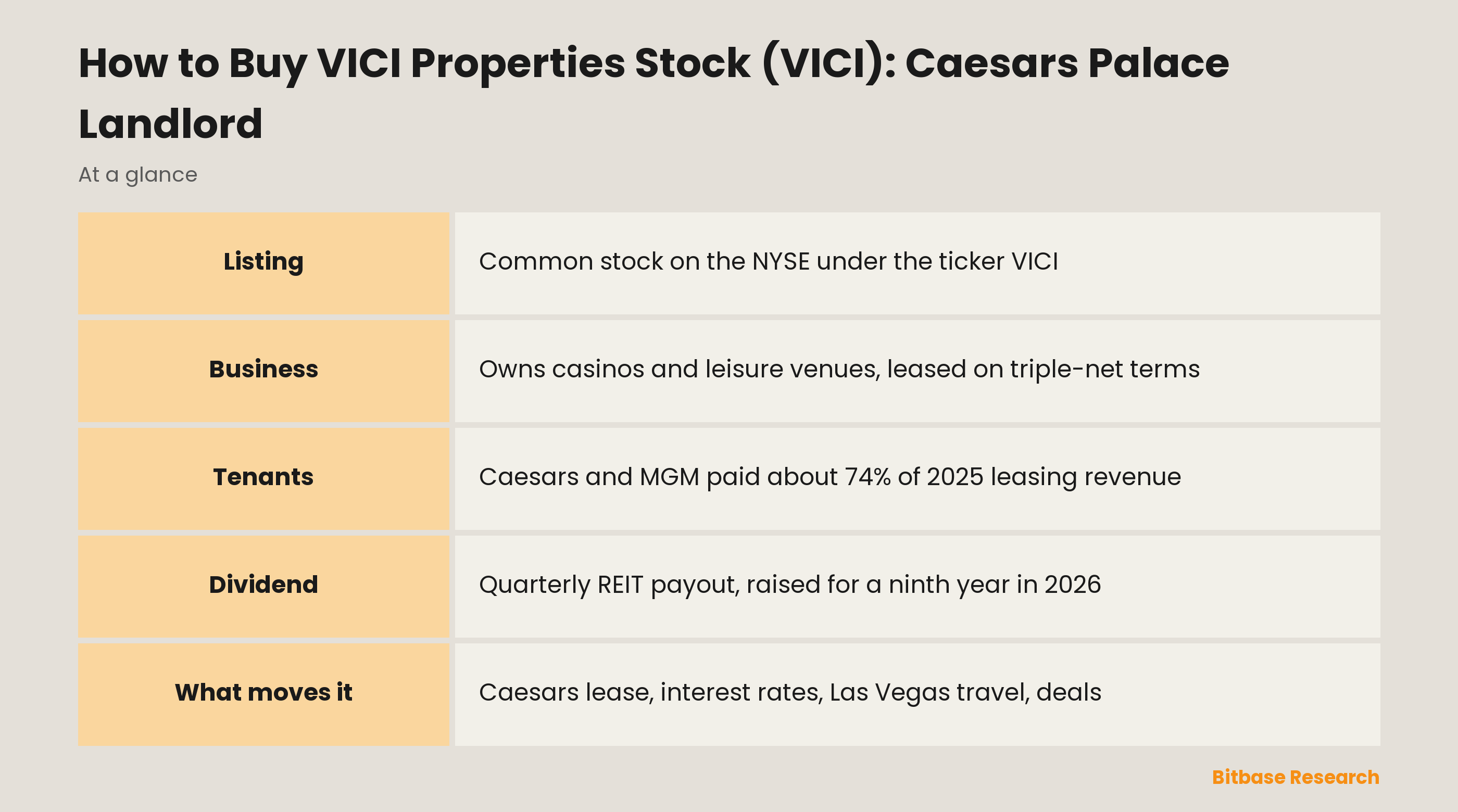
The landlord behind Caesars Palace, MGM Grand and the Venetian Resort is bought like any other US share: open an account with a broker that reaches the New York Stock Exchange and search for the ticker VICI. VICI Properties runs none of those casinos; it owns the land and buildings and collects rent under triple-net leases, and in 2025 its two biggest tenants, Caesars and MGM, paid about 74% of its leasing revenue. What follows covers how that rent becomes a REIT dividend, the order itself, and what the filings warn about, from tenant credit to Las Vegas.
What Does VICI Properties Do?
The annual report describes VICI as a Maryland corporation "primarily engaged in the business of owning and acquiring gaming, hospitality, wellness, entertainment and leisure destinations, subject to long-term triple net leases." At the end of 2025 it owned 93 such assets, 54 gaming properties and 39 others, spread over 26 states and Canada, with roughly 60,300 hotel rooms between them. Acquisitions during 2026 lifted the count to 103 by 30 September, 63 of them gaming properties, and added a resort in the US Virgin Islands.
Triple-net is the core of the model. The tenant pays the property taxes, insurance, maintenance and capital spending, and the 10-K says the leases give tenants "complete control over management" of the properties. VICI's job is to own the real estate, underwrite the tenant and collect a rent that rises each year. That is how a portfolio of this size ran with 28 employees at the end of 2025, mostly at the New York headquarters.
The tenant list reads like a directory of US casino operators. Caesars leases Caesars Palace Las Vegas, Harrah's Las Vegas and a string of regional casinos under three leases; MGM leases MGM Grand, Mandalay Bay, Luxor, Excalibur, Borgata and others; funds managed by Apollo lease the Venetian Resort. Hard Rock, PENN Entertainment, Century Casinos, two Cherokee tribal businesses, JACK, Foundation Gaming and a partnership of five First Nations holding the PURE casinos in Alberta lease the rest.
Outside gaming, VICI owns 38 Lucky Strike bowling centres and the Chelsea Piers complex in New York, and lends to developers in other "experiential" sectors: Canyon Ranch, Great Wolf, Kalahari, Cabot and Cain's One Beverly Hills project, partly for "the potential to convert our investment into the ownership of the underlying real estate." It also owns about 33 acres on and next to the Las Vegas Strip, leased to Caesars, and four golf courses.
The company was born out of a bankruptcy. Caesars Entertainment Operating Company filed for Chapter 11 in January 2015, and the reorganization plan confirmed in January 2017 moved its real property and golf courses into a new REIT. VICI was formed in October 2017 and began trading on the NYSE in February 2018. It bought MGM Growth Properties in April 2022 and joined the S&P 500 two months later.
How VICI Properties Makes Money
Rent is nearly everything. The 10-K splits 2025 revenue into four lines:
| Revenue line | Share of 2025 revenue | What it is |
|---|---|---|
| Leasing revenue | about 92% | Rent from casino and other experiential leases |
| Income from loans | about 5% | Interest on mezzanine, senior and other real estate loans |
| Other income | about 2% | Matched by an equal line of other expenses |
| Golf revenues | about 1% | The four golf courses, run by a Cabot affiliate |
Total revenue grew 4.1% in 2025, and 5.8% year on year in the third quarter of 2026.
Two details matter when you read those lines. First, most leases are booked as sales-type leases or financings, so income is recognized "on an effective interest basis at a constant rate of return" rather than as the rent billed. In 2025 the contractual rent tenants owed was about 86% of reported leasing revenue; the gap is a non-cash adjustment, one reason the company also reports adjusted funds from operations (AFFO), a non-GAAP measure.
Second, the rent climbs. All of VICI's leases carry annual escalators, and 15 of 17 are tied to inflation for some period, subject to caps. At the end of 2025, 42% of 2025 rent and 90% of rent over the long term featured CPI-linked escalation. Initial lease terms run from 15 to 32 years, and the weighted average remaining term including extension options was about 39.6 years.
The weak spot is concentration. Caesars and MGM made up about 74% of 2025 leasing revenue, and the Strip properties produced about 49% of total revenue. Both parent companies guarantee their leases and file their own reports with the SEC. In the first nine months of 2026 the pair still produced about 72% of lease revenue.
Lending grows fastest: income from loans rose 62% in 2025, and the loan book carried a weighted average rate of 9.1% at year-end. In 2026 VICI also closed the purchase of seven Nevada casinos from Golden Entertainment, including the STRAT in Las Vegas, on 30 April, paying former Golden shareholders partly in about 24.3 million new VICI shares. Two Alberta casinos bought from Gamehost followed in June.
VICI Stock at a Glance
| Feature | VICI |
|---|---|
| Exchange | New York Stock Exchange |
| Ticker | VICI |
| Security | Common stock, the only class registered under Section 12(b) |
| Structure | REIT; the holding company owns its real estate through VICI Properties L.P. |
| Sector | Gaming and other experiential real estate, mostly on triple-net leases |
| Largest tenants | Caesars and MGM |
| Index membership | S&P 500, since June 2022 |
| Headquarters | 535 Madison Avenue, New York |
| Incorporated | Maryland |
| Fiscal year | Calendar year, ending 31 December |
| Payouts | Quarterly cash dividend; the company says it raised the annual dividend for a ninth straight year in 2026 |
| SEC identifier | CIK 1705696 |
Quotes, market value and yield move all day, so for live figures use the VICI Properties stock page on Bitbase.
How to Buy VICI Properties Stock
The NYSE line is VICI's own common stock, with no depositary receipt in between. Seven steps:
1. Find a broker with NYSE access. Investors outside the US can use a local broker that sells US shares or an international firm; check which entity holds the account and who regulates it.
2. Complete the account checks. Brokers ask non-US individuals for IRS Form W-8BEN, which the IRS says is given "when requested by the withholding agent or payer."
3. Move money in. Paying in another currency means a conversion, and the rate you get can cost more than the commission.
4. Confirm the security. Type VICI and check that the name shown is VICI Properties Inc. common stock on the NYSE. The operating partnership, VICI Properties L.P., issues bonds of its own; those are debt, not shares.
5. Set the order. FINRA explains that a market order "provides the most certainty that your order will be executed," while a limit order fills only "at or better than a specified price."
6. Choose how much. Some brokers sell fractions of a share, but FINRA notes that some limit this to "large-cap stocks or ETFs," and that "as a fractional share owner, you might not have shareholder voting rights."
7. File the records. Statements and confirmations show what you paid and each dividend received, which you will need at tax time.
If you live outside the US. This is general information, not tax advice. The IRS says "most types of U.S. source income received by a foreign person are subject to U.S. tax of 30%," and a tax treaty may lower that. As a REIT, VICI is covered by an extra rule in IRS Publication 515: the part of a REIT distribution that comes from selling US real property is withheld at 21%, unless the stock is regularly traded on a US market and you owned 10% or less at all times in the year before the payment, in which case it is treated as an ordinary dividend. Your home country may tax the income too.
Through funds. Funds tracking the S&P 500 hold VICI as one small position among about five hundred. For a net-lease REIT with thousands of tenants instead of a few casino operators, see our Realty Income stock guide.
What Moves VICI Stock
Tenant health, above all Caesars. In the 10-K VICI wrote that it had "observed, and Caesars management has publicly reported, declining profitability" at some properties under the Caesars Regional Master Lease, that it had held "preliminary discussions" with Caesars about that lease, and that market narratives about it have hurt its stock and cost of capital. The lease runs to July 2035 with a Caesars parent guarantee. In the third quarter of 2026 the company raised its credit-loss allowance, roughly two-thirds of it tied to Caesars, after a rating agency downgraded Caesars' senior secured debt and VICI revised its loss estimates for the renewal periods that begin in August 2035.
Accounting swings that are not cash. Under the current expected credit loss rules, VICI must book estimated future losses on its leases and loans every quarter. That is why net income attributable to common stockholders fell 55.1% in the third quarter of 2026 while AFFO per share rose 4.3%.
Interest rates and capital. A REIT has to pay out most of its taxable income, so growth is funded with new debt and new shares. VICI holds investment-grade ratings from all three major agencies and in August 2026 refinanced all its remaining 2026 maturities. Higher rates raise the cost of the next deal.
Deals and rights to future deals. The 10-K lists a call right on the Caesars Forum Convention Center through 2028, rights of first refusal on four Caesars properties on the Strip, then on The LINQ, plus Horseshoe Baltimore and the casino resort in Danville, Virginia, and call rights on Canyon Ranch resorts. Whether VICI exercises any of these, and on what terms, can change its growth path.
Las Vegas visitation and new forms of betting. Anything that cuts travel to Las Vegas reaches the tenants' cash flow. The 10-K also names prediction markets, which "currently operate under federal rather than state regulation," as a competitor that may enjoy advantages over the licensed casinos that pay VICI's rent.
What the company does with its own shares. On 27 October 2026 the board authorized a share repurchase program running to 30 September 2029; the release says it does not oblige VICI to buy any particular amount.
Where a Casino Landlord Is Exposed
The risk-factor section of the 10-K, which the latest 10-Q leaves unchanged, puts these first:
Tenant credit. "Financial difficulties experienced by any of our tenants, borrowers or guarantors, including their potential bankruptcy or insolvency, could result in defaults under, or requests to modify or terminate, their lease agreements." With two tenants paying most of the rent, this one leads.
One industry. VICI says it is "dependent on the gaming industry" and exposed to "heightened competition, regulatory developments, changes in consumer behavior and discretionary spending."
One city. "Because a concentrated portion of our revenues are generated from the Las Vegas Strip, we are subject to greater risks than a company that is more geographically diversified," including travel disruption, labor unrest, heat and drought.
Gaming regulators, down to the shareholder. The charter says shares "held by investors who are found to be unsuitable by state gaming regulatory authorities are subject to redemption," and regulators must approve many transactions, which can delay deals.
Escalators cut both ways. Rent increases "will generally continue to apply regardless of the amount of cash flows generated by the properties," which protects VICI until a tenant can no longer pay them.
Lending risk. Development and construction loans "carry additional risks, including cost overruns, completion delays, operational underperformance."
Debt and REIT status. VICI carries a large amount of debt and relies on capital markets to grow; losing REIT status would mean corporate tax and less cash to distribute.
Beyond the business, the 10-K warns that "the market price and trading volume of shares of our common stock may be volatile," and every new share issued to fund a deal dilutes existing holders. The dividend is set by the board each quarter and depends on cash flow, debt service and the REIT payout rules.
How to Research VICI Yourself
VICI's filings sit on EDGAR under CIK 1705696, filed jointly with VICI Properties L.P.: the 10-K, three 10-Qs a year, and 8-Ks for events. The 2026 results came on 25 February, 29 April, 29 July and 28 October, each 8-K carrying the earnings release and a financial supplement.
In the 10-K, look at the lease table in the business section for each tenant, its properties and the initial expiry date; the risk factors; the results discussion for leasing revenue against contractual rent; and the credit-risk note for the share of revenue from Caesars, MGM and the Strip. The 10-Q adds the quarterly change in the credit-loss allowance and what drove it.
Two habits help. Read the tenants too: Caesars and MGM publish their own 10-Ks and 10-Qs, and their property results are the best early signal for VICI's rent. And when you compare years, separate GAAP net income from AFFO, because the credit-loss allowance can move one without the other. Live prices are on the stock page linked above, and the full list of US stock pages on Bitbase covers other companies.
VICI Properties Stock FAQ
Can I buy VICI Properties stock with crypto?
Not directly. VICI shares are bought through a brokerage account in US dollars, so crypto has to be sold for cash and the money moved to the broker first, and that sale may be taxable where you live. A share also carries dividend and voting rights in a regulated company, which is how a share differs from a crypto asset.
Does VICI Properties pay a dividend?
Yes. VICI says it intends to pay regular quarterly distributions, and as a REIT it must distribute at least 90% of its REIT taxable income each year to keep its status. The company says the 2026 increase was the ninth in a row, but the board decides each payment, so check the latest release for the current amount.
Does VICI Properties run the casinos it owns?
No. Operators such as Caesars, MGM and Hard Rock run the casinos and, under triple-net leases, pay VICI rent plus the taxes, insurance and upkeep. VICI owns the real estate, and in many jurisdictions gaming regulators require it to hold a license or a finding of suitability as the landlord.
Is VICI in the S&P 500?
Yes. VICI was added to the S&P 500 in June 2022; the company calls it the shortest time from IPO to S&P 500 inclusion for any REIT. Index weights change daily.
Where did VICI Properties come from?
It was created from the Chapter 11 reorganization of Caesars Entertainment Operating Company, whose plan, confirmed in January 2017, moved the real property and golf courses into a new REIT. VICI was formed in October 2017 and listed on the NYSE in February 2018.
Conclusion
VICI is a bet on rent from casinos rather than on gambling itself: long leases, rising rent and tenants who pay the property costs, set against heavy reliance on Caesars, MGM and one stretch of Las Vegas. The questions that decide whether it suits you are the health of those tenants, the cost of the money VICI borrows, and whether the deals in its pipeline arrive on good terms. Read the latest 10-K and quarterly supplement, follow the Caesars regional lease, and decide how much one landlord should weigh in your portfolio.
Related reading
Other Bitbase articles on this topic:
- How to Buy CBRE Stock (CBRE): Deals, Buildings and No Dividend
- How to Buy Crown Castle Stock (CCI): A Tower REIT, Fiber Sold
- How to Buy Extra Space Storage Stock (EXR): Rent and Reinsurance
Disclaimer: This article is educational content from Bitbase Academy, provided for information only. It explains what a company or fund does and how the instruments referenced here differ from one another; it does not constitute investment, trading, tax, or financial advice, and it is neither a recommendation nor an endorsement of any security, token, or trading strategy. A tokenized stock is issued by a third party and is designed to give economic exposure to an underlying asset: it is not a share, it carries no shareholder rights, and it depends on the issuer's structure, eligibility rules, and redemption terms, which the issuer can change. Perpetual futures are leveraged derivatives that hold no underlying asset and can be liquidated, and trading hours, product availability, and eligibility differ by instrument and by jurisdiction and can change at any time. Written as of November 2026; verify everything yourself through company filings, the issuer's own documentation, and the product pages of the venue you trade on.
References
[1] VICI Properties Form 10-K for 2025 (SEC EDGAR) www.sec.gov
[2] VICI Properties 2025 Form 10-K, XBRL cover page (SEC EDGAR) www.sec.gov
[3] VICI Properties Form 10-Q for the third quarter of 2026 (SEC EDGAR) www.sec.gov
[4] VICI Properties third quarter 2026 earnings release (SEC EDGAR) www.sec.gov
[5] VICI Properties Form 10 registration statement, September 2017 (SEC EDGAR) www.sec.gov
[6] VICI Properties IPO prospectus, February 2018 (SEC EDGAR) www.sec.gov
[7] FINRA: Order types www.finra.org
[8] FINRA: Investing in fractional shares www.finra.org
[9] IRS: NRA withholding www.irs.gov
[10] IRS: About Form W-8 BEN www.irs.gov
[11] IRS Publication 515: Withholding of tax on nonresident aliens and foreign entities www.irs.gov





