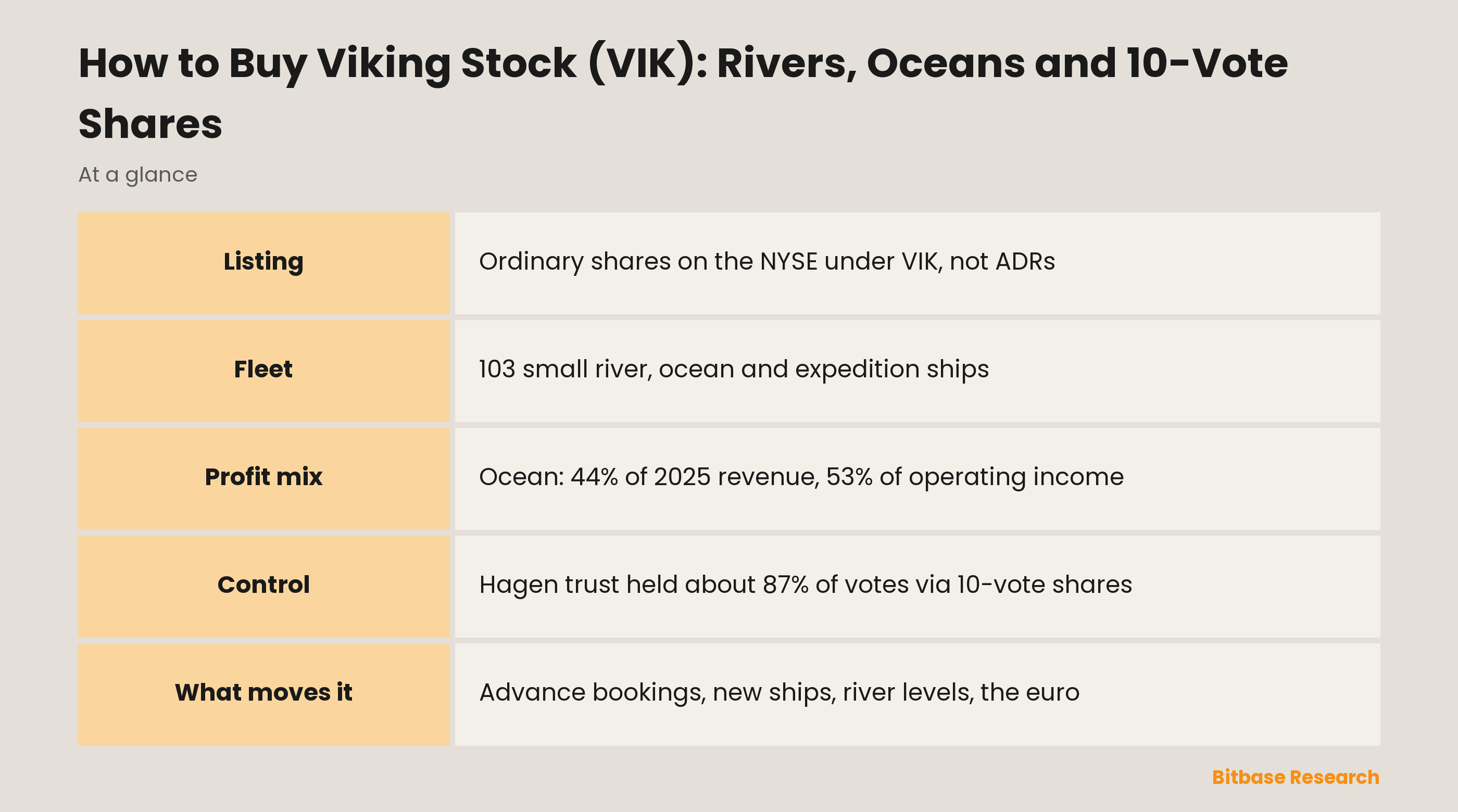
Whoever wants to own Viking can buy its ordinary shares on the New York Stock Exchange under the ticker VIK through any broker with NYSE access; they are the shares themselves, not depositary receipts, even though the company is incorporated in Bermuda. What sets the stock apart is who decides: a trust linked to founder Torstein Hagen held about 87% of the voting power at the end of 2025, largely through unlisted special shares carrying ten votes each. Below: the business, the order, and the pressures the annual report keeps naming, from low river water to the euro.
What Does Viking Do?
Viking sells cruises, and it calls its 103 small ships "floating hotels" built for one kind of traveler: "curious, affluent, English-speaking travelers aged 55 years and older." The ships have no casinos and take no children under 18, every port call includes a shore excursion, and most itineraries sail in Europe and the Mediterranean "rather than the Caribbean."
The company began in 1997 with four river vessels. Viking Ocean followed in 2015 with a single ship, a Mandarin-language river product called Asia Outbound in 2016, and Viking Expedition and Viking Mississippi in 2022. The holding company was set up in Bermuda in 2010 and listed on the NYSE in May 2024.
The fleet uses a few standard designs: 59 Longships, river vessels for 190 guests introduced in 2012; 12 ocean ships for 930 or 998 guests; two polar-class expedition ships for 378; and the Viking Mississippi for 386. Ships within each product are nearly identical, so one can stand in for another.
For the 2025 season the 20-F puts Viking's share at 52% of the North American outbound river market, about three times its nearest rival, 27% of luxury ocean cruising and 35% of Mississippi river cruising. Repeat guests made up 54% of that season, up from 27% in 2015, and more than 50% of 2025 guests booked directly rather than through an agent.
How Viking Makes Money
Revenue comes from voyages: fares plus the flights and land packages sold with them, and on board, optional excursions, drinks and shop sales. Viking reports two segments, River and Ocean, and groups expedition cruising, the Mississippi and Viking Asia as "Other."
| Segment | Share of 2025 revenue | Revenue growth in 2025 | Operating margin in 2025 |
|---|---|---|---|
| River | 47% | 16% | 23% |
| Ocean | 44% | 31% | 28% |
| Other | 9% | 16% | Small loss |
Shares and margins are calculated from the segment note of the 20-F. Ocean, launched 18 years after the first river cruise, now produces 53% of operating income, more than River.
Total revenue rose 21.9% in 2025, driven by more berth-days on offer and fuller ships: Occupancy reached 95.4%, up from 93.6%. North Americans were 89.7% of passengers, while the ships mostly sail in Europe. Guests pay well before departure, so Viking holds their cash long before it books the revenue.
VIK Stock at a Glance
| Feature | VIK |
|---|---|
| Exchange | New York Stock Exchange |
| Ticker | VIK |
| Security | Ordinary shares, the only class registered for trading |
| Unlisted class | Special shares, ten votes each, held almost entirely by Viking Capital Limited |
| Sector | Cruise travel: river, ocean and expedition |
| Listed since | May 2024 |
| Incorporated | Bermuda, 2010 |
| Annual report | Form 20-F as a foreign private issuer; quarterly results on Form 6-K |
| Fiscal year | Calendar year, ending 31 December |
| Payouts | No cash dividend expected; share repurchase program authorized in September 2026 |
| SEC identifier | CIK 1745201 |
Quotes and market value move all day; the Viking stock page on Bitbase carries the live figures.
How to Buy Viking Stock
VIK is an ordinary share listed directly in New York, so there is no ADR ratio to look up and the order works like any NYSE purchase:
1. Find a broker with NYSE access, local or international, and check which entity holds your account and who regulates it.
2. Complete the account checks. Non-US residents are usually asked for IRS Form W-8BEN to certify foreign status.
3. Fund the account. If your money is converted into dollars, the exchange rate is part of the cost.
4. Search for VIK and confirm the listing reads Viking Holdings Ltd on the NYSE. Viking Therapeutics, ticker VKTX, is a different company.
5. Choose the order. A market order fills at the going price; a limit order caps what you pay and may not fill.
6. Set the amount. Some brokers sell fractions of a share, so a fixed sum can be invested; rules differ between firms.
Tax for investors abroad. The 20-F states that Bermuda currently charges shareholders no withholding tax "in respect of our shares." With no dividend planned, the main tax question is how a sale is treated where you live.
Through funds. State Street's SPY holdings file dated 6 November 2026 lists Carnival, Royal Caribbean and Norwegian but not Viking, so an S&P 500 tracker gives no exposure. Check a fund's published holdings before assuming it owns VIK.
What Moves VIK Stock
Next season, sold early. As of 9 August 2026 Viking had sold 96% of 2026 capacity for its Core Products and 53% of 2027, with that capacity set to grow 7% in 2026 and 15% in 2027.
Ships on order. At the end of 2025 there were 17 river vessels and eight ocean ships on order, plus options reaching 2034. In December 2025 Viking learned that eight river vessels would arrive late, pushing capacity back.
River levels. Low water disrupted river cruises in parts of Europe in 2018 and 2022. Viking moved guests between Longships parked on either side of the shallow stretch, but cancellations still mean refunds or vouchers.
The euro. Guests pay mostly in dollars, while "a substantial portion of our operating expenses and costs of newbuilds are in euros," so a stronger euro raises costs.
Seasons. Demand peaks in the northern summer, and most river vessels are out of service from roughly November to March, so quarters are uneven.
Leadership and capital. On 14 May 2026 President and CFO Leah Talactac became chief executive and Torstein Hagen executive chairman. In September 2026 the board approved a share repurchase program that can be changed or stopped at any time.
Low Water, Euro Costs and One Controlling Holder
These risk factors from the 20-F bear most directly on a VIK share:
Demand. "Changes in the general worldwide economic and political environment could reduce the demand for cruises."
Weather. "Adverse weather conditions or other natural disasters, including high or low river water levels, may require us to alter our itineraries or cancel existing cruises."
Currency and shipyards. "Fluctuations in foreign currency exchange rates could affect our financial results," and delays or cost changes in "ship construction or ship repairs" could hurt results.
Tax status. Bermuda's 15% corporate income tax from 2025 exempts international shipping income only if management conditions in Bermuda are met, and the US exemption under Section 883 depends partly on who owns the shares.
Control. With about 87% of the votes, the Hagen-linked holder can elect almost all of the board, and Viking uses the NYSE's "controlled company" exemptions.
The share adds two points. Viking does "not anticipate paying any cash dividends in the foreseeable future," so returns depend on the price, and shareholder rights follow Bermuda law and the company's bye-laws.
Where Viking's Numbers Are Published
Viking files with the SEC under CIK 1745201. The annual report is a 20-F (FY2025 arrived on 3 March 2026), and quarterly results come on Form 6-K with a press release and interim statements. As a foreign private issuer, Viking is exempt from US proxy rules, so expect fewer filings than from a US company.
In the 20-F, the business overview covers products and market shares, the risk factors section the risks, the major shareholders section the ownership table, the segment note the results by River, Ocean and Other, and the commitments note every ship on order. Across quarters, compare Occupancy and the share of next season sold, not just revenue.
Our Royal Caribbean stock guide covers one of the large ocean cruise groups Viking measures itself against. Live prices sit on the stock page linked earlier, and all US stock pages on Bitbase list other companies.
Viking Stock FAQ
Does Viking pay a dividend?
No. The 20-F says Viking will retain earnings to fund growth and does "not anticipate paying any cash dividends in the foreseeable future." In September 2026 the board authorized a share repurchase program instead, with no obligation to buy a set number of shares.
Who controls Viking Holdings?
Viking Capital Limited, which belongs through an intermediate company to a Cayman Islands trust set up by Torstein Hagen, held 86.8% of the voting power on 1 February 2026: 34.1% of the ordinary shares and 99.9% of the special shares. Hagen and his daughter Karine Hagen are treated as sharing beneficial ownership.
Is VIK the same as Viking Therapeutics?
No. Viking Holdings trades as VIK and Viking Therapeutics as VKTX; the SEC lists them as separate registrants.
Is Viking stock in the S&P 500?
Not according to State Street's SPY holdings file dated 6 November 2026. Index membership changes, so check the current list.
Can I buy Viking stock with crypto?
Not directly. A broker sells VIK for US dollars, so crypto has to be converted to cash and moved to the brokerage first, and that conversion can count as a taxable sale in your country. Owning a share also brings different rights from holding a token, as our guide to how crypto differs from stocks explains.
Conclusion
Viking is a bet on one well-defined customer: older, English-speaking travelers who book Europe nearly a year ahead, and in 2025 they filled about 95% of its berths. The ocean fleet now earns more than the rivers that built the brand, but low water, the euro and late ships can still dent a season. A buyer also accepts that the Hagen trust holds most of the votes and that no dividend is planned. Read the latest 20-F and 6-K, follow the share of next season already sold, and decide what weight one founder-controlled cruise line deserves in your portfolio.
Related reading
Other Bitbase articles on this topic:
- How to Buy Ford Stock (F): One Letter, Family Votes and EV Reset
- How to Buy Honda Stock (HMC): Motorcycle Profits and an EV Reset
- How to Buy IHG Stock (IHG): Holiday Inn Fees and a One-Share ADS
Disclaimer: This article is educational content from Bitbase Academy, provided for information only. It explains what a company or fund does and how the instruments referenced here differ from one another; it does not constitute investment, trading, tax, or financial advice, and it is neither a recommendation nor an endorsement of any security, token, or trading strategy. A tokenized stock is issued by a third party and is designed to give economic exposure to an underlying asset: it is not a share, it carries no shareholder rights, and it depends on the issuer's structure, eligibility rules, and redemption terms, which the issuer can change. Perpetual futures are leveraged derivatives that hold no underlying asset and can be liquidated, and trading hours, product availability, and eligibility differ by instrument and by jurisdiction and can change at any time. Written as of November 2026; verify everything yourself through company filings, the issuer's own documentation, and the product pages of the venue you trade on.
References
[1] Viking Holdings Form 20-F for 2025 (SEC EDGAR) www.sec.gov
[2] Viking Holdings 2025 Form 20-F, XBRL cover page (SEC EDGAR) www.sec.gov
[3] Viking second-quarter 2026 results release, furnished on Form 6-K (SEC EDGAR) www.sec.gov
[4] Viking release of 14 May 2026: CEO transition and first-quarter results, Form 6-K (SEC EDGAR) www.sec.gov
[5] Viking Form 6-K of 11 September 2026: share repurchase program (SEC EDGAR) www.sec.gov
[6] Viking fourth-quarter and full-year 2025 results release, Form 6-K (SEC EDGAR) www.sec.gov
[7] SEC: company tickers list (VIK and VKTX) www.sec.gov
[8] State Street SPDR S&P 500 ETF Trust (SPY): fund page and daily holdings www.ssga.com
[9] IRS: About Form W-8 BEN www.irs.gov
[10] FINRA: Order Types www.finra.org
[11] FINRA: Investing in Fractional Shares www.finra.org





