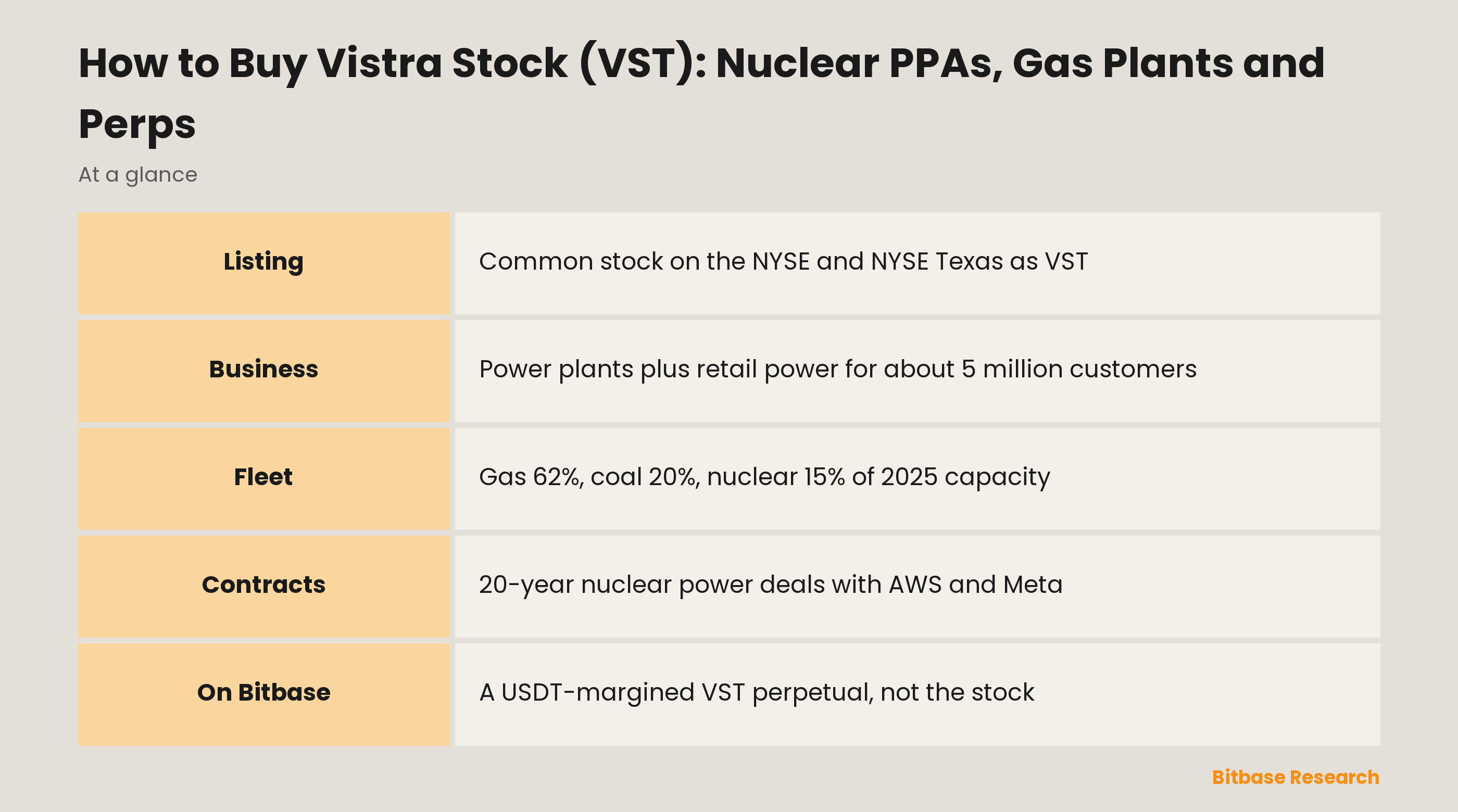
Both the New York Stock Exchange and NYSE Texas list Vistra Corp.'s common stock under the ticker VST, so any broker that offers US-listed shares can take your order. Behind the ticker sits one of the largest competitive power producers in the United States, a Texas-based company that also sells power and gas directly to about 5 million retail customers and has signed 20-year nuclear power contracts with Amazon Web Services and Meta. Bitbase offers a VST perpetual in USDT as well, a contract that mirrors the share price while owning no stock.
What Does Vistra Do?
Vistra describes itself as "an integrated retail electricity and power generation company." It owns power plants, sells their output into wholesale markets, and runs retail brands that sell electricity and natural gas to households and businesses. The company operates in 18 states and the District of Columbia, including every major competitive wholesale power market in the country.
The generation fleet totaled roughly 44 gigawatts at the end of 2025. By fuel, natural gas plants made up 62% of net capacity, coal 20% and nuclear 15%, with solar, batteries and a little fuel oil making up the rest. Six nuclear units at four sites anchor the fleet: two at Comanche Peak in Texas and four in the PJM market at Beaver Valley, Perry and Davis-Besse, with operating licenses running out between 2036 and 2053. Vistra says it has nuclear fuel under contract for all refueling needs through 2030.
On the retail side, Texas accounts for about 2.6 million of Vistra's roughly 5 million customers, and the TXU Energy brand has sold electricity in the state's competitive market for more than 20 years.
The company's roots are in a bankruptcy. Its predecessor, once owned indirectly by Energy Future Holdings, finished reorganizing under Chapter 11 on 3 October 2016, and the common stock was registered on the NYSE in May 2017 under the name Vistra Energy Corp. Acquisitions built most of what exists today: Dynegy merged into Vistra in April 2018, the Energy Harbor nuclear fleet joined in March 2024, Lotus Infrastructure Partners sold Vistra about 2.6 gigawatts of gas plants in 2025, and on 30 October 2026 Vistra closed its purchase of Cogentrix Energy, ten modern gas-fired plants of about 5.5 gigawatts. James A. Burke is president and chief executive, and the head office is in Irving, Texas.
How Vistra Makes Money
Vistra reports five segments. Retail sells power and gas to end customers. Texas, East and West hold the generation fleet, grouped by grid: ERCOT for Texas; PJM, MISO, ISO New England and NYISO for the East; and the California market for the West. Asset Closure handles the decommissioning of retired plants and mines.
Most revenue arrives through the retail bills. In 2025 retail energy charges, in Texas and in the Northeast and Midwest combined, made up about 73% of consolidated operating revenue, with Texas alone close to half of the total. Wholesale sales of generation into the grid operators' markets supplied about 18%. Total operating revenue edged up about 3% from 2024.
The reason for owning both halves is spelled out in the filing: integrating retail with power generation "mitigates the impact of commodity price fluctuations and enhances the stability and predictability of our cash flows." Vistra hedges much of its output ahead of time, and that hedge book makes reported profit lumpy. When forward power prices rise above what the plants have already sold, the generation segments book unrealized losses, and retail books the mirror image. In 2025 unrealized hedging revenue swung from a gain the year before to a loss, and operating income fell about 53% even though revenue grew.
Fuel matters on the cost side. The 10-K explains that wholesale electricity prices "generally move with natural gas prices," because gas plants usually set the clearing price. A higher gas price therefore lifts the price received by Vistra's nuclear, coal and lignite units, whose own fuel costs do not move with gas.
VST Stock at a Glance
| Item | Detail |
|---|---|
| Exchanges | New York Stock Exchange and NYSE Texas |
| Ticker | VST |
| Share class | One class of common stock |
| Industry | Competitive power generation and retail electricity |
| Index membership | S&P 500 (held by SPY on 6 November 2026) |
| Headquarters | Irving, Texas |
| Incorporated in | Delaware |
| Registered on the NYSE | May 2017 |
| NYSE Texas listing | Registered in August 2025, same ticker |
| Fiscal year end | 31 December |
| Reportable segments | Five: Retail, Texas, East, West, Asset Closure |
| Dividend policy | Quarterly cash dividend, at the board's discretion |
| Share buybacks | Program running since October 2021 |
Quotes and charts are on the Vistra stock page on Bitbase.
How to Buy Vistra Stock
Most brokers follow the same steps:
1. Find a broker that offers NYSE-listed US shares and accepts residents of your country.
2. Open the account and pass identity checks. Non-US residents are generally asked to file Form W-8BEN.
3. Fund the account. Converting a non-dollar currency usually costs a spread or a fee.
4. Look up VST and confirm the name reads Vistra Corp. common stock.
5. Choose the order type. A market order fills at the going price; a limit order caps what you pay and may not fill. Some brokers also sell fractional shares.
The dual listing does not create a second kind of share. NYSE and NYSE Texas trade the same Vistra common stock under the same symbol, and your broker routes the order. Vistra is a US company that files a 10-K, so there is no ADR and no conversion ratio. Dividends paid to non-US holders may face US withholding tax depending on where you live and any tax treaty; treat that as general information rather than tax advice.
S&P 500 index funds offer indirect ownership; SPY held Vistra on 6 November 2026, though the slice is small and shifts with the index.
Trading VST on Bitbase
The VST perpetual futures contract on Bitbase uses USDT for margin and settlement and moves with Vistra's share price. What you get is price exposure and nothing else: nobody holds a share on your behalf, so there is no dividend and no proxy ballot. There is no expiry date. You can buy or sell first, add leverage if you choose, and keep trading through nights and weekends when the NYSE is closed.
Two mechanics set it apart from owning the stock. At set intervals, funding moves from whichever side of the market is more crowded to the other side; this pulls the contract toward the share price, and the cost grows with every interval you hold. If margin is exhausted, the position is liquidated, and the trigger is the mark price, not the most recent fill. Because Vistra announces results and power deals by press release, news landing after the NYSE close can move the perpetual hours before the shares reopen. The guide to stock perpetuals explains these mechanics in more depth.
This article does not state the funding interval or formula, the margin tiers, the maximum leverage, or how mark price and funding are handled while the exchange is closed; read the VST contract rules for those. Other contracts tied to listed companies sit on the TradFi page.
What Moves VST Stock
Data-center contracts. The 10-K names large data centers, including those driven by artificial intelligence, and the electrification of oil fields in the Permian Basin as reasons demand is growing faster. Vistra has turned that into contracts: a 20-year power purchase agreement with Amazon Web Services for 1.2 gigawatts of carbon-free power from Comanche Peak, with delivery expected to start in the fourth quarter of 2027, and 20-year agreements with Meta for about 2.6 gigawatts from its PJM nuclear plants, partly from uprates still to be built.
Power and gas prices. Unhedged output earns whatever the wholesale market pays. Vistra hedges heavily ahead of time; at the end of 2025 it reported 100% of expected 2026 nuclear, renewable and coal output hedged in Texas and 89% in the East. Later years carry lower hedge levels, so forward price curves still matter.
Texas market design. ERCOT has no capacity market and, in the 10-K's words, "relies primarily on energy-market price signals" to attract new plants. Changes such as the December 2025 switch to real-time co-optimization or the large-load rules in Texas Senate Bill 6 can alter how scarcity is priced.
Weather. Heat waves and cold snaps push demand and prices up, and Vistra's results move with the seasons.
Deals and capital returns. Vistra keeps buying plants and selling ones that fit less well; in October 2026 it sold three gas plants in New England and New York. It pays a quarterly dividend, has bought back shares under a program first authorized in October 2021, and on 29 October 2026 the board enlarged the program. S&P raised Vistra's issuer rating to investment grade in December 2025.
Where Vistra's Model Can Crack
Wholesale prices it does not set. The first risk Vistra lists is that revenue and cash flow "are affected by price fluctuations in the wholesale power market and other market factors beyond our control." Hedges soften this but cannot remove it.
Demand that arrives late. The company warns that if electricity demand "does not grow at the rate expected," or if it cannot deliver on large-load contracts, its financial performance and stock price could suffer.
Plants that can fail. On 16 January 2025 a fire broke out at the Moss Landing battery facility in California. Vistra wrote off the 300-megawatt unit, decided not to restart the neighboring 100-megawatt one, and in the third quarter of 2026 recorded an impairment on the remaining 350-megawatt battery there. Nuclear ownership adds the possibility of accidents and strict federal oversight.
Rules and retirements. Environmental limits, coal-ash requirements and shifts in market structure can raise costs or force units to retire early.
A holding company with debt. Vistra itself runs no business; its cash depends on payments from subsidiaries, and debt agreements restrict what it can do. The 10-K also cautions that it "may not pay any dividends" in the future and that buybacks may not deliver their intended benefits.
Extra risk in the perpetual. Borrowed exposure magnifies every loss, funding keeps charging while you stay in, and an opening gap on the NYSE can jump straight past your liquidation price.
Tracing Vistra's Contracts and Hedges in Its Filings
Vistra's SEC filer number (CIK) is 1692819, and its fiscal year matches the calendar. Its 10-K for 2025 came out on 27 February 2026, a day after the results release. The 2026 quarterly reports followed on 8 May, 10 August and 9 November, each a few days after the earnings 8-K, and the proxy statement was filed on 18 March 2026.
Three places repay a close read. The fleet table in Item 1 shows each plant's fuel, market and capacity. The commodity price section of the MD&A gives settled power and gas prices and the share of future output already hedged. The revenue note breaks sales down by segment and source, separating retail charges from wholesale sales and hedging results. Vistra says it uses www.vistracorp.com, alongside the SEC, to post filings, press releases and presentations, and as a channel for disclosure under Regulation FD.
Vistra Stock FAQ
Does Vistra pay a dividend?
Yes. Vistra pays a quarterly cash dividend on its common stock, and the 10-K says the board intends to keep paying one. Each payment remains at the board's discretion and depends on market conditions, results, financial condition, liquidity, Delaware law and contractual limits.
Is Vistra stock in the S&P 500?
Yes. The daily holdings file for SPY, State Street's S&P 500 fund, listed Vistra Corp. on 6 November 2026. Constituents get added and removed, so look at the latest list before relying on it.
Why is VST listed on both the NYSE and NYSE Texas?
In August 2025 Vistra registered its common stock with NYSE Texas for a dual listing under the same symbol. It is one class of stock, so a share bought through either venue is the same share.
Is Vistra a regulated utility?
No. Its 10-K describes the business as competitive energy market activities, including generation, wholesale energy sales and purchases and commodity risk management, and its retail brands compete for customers with other retail electricity providers. The filing does chart its stock against the S&P Utilities index, but its revenue rides on market prices. The Constellation Energy profile describes another large nuclear operator that also sells into competitive markets.
Can I buy Vistra stock with crypto?
You cannot pay a broker in crypto for the shares; the coins must first be converted to cash. What USDT can buy on Bitbase is exposure through the VST perpetual, which has no stock behind it, earns no dividend and may be liquidated. For the ways to move from coins to actual shares, see buying stocks with crypto.
Conclusion
Vistra's earnings rest on a spread between what it pays for fuel and what the power markets pay for electricity, smoothed by a retail book and heavy hedging and now underpinned by long nuclear contracts with data-center buyers. VST common stock trades on the NYSE and NYSE Texas through any broker with access to US shares. On Bitbase the perpetual offers that price without the shares, in exchange for funding costs and liquidation risk.
Related reading
Other Bitbase articles on this topic:
- How to Buy DTE Energy Stock (DTE): A Century of Dividends
- How to Buy Eversource Stock (ES): The Utility, Not the Futures
- How to Buy Exelon Stock (EXC): Six Utilities, No Power Plants
Disclaimer: This article is educational content from Bitbase Academy, provided for information only. It explains what a company or fund does and how the instruments referenced here differ from one another; it does not constitute investment, trading, tax, or financial advice, and it is neither a recommendation nor an endorsement of any security, token, or trading strategy. A tokenized stock is issued by a third party and is designed to give economic exposure to an underlying asset: it is not a share, it carries no shareholder rights, and it depends on the issuer's structure, eligibility rules, and redemption terms, which the issuer can change. Perpetual futures are leveraged derivatives that hold no underlying asset and can be liquidated, and trading hours, product availability, and eligibility differ by instrument and by jurisdiction and can change at any time. Written as of November 2026; verify everything yourself through company filings, the issuer's own documentation, and the product pages of the venue you trade on.
References
[1] Vistra Form 10-K for 2025 (SEC EDGAR) www.sec.gov
[2] Vistra Form 10-Q, third quarter of 2026 (SEC EDGAR) www.sec.gov
[3] Vistra Form 8-K, November 2026: Cogentrix deal completed (SEC EDGAR) www.sec.gov
[4] Vistra Form 8-A, August 2025: NYSE Texas listing (SEC EDGAR) www.sec.gov
[5] Vistra Energy Form 8-A, May 2017: NYSE registration (SEC EDGAR) www.sec.gov
[6] Vistra Energy Form 8-K, April 2018: Dynegy merger completed (SEC EDGAR) www.sec.gov
[7] State Street: SPY daily holdings, 6 November 2026 www.ssga.com





