
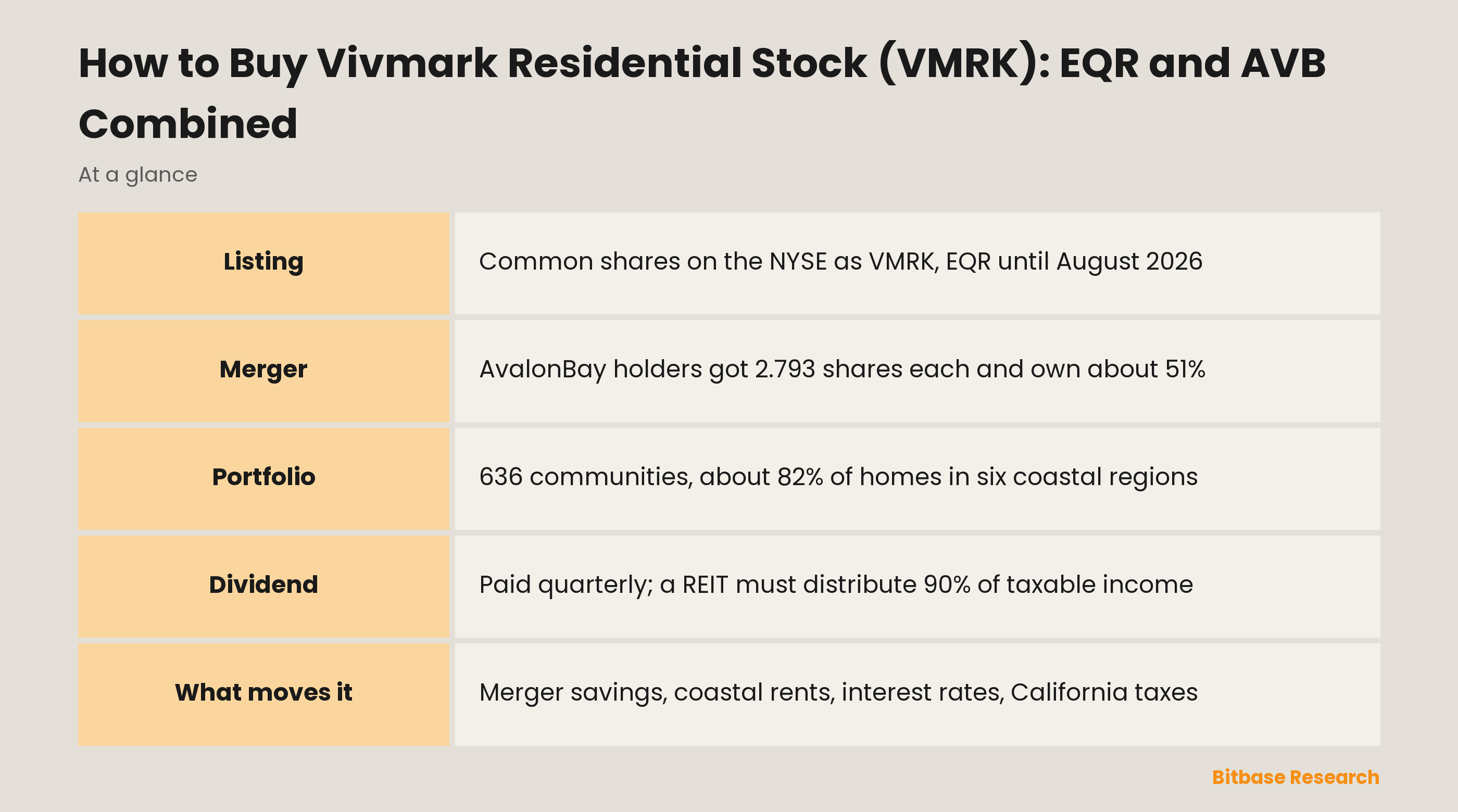
Since 18 August 2026, the apartment landlord created by the merger of Equity Residential and AvalonBay Communities has traded on the New York Stock Exchange as VMRK, so any broker that offers US stocks can take the order. Vivmark Residential is Equity Residential under a new name, while AvalonBay holders swapped each share for 2.793 Vivmark shares and now own about 51% of the company. Below: the business, the purchase steps and why its financial history now reads as AvalonBay's.
What Does Vivmark Residential Do?
Vivmark Residential owns, operates and builds rental apartment communities in US metro areas. It is a Maryland real estate investment trust (REIT) that took its present form on 17 August 2026, when AvalonBay merged into a subsidiary of Equity Residential in what the 20 May 2026 agreement called "an all-stock merger-of-equals transaction." At closing, Equity Residential renamed itself Vivmark Residential, and the next morning its shares switched from the EQR ticker to VMRK.
Equity Residential, a Maryland REIT formed in March 1993, focused on "the major coastal markets" of Boston, New York, Washington, D.C., Southern California, San Francisco and Seattle, with a smaller presence in Denver, Atlanta and Texas. AvalonBay said it would "develop, redevelop, acquire, own and operate apartment communities" in similar coastal regions plus expansion markets, and development heads that list.
At 30 September 2026, Vivmark reported 636 communities with 185,212 apartment homes across 11 regions, including 35 communities still under development. By apartment count, Southern California is the largest region at about 21%, followed by the Mid-Atlantic at 16%, Metro New York/New Jersey at 14%, Northern California at 13%, Boston at 10% and Seattle at 8%. Those six coastal regions hold about 82% of the homes, and California alone about 34%.
Operations run through ERP Operating Limited Partnership, Equity Residential's old operating partnership. Chief executive Benjamin Schall was an AvalonBay executive before the merger, Stephen Sterrett chairs a 14-member board with seven trustees from each side, and the company keeps dual headquarters in Chicago and Arlington, Virginia.
How Vivmark Residential Makes Money
The business is rent. In the first nine months of 2026, rental income made up about 99.8% of total revenues, the rest being management, development and other fees. Equity Residential's last annual report noted that its leases "are for twelve months or less," so rents reset at least yearly, in both directions.
Profit is the gap between rent and the cost of running buildings, reported as net operating income (NOI). For the third quarter of 2026, on a "merged same store" basis covering 157,377 stabilized homes of both predecessors, revenues rose 2.4% from a year earlier, expenses 3.6% and NOI 1.7%. Physical occupancy was 95.8%. Rents on renewals rose 5.3%, while rents on new leases were up just 0.4%.
REITs report funds from operations (FFO), which adds back real estate depreciation. Vivmark's GAAP result for the third quarter of 2026 was a loss per share that included merger costs; Core FFO per share, which excludes them, rose 5.1% against AvalonBay's restated figure a year earlier. As a REIT it must distribute at least 90% of its taxable income, excluding net capital gains, each year.
VMRK Stock at a Glance
| Feature | VMRK |
|---|---|
| Exchange | New York Stock Exchange |
| Ticker | VMRK (EQR until 17 August 2026) |
| Security | Common shares of beneficial interest, the only class registered under Section 12(b) |
| Legal form | Maryland real estate investment trust |
| Sector | Residential REIT: apartment communities in US metro areas |
| Index membership | S&P 500 |
| Headquarters | Chicago, Illinois and Arlington, Virginia |
| Fiscal year | Calendar year, ending 31 December |
| Dividend | Paid quarterly; at least 90% of taxable income must be distributed |
| SEC identifier | CIK 906107, the former Equity Residential filer |
Price and yield move all day, so they stay out of this table; the Vivmark Residential stock page on Bitbase shows them live.
How to Buy Vivmark Residential Stock
Vivmark is a US REIT, so no depositary receipt is involved. Buying takes six steps:
1. Choose a broker with NYSE access. Outside the US, use a local or international broker that offers US shares, and check who regulates it.
2. Open and verify the account. Non-US individuals usually certify their status on IRS Form W-8BEN; the IRS says to submit it "when requested by the withholding agent or payer."
3. Fund it. If your money is not in dollars, the currency spread can cost more than the commission, so check both.
4. Search for VMRK, not EQR. The old ticker is history. Confirm the result reads Vivmark Residential common shares on the NYSE, the only class its filings list.
5. Choose an order type. A market order takes the going price; a limit order executes only at your price or better and may not execute at all.
6. Size the position and keep records. Fractional shares and the voting rights attached to them differ by broker. Keep confirmations for your cost basis.
If you already held EQR. Those shares simply became Vivmark shares, and the company said existing certificates "need not be exchanged."
Taxes abroad. The IRS says "most types of U.S. source income received by a foreign person are subject to U.S. tax of 30%," with lower rates possible under a tax treaty. REIT dividends can be classified differently from other dividends and may be taxed at home too, so ask your broker or an adviser.
Through a fund. On 5 November 2026, State Street's daily holdings files for SPY, which tracks the S&P 500, and XLRE, its real estate sector ETF, both listed VMRK among their holdings.
What Moves VMRK Stock
Whether the merger delivers. Management expects annual operating synergies to reach their full run-rate by March 2028, and in November 2026 it raised its estimate of their size. The test is whether those savings show up in Core FFO per share.
Coastal rents and new supply. With about four in five homes in six coastal regions, local jobs and new construction set the rent trend. Watch the gap between renewal increases (5.3% in the third quarter) and new-lease increases (0.4%): it shows the pricing power left when residents move out.
Interest rates. Equity Residential's 10-K warned that "continuing high interest rates can also negatively impact the value of our Common Shares." At 30 September 2026, 88% of the debt was unsecured and about 91% carried fixed rates. On 18 August 2026, S&P Global Ratings raised the issuer rating to A from the A- both companies held before.
California property taxes. The company expects merger-related reassessments on former AvalonBay communities in California, home to about a third of its apartments, to raise operating expenses starting in 2026.
Rent Rules, Rate Pressure and Merger Risk at Vivmark
From Equity Residential's 2025 annual report and second-quarter 2026 10-Q:
Location. "The geographic concentration of our properties could have an adverse effect on our operations." The factors named include "rent control or rent stabilization laws" and "changes in multifamily housing supply and demand."
Short leases. These "expose us more quickly to the effects of declining market rents, potentially making our results of operations and cash flows more volatile."
Integration. "The combined company may be unable to successfully integrate the businesses of the Company and AvalonBay and realize the anticipated benefits of the Merger."
REIT status. "Our failure to qualify as a REIT would have serious adverse consequences to our security holders." The dividend is discretionary as well, and the company states that "we may change the dividend policy for our securities in the future."
Above all this sits the basic risk of one stock: your money depends on a single company.
How to Research VMRK Yourself
Vivmark files with the SEC under CIK 906107, the number Equity Residential used, so the 2025 10-K there describes Equity Residential alone. AvalonBay's own history remains under its old file, CIK 915912. The 8-K of 17 August 2026 covers the closing, the name change and the new board.
Read new reports with three adjustments. The merger was a reverse acquisition: AvalonBay was the accounting acquirer, so financial statements "continue those of AVB," and periods before 17 August 2026 are AvalonBay's alone, with per-share figures restated by the exchange ratio. Former Equity Residential communities cannot enter the official same-store pool until 1 January 2028, hence the "merged same store" view. And the first annual report filed as Vivmark, expected in early 2027, will carry combined risk factors.
Each quarterly release comes as an 8-K with a supplement covering regions, debt and development. Quotes are on the stock page linked above, and other listed companies are in Bitbase's directory of US stock pages. For other REIT models, compare our Realty Income stock guide on net-lease property and our Welltower stock guide on senior housing.
Vivmark Residential Stock FAQ
Can I buy Vivmark Residential stock with crypto?
Not directly. VMRK is bought with US dollars at a broker, so crypto has to be sold for cash first, and that sale may be taxable where you live. A share is a legal stake with dividend and voting rights, which is how a share differs from a crypto asset.
Is Vivmark Residential the same company as Equity Residential?
Legally, yes: Equity Residential changed its name to Vivmark Residential on 17 August 2026 and kept its SEC file and Maryland trust. Economically it is a combination with AvalonBay, whose former holders own about 51% and whose history the financial statements now continue.
What happened to AVB stock?
Each AvalonBay share became 2.793 Vivmark shares at closing, with cash paid for fractional shares, and on 17 August 2026 the NYSE filed to remove AvalonBay common stock from listing.
Does Vivmark Residential pay a dividend?
Yes. Its common shares pay quarterly dividends, and as a REIT it must distribute at least 90% of its taxable income. The board sets each payment and can change the policy; check the latest release for the current amount.
Is VMRK in the S&P 500?
Yes. The company describes itself as an S&P 500 company, and VMRK appeared in State Street's SPY holdings file dated 5 November 2026.
Conclusion
Vivmark is a new name for two older landlords combined, and for now its financial history still has to be read through AvalonBay. Underneath the VMRK ticker sit a coastal apartment portfolio, a development pipeline and a merger still being integrated. Read the latest release and, once filed, the first Vivmark 10-K, then decide how much one landlord should weigh in your portfolio.
Related reading
Other Bitbase articles on this topic:
- How to Buy CBRE Stock (CBRE): Deals, Buildings and No Dividend
- How to Buy Crown Castle Stock (CCI): A Tower REIT, Fiber Sold
- How to Buy Extra Space Storage Stock (EXR): Rent and Reinsurance
Disclaimer: This article is educational content from Bitbase Academy, provided for information only. It explains what a company or fund does and how the instruments referenced here differ from one another; it does not constitute investment, trading, tax, or financial advice, and it is neither a recommendation nor an endorsement of any security, token, or trading strategy. A tokenized stock is issued by a third party and is designed to give economic exposure to an underlying asset: it is not a share, it carries no shareholder rights, and it depends on the issuer's structure, eligibility rules, and redemption terms, which the issuer can change. Perpetual futures are leveraged derivatives that hold no underlying asset and can be liquidated, and trading hours, product availability, and eligibility differ by instrument and by jurisdiction and can change at any time. Written as of November 2026; verify everything yourself through company filings, the issuer's own documentation, and the product pages of the venue you trade on.
References
[1] Vivmark Residential Form 8-K of 17 August 2026: merger closing and name change (SEC EDGAR) www.sec.gov
[2] Vivmark Residential merger completion press release, 17 August 2026 (SEC EDGAR) www.sec.gov
[3] Vivmark Residential Form 8-K of 4 November 2026, XBRL cover page (SEC EDGAR) www.sec.gov
[4] Vivmark Residential third-quarter 2026 results release (SEC EDGAR) www.sec.gov
[5] Vivmark Residential third-quarter 2026 supplemental data (SEC EDGAR) www.sec.gov
[6] Equity Residential Form 10-K for 2025 (SEC EDGAR) www.sec.gov
[7] Equity Residential Form 10-Q for the second quarter of 2026 (SEC EDGAR) www.sec.gov
[8] AvalonBay Communities Form 10-K for 2025 (SEC EDGAR) www.sec.gov
[9] NYSE Form 25 for AvalonBay common stock, 17 August 2026 (SEC EDGAR) www.sec.gov
[10] State Street SPDR S&P 500 ETF Trust (SPY): daily holdings file www.ssga.com
[11] State Street Real Estate Select Sector SPDR ETF (XLRE): daily holdings file www.ssga.com
[12] IRS: NRA Withholding www.irs.gov
[13] IRS: About Form W-8 BEN www.irs.gov





