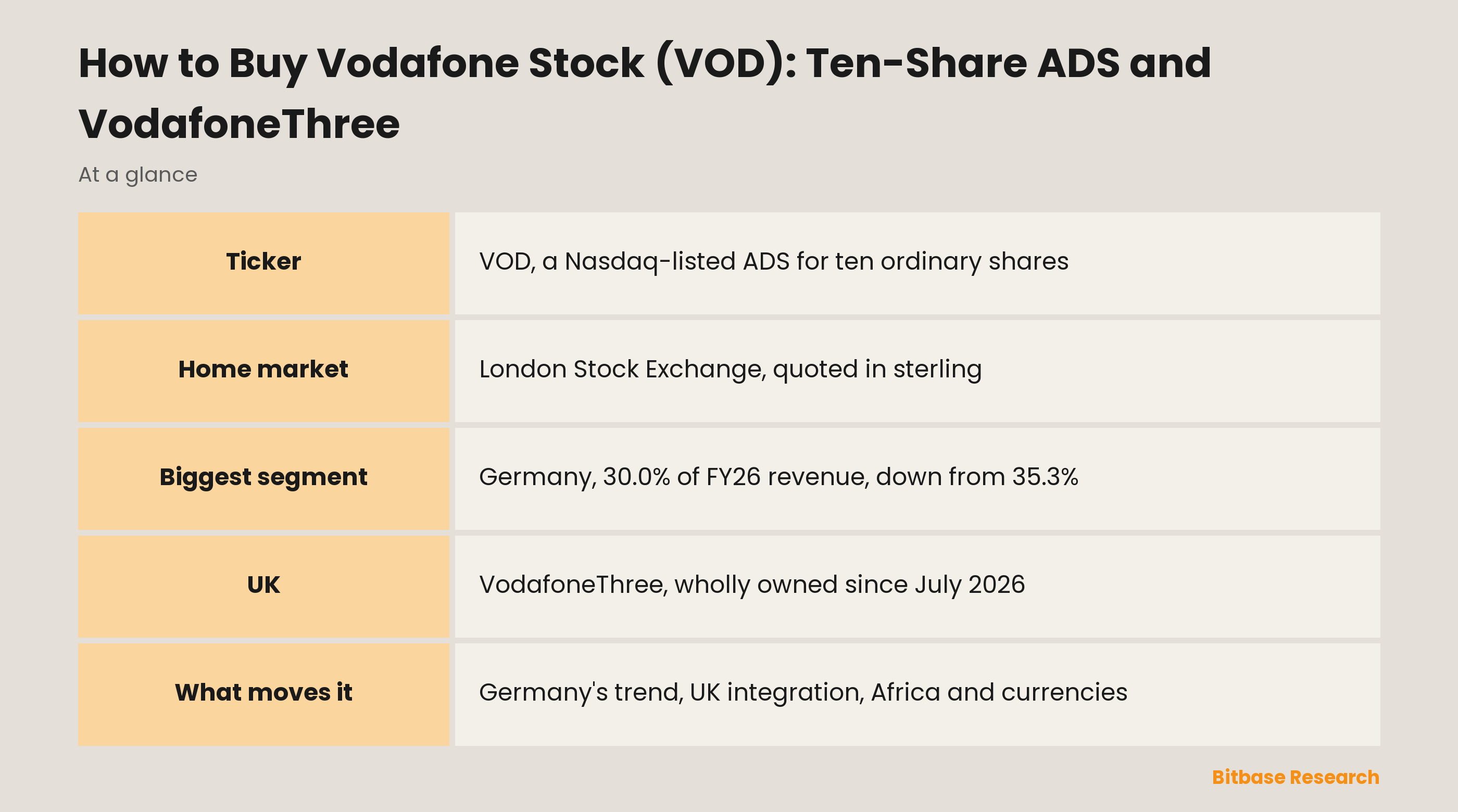
From a US brokerage account, Vodafone is bought as an American depositary share (ADS) listed on the Nasdaq Global Select Market under VOD, and each of those ADSs stands for ten ordinary shares of the London-listed parent. The company behind the ticker has been rebuilt since 2024: Spain and Italy were sold, the UK business merged with Three and is now wholly owned, and Germany's share of group revenue fell from 35.3% to 30.0% in two financial years. This guide walks through where Vodafone's revenue comes from, how VOD relates to the London shares and which risks the latest 20-F flags as rising.
What Does Vodafone Do?
Vodafone Group Plc is a telecoms operator working across Europe and Africa. Its annual report on Form 20-F for the year to March 2026 says it provides mobile and fixed services to approximately 300 million customers in 15 countries, has more than 59 million users of its financial services and reaches another 72 million customers through joint ventures and associates. The count includes 18 million fixed broadband customers and 244 million Internet of Things (IoT) connections.
Network access is still what pays the bills: "Core connectivity products and services in fixed and mobile account for the majority of our revenue." Around that core sit digital services for companies, IoT contracts and, mainly in Africa, mobile money. Results are split into five operating segments: Germany; the UK; Other Europe, which covers Portugal, Ireland, Greece, Romania, the Czech Republic and Albania; Türkiye; and Africa, which is the Vodacom Group. Margherita Della Valle was appointed Group Chief Executive in 2023.
The business started inside a British electronics group. It was incorporated in 1984 as Racal Strategic Radio Limited; in October 1988, 20% of Racal Telecom was offered to the public, and in September 1991 the company was fully demerged from Racal Electronics and took the name Vodafone Group Plc. EDGAR's records show it filing as Vodafone AirTouch between 1999 and 2002.
The last few years have been about fewer markets with more weight in each. Vodafone completed the sale of Vodafone Spain to Zegona Communications on 31 May 2024 and of Vodafone Italy to Swisscom on 31 December 2024. On 31 May 2025 it combined Vodafone UK with Three UK as VodafoneThree, 51% owned by Vodafone and 49% by CK Hutchison; the 20-F calls it the biggest mobile network operator in the UK, with 28 million customers. A 6-K dated 30 July 2026 then reported that Vodafone had bought out CK Hutchison's 49% and "now owns 100% of VodafoneThree."
Two more moves followed in mid-2026. Vodacom completed the purchase of an effective 20% of Kenya's Safaricom on 30 June, lifting its holding to 55%, and Safaricom has been consolidated since 1 July. In August, the 50% stake in the Dutch joint venture VodafoneZiggo passed to Liberty Global for cash and 10% of a new Benelux company. Outside the segments, Vodafone still holds 44.7% of the tower company Vantage Towers and 16.1% of India's Vodafone Idea, carried at nil since the year to March 2020.
How Vodafone Makes Money
Vodafone keeps its books in euros, and its financial year ends on 31 March, so FY26 means the twelve months to 31 March 2026. Total revenue rose 8.0% that year, lifted by ten months of Three UK, while organic service revenue, a measure that removes acquisitions, disposals and currency swings, grew 5.4%. Service revenue, the recurring charges for connections rather than handset sales, made up 82.7% of the total.
| Segment | Share of FY26 revenue | Organic service revenue growth, FY26 | What the 20-F points to |
|---|---|---|---|
| Germany | 30.0% | −0.2% | Bulk TV contracts in apartment blocks ended; 1&1's customers moved onto Vodafone's network |
| UK | 22.7% | +0.3% | Reported revenue up 30.0% once Three UK was consolidated |
| Africa (Vodacom) | 20.7% | +12.9% | Growth in every Vodacom market; M-Pesa revenue up 23.1% on an organic basis |
| Other Europe | 14.1% | +0.5% | Gains in Albania, the Czech Republic, Ireland and Greece; price pressure in Portugal |
| Türkiye | 8.5% | +45.2% | Hyperinflation accounting; 13.8% growth in euro terms under IAS 29 |
| Common functions | 4.5% | — | Corporate functions and shared operations |
Shares are worked out from the segment revenue note of the 2026 20-F; a small eliminations line between segments is left out.
Germany is still the biggest segment, but it carries less of the group than it did: 35.3% of revenue in FY24 against 30.0% in FY26. Part of the slide came from television. Bulk TV contracts in German multi-dwelling units ended, and the 20-F puts the drag on organic service revenue growth at 0.8 percentage points. Wholesale went the other way: more than 12 million customers of 1&1, a rival brand, now use Vodafone's national 5G network.
The UK rose from 18.6% of revenue to 22.7% over the same two years, but that is mostly consolidation. Three UK's results joined the group from 31 May 2025, and organic UK service revenue grew only 0.3%.
Türkiye needs a footnote. Vodafone has treated the Turkish economy as hyperinflationary since 30 June 2022, so organic growth of 45.2% says more about lira inflation than about volume; in euros under IAS 29, service revenue rose 13.8%.
Africa is the steadiest grower in the table. Vodacom, which covers South Africa, Egypt and several other markets, depends on payments as well as calls and data: M-Pesa revenue rose 23.1% and Vodafone Cash in Egypt 48.2% on an organic basis. Safaricom is not in these FY26 figures.
VOD Stock at a Glance
| Item | Detail |
|---|---|
| What VOD is | An American depositary share of Vodafone Group Plc; each ADS represents ten ordinary shares |
| US listing | Nasdaq Global Select Market, symbol VOD |
| Depositary | J.P. Morgan, under a deposit agreement dated 15 February 2022 |
| Services for ADS holders | Computershare Trust Company, including a direct purchase and dividend reinvestment plan |
| Primary listing | London Stock Exchange, where the ordinary shares are quoted in sterling |
| Held via the ADR programme | About 12.17% of the ordinary shares on 13 May 2026 |
| Other Nasdaq lines | Bond and capital-securities issues with symbols built on VOD, such as VOD32 and VOD79 |
| Legal form | Public limited company registered in England and Wales, head office in Newbury, Berkshire |
| Financial year | Ends 31 March; IFRS accounts presented in euros |
| Dividend policy | Progressive since November 2025; an interim and a final dividend each year, declared in euros |
| SEC filings | Form 20-F once a year plus Forms 6-K, CIK 839923 |
Quotes change by the second, so none appear above. The Vodafone stock page on Bitbase carries the live price, chart and trading volume.
How to Buy Vodafone Stock
There are two ways in: the ADS on Nasdaq, priced in dollars and traded during New York hours, or the ordinary shares in London, priced in sterling. Outside the UK, the ADS is usually the simpler of the two.
1. Decide which line you want. Any broker with Nasdaq access can buy VOD; the London shares need a broker that reaches the London Stock Exchange.
2. Open an account and pass the checks. Brokers set their own rules on which countries' residents they take and verify identity before the first order.
3. Fund the account. If your money is in another currency, the broker's conversion rate adds a separate cost on top of any commission.
4. Check what the symbol points to. VOD is the ADS. Lines such as VOD32 or VOD79 are Vodafone bonds and capital securities, and EDGAR's company data also lists an OTC symbol, VODPF; on Nasdaq, the ADS is Vodafone's only equity line.
5. Choose how the order executes. A market order accepts the next price on offer, while a limit order names the most you will pay and may sit unfilled; the mechanics of a market order are the same idea whatever the asset.
6. Do the arithmetic. One VOD equals ten Vodafone shares, so a London quote only lines up with VOD after multiplying by ten and converting pence into dollars. Whether you can buy part of an ADS depends on the broker.
The ADS and the London share. The 20-F is blunt about the wrapper: "ADS holders are not shareholders in the Company but may instruct J.P. Morgan on the exercise of voting rights." J.P. Morgan held about 12.17% of the ordinary shares as nominee in May 2026 and votes them as instructed. Dividends are declared in euros; London shareholders receive euros or sterling depending on where they live, and ADS holders receive dollars, converted at the average exchange rate of the five business days in the week before payment. The ratio is specific to Vodafone, too: each British American Tobacco ADS represents a single share, against ten here.
Stamp duty and UK tax. According to the 20-F, no stamp duty should in practice be payable on a transfer of ADSs executed and kept outside the UK, and an agreement to transfer ADSs does not trigger stamp duty reserve tax. Buying registered ordinary shares generally costs 0.5% of the price, and moving shares into the depositary's custody 1.5%. Vodafone has no requirement under current UK law to withhold tax from dividends, and a US holder not resident in the UK is generally not liable for UK tax on gains from selling. Where you live still decides how dividends and gains are taxed; none of this is tax advice.
What Moves VOD Stock
Whether Germany turns. The largest segment shrank 0.2% on an organic basis in FY26, but the quarters improved, to growth of 0.7% in the third quarter and 1.3% in the fourth. The first quarter of FY27, reported in a 6-K on 27 July 2026, showed 1.2% in Germany and 5.2% for the group, with every segment growing.
VodafoneThree. Full ownership means the UK result now belongs entirely to Vodafone, and so do the merger's obligations: legally binding commitments to the Competition and Markets Authority, including an eight-year network investment obligation. The filing warns that the integration "carries the risk of disruption and further operational complexity if not managed correctly."
Africa, now with Safaricom. Africa grew fastest among the large segments, and from July 2026 it includes Safaricom. In its July trading update Vodafone raised its guidance range to reflect the contribution from Kenya and Ethiopia.
Three currencies at once. Vodafone reports in euros, the London shares are quoted in sterling and VOD trades in dollars. The 20-F names the euro, the South African rand and sterling as the main currencies of its future cash flows, so a strong dollar can weigh on VOD even when the business is unchanged in local terms.
A changing shareholder register. At 31 March 2026 Emirates Telecommunications Group (e&) had notified a holding of about 17.0%. On 10 July 2026 e& agreed to sell its entire stake to Vega, a vehicle wholly owned by the Niel family group; the relationship agreement with Vodafone ended and e&'s nominee director left the board. In a Schedule 13D filed in August 2026, Vega and members of the Niel family reported beneficial ownership of about 9.9% through two equity derivative transactions.
Where Vodafone's 20-F Sees Rising Risk
Vodafone's list of principal risks gives each one a trend, and several are marked increasing or new.
Funding and markets. "Adverse macroeconomic, liquidity, funding and market risk" is marked increasing; the 20-F notes that "financial markets are experiencing high levels of volatility, with sovereign debt at record levels," which could change the availability and cost of capital. Vodafone had 16 bond and capital-securities lines registered on Nasdaq alone, so the cost of debt is not abstract.
Competition from outside telecoms. Vodafone points to "the increasing influence of 'Big Tech'" and adds that "Increased investment by satellite providers and hyperscalers is also reshaping the connectivity ecosystem." Ordinary price competition, as in Portugal after a fourth operator arrived, sits alongside it.
Cyber attacks and outages. The cyber risk is marked increasing; network resilience is a separate entry, illustrated by the power failure across the Iberian Peninsula and the deliberate attack on Berlin's power grid.
Execution and supply. "Strategic transformation execution" is new, covering the German efficiency programme and the VodafoneThree integration. Supply chain risk is rising, with bans on high-risk vendors, server costs pushed up by AI infrastructure and US tariffs named as pressures.
Internal controls. At the FY26 year-end, Vodafone found an error in how it assessed the recoverability of a deferred tax asset in the new UK tax group formed after the Three merger. Management classified the control deficiency as a material weakness under section 404 of the Sarbanes-Oxley Act, and remediation has begun.
Following Vodafone Through Its SEC Filings
Vodafone files under CIK 839923. The annual report on Form 20-F for the year to 31 March 2026 was filed on 22 May 2026 and combines the UK annual report with the SEC disclosures, so the principal risks, the segment note and the shareholder information section, with its ADS and taxation details, sit in one document. Between annual reports, Forms 6-K carry quarterly trading updates, completed deals, monthly voting rights totals and notices from large holders; Schedules 13D and 13G from investors appear in the same EDGAR list. A figure labelled FY27 belongs to the year ending 31 March 2027, not calendar 2027. For live prices on other listed companies, see Bitbase's stock section.
Vodafone Stock FAQ
How many Vodafone shares does one VOD ADS represent?
Ten. The 20-F cover describes the ADS as "each representing ten ordinary shares," held by J.P. Morgan as depositary, which is why the VOD price is roughly ten London shares converted into dollars.
Can I buy Vodafone stock with crypto?
Not directly. Brokers take dollars for VOD and sterling for the London shares, so the coins have to be converted to money and the proceeds moved into a brokerage account first. Many countries treat that conversion as a taxable disposal; how crypto disposals are taxed depends on where you live.
Does Vodafone pay a dividend?
Yes, twice a year, as an interim and a final dividend declared in euros and paid to ADS holders in dollars. The board adopted a progressive dividend policy in November 2025, and the FY26 total rose 2.5%. Each payment still needs a board decision.
Is VOD listed on Nasdaq or the NYSE?
Nasdaq. The ADS trades on the Nasdaq Global Select Market, while the company's primary listing is the London Stock Exchange.
Does Vodafone still operate in Spain and Italy?
No. Vodafone Spain went to Zegona Communications in May 2024 and Vodafone Italy to Swisscom in December 2024. In 2026 Vodafone also sold its half of VodafoneZiggo, while taking full ownership of VodafoneThree and, through Vodacom, control of Safaricom.
Conclusion
Vodafone today is a narrower and more concentrated company than the one many investors remember: Germany, a wholly owned VodafoneThree, six other European markets, Türkiye and an Africa business enlarged by Safaricom. The ADS adds two things to keep in mind, the ten-share ratio and a price that moves with the euro, sterling and the dollar as well as with the business. What decides the result from here is whether German revenue keeps growing, whether the UK integration runs to plan and how the new shareholder base behaves. The 20-F and the quarterly 6-K trading updates are the places to check each of those.
Related reading
Other Bitbase articles on this topic:
- How to Buy Chunghwa Telecom Stock (CHT): 10-Share ADS, State Stake
- How to Buy EchoStar Stock (ECHO): Spectrum Sales, SpaceX Deal
- How to Buy Formula One Stock (FWONK): F1, MotoGP and No Vote
Disclaimer: This article is educational content from Bitbase Academy, provided for information only. It explains what a company or fund does and how the instruments referenced here differ from one another; it does not constitute investment, trading, tax, or financial advice, and it is neither a recommendation nor an endorsement of any security, token, or trading strategy. A tokenized stock is issued by a third party and is designed to give economic exposure to an underlying asset: it is not a share, it carries no shareholder rights, and it depends on the issuer's structure, eligibility rules, and redemption terms, which the issuer can change. Perpetual futures are leveraged derivatives that hold no underlying asset and can be liquidated, and trading hours, product availability, and eligibility differ by instrument and by jurisdiction and can change at any time. Written as of November 2026; verify everything yourself through company filings, the issuer's own documentation, and the product pages of the venue you trade on.
References
[1] Vodafone Group Plc Annual Report on Form 20-F 2026 (SEC EDGAR) www.sec.gov
[2] Vodafone 2026 Form 20-F, XBRL cover page (SEC EDGAR) www.sec.gov
[3] Vodafone 2026 Form 20-F, segment revenue in XBRL (SEC EDGAR) www.sec.gov
[4] Vodafone Form 6-K, 30 July 2026: full ownership of VodafoneThree (SEC EDGAR) www.sec.gov
[5] Vodafone Form 6-K, 30 June 2026: Safaricom transaction completed (SEC EDGAR) www.sec.gov
[6] Vodafone Form 6-K, 3 August 2026: sale of VodafoneZiggo completed (SEC EDGAR) www.sec.gov
[7] Vodafone Form 6-K, 27 July 2026: Q1 FY27 trading update (SEC EDGAR) www.sec.gov
[8] Vodafone Form 6-K, 10 July 2026: response to e&'s announcement (SEC EDGAR) www.sec.gov
[9] Schedule 13D on Vodafone filed by Vega SAS and the Niel family, August 2026 (SEC EDGAR) www.sec.gov
[10] SEC EDGAR company data for Vodafone Group, CIK 839923 data.sec.gov





