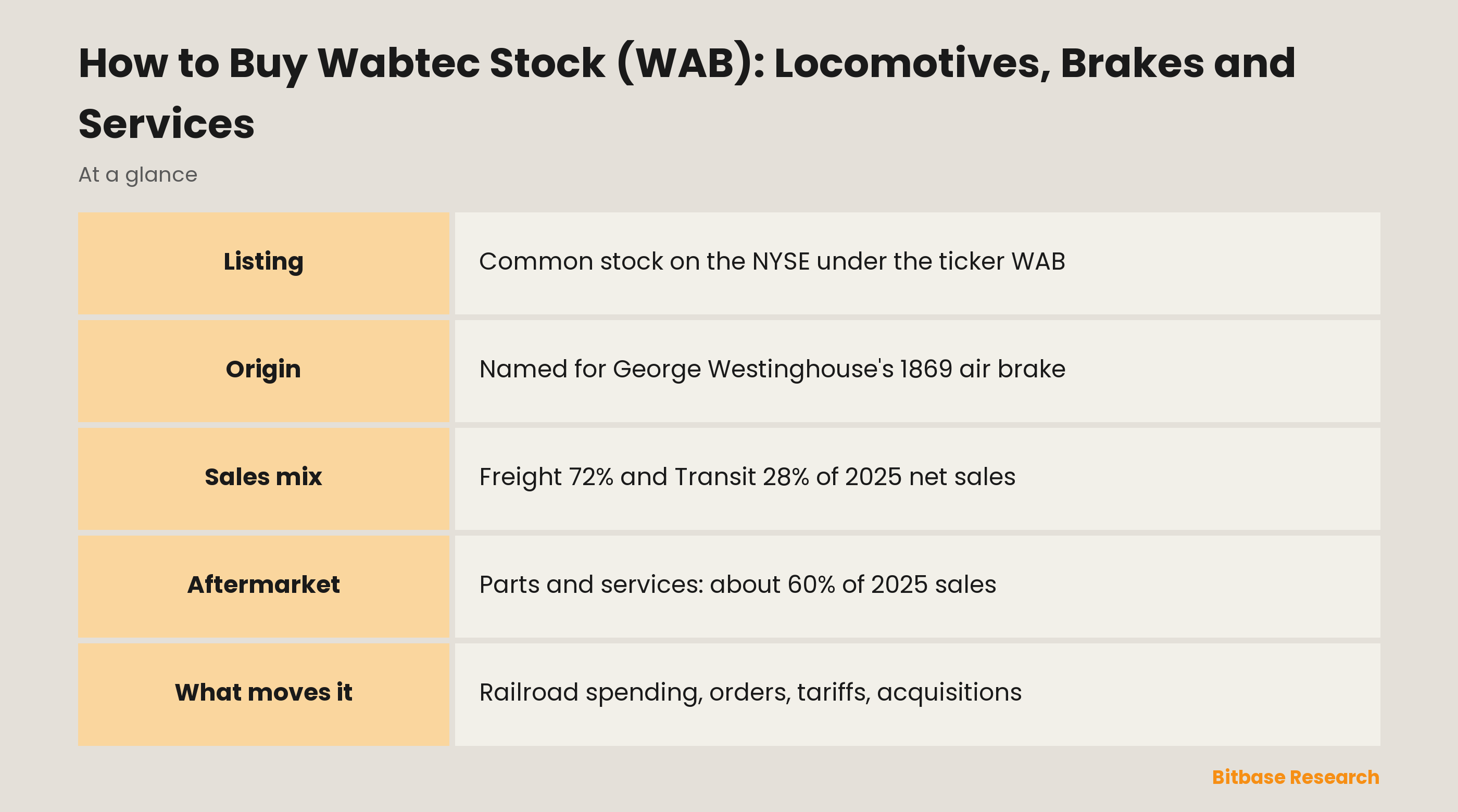
A single WAB share can be bought through any broker with access to the New York Stock Exchange, where the common stock of Westinghouse Air Brake Technologies Corporation, the company that does business as Wabtec, trades under that ticker. The name goes back to the air brake George Westinghouse invented in 1869, yet in 2025 the Freight segment, home to its diesel-electric locomotives, made up about 72% of sales, and aftermarket parts and services about 60%. Below: what the company builds and maintains, the steps of an order, and what its filings say moves the business, from railroad spending and tariffs to a record order backlog.
What Does Wabtec Do?
Wabtec makes, upgrades and services equipment for railways. Its annual report calls it "a global provider of value-added, technology-based locomotives, equipment, systems and services for the freight rail and passenger transit industries, and the mining, marine, and industrial markets." It is a Delaware corporation headquartered in Pittsburgh, Pennsylvania, with about 31,000 employees and operations in more than 50 countries, and its products are in use in more than 100.
The history explains the name. "George Westinghouse founded the original Westinghouse Air Brake Co. in 1869 when he invented the air brake." The present company was formed in 1990, when it bought assets from American Standard, now Trane, and it went public on the New York Stock Exchange in 1995. A 1999 merger with MotivePower Industries gave it its current legal name. Two larger acquisitions followed: Faiveley Transport of France in 2017, a supplier of pantographs, door systems, air conditioning and braking for passenger trains, and GE Transportation in 2019, which brought General Electric's locomotive business with it. Rafael Santana, chief executive since July 2019, previously ran GE Transportation.
The Freight segment builds new diesel-electric locomotives and modernizes old ones, overhauls and maintains them, and sells components for freight cars, such as trucks, brakes and air compressors. It also supplies signaling and train control, including Positive Train Control (PTC) equipment, plus software for train performance, rail yards and logistics. Wabtec counts an installed base of nearly 24,600 locomotives, "the majority of which are equipped with Digital Intelligence technologies, like Positive Train Control." Customers include large railroads, leasing companies, freight car builders and mining, marine and industrial companies.
The Transit segment supplies parts and services for regional and high-speed trains, subway cars, light rail and buses: brakes and friction products, heating and air conditioning, train doors and platform screen doors, pantographs, power converters and passenger information systems. Its customers are transit authorities, cities, leasing companies and the manufacturers that build passenger vehicles, and the 10-K places its global headquarters in France.
Recent purchases have added to both segments. Wabtec acquired Inspection Technologies, a maker of nondestructive testing and remote visual inspection instruments that once belonged to Olympus, on 1 July 2025; Frauscher, a specialist in train detection and axle counting, on 1 December 2025; and Dellner Couplers, which makes the connection systems that join passenger rail cars, on 10 February 2026. The first two sit in Freight's Digital Intelligence line, Dellner in Transit.
The 10-K names its rivals. In North America, New York Air Brake, a subsidiary of Germany's Knorr-Bremse, and Amsted Rail are the principal equipment competitors, and Progress Rail, a Caterpillar company, is the main competitor in locomotives. Outside North America, Knorr is the main competitor, and in some product lines Wabtec competes with its own customers, such as China's CRRC.
How Wabtec Makes Money
Wabtec reports two segments, and Freight is much the larger. In 2025 net sales rose 7.5%, with both segments growing at about the same pace:
| Segment | Share of 2025 net sales | 2025 sales growth | 2025 operating margin | Aftermarket share of segment sales |
|---|---|---|---|---|
| Freight | 72% | 7.6% | 19.5% | About 58% |
| Transit | 28% | 7.3% | 13.5% | About 56% |
Because Freight also earns the higher margin, it produced about 79% of the two segments' combined operating income in 2025.
Inside Freight, the 10-K splits sales into four product lines. Services, the overhauls, modernizations and maintenance agreements on locomotives already in use, was the largest at about 38% of Freight sales in 2025. Equipment, mainly new locomotives plus engines and mining and marine products, made up about 29%; Components about 20%; and Digital Intelligence, the signaling, train control, software and inspection line, about 13%.
The aftermarket is the steadier part. Parts and services made up about 60% of total net sales, and the 10-K explains why that matters: "Aftermarket sales are typically done at higher margins and are less cyclical than OEM sales because a certain level of aftermarket maintenance and service work must be performed, even during an industry slowdown."
The sources of growth in 2025 were uneven. Freight's organic increase came mainly from higher North American locomotive deliveries and higher parts sales. Digital Intelligence sales rose about 31%, but almost entirely because of acquisitions: on an organic basis the line declined, which the 10-K attributes to "softness in the North American market." Components were flat, as industrial sales offset fewer railcars being built in North America. In Transit, the company points to fleet expansion and renewals, higher ridership and investment in sustainable infrastructure.
No single buyer dominates. Wabtec's top five customers made up about 30% of 2025 net sales, and no customer reached 10%. Geographically, about 48% of 2025 sales went to customers in the United States, with India accounting for roughly 6%, and sales to Kazakhstan and the CIS fell about 23% from the year before.
WAB Stock at a Glance
| Feature | WAB |
|---|---|
| Exchange | New York Stock Exchange |
| Ticker | WAB |
| Legal name | Westinghouse Air Brake Technologies Corporation, doing business as Wabtec |
| Security | Common stock, the only class registered under Section 12(b) |
| Business | Locomotives, freight car and passenger train components, signaling, rail services |
| Segments | Freight and Transit |
| Index membership | S&P 500 |
| Headquarters | Pittsburgh, Pennsylvania |
| Incorporated | Delaware |
| Listed | New York Stock Exchange since 1995 |
| Fiscal year | Calendar year, ending 31 December |
| Payouts | Quarterly cash dividend, each one approved by the board |
| SEC identifier | CIK 943452 |
Price, market value and dividend yield change with each trade. For live figures, use the Wabtec stock page on Bitbase.
How to Buy Wabtec Stock
WAB is the common stock of a US company, so no depositary receipt stands between you and the share: the line that trades on the New York Stock Exchange is the stock itself. An order runs through seven steps:
1. Find a broker that can reach the NYSE. Outside the United States, that may be a local broker with a US-shares service or an international one; check which legal entity holds your account and which regulator supervises it.
2. Open and verify the account. Brokers ask non-US individuals to certify their status, usually on IRS Form W-8BEN; the IRS tells foreign persons to submit it "when requested by the withholding agent or payer."
3. Fund it. If you deposit another currency, the conversion has a cost of its own, so compare the exchange rate a broker applies along with its commission.
4. Search for WAB. The listing may appear as Westinghouse Air Brake Technologies Corp or as Wabtec Corp; both are the same company, and the 10-K cover shows one registered class of shares.
5. Choose an order type. A market order fills at the best price available when it reaches the exchange; a limit order sets the highest price you will pay and may not fill at all.
6. Set the size. Some brokers sell fractions of a share for a fixed amount of money, others only whole shares. If you buy a fraction, check how your broker handles dividends and voting on it.
7. Keep the records. Confirmations and monthly statements show your cost basis and every dividend paid, which you need when you sell or file taxes.
Taxes for investors abroad. The IRS says that "most types of U.S. source income received by a foreign person are subject to U.S. tax of 30%," with a reduced rate or exemption possible under a tax treaty. That is the reason for the W-8BEN form, and dividends may be taxed again in your home country.
Holding it through a fund. WAB is a member of the S&P 500, so funds that track that index, such as State Street's SPY, hold it as one small position in the index. That route gives exposure to Wabtec without concentrating money in one rail supplier.
What Moves WAB Stock
Railroad spending. Wabtec's results depend, in the 10-K's words, on "the level of activity, financial condition and capital spending plans of freight railroads and passenger transit agencies around the world." When freight volumes soften, railroads delay purchases: "In economic downturns, railroads have deferred, and may defer, certain expenditures in order to conserve cash in the short term." Orders for new locomotives swing more with that cycle than parts and service work does.
Locomotive orders and the backlog. Big orders arrive in lumps and are delivered over years. In 2025 Wabtec signed an agreement with KTZ, Kazakhstan's national railway, for Evolution Series locomotives and long-term service, which it calls "the largest locomotive agreement in Wabtec's history." In North America, fourth-quarter 2025 orders for modernizations were larger than those for new locomotives, and in 2026 Wabtec began building its first EVO modernization units. About 70% of the backlog at the end of 2025 was scheduled for delivery after 2026, and at 30 September 2026 the total backlog, a record, was 22.9% higher than a year earlier.
The installed base. With roughly 60% of sales coming from the aftermarket, the number of locomotives and transit cars in service matters as much as new builds. Freight Services sales grew 6.7% in the third quarter of 2026 on core demand and more modernization deliveries.
Transit funding. Passenger rail runs on public money. The 10-K notes that new transit car orders depend on replacement programs and system expansions, and that projects "may be delayed or canceled" if funding is cut. Transit sales rose 11.3% in the third quarter of 2026, helped by the Dellner acquisition.
Acquisitions and integration. Inspection Technologies, Frauscher and Dellner were bought within eight months of each other. They lift reported growth, as in the third quarter of 2026, when Digital sales rose 24.2% with Frauscher included, but they also add debt and integration work: Wabtec borrowed for the deals and sold new senior notes due 2037 in November 2026. A three-year cost program announced in February 2025 aims to consolidate plants and shift capacity to lower-cost countries.
Tariffs and materials. The 10-Q for the third quarter of 2026 reports "increased tariff costs which have unfavorably impacted our operating results," with only "a nominal amount" recovered through refunds so far. Steel, aluminum, copper and rubber are bought without long-term price contracts, so cost swings flow through unless Wabtec can raise prices.
Recent results. In the third quarter of 2026, sales grew 8.1%, the GAAP operating margin was 20.0% against 17.0% a year earlier, and GAAP diluted earnings per share rose 33.7%.
Wabtec's Customer, Backlog and Trade Risks
The Risk Factors section of the 10-K lists what Wabtec considers material. These are the most specific to the company:
Concentrated, cyclical customers. "We are dependent upon key customers," the filing says, and many of them "place orders for products on an as-needed basis and operate in cyclical industries." Losing one large railroad, or a cut in its spending, would show up quickly.
A backlog that is not guaranteed. The 10-K states that its backlog "is not necessarily indicative of the level of our future revenues." Contracts carry standard industry cancellation provisions, and scope changes are common, so a record backlog can still slip or shrink.
Emerging markets and conflict. The company has "substantial operations located in emerging markets, such as Brazil, India, and Kazakhstan." Its Kazakhstan operations have "incurred supply, distribution and currency impacts as an indirect result from the Russian invasion of Ukraine," and Kazakhstan's national railway is also the customer behind the largest locomotive agreement in the company's history.
Inputs, trade policy and currency. Wabtec says it has traditionally bought raw materials without long-term pricing contracts, and it warns that tariffs and foreign trade restrictions "could adversely affect our business." With about half of sales outside the United States, exchange rates also move reported results.
Deals and labor. Acquisitions bring integration risk and goodwill that could later be written down, which the 10-K says would mean "a significant non-cash charge to earnings." A labor agreement covering about 1,400 locomotive manufacturing workers in Erie, Pennsylvania, runs until 30 April 2027, and its renewal is worth watching.
Two risks sit at the level of the stock. Owning shares of one company concentrates your risk in a single business and a single industry. And the dividend is not promised: "The declaration and payment of future dividends are at the discretion of the Board of Directors."
How to Research WAB Yourself
Wabtec files with the SEC under CIK 943452: the 10-K once a year, 10-Qs after each of the first three quarters and 8-Ks for events such as earnings releases, which in 2026 came on 11 February, 22 April, 22 July and 21 October. The same documents are free on wabteccorp.com.
In the 10-K, the business section describes the two segments and the product lines, names the competitors and sets out the backlog, including how much of it is due in the coming year. Risk Factors covers the risks, the MD&A explains sales changes by product line, separating acquisitions from organic growth, and the segment note gives sales and operating income side by side.
Read the latest 10-Q alongside the 10-K, because facts move. The annual report filed in February 2026 described a pending lawsuit by Progress Rail with a trial date set; the third-quarter 10-Q reports that the two companies settled all of Progress Rail's claims in February 2026 without any admission of liability by Wabtec. Note also that Wabtec closes its books on a four-four-five week calendar, so quarters end on or about the calendar dates.
Railroads' own reports show the other side of the market, since capital spending at the big freight carriers is what Wabtec sells into. Union Pacific and Norfolk Southern both gave Wabtec partnership awards in 2024 and 2025; our Union Pacific stock guide and Norfolk Southern stock guide explain how those businesses work. For quotes on other listed companies, see the full list of US stock pages on Bitbase.
Wabtec Stock FAQ
Can I buy Wabtec stock with crypto?
Not directly. WAB shares are bought in US dollars through a brokerage account, so crypto would first have to be sold for cash and the money moved to the broker, and that sale may be a taxable event where you live. A share and a coin are different assets: the share is a claim on a company that files audited reports and pays dividends at its board's discretion, which is how a share differs from a crypto asset.
Does Wabtec pay a dividend?
Yes. Wabtec has historically paid a quarterly cash dividend, each one approved by the board, and the dividend per share rose in both 2024 and 2025. The 10-K says future payments "are at the discretion of the Board of Directors," so check the latest earnings release for the current amount and dates.
Is WAB in the S&P 500?
Yes. Wabtec Corp appeared in State Street's daily holdings file for SPY, a fund that tracks the S&P 500, on 5 November 2026. Its weight in the index changes every trading day.
What does Wabtec stand for?
Wabtec is short for Westinghouse Air Brake Technologies, the legal name the company took after its 1999 merger with MotivePower Industries. It refers back to George Westinghouse, who invented the railway air brake and founded the original Westinghouse Air Brake Co. in 1869.
Does Wabtec make locomotives?
Yes. Wabtec builds diesel-electric locomotives, including its Evolution Series, and also modernizes and overhauls existing ones. The business came mainly from its 2019 acquisition of GE Transportation, and the 10-K names Progress Rail, owned by Caterpillar, as its primary locomotive competitor.
Conclusion
The question with WAB is how much of its revenue keeps coming after a locomotive has been delivered. Wabtec is a rail supplier whose name comes from a 19th-century brake but whose sales now rest on locomotives, a large installed base that generates repeat service work, and a growing set of signaling and inspection products bought in the past two years. Before buying, read the latest 10-K and 10-Q, compare orders against deliveries over a full rail cycle, and decide how much one rail equipment company should weigh in your portfolio.
Related reading
Other Bitbase articles on this topic:
- How to Buy Honeywell Aerospace Stock (HONA): APUs and Avionics
- How to Buy Ingersoll Rand Stock (IR): Compressors and Spare Parts
- How to Buy L3Harris Stock (LHX): Rocket Motors, Radios, Satellites
Disclaimer: This article is educational content from Bitbase Academy, provided for information only. It explains what a company or fund does and how the instruments referenced here differ from one another; it does not constitute investment, trading, tax, or financial advice, and it is neither a recommendation nor an endorsement of any security, token, or trading strategy. A tokenized stock is issued by a third party and is designed to give economic exposure to an underlying asset: it is not a share, it carries no shareholder rights, and it depends on the issuer's structure, eligibility rules, and redemption terms, which the issuer can change. Perpetual futures are leveraged derivatives that hold no underlying asset and can be liquidated, and trading hours, product availability, and eligibility differ by instrument and by jurisdiction and can change at any time. Written as of November 2026; verify everything yourself through company filings, the issuer's own documentation, and the product pages of the venue you trade on.
References
[1] Wabtec Form 10-K for 2025 (SEC EDGAR) www.sec.gov
[2] Wabtec 2025 Form 10-K, XBRL cover page (SEC EDGAR) www.sec.gov
[3] Wabtec 2025 Form 10-K, XBRL segment data (SEC EDGAR) www.sec.gov
[4] Wabtec 2025 Form 10-K, XBRL sales by region (SEC EDGAR) www.sec.gov
[5] Wabtec 2025 Form 10-K, XBRL sales by product line (SEC EDGAR) www.sec.gov
[6] Wabtec Form 10-Q for the third quarter of 2026 (SEC EDGAR) www.sec.gov
[7] Wabtec third-quarter 2026 earnings release, filed with Form 8-K (SEC EDGAR) www.sec.gov
[8] Wabtec Form 8-K of 4 November 2026: senior notes due 2037 (SEC EDGAR) www.sec.gov
[9] State Street SPDR S&P 500 ETF Trust (SPY): fund page and daily holdings www.ssga.com
[10] IRS: NRA Withholding www.irs.gov
[11] IRS: About Form W-8 BEN www.irs.gov





