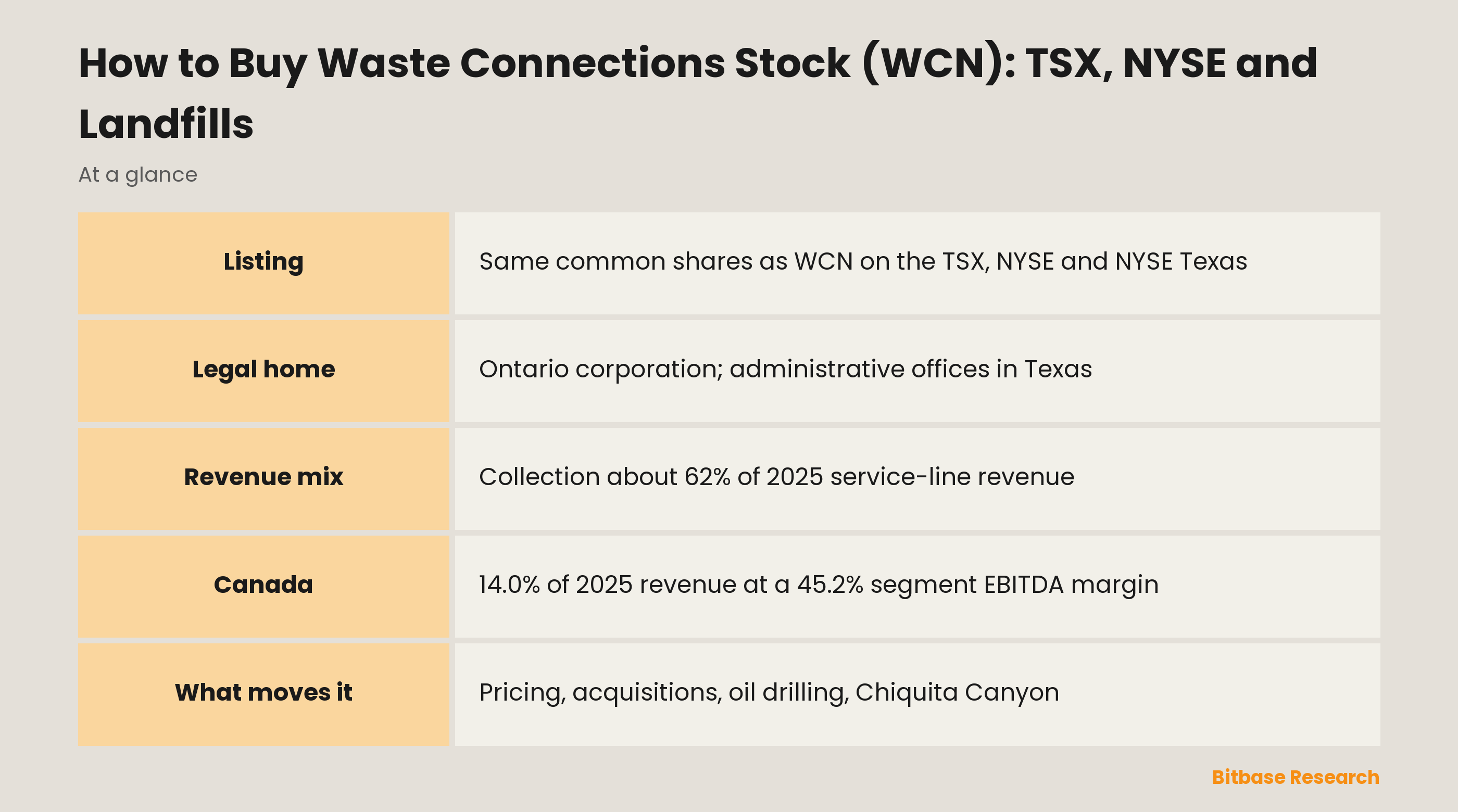
You could buy Waste Connections in Toronto or in New York and own the same thing either way: its common shares trade as WCN on the Toronto Stock Exchange, the New York Stock Exchange and NYSE Texas, so a broker that reaches any one of them can fill the order. The company is incorporated in Ontario, keeps its administrative offices in Texas and files a Form 10-K in US dollars; in 2025 its Canada segment brought in 14.0% of revenue at a 45.2% segment EBITDA margin, the highest of its six regions.
What Does Waste Connections Do?
Waste Connections collects, transfers and buries non-hazardous waste. Its 10-K calls it "the third largest solid waste services company in North America," operating in 46 US states and six Canadian provinces, and the company says it serves about nine million customers "in mostly exclusive and secondary markets."
The business has two roots. Waste Connections was founded in the United States in 1997. In June 2016 it combined with Progressive Waste Solutions, a Canadian waste company: the old Waste Connections became a subsidiary of the Ontario corporation, which took the Waste Connections name. That is why a company whose operations are mostly American is legally Canadian.
Much of its collection work is shielded from head-to-head competition. Exclusive franchise agreements usually run seven years or longer, and in Washington State governmental certificates "typically grant the holder the exclusive and perpetual right" to serve a territory at set rates.
Behind the trucks sits disposal. At the end of 2025 the company owned or operated 77 municipal solid waste landfills, 20 landfills and caverns that take only oil and gas waste, and 17 landfills for construction and other non-putrescible waste. On permitted capacity, its owned landfills and those run under life-of-site agreements have about 31 years of remaining life on average. Gas systems at 61 landfills turn methane into electricity or renewable natural gas.
How Waste Connections Makes Money
Collection is the core. Before intercompany eliminations, it made up about 62% of the service-line revenue in the 2025 10-K: commercial 27%, residential 22% and industrial and construction roll-off 13%. Landfills contributed 14%, transfer stations 13%, E&P waste 6%, recycling 2% and intermodal and other 2%.
The company is run through six geographic segments, and their margins differ widely:
| Segment | Share of 2025 revenue | 2025 segment EBITDA margin |
|---|---|---|
| Southern | 20.2% | 33.1% |
| Western | 19.5% | 27.8% |
| Eastern | 18.0% | 26.5% |
| Central | 16.8% | 36.2% |
| Canada | 14.0% | 45.2% |
| MidSouth | 11.5% | 28.0% |
| Total | 100% | 32.2% |
Shares are calculated from the segment note. Canada produced 14.0% of revenue but 19.4% of the six segments' combined EBITDA.
Price was the largest source of growth in 2025. Total revenue rose 6.1%: core price increases added about 6.0% of the prior year's revenue and acquisitions added more, while volume losses took away about 2.7%. One cause, per the 10-K, was "the purposeful shedding of certain low-margin municipal contracts." The E&P service line grew 32% and has almost tripled in two years.
WCN Stock at a Glance
| Feature | WCN |
|---|---|
| Listing venues | Toronto Stock Exchange, New York Stock Exchange and NYSE Texas |
| Symbol | WCN on all three |
| Security | Common shares, no par value; no depositary receipts |
| Sector | Solid waste collection, disposal and recycling |
| Index membership | In S&P/TSX 60 funds such as XIU; not in SPY's S&P 500 holdings (November 2026 files) |
| Incorporated | Ontario, Canada |
| Offices | Woodbridge, Ontario; administrative offices in The Woodlands, Texas |
| Fiscal year | Calendar year |
| Dividend | Quarterly, in US dollars; raised 10% in October 2026 |
| Stock split | Three-for-two, effective 16 June 2017 |
Price, market value and yield change with every trade; the Waste Connections stock page on Bitbase shows live figures.
How to Buy Waste Connections Stock
WCN is one class of shares listed in two countries, not a repackaged foreign security. The real choices are market and currency.
1. Choose the market. A US-focused broker will usually buy on the NYSE in US dollars; a Canadian broker can buy on the TSX in Canadian dollars. Either way you hold the same shares.
2. Open and verify the account. Check which entity holds it and who regulates it, and declare your tax residence accurately.
3. Fund it in the trading currency. A poor conversion rate can cost more than the commission.
4. Look up WCN. Confirm the result reads Waste Connections common shares, the only class on the 10-K cover.
5. Pick an order type. FINRA says a market order "provides the most certainty that your order will be executed," while a limit order executes only "at or better than a specified price."
6. Size the position. Fractional shares are a broker feature, and FINRA notes that "as a fractional share owner, you might not have shareholder voting rights."
7. Keep the records. Confirmations and dividend statements show your cost and any tax taken at source.
Dividends and Canadian tax. Because the issuer is Canadian, Canada's rules apply to its dividends. The Canada Revenue Agency says non-residents "have to pay a 25% tax on amounts that are taxable under Part XIII," which include dividends, and that a tax treaty or the Income Tax Act can reduce the rate or exempt the payment. Ask your broker what it will withhold for someone in your country.
Indirectly. The iShares S&P/TSX 60 Index ETF (XIU) holds WCN; S&P 500 funds such as SPY do not.
What Moves WCN Stock
Price against volume. The company seeks price increases to cover costs and widen margins. In 2025 price and acquisitions supplied the growth while volume shrank, and the MD&A of each 10-Q reports the two separately; the balance shows how far pricing can go before customers leave.
Acquisitions. Buying local haulers and folding them into existing routes is part of the strategy: 19 deals closed in 2025 and 24 in 2024.
Oil and gas drilling. E&P waste follows drilling and production in the basins it serves, and the 10-K warns that crude oil prices "may in the future impact the level of drilling or production activity."
Commodity and credit prices. In 2025, recycled commodity revenue fell on lower prices for old corrugated cardboard and plastics, and landfill gas revenue dropped as renewable energy credits lost value. In the first nine months of 2026 gas revenue rose again.
The Canadian dollar. Canadian results are translated into US dollars, and a weaker average rate in 2025, 0.7160 against 0.7298, cut reported revenue.
Chiquita Canyon. At this landfill near Los Angeles, consultants hired by the company attribute odours to an elevated temperature event in a lined, non-active area. The site stopped accepting waste at the end of 2024, and regulatory notices, civil suits and a county lawsuit remain open.
Where Waste Connections Could Fall Short
Contracts can be lost. Franchises and municipal contracts come up for bidding, and towns can annex territory or bring service in-house. About 454 contracts, roughly 4.0% of annual revenue, expire or renew automatically by the end of 2026.
Landfills carry long liabilities. The company warns that its accruals for closure and post-closure costs "may be inadequate," and tighter rules on PFAS could raise the cost of treating leachate. For the Chiquita Canyon cases it says it cannot reasonably estimate the possible loss.
Labour and fuel. About 16% of employees work under collective agreements, mainly with the Teamsters. Diesel prices are "volatile," and fixed-price contracts cover only part of the exposure.
Tax and currency. A risk factor states that "Canadian and foreign tax laws could materially adversely affect us," and Canada levies a 2% tax on share repurchases by listed Canadian companies.
No dividend promise. The 10-K states: "We cannot assure as to the amounts or timing of future dividends."
How to Research WCN Yourself
The SEC filings sit under CIK 1318220, and the same reports go to Canadian regulators. The 2025 10-K was filed on 12 February 2026; quarterly results arrive on Form 8-K, in 2026 on 11 February, 22 April, 22 July and 21 October.
In the 10-K, Item 1 covers contract types and landfills, Item 1A the risks, the MD&A the split of growth into price, volume, acquisitions and currency, Note 13 Chiquita Canyon and other litigation, and Note 17 the six segments. The 10-K names Waste Management and Republic Services among its competitors; see our guides to Waste Management stock and Republic Services stock.
One habit helps: compare price growth with volume change in the same quarter, because acquisitions can hide a shrinking base. For other companies, see all US stock pages on Bitbase.
Waste Connections Stock FAQ
Can I buy Waste Connections stock with crypto?
Not directly. WCN shares are bought through a broker in US or Canadian dollars, so crypto has to be sold for cash first, and that sale may be taxable where you live. A share is a registered claim on a company, which is how a share differs from a crypto asset.
Is WCN in the S&P 500?
No. It is absent from the 5 November 2026 holdings file of SPY, State Street's S&P 500 fund, which does hold Waste Management and Republic Services. It is held by XIU, BlackRock's S&P/TSX 60 fund.
Does Waste Connections pay a dividend?
Yes, quarterly. In October 2026 it was raised by 10%, which the chief executive called the sixteenth double-digit annual increase in a row. The board aims to raise it over time, but future payments are not guaranteed.
Is Waste Connections a Canadian or an American company?
Legally Canadian: the parent is an Ontario corporation, a result of the 2016 combination with Progressive Waste Solutions. Five of its six segments are in the United States, and it reports to the SEC on Form 10-K.
Has WCN stock ever split?
Yes, three-for-two, effective 16 June 2017, so older per-share figures need adjusting before you compare them.
Conclusion
Buying WCN takes a broker that reaches Toronto or New York and a choice of currency. Understanding it takes longer: a mostly American waste company with a Canadian parent, growth that leans on price and acquisitions, a Canada segment with the widest margin, and an open dispute at a closed California landfill. Read the latest 10-Q, check how a Canadian dividend is taxed where you live, and decide how much one waste company should weigh in your portfolio.
Related reading
Other Bitbase articles on this topic:
- How to Buy L3Harris Stock (LHX): Rocket Motors, Radios, Satellites
- How to Buy Mettler-Toledo Stock (MTD): Balances and Buybacks
- How to Buy Old Dominion Stock (ODFL): Union-Free LTL Freight
Disclaimer: This article is educational content from Bitbase Academy, provided for information only. It explains what a company or fund does and how the instruments referenced here differ from one another; it does not constitute investment, trading, tax, or financial advice, and it is neither a recommendation nor an endorsement of any security, token, or trading strategy. A tokenized stock is issued by a third party and is designed to give economic exposure to an underlying asset: it is not a share, it carries no shareholder rights, and it depends on the issuer's structure, eligibility rules, and redemption terms, which the issuer can change. Perpetual futures are leveraged derivatives that hold no underlying asset and can be liquidated, and trading hours, product availability, and eligibility differ by instrument and by jurisdiction and can change at any time. Written as of November 2026; verify everything yourself through company filings, the issuer's own documentation, and the product pages of the venue you trade on.
References
[1] Waste Connections Form 10-K for 2025 (SEC EDGAR) www.sec.gov
[2] Waste Connections 2025 Form 10-K, XBRL cover page (SEC EDGAR) www.sec.gov
[3] Waste Connections Form 10-Q for the third quarter of 2026 (SEC EDGAR) www.sec.gov
[4] Waste Connections third-quarter 2026 results release, filed with Form 8-K (SEC EDGAR) www.sec.gov
[5] Waste Connections Form 10-K for 2016: Progressive Waste merger (SEC EDGAR) www.sec.gov
[6] Waste Connections Form 10-K for 2017: three-for-two share split (SEC EDGAR) www.sec.gov
[7] State Street SPDR S&P 500 ETF Trust (SPY): fund page and daily holdings www.ssga.com
[8] BlackRock Canada: iShares S&P/TSX 60 Index ETF (XIU) holdings www.blackrock.com
[9] Canada Revenue Agency: NR4, Non-Resident Tax Withholding, Remitting, and Reporting www.canada.ca
[10] FINRA: Order Types www.finra.org
[11] FINRA: Investing in Fractional Shares www.finra.org





