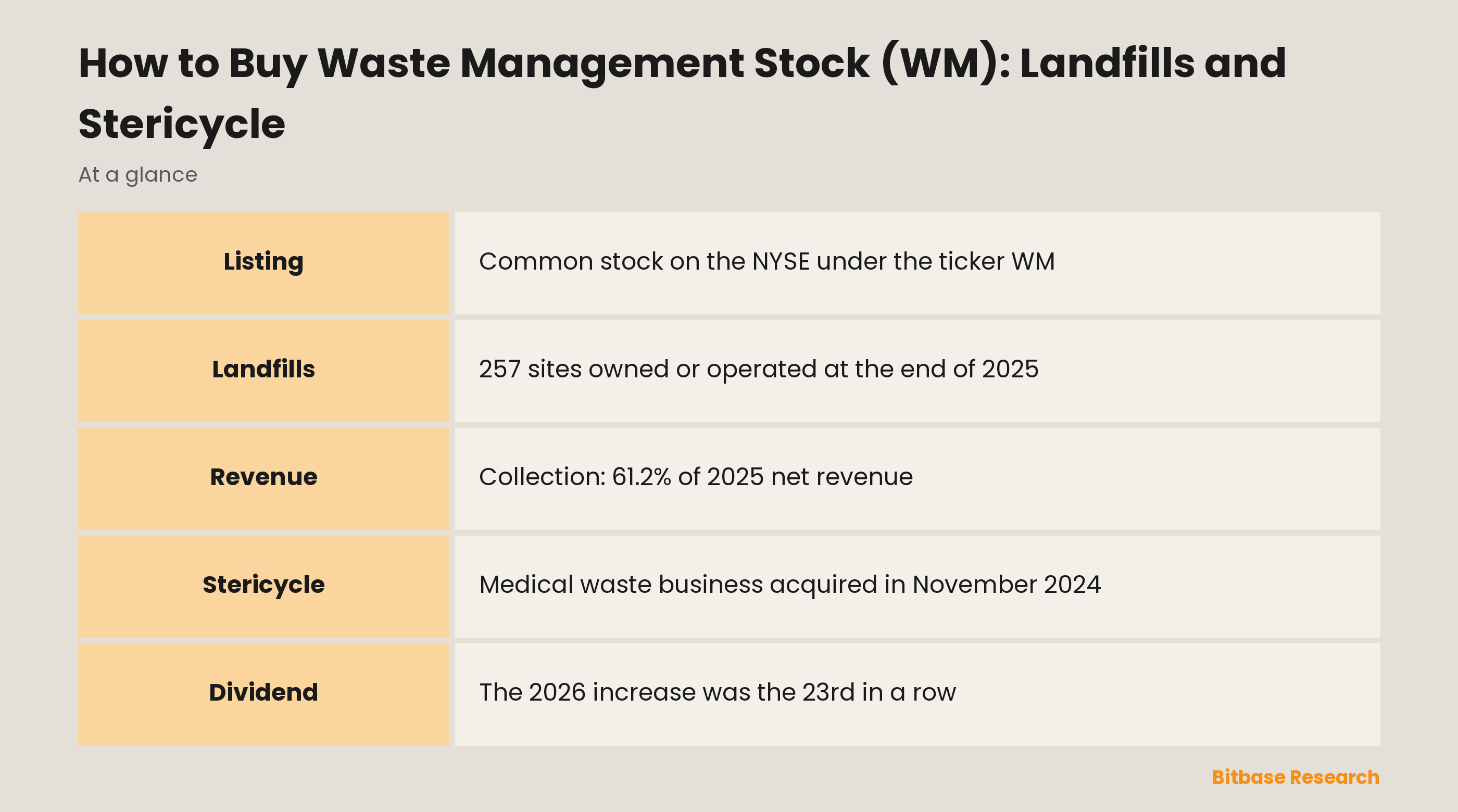
Waste Management is traded on the New York Stock Exchange under the ticker WM, the two letters the company now also uses as its brand, and any brokerage account with NYSE access can buy its common stock. Underneath the new name the business still starts with trash: collection earned 61.2% of 2025 net revenue, and at the end of that year WM owned or operated 257 landfill sites, a network its annual report calls the largest in the US and Canada. Since November 2024 it has also owned Stericycle, which handles medical waste and shreds confidential documents. The sections below follow the money first, then the order screen, then the risks named in WM's own filings.
What Does Waste Management Do?
Waste Management, Inc. is a holding company; in the words of its annual report, "all operations are conducted by its subsidiaries." The legal entity began in Oklahoma in 1987 as USA Waste Services, moved its incorporation to Delaware in 1995 and took its present name in a 1998 merger, when the Illinois-based company then called Waste Management became its subsidiary. Headquarters are in Houston, Texas, and press releases now use the short name WM.
The work runs from the curb to the disposal site: trucks collect waste from businesses, industrial sites and homes, transfer stations compact the loads for longer hauls, and landfills take what is left. At the end of 2025 WM owned or operated 253 solid waste landfills and four hazardous waste landfills, plus 342 transfer stations.
Three other businesses sit around that core. Recycling Processing and Sales ran 113 recycling facilities at the end of 2025, 51 of them single-stream, and the 10-K calls WM "the first major solid waste company to focus on residential single-stream recycling." Renewable Energy captures the gas that landfills give off as waste decomposes: of its 103 landfill gas projects at year-end, 62 fed electricity generators and 17 upgraded the gas to pipeline-quality renewable natural gas (RNG), some of which fuels WM's own trucks. Healthcare Solutions, run through the acquired Stericycle, treats regulated medical, pharmaceutical and hazardous waste and destroys confidential documents in the US, Canada and Western Europe.
Collection and disposal is reported as two geographic segments. East Tier covers the eastern US, the Great Lakes region and substantially all of Canada; West Tier covers the western, southern and central US plus British Columbia. WM had about 60,500 full-time employees at the end of 2025, and its leadership is about to change: Jim Fish, chief executive since 2016, retires on 4 January 2027, when President John Morris becomes CEO.
How WM Makes Money
Net operating revenue rose 14.2% in 2025, mostly because of Stericycle: acquisitions added 10.7 percentage points, while internal revenue growth was 3.7%. The 10-K's revenue table shows where the money now comes from:
| Line of business | What it covers | Share of 2025 net revenue |
|---|---|---|
| Commercial collection | Containers serviced for business customers | 22.3% |
| Landfill | Disposal fees at WM landfills | 15.0% |
| Residential collection | Household pickup under municipal contracts, franchises and subscriptions | 13.9% |
| Other collection | Collection services outside the three main lines | 12.6% |
| Industrial collection | Waste hauled for industrial customers | 12.3% |
| Healthcare Solutions | Medical waste and secure document destruction | 10.0% |
| Transfer | Fees at transfer stations | 6.0% |
| Recycling Processing and Sales | Sorting and selling recyclables, recycling brokerage, organics | 5.9% |
| Renewable Energy | Landfill gas, RNG, electricity and environmental credits | 1.9% |
Shares are net of intercompany revenue, rounded to one decimal; Corporate and Other makes up the remainder.
Much of the collection revenue is contracted: the 10-K says commercial and industrial customers typically sign three-year service agreements, while residential municipal contracts or franchises typically run three to ten years. The largest customer accounted for less than 5% of 2025 revenue.
The landfills matter more than their share suggests. Building one takes so much capital that it serves, in the 10-K's phrase, "as a barrier to landfill ownership," so outside haulers often pay to tip at WM sites, while WM routes its own trucks to its own landfills where it can, a practice it calls internalization. In 2025, 29.3% of landfill gross revenue was intercompany, billed to other parts of WM. The risk factors add that the landfills "currently provide our highest income from operations margins."
Recycling and renewable energy are the commodity-linked parts. WM has been moving recycling customers from a rebate model, where it paid suppliers for incoming material, to a fee-for-service model that covers processing costs first. Even so, average prices for single-stream recycled commodities fell about 20% in 2025, and the segment posted an operating loss, partly because WM temporarily suspended a plastic film recycling business as demand for post-consumer plastics deteriorated. Renewable Energy sells gas, electricity and the credits government programs create, such as renewable identification numbers (RINs) under the federal Renewable Fuel Standard.
Across the company, income from operations was 17.1% of revenue in 2025, down from 18.4% in 2024.
WM Stock at a Glance
| Item | Detail |
|---|---|
| Exchange | New York Stock Exchange (NYSE) |
| Ticker | WM |
| Security | Common stock, the only class registered on the 10-K cover |
| Legal name | Waste Management, Inc. (brand: WM) |
| Sector | Environmental services: collection, disposal, recycling, renewable energy, medical waste |
| Index membership | S&P 500 |
| Headquarters | Houston, Texas |
| Incorporated | Delaware; began in Oklahoma in 1987 as USA Waste Services |
| Fiscal year | Calendar year, ending 31 December |
| Dividend policy | Quarterly cash dividend; the increase set for 2026 was the 23rd consecutive annual rise |
| SEC identifier | CIK 823768 |
| CUSIP | 94106L109 |
Price, market value and dividend yield move with every trade, so for those open the WM stock page on Bitbase, which carries live quotes.
How to Buy Waste Management Stock
WM is a US company listed directly on the NYSE, so no depositary receipt is involved. The purchase runs through a broker:
1. Choose a broker with NYSE access. Outside the US that can be a local broker offering US markets or an international one; confirm which firm holds your account and which regulator oversees it.
2. Complete the account checks. A non-US individual fills in IRS Form W-8BEN so the broker can withhold the right rate on US dividends.
3. Deposit funds. If your money starts in another currency, the conversion rate is part of the cost, next to any commission.
4. Search for WM. Confirm that the result reads Waste Management, Inc. common stock on the NYSE; with a two-letter ticker, one wrong keystroke can land on another company.
5. Pick the order type. FINRA explains that a market order "provides the most certainty that your order will be executed," although "you might not get the price you saw"; a buy limit order "can be executed only at or below the limit price."
6. Settle the size. Buying a fraction of a share lets you invest a fixed cash amount, but FINRA notes that fractional shares cannot be moved to another brokerage firm without selling first, and that "you might not have shareholder voting rights" on them.
7. Keep the confirmations. They record your cost basis; later statements record each dividend and any tax withheld.
If your savings sit in crypto, buying stocks with crypto still means selling the coins and moving dollars to a broker. Orders placed outside the regular session can fill away from the closing price, so learn to tell regular-session and extended-hours quotes apart.
Outside the United States, WM dividends face US withholding. The IRS default for US-source income paid to a foreign person is a 30% tax, and "a reduced rate, including exemption, may apply" under a tax treaty; Form W-8BEN is how you claim it. Your home country may tax the dividend again.
Through an index fund, you can hold WM without picking it. It belongs to the S&P 500, and State Street's daily holdings file for its S&P 500 trust (SPY) listed it on 29 October 2026 as one small position among hundreds.
What Moves WM Stock
Price against cost. Earnings depend on raising prices faster than costs rise. In 2025, collection and disposal yield, the 10-K's measure of pricing excluding volume changes, was 3.8%, with commercial at 5.1% and residential at 5.4%. For the third quarter of 2026 WM reported core price of 5.8%, yet operating expenses rose to 59.8% of revenue from 58.9% a year earlier, mainly on fuel and risk management costs.
Volume and weather. Volume added 0.9% to 2025 revenue, but collection and disposal volume fell 0.4% in the third quarter of 2026, which WM tied to "intentional shedding of lower-margin residential business" and to commercial losses linked to national account brokers. Wildfire clean-up in the West Tier lifted 2025 landfill volumes, harsh winter weather held volumes back in early 2026, and the 10-K notes that revenue typically rises in the summer months, showing up in second- and third-quarter results.
Recycled commodities and credits. Recycling returned to operating income in the third quarter of 2026, which the quarterly report put down to the absence of the prior year's impairment, automated facilities and better commodity pricing. Renewable Energy grew on higher volumes but was held back by lower RIN prices. The 10-K warns that the RIN market "has historically been volatile" and that federal blending volumes were cut retroactively for 2024 and set low for 2026 and 2027. An RNG plant in New York that began operating in the third quarter of 2026 was, by the company's count, its 18th new facility completed since 2022.
Stericycle's integration. Healthcare Solutions supplied 10.0% of 2025 revenue but posted an operating loss that year, and the 10-K lists ways the deal could disappoint, from lower medical waste volumes to problems deploying an enterprise resource planning system and the related billing issues. In the third quarter of 2026 the segment's revenue grew 3.7% and it reported operating income, which WM credited to the absence of the prior year's integration costs and to synergies.
Capital returns. WM bought back no stock in 2025 while it brought leverage down after the Stericycle deal, then resumed repurchases in February 2026; the 2026 quarterly reports also show the higher dividend announced in December 2025 being declared.
Weak Links in the WM Business
Item 1A of the 10-K runs for about fifteen pages. These parts bear most directly on a WM share:
Permits and landfill space. WM may be unable to obtain or keep permits "or expand existing permitted capacity at our landfills, due to land scarcity, public opposition or otherwise," and such permits "have become more difficult and expensive to obtain and maintain."
Waste going elsewhere. Recycling, composting and bans on landfilling certain materials "could reduce our landfill volumes and cause our revenues and operating results to decline," and less buried organic waste means less gas for the RNG plants.
Regulation. The company names "emerging contaminants and extended producer responsibility" among the rule changes that could raise costs or require more capital spending; PFAS, a large group of chemicals used in products since the 1940s, get a section of their own in the business description.
Energy policy and commodity prices. "Changes to federal and state renewable fuel policies could affect the financial performance of our Renewable Energy segment," and results tied to commodity prices "may fluctuate substantially without notice in the future."
Fuel and labor. Diesel runs a notable part of the truck fleet, and shortages or price increases "will increase our operating expenses." Drivers, equipment operators and sorters do jobs that "carry inherent risks," and about 9,200 employees are covered by collective bargaining agreements.
The Stericycle bet. The company "may not realize the strategic benefits, revenue and earnings growth, or cost synergies anticipated from the Stericycle acquisition."
Above the business sit the ordinary risks of a single stock: one company is one set of outcomes, the dividend is declared at the board's discretion, and if your currency is not the dollar, both price and dividend reach you through an exchange rate. The report for the quarter ended 30 September 2026 said there had been no material changes to these risk factors.
How to Research WM Yourself
WM files with the SEC under CIK 823768: the 10-K annually, 10-Qs each quarter and 8-Ks for events in between, including every earnings release and the August 2026 announcement of the CEO transition. The filings are also free on the company's website, and investors.wm.com carries webcasts of the quarterly calls.
In the 10-K, Item 1 describes the segments and counts the facilities, Item 1A sets out the risks, and the segment note breaks results down by tier and business. The MD&A table that splits revenue growth into yield, volume and acquisitions shows whether growth came from pricing or from deals, and the quarterly releases add the average prices WM received for recycled commodities, RINs, natural gas and electricity.
One caution: the 2024 figures include Stericycle only from November, so comparing 2025 with 2024 mixes acquired revenue with underlying growth. The performance graph in Item 5 benchmarks WM against the S&P 500 and the Dow Jones Waste & Disposal Services Index. For other companies, browse Bitbase's full list of US stock pages.
WM Stock FAQ
Does WM pay a dividend?
Yes, every quarter. In December 2025 the board said it expected to raise the quarterly dividend by 14.5% for dividends declared in 2026, which the 10-K calls the 23rd consecutive year of increases. Each payment is still declared at the board's discretion; the per-share amount appears in every quarterly report.
Can I buy Waste Management stock with crypto?
Not directly. A broker sells WM shares for US dollars, which means converting any crypto to cash and transferring it before you can place the order, and the conversion may count as a taxable disposal where you live. The two holdings also work differently: the proxy statement gives each common share one vote on each proposal at the annual meeting, and shares receive whatever dividend the board declares, which is how a share differs from a crypto asset in practice.
Are Waste Management and WM the same company?
Yes. The legal name on SEC filings is Waste Management, Inc.; the company markets itself as WM, and its press releases describe it as previously known as Waste Management. Either name at a broker should lead to the same NYSE-listed stock.
What exchange is WM listed on, and is it in the S&P 500?
The New York Stock Exchange, the only exchange named on the 10-K cover. It is a member of the S&P 500: State Street's SPY holdings file dated 29 October 2026 included it under CUSIP 94106L109. Index weights change daily.
What does Stericycle do for WM?
Stericycle, acquired on 4 November 2024, now forms the Healthcare Solutions segment. It treats regulated medical, pharmaceutical and hazardous waste and shreds confidential records in the US, Canada and Western Europe, and in 2025 it supplied 10.0% of WM's net revenue.
Conclusion
Buying WM takes a broker with NYSE access, a check that the result reads Waste Management, Inc., and a market or limit order. What the share holds is a landfill-anchored collection business, joined by medical waste, recycling and landfill gas, whose results turn on pricing against costs, on commodity and credit prices, and on how Stericycle develops. Read the latest 10-K and quarterly release before deciding how much of a portfolio belongs in one environmental services stock.
Related reading
Other Bitbase articles on this topic:
- How to Buy Illinois Tool Works Stock (ITW): Seven Segments, 80/20
- How to Buy Johnson Controls Stock (JCI): Tyco, Irish Tax, Cooling
- How to Buy Keysight Stock (KEYS): Spirent, AI Networks, Buybacks
Disclaimer: This article is educational content from Bitbase Academy, provided for information only. It explains what a company or fund does and how the instruments referenced here differ from one another; it does not constitute investment, trading, tax, or financial advice, and it is neither a recommendation nor an endorsement of any security, token, or trading strategy. A tokenized stock is issued by a third party and is designed to give economic exposure to an underlying asset: it is not a share, it carries no shareholder rights, and it depends on the issuer's structure, eligibility rules, and redemption terms, which the issuer can change. Perpetual futures are leveraged derivatives that hold no underlying asset and can be liquidated, and trading hours, product availability, and eligibility differ by instrument and by jurisdiction and can change at any time. Written as of October 2026; verify everything yourself through company filings, the issuer's own documentation, and the product pages of the venue you trade on.
References
[1] Waste Management, Inc. Form 10-K, fiscal 2025: business, revenue mix and risk factors (SEC EDGAR) www.sec.gov
[2] Waste Management, Inc. Form 10-Q for the quarter ended 30 September 2026 (SEC EDGAR) www.sec.gov
[3] WM release furnished on Form 8-K, 27 October 2026: third quarter 2026 results (SEC EDGAR) www.sec.gov
[4] Waste Management, Inc. Form 8-K, 26 August 2026: CEO transition (SEC EDGAR) www.sec.gov
[5] Waste Management, Inc. Form 8-K, 4 November 2024: completion of the Stericycle merger (SEC EDGAR) www.sec.gov
[6] Waste Management, Inc. proxy statement for the 2026 annual meeting (SEC EDGAR) www.sec.gov
[7] State Street SPDR S&P 500 ETF Trust (SPY): fund page and daily holdings www.ssga.com
[8] FINRA: Order Types www.finra.org
[9] FINRA: Investing in Fractional Shares, 26 June 2025 www.finra.org
[10] IRS: NRA Withholding www.irs.gov
[11] IRS: About Form W-8 BEN www.irs.gov





