
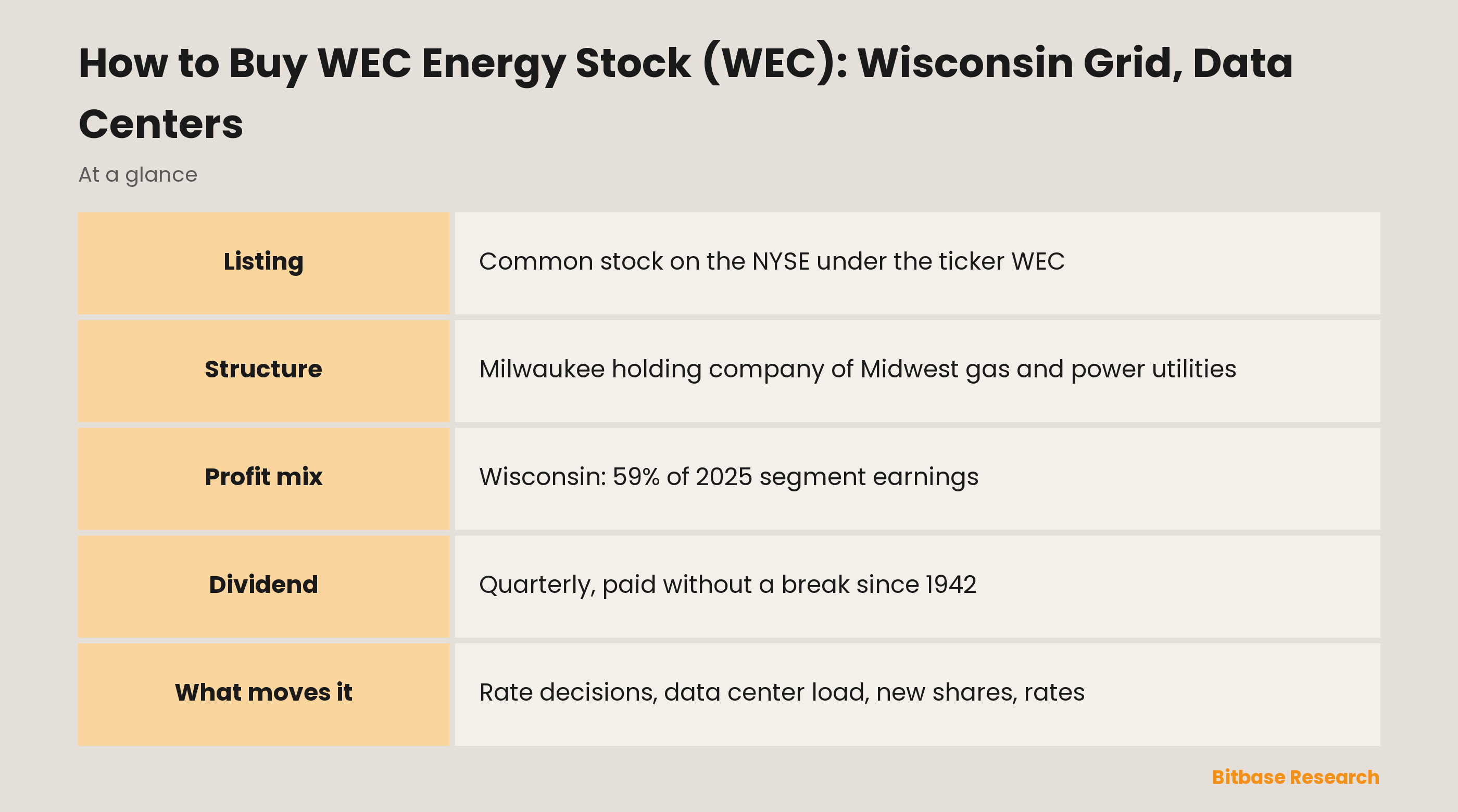
A single ticker, WEC, is what you search for once your brokerage account can trade New York Stock Exchange shares, and the order goes through like any other US stock. Behind it sits a Milwaukee holding company whose Wisconsin utilities produced about 59% of the earnings its five operating segments reported for 2025, and which is now building power plants for data center customers under a tariff Wisconsin regulators approved in May 2026. Below: the businesses, the purchase, and the rate and financing questions that steer the share.
What Does WEC Energy Do?
WEC Energy Group is a holding company that owns regulated electric and natural gas utilities in four Midwestern states. It was incorporated in Wisconsin in 1981, became a diversified holding company in 1986 and was known as Wisconsin Energy Corporation until 29 June 2015, when it bought all the common shares of Integrys and took its current name.
It reports six segments. The largest, Wisconsin, combines Wisconsin Electric Power Company, Wisconsin Public Service, Wisconsin Gas and Upper Michigan Energy Resources, which deliver electricity across much of Wisconsin, including metropolitan Milwaukee, and in Michigan's Upper Peninsula, and sell natural gas throughout the state. The company's third-quarter 2026 earnings release lists We Energies first among its principal utilities. Illinois is two gas distributors, Peoples Gas and North Shore Gas, serving Chicago and its northern suburbs. Other States is Minnesota Energy Resources and Michigan Gas Utilities, also gas only.
Electric Transmission is an approximately 60% stake in American Transmission Company (ATC), which operates transmission systems in Wisconsin, Michigan, Illinois and Minnesota under federal regulation. Non-Utility Energy Infrastructure holds We Power, which leases about 2,500 MW of generating units it built to Wisconsin Electric on a 12.7% return on equity; Bluewater, which owns gas storage in Michigan; and WEC Infrastructure, which owns stakes in wind and solar farms with long-term sales contracts. The sixth segment, Corporate and Other, carries holding company costs.
The fleet still leans on coal. In 2025 company-owned coal plants supplied 30.5% of the electricity the utilities sold, gas combined-cycle plants 24.1%, company-owned renewables 8.4%, and nuclear power bought under contract 19.8%. The company aims for net carbon neutral generation by the end of 2050 and reports that emissions from generation were 53% below their 2005 level by the end of 2025.
How WEC Energy Makes Money
Almost all income comes from rates set by state commissions, chiefly the Public Service Commission of Wisconsin (PSCW) and the Illinois Commerce Commission (ICC). A rate order lets a utility recover prudently incurred costs and earn an authorized return on equity on the capital it has invested: in 2025, 9.80% for the three Wisconsin utilities and 9.38% for Peoples Gas and North Shore Gas. Profit therefore tends to follow the asset base on which a return is allowed, which is why investors watch the capital plan so closely.
| Segment | What it does | Share of 2025 utility revenue | Share of 2025 segment earnings |
|---|---|---|---|
| Wisconsin | Electricity, gas and steam in Wisconsin and Upper Michigan | 77% | 59% |
| Illinois | Gas distribution in Chicago and northern suburbs | 18% | 7% |
| Other States | Gas distribution in Minnesota and Michigan | 6% | 3% |
| Electric Transmission | About 60% of ATC, booked as an equity investment | n/a | 8% |
| Non-Utility Energy Infrastructure | We Power leases, Bluewater storage, wind and solar stakes | n/a | 23% |
Earnings shares use each segment's net income attributed to common shareholders over the five operating segments' total, before the Corporate and Other loss.
Electricity brought in about 56% of 2025 operating revenue and natural gas about 41%. Revenue rose 14% from 2024, a year in which the 10-K says the Milwaukee area was 28.0% colder, measured in heating degree days. Wisconsin's contribution to earnings rose 22.2% after new rate orders took effect on 1 January 2025. Illinois went the other way: its contribution fell 52% because of a charge for a proposed settlement with the Illinois Attorney General over past cost-recovery riders, which the ICC approved in May 2026.
WEC Stock at a Glance
| Feature | WEC |
|---|---|
| Exchange | New York Stock Exchange |
| Ticker | WEC |
| Security | Common stock, $.01 par value, the only class registered under Section 12(b) |
| Sector | Regulated electric and gas utilities |
| Main utilities | We Energies, Wisconsin Public Service, Peoples Gas, North Shore Gas |
| Index membership | S&P 500 |
| Headquarters | Milwaukee, Wisconsin |
| Incorporated | Wisconsin, 1981 |
| Fiscal year | Calendar year, ending 31 December |
| Payouts | Quarterly cash dividend, paid without a break since 1942 |
| SEC identifier | CIK 783325 |
Quotes and market value move all day; the WEC Energy stock page on Bitbase shows the current figures.
How to Buy WEC Energy Stock
WEC's common stock trades directly on the NYSE, with no depositary receipt or second share class. A typical purchase:
1. Pick a broker that offers NYSE stocks. Abroad, check which legal entity holds your account and who regulates it.
2. Complete the account checks. Non-US individuals are usually asked for IRS Form W-8BEN, which the IRS says to submit "when requested by the withholding agent or payer."
3. Fund it. A currency conversion adds its own cost.
4. Search WEC and read the name. The result should be WEC Energy Group common stock on the NYSE, not a fund or a bond.
5. Choose the order. FINRA describes a market order as the one that "provides the most certainty that your order will be executed," while a limit order fills only "at or better than a specified price."
6. Decide the amount. Some brokers sell fractional shares, but FINRA warns that "you might not have shareholder voting rights" on them.
Taxes for non-US holders. The IRS says "most types of U.S. source income received by a foreign person are subject to U.S. tax of 30%," and a tax treaty can lower that rate.
The company's own plan. The 10-K mentions a WEC Energy stock purchase and dividend reinvestment plan, through which the company also issues some new shares. Eligibility and fees are set in the plan documents.
Through funds. WEC appears in the daily holdings of State Street's SPY, which tracks the S&P 500, and of its utilities sector fund, XLU. Our guide to an S&P 500 index fund explains how that kind of indirect holding works.
What Moves WEC Stock
Rate decisions. On 5 November 2026 the PSCW approved rate changes for the three Wisconsin utilities for the 2027 and 2028 test years, with an authorized return on equity of 9.50%, compared with 9.80% in 2025, and a 53.0% equity ratio; the company expects the final written order before year-end. Peoples Gas and North Shore Gas filed for higher base rates in January 2026, and that case is still pending.
Data centers. In May 2026 the PSCW approved two tariffs for customers adding more than 100 MW of load, under which they "will directly pay for the electricity they consume, along with the power plants and distribution facilities built to serve them." Microsoft has signed up for service under them, and the company expects up to 3.2 GW of load growth in the Milwaukee-to-Chicago corridor through 2031, plus 1.3 GW from a Vantage Data Centers campus in Port Washington that its investor slides tie to OpenAI and Oracle's Stargate expansion. For scale, data centers took 1% of the Wisconsin segment's large commercial and industrial deliveries in 2025, against 24% for paper and packaging.
The size of the build and its funding. The 2027–2031 capital plan presented in November 2026 is about 27% larger than the 2026–2030 plan, with generation the biggest increase. The financing plan includes new common stock, and on 4 November 2026 the company signed an equity distribution agreement that lets it sell shares from time to time through 15 sales agents. New shares can dilute existing holders even as earnings grow.
Interest rates and weather. The 10-K warns that "an increase in interest rates may adversely affect our results of operations and the ability of our regulated subsidiaries to earn their approved rates of return." Weather moves volumes, and chief executive Scott Lauber credited third-quarter 2026 results partly to "warmer-than-normal weather."
Generation changes. Two Oak Creek coal units due to retire at the end of 2026 will now stay available through 2027, and a 20-year extension of the Point Beach nuclear contract signed in August 2026 awaits PSCW approval.
Where WEC's 10-K Sees Trouble
These Item 1A risk factors bear most directly on the share:
Regulators decide the return. "Our business is significantly impacted by governmental legislation, regulation, and oversight," and "there is no assurance that our regulators will consider all of our costs to have been prudently incurred."
A few very large customers. "This concentration of business with a small number of customers in an industry based on emerging technologies, including AI and machine learning, presents several risks." Cancelled projects can trigger contract penalties that may not be recoverable in rates.
Big projects. Supply chain problems, solar panel tariffs and permitting can delay plants or raise costs, and regulators may disallow spending they judge imprudent.
The holding company structure. WEC's ability to pay dividends on its common stock "is dependent upon the ability of our subsidiaries to pay amounts to us."
Takeover limits. Under Wisconsin law, buying 10% or more of the voting shares first needs a PSCW finding that the deal serves customers, investors and the public, which the company says may deprive shareholders of a premium.
Above the business, one stock is a concentrated position, and future dividends "will depend upon, among other factors, earnings, financial condition, and other requirements."
How to Research WEC Yourself
WEC Energy files with the SEC under CIK 783325: the 10-K each February, 10-Qs for the first three quarters, and 8-Ks that carry earnings releases and the slides used at investor meetings. In the 10-K, Item 1 gives each utility's generation mix and authorized returns, and the regulatory note follows each rate case; the commissions' own dockets sit at psc.wi.gov and icc.illinois.gov.
When earnings change, check whether the cause was weather, which reverses, or new rates and assets, which persist. To compare another regulated utility built the same way, see our Duke Energy stock guide; Bitbase's US stock pages list other companies.
WEC Energy Stock FAQ
Can I buy WEC Energy stock with crypto?
Not directly. WEC shares are bought through a brokerage account in US dollars, so crypto has to be sold first and the cash moved to the broker, a sale that may be taxable where you live. A share also carries dividend and voting rights in a registered company, one way stocks differ from crypto assets.
Does WEC Energy pay a dividend?
Yes. The company says it has paid consecutive quarterly dividends since 1942, and in January 2026 the board raised the quarterly amount by 6.7%. Its November 2026 investor slides call 2026 the 23rd consecutive year of higher dividends. Future payments depend on the board.
Is WEC in the S&P 500?
Yes. The company describes itself as a component of the S&P 500, and WEC Energy Group appeared in State Street's SPY holdings file dated 6 November 2026.
Is WEC Energy the same as We Energies?
No. We Energies is one of its principal utilities; WEC Energy Group is the Milwaukee holding company whose common stock trades as WEC.
Has WEC Energy stock ever split?
Yes. On 20 January 2011, when the company was still Wisconsin Energy Corporation, the board approved a two-for-one split paid as a stock dividend, with the new shares distributed on 1 March 2011. Later filings restate older per-share figures for it.
Conclusion
WEC Energy's share is a claim on regulated returns earned mostly in Wisconsin, and its next chapter depends on data center load the company expects to reach several gigawatts by 2031. Whether that adds value comes down to two things the filings let you track: the returns the PSCW and the ICC allow, and how many new shares the company sells to pay for its plants. Read the latest 10-K, the November 2026 rate decision and the next earnings release, then decide how much weight one utility should carry in your portfolio.
Related reading
Other Bitbase articles on this topic:
- How to Buy DTE Energy Stock (DTE): A Century of Dividends
- How to Buy Eversource Stock (ES): The Utility, Not the Futures
- How to Buy Exelon Stock (EXC): Six Utilities, No Power Plants
Disclaimer: This article is educational content from Bitbase Academy, provided for information only. It explains what a company or fund does and how the instruments referenced here differ from one another; it does not constitute investment, trading, tax, or financial advice, and it is neither a recommendation nor an endorsement of any security, token, or trading strategy. A tokenized stock is issued by a third party and is designed to give economic exposure to an underlying asset: it is not a share, it carries no shareholder rights, and it depends on the issuer's structure, eligibility rules, and redemption terms, which the issuer can change. Perpetual futures are leveraged derivatives that hold no underlying asset and can be liquidated, and trading hours, product availability, and eligibility differ by instrument and by jurisdiction and can change at any time. Written as of November 2026; verify everything yourself through company filings, the issuer's own documentation, and the product pages of the venue you trade on.
References
[1] WEC Energy Group Form 10-K for 2025 (SEC EDGAR) www.sec.gov
[2] WEC Energy Group 2025 Form 10-K, XBRL cover page (SEC EDGAR) www.sec.gov
[3] WEC Energy Group Form 10-Q for the third quarter of 2026 (SEC EDGAR) www.sec.gov
[4] WEC Energy Group third-quarter 2026 earnings release, filed with Form 8-K (SEC EDGAR) www.sec.gov
[5] WEC Energy Group Form 8-K, 6 November 2026: Wisconsin rate decision (SEC EDGAR) www.sec.gov
[6] WEC Energy Group investor update, November 2026, filed with Form 8-K (SEC EDGAR) www.sec.gov
[7] WEC Energy Group Form 8-K, 4 November 2026: equity distribution agreement (SEC EDGAR) www.sec.gov
[8] Wisconsin Energy Form 10-K for 2011: two-for-one stock split (SEC EDGAR) www.sec.gov
[9] State Street SPDR S&P 500 ETF Trust (SPY): fund page and daily holdings www.ssga.com
[10] State Street Utilities Select Sector SPDR ETF (XLU): fund page and daily holdings www.ssga.com
[11] FINRA: Order Types www.finra.org
[12] FINRA: Investing in Fractional Shares www.finra.org
[13] IRS: NRA Withholding www.irs.gov
[14] IRS: About Form W-8 BEN www.irs.gov





