
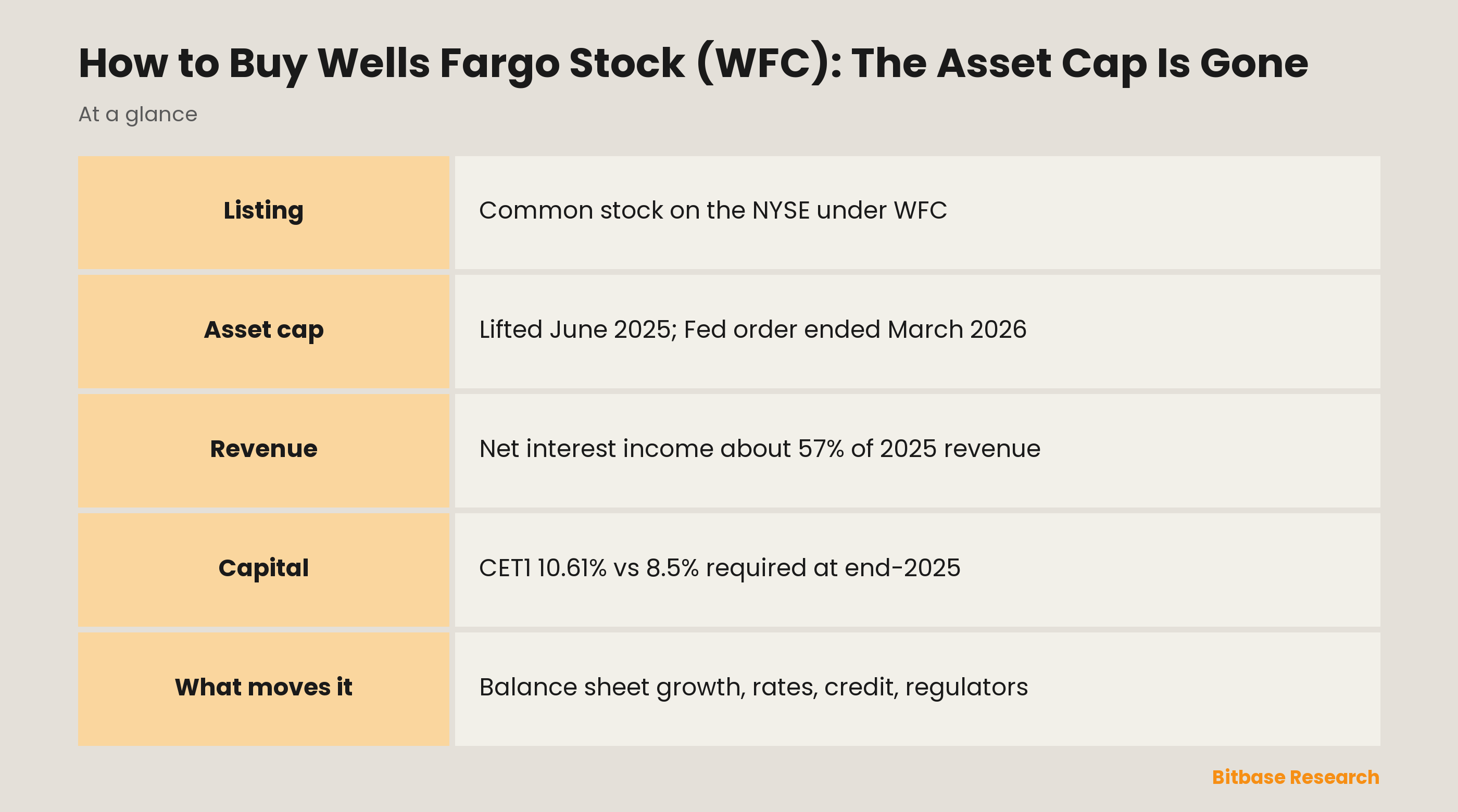
The ticker to look for is WFC: Wells Fargo & Company's common stock is listed on the New York Stock Exchange, and any brokerage account that reaches the NYSE can buy it. For more than seven years the bank behind it worked under a Federal Reserve order that capped its total assets at their end-2017 size; the Fed lifted that cap in June 2025 and ended the order in March 2026. What a share holds today is a lender for which net interest income was about 57% of 2025 revenue, plus a wealth business and an investment bank.
What Does Wells Fargo Do?
Wells Fargo & Company is a Delaware corporation whose "principal business is to act as a holding company for its subsidiaries," in the words of its 10-K. The largest of those is Wells Fargo Bank, N.A., which held 85% of the company's assets at the end of 2025, when the filing counted Wells Fargo as the fourth-largest US bank holding company by assets. The head office is in San Francisco.
The name is older than the company that carries it. The bank descends from the business Henry Wells and William G. Fargo founded in 1852, which, as the company's 10-K for 1998 recounts, "later operated the westernmost leg of the Pony Express and ran stagecoach lines." The listed company itself was Norwest Corporation until 2 November 1998, when the former Wells Fargo merged into a Norwest subsidiary and Norwest took the Wells Fargo name.
The business reports four segments:
Consumer Banking and Lending serves consumers and small businesses: checking and savings accounts, credit and debit cards, and home, auto, personal and small business loans.
Commercial Banking provides banking and credit products, secured lending, leases and treasury management to private, family-owned and certain public companies.
Corporate and Investment Banking serves corporate, commercial real estate, government and institutional clients worldwide with corporate and investment banking, property lending, and sales, trading and research.
Wealth and Investment Management works with affluent and high-net-worth clients through financial advisors, and online through WellsTrade and Intuitive Investor.
A fifth unit, Corporate, holds treasury, the investment portfolio and businesses that no longer fit the strategy. The rail car leasing business was sold in a deal that closed on 1 January 2026.
How Wells Fargo Makes Money
Interest is still the larger half. In 2025, net interest income, what the bank earns on loans and securities minus what it pays on deposits and borrowings, made up about 57% of total revenue; fees, card income, trading gains and other noninterest income supplied the other 43%. In 2023 the interest share had been about 63%. Net interest income fell 9% in 2024 and was roughly flat in 2025, while noninterest income rose 5% in 2025.
| Segment | Main clients | Share of segment revenue, 2025 | Revenue change vs 2024 |
|---|---|---|---|
| Consumer Banking and Lending | Consumers and small businesses | 44.0% | Up 3.2% |
| Corporate and Investment Banking | Corporations, institutions, governments | 22.7% | Down 0.6% |
| Wealth and Investment Management | Affluent and high-net-worth clients | 19.2% | Up 5.8% |
| Commercial Banking | Private, family-owned and some public companies | 14.1% | Down 6.3% |
Shares are computed from the four segments' 2025 revenue totals in the annual report; Corporate and the taxable-equivalent reconciling items are left out.
Inside the consumer segment, the Consumer, Small and Business Banking line produced about 68% of the segment's 2025 revenue, and credit card revenue rose 8%; card fees also gained from the 2025 acquisition of Wells Fargo's merchant services joint venture.
Corporate and Investment Banking splits three ways. Banking, which covers lending, treasury management and investment banking, and Markets each brought in about 37% of the segment's 2025 revenue, and commercial real estate about 26%. Wealth and Investment Management runs mostly on fees, which the annual report ties to markets: "Fees from the majority of WIM advisory assets are based on a percentage of the market value of the assets at the beginning of the quarter."
WFC Stock at a Glance
| Item | Detail |
|---|---|
| Exchange | New York Stock Exchange (NYSE) |
| Ticker | WFC |
| Security | Common stock |
| Other NYSE listings | Seven more, all with symbols starting WFC: Series L convertible preferred stock, depositary shares in five other preferred series, and a guarantee of notes issued by Wells Fargo Finance LLC |
| Sector | Financials: banking, lending, wealth management, investment banking |
| Index membership | S&P 500; not in the Dow Jones Industrial Average (State Street fund holdings, 16 October 2026) |
| Headquarters | San Francisco, California |
| Incorporated | Delaware |
| Regulatory status | Bank and financial holding company; primary regulator: the Federal Reserve |
| Fiscal year | Ends 31 December |
| Dividend policy | Quarterly cash dividend declared by the board; raised in July 2026 |
| Stock split | Two-for-one, distributed 11 August 2006 |
| SEC identifier | CIK 72971 |
For live figures on price, market value and yield, open the Wells Fargo stock page on Bitbase.
How to Buy Wells Fargo Stock
The common stock itself is listed in New York, so you buy the share directly, with no depositary receipt involved. Everything goes through a broker:
1. Find a broker that reaches the NYSE. Outside the United States, that means a local broker offering US markets or an international one; confirm the legal entity behind the account and its regulator.
2. Open and verify the account. If you are not a US person, the broker will ask for IRS Form W-8BEN, the certificate of foreign status it uses to apply the right withholding rate to US dividends.
3. Add funds. Funding from another currency means paying a conversion spread on top of any commission, so check both.
4. Check the security. Search for WFC and check that the result reads Wells Fargo & Company common stock. The preferred shares under similar symbols are different securities that "rank senior to shares of common stock both as to the payment of dividends and liquidation preferences, but have no general voting rights."
5. Set the order type. A market order "guarantees that the order will be executed, but does not guarantee the execution price," while "a buy limit order can only be executed at the limit price or lower."
6. Size the position. With fractional shares you can put in a set cash amount, but Investor.gov notes that "you generally cannot transfer fractional shares to another brokerage firm," so switching brokers may mean selling them first.
7. Keep the paperwork. Trade confirmations and account statements document your purchase price and every dividend.
Withholding tax for non-US holders. The IRS states that "most types of U.S. source income received by a foreign person are subject to U.S. tax of 30%," and a tax treaty can lower that rate. Your home country may also tax it.
Through a fund. In State Street's 16 October 2026 holdings files, Wells Fargo appears in the SPY trust, which tracks the S&P 500, and in the XLF financial sector fund, each time as one position among many.
What Moves WFC Stock
Growth after the asset cap. In February 2018 the Federal Reserve, responding to what it called "widespread consumer abuses and compliance breakdowns," announced that the bank would be "restricted from growing any larger than its total asset size as of the end of 2017." On 3 June 2025 the Fed announced that the bank "is no longer subject to the asset growth restriction," and on 5 March 2026 it terminated the 2018 enforcement action altogether. The balance sheet moved quickly: total assets ended 2025 up 11.3% on a year earlier, with Corporate and Investment Banking's assets up 32%, much of it trading-related, and in the third quarter of 2026 average loans and deposits were each 11% above a year before. Chief executive Charlie Scharf said in July 2026: "After years of not being on a level playing field with our competitors because we couldn't grow our balance sheet, we are carefully deploying capital to grow and support our clients." Each quarterly report now tests whether that growth pays.
Interest rates. With about 57% of revenue from net interest income, rates run straight into earnings. The annual report attributes the 2025 dip in that line to "the impact of lower interest rates on floating rate assets and deposit mix," and its sensitivity analysis concludes that "we would expect to benefit from higher interest rates as our assets would reprice faster and to a greater degree than our liabilities." Cuts work in reverse. Every large US lender lives with this cycle, as the JPMorgan Chase profile shows for another of them; for the policy side, see how Fed rate decisions, QE and QT work through funding and expectations.
Capital. Every dividend and buyback has to fit inside the Federal Reserve's framework. At the end of 2025 the common equity tier 1 (CET1) ratio stood at 10.61% against a requirement of 8.5%, which included a 2.5% stress capital buffer and a 1.5% surcharge that applies to global systemically important banks. The 2026 stress test left the buffer at its 2.5% floor, and the Fed has said current buffers hold until 30 September 2027. Meanwhile the ratio has come down, from 11.07% at the end of 2024 to 10.0% in the third quarter of 2026, while risk-weighted assets grew and buybacks continued.
Credit, commercial property in particular. The 10-K is direct about one concentration: "We are currently one of the largest CRE lenders in the U.S." Smaller losses on commercial property, chiefly office buildings, helped reduce the 2025 provision for credit losses, and the loan loss allowance came down to 1.45% of total loans from 1.60%, while nonperforming assets rose to 0.86% of total loans. The filing names the pressure points for CRE borrowers: "increases in interest rates and related refinancing risks at maturity, declines in commercial property values."
What remains open with regulators. In September 2024 Wells Fargo Bank entered a formal agreement with the Office of the Comptroller of the Currency to strengthen its anti-money laundering and sanctions controls, and the June 2026 quarterly report still describes government inquiries into those programmes. The annual report also recalls past settlements "arising out of certain retail sales practices of the Company."
Fees that follow markets. Because most wealth advisory fees are set from asset values at the start of each quarter, a market fall reaches the next quarter's fees; the third-quarter 2026 release put client assets in that segment up 11% on a year earlier. Investment banking fees rose 14% in 2025 on debt underwriting, a gain a slow deal year would reverse.
Risks to Weigh Before Buying WFC
The annual report's risk factors start with a warning that fits any share: the value of an investment "could fall substantially" and dividends "could be reduced or eliminated." These bear most directly on Wells Fargo:
Rates and market values. "Changes in interest rates and financial market values could reduce our net interest income and earnings."
Dividends from subsidiaries. "We rely on dividends from our subsidiaries for liquidity, and federal and state law, regulatory requirements, and certain contractual arrangements can limit those dividends."
Regulatory escalation. "Regulators have indicated the potential for escalating consequences for banks that do not timely resolve open issues or have repeat issues."
Competition, crypto included. The 10-K names "cryptocurrencies, stablecoins, and tokens" among the alternatives that "could lead to a reduction in deposits at banks," a funding question for a company that relies primarily on customer deposits.
The same section looks back at the financial crisis: "As we did during the financial crisis in 2009, we may also need, or be required by our regulators, to raise additional capital through the issuance of common stock," or "reduce or even eliminate our common stock dividend." Add the usual risks of one stock: a single company decides the outcome, and if you invest from another currency, exchange rates change what both the price and the dividend are worth to you.
How to Research WFC Yourself
Wells Fargo files with the SEC under CIK 72971, listed on EDGAR as WELLS FARGO & COMPANY/MN, the same filer number Norwest Corporation used before 1998; searching by that number leads straight to the holding company.
One quirk catches first-time readers: the 10-K document itself is short. The risk factors, management's discussion and financial statements are incorporated from the Annual Report to Shareholders, a much longer file inside the same submission, and that is where the tables quoted above live.
The 10-Qs record what changes in between; the first-quarter 2026 report is where the end of the 2018 consent order appears. Quarterly results arrive on Form 8-K with the earnings release attached, most recently on 13 October 2026. The Federal Reserve's releases of 2 February 2018, 3 June 2025 and 5 March 2026 give the regulator's side of the asset cap, and the company's investor relations pages on wellsfargo.com carry the same filings. For other companies, see the full list of US stock pages on Bitbase.
Wells Fargo Stock FAQ
Does Wells Fargo pay a dividend?
Yes. The board declares a cash dividend on the common stock every quarter, and on 28 July 2026 it approved an increase. Dividends declared per common share in 2025 were about 13% higher than in 2024. Preferred stock is paid first, and every payment depends on staying above capital requirements.
Can I buy Wells Fargo stock with crypto?
Not directly. WFC trades on the NYSE for dollars, through a brokerage account, so any crypto must first be converted to cash and transferred to the broker; the conversion can itself be a taxable sale where you live. A share is part ownership of the company, with dividends and votes attached, which is how stocks and crypto differ at the root.
Is Wells Fargo still under the Fed's asset cap?
No. The Federal Reserve lifted the cap on total assets on 3 June 2025, and on 5 March 2026 it terminated the whole 2018 enforcement action, including the remaining provisions on board oversight and risk management. Separate matters remain, notably the 2024 formal agreement with the OCC on anti-money laundering and sanctions controls.
Is owning WFC stock the same as owning Wells Fargo Bank?
No. WFC is the parent holding company, and Wells Fargo Bank, N.A. is its main subsidiary, with 85% of the company's assets at the end of 2025. The parent "receives substantially all of its funding and liquidity from dividends and other distributions from its subsidiaries," and in a failure its security holders "could face significant or complete losses" even if the subsidiaries' creditors recover in full.
Is WFC in the S&P 500 or the Dow?
Yes to the first, no to the second. As of 16 October 2026, State Street's S&P 500 trust (SPY) listed Wells Fargo among its holdings, while its Dow trust (DIA), whose 30 holdings include JPMorgan Chase and Goldman Sachs, did not.
Has Wells Fargo stock ever split?
Yes. The board declared a two-for-one split on 27 June 2006, paid as a 100% stock dividend on 11 August 2006, according to the 2006 annual report, so per-share prices from before then should be halved for a like-for-like comparison.
Conclusion
The purchase is routine: a broker that reaches the NYSE, the line that reads Wells Fargo & Company common stock, and either a market or a limit order. What has changed is the company behind it. With the asset cap lifted and the 2018 order closed, Wells Fargo is growing its balance sheet again, and its results turn on how well that growth is priced and underwritten while interest still supplies most of the revenue. Read the annual report, the latest 10-Q and the Fed's releases before settling on how large a position in one bank makes sense.
Related reading
Other Bitbase articles on this topic:
- How to Buy Lloyds Banking Group Stock (LYG): ADS, LLOY and Halifax
- How to Buy Mizuho Stock (MFG): Five ADSs Equal One Share
- How to Buy NatWest Stock (NWG): Two Shares per ADS, No State Stake
Disclaimer: This article is educational content from Bitbase Academy, provided for information only. It explains what a company or fund does and how the instruments referenced here differ from one another; it does not constitute investment, trading, tax, or financial advice, and it is neither a recommendation nor an endorsement of any security, token, or trading strategy. A tokenized stock is issued by a third party and is designed to give economic exposure to an underlying asset: it is not a share, it carries no shareholder rights, and it depends on the issuer's structure, eligibility rules, and redemption terms, which the issuer can change. Perpetual futures are leveraged derivatives that hold no underlying asset and can be liquidated, and trading hours, product availability, and eligibility differ by instrument and by jurisdiction and can change at any time. Written as of October 2026; verify everything yourself through company filings, the issuer's own documentation, and the product pages of the venue you trade on.
References
[1] Wells Fargo & Company Form 10-K for 2025: business, regulation and competition (SEC EDGAR) www.sec.gov
[2] Wells Fargo 2025 Annual Report, filed with the 10-K: segments, capital, risk factors www.sec.gov
[3] Wells Fargo Form 10-Q, first quarter 2026: termination of the 2018 consent order www.sec.gov
[4] Wells Fargo Form 10-Q, second quarter 2026: capital, dividend, preferred stock, legal actions www.sec.gov
[5] Wells Fargo second-quarter 2026 results release, 14 July 2026 (Form 8-K, Exhibit 99.1) www.sec.gov
[6] Wells Fargo third-quarter 2026 results release, 13 October 2026 (Form 8-K, Exhibit 99.1) www.sec.gov
[7] Federal Reserve press release, 2 February 2018: growth restriction on Wells Fargo www.federalreserve.gov
[8] Federal Reserve press release, 3 June 2025: asset growth restriction lifted www.federalreserve.gov
[9] Federal Reserve press release, 5 March 2026: termination of the 2018 enforcement action www.federalreserve.gov
[10] Wells Fargo Form 10-K for 1998: the Norwest merger and the company's history (SEC EDGAR) www.sec.gov
[11] Wells Fargo 2006 Annual Report (10-K Exhibit 13): two-for-one stock split www.sec.gov
[12] State Street SPDR S&P 500 ETF Trust (SPY): daily holdings www.ssga.com
[13] State Street Financial Select Sector SPDR ETF (XLF): daily holdings www.ssga.com
[14] State Street SPDR Dow Jones Industrial Average ETF Trust (DIA): daily holdings www.ssga.com
[15] Investor.gov (SEC): Types of Orders www.investor.gov
[16] Investor.gov (SEC): investor bulletin on fractional shares www.investor.gov
[17] IRS: NRA Withholding www.irs.gov





