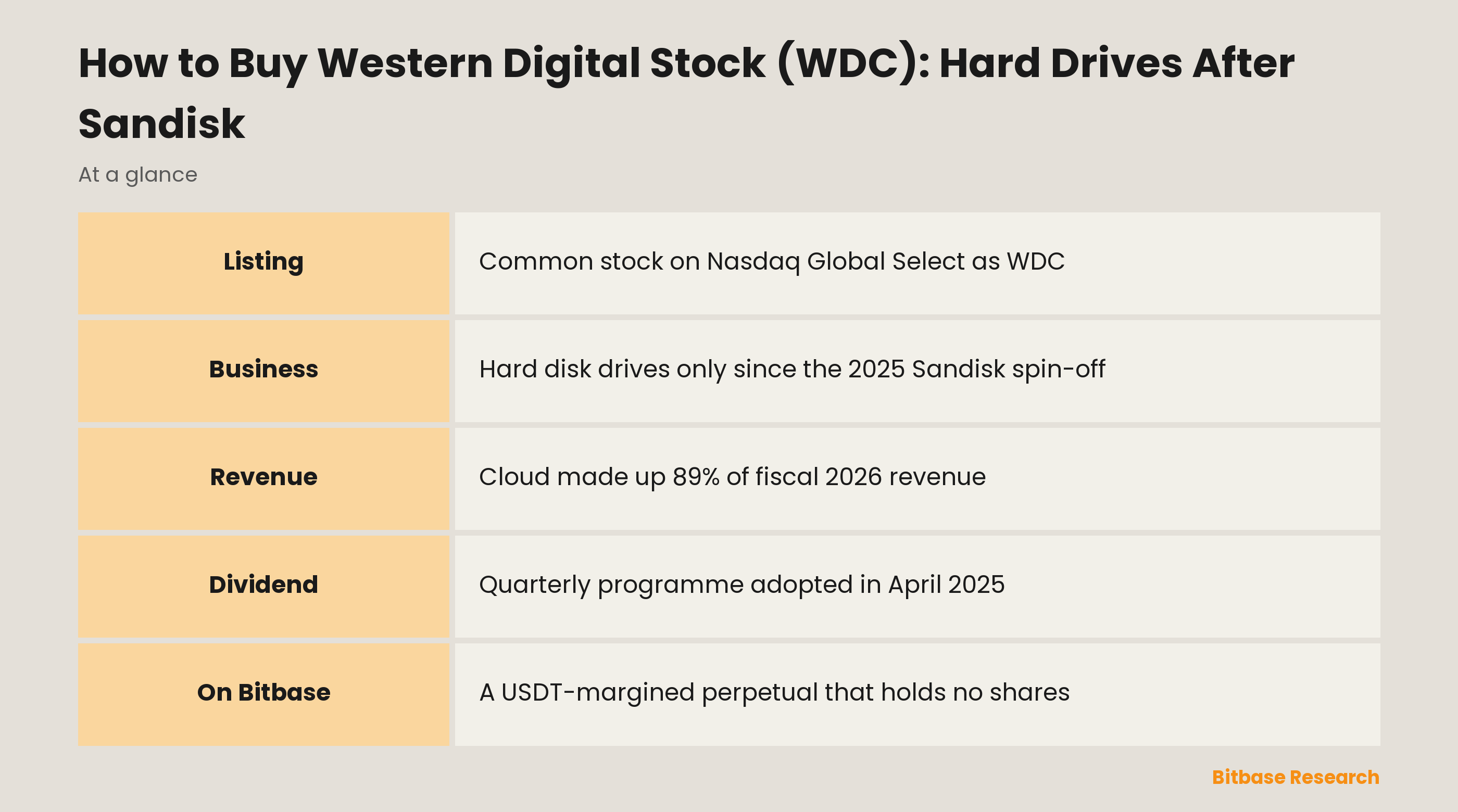
Western Digital is a Nasdaq company trading as WDC on the Global Select Market, and any broker that reaches US exchanges can buy it for you. The business behind the ticker has changed shape: since spinning off Sandisk in February 2025 it makes only hard disk drives, and cloud customers brought in 89% of its fiscal 2026 revenue. Bitbase does not sell WDC shares; what it offers is a WDC perpetual, margined in USDT, that tracks the price and holds no stock.
What Does Western Digital Do?
Western Digital makes hard disk drives (HDDs), which store data by recording magnetic information on rotating disks. Founded in 1970 and based in San Jose, California, it now reports a single business segment, HDD, and sells drives branded Western Digital and WD.
Revenue is reported in three end markets. Cloud, the largest and fastest growing, is high-capacity enterprise drives for public and private cloud environments and enterprise customers. Client is drives that computer makers and channel partners put into desktops and notebooks. Consumer is external storage sold through retail and channel partners. Buyers range from hyperscale cloud providers and newer "neoclouds" to retailers, some under long-term agreements.
Western Digital makes "substantially all of the recording heads and magnetic media" itself and buys the other parts from suppliers. Its assembly and test plants are concentrated in Thailand, Malaysia, the Philippines, Shenzhen and California. The engineering race is capacity per drive, and the roadmap runs through ePMR, OptiNAND, UltraSMR and heat-assisted magnetic recording (HAMR). The annual report names Seagate Technology and Toshiba Electronic Devices & Storage as hard-drive rivals, with flash makers offering competing storage.
Two acquisitions and one separation produced this shape. Western Digital bought HGST, formally Hitachi Global Storage Technologies, in March 2012, and the flash maker SanDisk in May 2016. In February 2025 the flash side left as a new listed company, Sandisk, and Western Digital now calls itself "a pure-play HDD company."
How Western Digital Makes Money
The annual report explains each year with two numbers: exabytes of storage shipped and the average price per exabyte. Fiscal 2026 ran 53 weeks to 3 July 2026, and revenue rose 36%, driven by a 25% increase in exabytes sold and an 8% increase in average prices per exabyte.
The mix has narrowed. Cloud's share of revenue went from about 80% in fiscal 2024 to about 88% a year later and 89% in fiscal 2026; across those two years Client slipped from about 9% to 6% and Consumer from about 11% to 5%.
The buyers are few and large. The top 10 customers accounted for 73% of fiscal 2026 revenue, against 68% a year earlier and 55% in fiscal 2024, and three customers took 16%, 15% and 13% respectively; the filing does not name them. By ship-to location, the Americas produced about 44% of revenue and Asia about 40%, with Europe, the Middle East and Africa the rest.
Gross margin widened each year, from about 28% of revenue in fiscal 2024 to about 39% and then about 49%, which the company puts down to higher shipments, a better cost structure on newer products, a shift towards higher-capacity drives and better pricing. Operating income came to about 34% of fiscal 2026 revenue.
These are continuing-operations figures; pre-spin-off flash results sit apart as discontinued operations. Fiscal 2026 net income also included a mark-to-market gain on the Sandisk shares Western Digital had kept, larger than its operating income, and that stake is now gone.
WDC Stock at a Glance
| Feature | Western Digital |
|---|---|
| Ticker | WDC |
| Listing | Nasdaq, Global Select Market tier |
| Share class | Common stock; a single class is registered for trading |
| Industry | Data storage: hard disk drives |
| Indices | S&P 500 and Nasdaq-100 (held by SPY and QQQ on 28 October 2026) |
| Incorporated | Delaware |
| Head office | San Jose, California |
| Founded | 1970 |
| Fiscal year | Ends on the Friday closest to 30 June |
| Dividend | Quarterly programme adopted on 29 April 2025; each payment set by the board |
| Buybacks | Authorised in fiscal 2025, enlarged in February 2026 |
| Sandisk shares held | None as of 3 July 2026 |
Real-time prices and a chart are on Bitbase's WDC stock page.
How to Buy Western Digital Stock
A broker purchase takes five steps:
1. Find a broker that serves your country and trades Nasdaq shares.
2. Open the account and verify your identity. Non-US customers are usually asked for Form W-8BEN.
3. Move money in. Converting your deposit into US dollars has a cost.
4. Search for WDC and pick market or limit. The first fills at the going price; the second sets your ceiling and might not fill at all.
5. Decide the amount. Whether you can buy part of a share depends on the broker.
If you live outside the US, you get the same shares a US buyer gets: WDC is the company's ordinary common stock, with no ADR layer to account for. The difference appears when dividends are paid. The IRS states that "Most types of U.S. source income received by a foreign person are subject to U.S. tax of 30%," and a tax treaty can reduce that; Form W-8BEN goes to the broker or other payer whether or not a lower rate is claimed. None of this is tax advice.
If you prefer a fund, an S&P 500 or Nasdaq-100 index fund holds a small piece of Western Digital along with the other members; on 28 October 2026, WDC appeared in the holdings of both SPY and QQQ.
If you were a WDC holder of record on 12 February 2025, the spin-off also gave you Sandisk shares. They trade separately under SNDK, and buying WDC today brings none of them.
Trading WDC on Bitbase
Bitbase lists a WDC perpetual contract that uses USDT for margin and settlement. It follows Western Digital's share price, yet no share stands behind it, so it pays no dividend and carries no vote, even though WDC itself now pays one. In exchange, positions can be long or short, with leverage, and the contract keeps trading while Nasdaq is closed.
Every so often a funding payment changes hands between long and short holders; which way it flows depends on which side is more crowded, and it keeps the contract tied to the reference price. Once margin is exhausted, liquidation is triggered by the mark price rather than the latest fill. Nasdaq is closed overnight and at weekends, so the contract can move to a level where the shares do not open. The stock perpetual guide explains both mechanisms.
How often funding settles, the margin tiers, the leverage cap and the pricing used when Nasdaq is shut are all in Bitbase's WDC contract rules; read them before trading. Other stock-linked markets are on Bitbase's TradFi page.
What Drives WDC Stock
Cloud build-outs. With Cloud at 89% of revenue, results follow a small group of hyperscale and neocloud buyers. Sales depend on "the buying patterns of our large Cloud customers," the company says, and its hyperscale customers "could lower their investment in AI infrastructure."
Volume and price per exabyte. Fiscal 2026 growth came mostly from volume, with a smaller lift from price. Average selling prices "tend to be relatively stable," the risk factors say, but the market has known "periods of excess capacity" that left factories underused and prices lower.
The capacity race. Higher-capacity drives have lifted gross margin through both lower costs and better prices. Among its risks the company lists "the transition to areal density recording technologies that use HAMR technology," and margins could suffer if yields fall short while new technology ramps.
Longer contracts. Customers are committing earlier and for longer, which "improves our long-term visibility of demand." The flip side: with volumes and prices set in advance, Western Digital "may be unable to take full advantage of periods of rising prices."
Capital returns and materials. The dividend came back in 2025 after a pause that began in April 2020, and buybacks run under a board programme. On inputs, China "has imposed export restrictions on rare earth minerals" used in hard drive manufacturing, the 10-K notes.
Risks Western Digital Flags
Customer concentration. "There is significant revenue concentration in our Cloud end market and among our top customers." Three customers each took more than 10% of fiscal 2026 revenue, and losing a key customer, or seeing its orders shrink, could hurt results.
Narrow supply. Many components are "only available from a limited number of suppliers, some of whom are our sole-source suppliers."
Plants in a few places. Operations sit "primarily at large, high-volume, purpose-built facilities in California and throughout Asia," and fire, flood, earthquake, tsunami or an epidemic could halt output.
Flash as a substitute. Flash memory competes with hard drives, especially in older markets for lower-capacity, smaller drives.
Spin-off tax. The separation was intended to be tax-free for US federal income tax purposes, but "there is no assurance that the Separation will qualify for this treatment," and a taxable outcome could leave the company, Sandisk or stockholders with significant liabilities.
The stock and the perpetual. The share price can fall, and the board is "under no obligation to pay cash dividends to our stockholders in the future." On the perpetual, leverage enlarges any loss, funding costs build up the longer you hold, and if the shares open well away from the contract's last level, a position can be liquidated before you act.
How to Research Western Digital Yourself
Start at SEC EDGAR, where Western Digital files under CIK 106040. The 10-K's Item 1 is the business description, Item 1A lists the risk factors and Item 7 holds the tables by end market and region; 10-Qs cover each quarter and 8-Ks carry results and other material events. Reports filed before February 2025 include the flash business, while later ones restate earlier years without it, so compare like with like. The company posts the same reports on www.westerndigital.com.
Western Digital Stock FAQ
Does Western Digital pay a dividend?
Yes, again. It paid a quarterly dividend from the first quarter of fiscal 2013 to the third quarter of fiscal 2020, then suspended it in April 2020 "to reinvest in the business and to support our ongoing deleveraging efforts." On 29 April 2025 the board adopted a new quarterly programme; each payment is declared separately and reported in its filings.
What happened to Western Digital's flash business?
It became Sandisk. On 21 February 2025, Western Digital distributed 80.1% of Sandisk's shares to its stockholders and kept 19.9%. Holders of record on 12 February 2025 received one Sandisk share for every three WDC shares, with no fractional shares issued. Sandisk began regular-way trading on Nasdaq as SNDK on 24 February 2025.
Does Western Digital still own Sandisk shares?
No. Most of the retained stake went into debt-for-equity exchanges in June 2025 and February 2026, and the last block was swapped for Western Digital's own shares in the fourth quarter of fiscal 2026. The 10-K states that as of 3 July 2026, "we no longer held shares of Sandisk common stock."
Is WDC in the S&P 500 or the Nasdaq-100?
Both. The 10-K calls Western Digital an S&P 500 company, and on 28 October 2026 WDC sat in the portfolios of SPY, which tracks the S&P 500, and QQQ, which tracks the Nasdaq-100. Lists change, hence the date.
Can I buy Western Digital stock with crypto?
Not the shares themselves. A broker sells WDC for dollars, so crypto would first have to be turned into money. What Bitbase offers for USDT is the WDC perpetual: it tracks WDC's price, yet it is a derivative rather than a share. Buying stocks with crypto sets out the alternatives.
When does Western Digital report earnings?
Quarterly. Fiscal 2026 results came by 8-K on 30 October 2025, 29 January 2026, 30 April 2026 and 5 August 2026, with the 10-K on 14 August 2026; first-quarter fiscal 2027 results followed on 22 October 2026.
Conclusion
Buying Western Digital stock is a routine broker order; the work is in knowing what WDC now stands for. Since the Sandisk spin-off it is a hard-drive company, with 89% of revenue from cloud customers and three buyers each above 10%. Its results rest on drive volumes, pricing and the move to higher capacities. For price exposure without ownership, the WDC perpetual on Bitbase is a separate, leveraged instrument.
Related reading
Other Bitbase articles on this topic:
- How to Buy TE Connectivity Stock (TEL): Cars, AI and Irish Tax
- How to Buy Vertiv (VRT) Stock: Trading Methods, Costs and Risks
- How to Buy Arista Networks Stock (ANET): AI Switches, No Dividend
Disclaimer: This article is educational content from Bitbase Academy, provided for information only. It explains what a company or fund does and how the instruments referenced here differ from one another; it does not constitute investment, trading, tax, or financial advice, and it is neither a recommendation nor an endorsement of any security, token, or trading strategy. A tokenized stock is issued by a third party and is designed to give economic exposure to an underlying asset: it is not a share, it carries no shareholder rights, and it depends on the issuer's structure, eligibility rules, and redemption terms, which the issuer can change. Perpetual futures are leveraged derivatives that hold no underlying asset and can be liquidated, and trading hours, product availability, and eligibility differ by instrument and by jurisdiction and can change at any time. Written as of October 2026; verify everything yourself through company filings, the issuer's own documentation, and the product pages of the venue you trade on.
References
[1] Western Digital fiscal 2026 Form 10-K (SEC EDGAR) www.sec.gov
[2] Western Digital Form 8-K, February 2025: completion of the Sandisk spin-off (SEC EDGAR) www.sec.gov
[3] Western Digital fiscal 2020 Form 10-K: dividend suspended in April 2020 (SEC EDGAR) www.sec.gov
[4] Western Digital fiscal 2017 Form 10-K: HGST and SanDisk acquisitions (SEC EDGAR) www.sec.gov
[5] State Street: SPY daily holdings, 28 October 2026 www.ssga.com
[6] Invesco QQQ: fund overview and holdings (tracks the Nasdaq-100) www.invesco.com
[7] IRS: NRA withholding www.irs.gov
[8] IRS: About Form W-8 BEN www.irs.gov





