
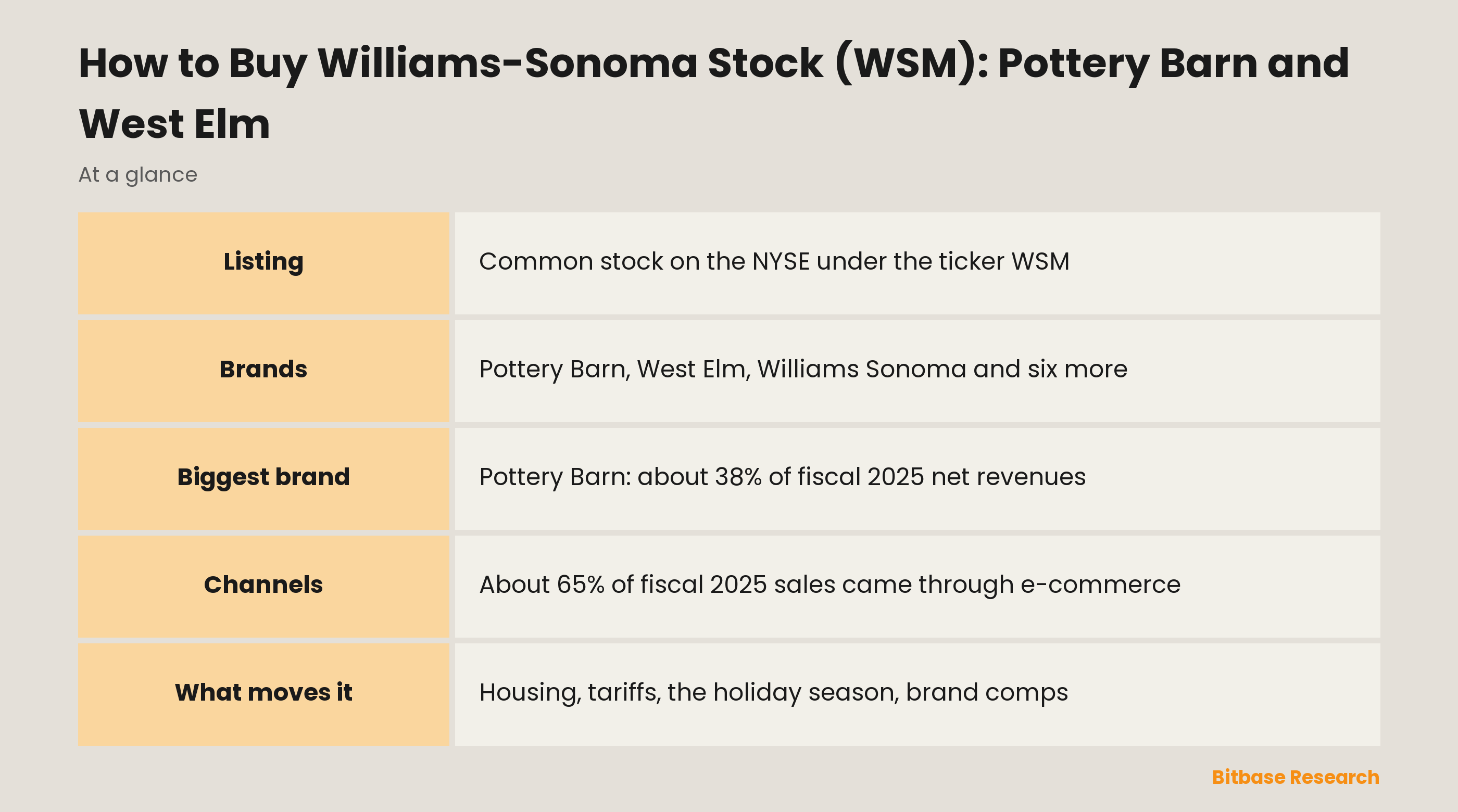
Buying a stake in Williams-Sonoma comes down to one order for WSM, the company's common shares on the New York Stock Exchange, placed through a broker that offers US equities. The kitchen shop in the name is no longer the largest part of the business: Pottery Barn brought in about 38% of fiscal 2025 net revenues, and about 65% of all sales came through e-commerce. What follows covers the nine brands, the order itself, and the pressures its filings dwell on, from tariffs on imported furniture to a slow housing market.
What Does Williams-Sonoma Do?
Williams-Sonoma, Inc. sells furniture, kitchenware and decor under its own brands. The annual report calls it "an omni-channel specialty retailer of high-quality products for the home" and, in its own words, "the world's largest digital-first, design-led and sustainable home retailer." It sells through websites, direct-mail catalogs, stores and a business-to-business division.
It began in 1956, when Chuck Williams opened a store in Sonoma, California to sell French cookware he could not find in America. The company was incorporated in 1973 and is now a Delaware corporation headquartered on Van Ness Avenue in San Francisco.
Nine brands share one back office:
1. Williams Sonoma, the original kitchen brand, plus Williams Sonoma Home for furnishings.
2. Pottery Barn, established in 1949 and bought in 1986, selling furniture, bedding, lighting and rugs.
3. Pottery Barn Kids, founded in 1999, and Pottery Barn Teen, launched in 2003 for teen bedrooms and dorms.
4. West Elm, started in Brooklyn in 2002 with modern furniture and decor it describes as affordable.
5. Rejuvenation, founded in 1977 and acquired in 2011, which makes lighting and hardware to order in Portland, Oregon.
6. Mark and Graham, a monogrammed gifts brand from 2012, and GreenRow, a 2023 brand built on sustainable materials and artisan production.
All nine feed The Key Rewards, a loyalty and credit card program. At the end of fiscal 2025 the company ran 506 stores: 473 in 41 states, Washington, D.C. and Puerto Rico, 18 in Canada, 13 in Australia and 2 in the United Kingdom. Franchise partners operate 90 more locations in Mexico, South Korea, India and the Philippines. During the year it opened 12 stores and closed 18.
Most products are designed in-house and made by outside suppliers, and no single supplier is large: the biggest accounted for about 3% of fiscal 2025 purchases. About 19% of products were made in the United States, while foreign suppliers provided the rest, about 19% from China, 16% from Vietnam, 15% from India and 31% from other countries. The company also makes some goods itself, mainly upholstered furniture and lighting, in Mississippi, North Carolina and Oregon.
How Williams-Sonoma Makes Money
The filings treat each brand as an operating segment but combine them into a single reportable segment, which earns its revenue from selling merchandise through the websites, catalogs and stores, including the shipping fees customers pay for home delivery. Net revenues are broken down by brand:
| Brand group | Share of fiscal 2025 net revenues | What it sells |
|---|---|---|
| Pottery Barn | 38% | Furniture, bedding, lighting, rugs, tabletop |
| West Elm | 24% | Modern furniture and decor |
| Williams Sonoma (incl. Williams Sonoma Home) | 17% | Cookware, kitchen electrics, food, home furnishings |
| Pottery Barn Kids and Teen | 15% | Children's and teen furniture, bedding, baby goods |
| Other | 6% | Mainly Rejuvenation, Mark and Graham, GreenRow and franchise income |
Shares are calculated from the brand table in the segment note of the fiscal 2025 10-K. Business-to-business sales are counted inside each brand.
The mix has been moving away from Pottery Barn. Its share was about 41% in fiscal 2023, and its revenue fell about 6% over the two years to fiscal 2025, while the other brand groups were flat or grew. Comparable brand revenue, the measure the company uses for like-for-like growth, shows the same pattern:
| Comparable brand revenue | Fiscal 2025 | Fiscal 2024 |
|---|---|---|
| Pottery Barn | 0.4% | −6.2% |
| West Elm | 2.9% | −2.0% |
| Williams Sonoma | 6.9% | 2.4% |
| Pottery Barn Kids and Teen | 4.4% | 3.0% |
| Total | 3.5% | −1.6% |
Reported net revenues rose only 1.2% in fiscal 2025 because the year had 52 weeks against 53 in fiscal 2024, and because franchise revenue was lower and stores were closed. Retail stores grew faster than the web: comparable revenue rose 6.4% in stores and 2.2% online, though e-commerce still made up about 65% of net revenues.
Tariffs showed up in margins. Gross margin slipped to 46.2% from 46.5%, and the 10-K lists "the flow-through of tariffs into cost of goods sold" among the reasons. Operating margin, calculated from the income statement, was about 18.1% in fiscal 2025 against 18.5% a year earlier, and management still reported record diluted earnings per share. The business is almost entirely American: operations in Canada, Australia and the United Kingdom plus franchise income made up about 4% of fiscal 2025 net revenues.
WSM Stock at a Glance
| Feature | WSM |
|---|---|
| Exchange | New York Stock Exchange |
| Ticker | WSM |
| Security | Common stock, the only class registered under Section 12(b) |
| Sector | Specialty retail: home furnishings, kitchenware and decor |
| Brands | Williams Sonoma, Pottery Barn, Pottery Barn Kids, Pottery Barn Teen, West Elm, Williams Sonoma Home, Rejuvenation, Mark and Graham, GreenRow |
| Index membership | S&P 500 |
| Headquarters | San Francisco, California |
| Incorporated | Delaware |
| Fiscal year | 52 or 53 weeks, ending on the Sunday closest to 31 January |
| Payouts | Quarterly cash dividend; share buybacks under board authorizations |
| SEC identifier | CIK 719955 |
Quotes, market value and yield move all day, so live numbers are kept on the Williams-Sonoma stock page on Bitbase.
How to Buy Williams-Sonoma Stock
There is no depositary receipt or foreign listing to sort out: Williams-Sonoma is a US company and the shares that trade on the NYSE are its ordinary common stock. A purchase runs like this:
1. Find a broker that reaches the NYSE. Outside the United States that can be a local firm with access to US markets or an international broker. Check which legal entity holds your account and who supervises it.
2. Complete the account checks. Non-US individuals normally fill in IRS Form W-8BEN, which the IRS says to submit "when requested by the withholding agent or payer."
3. Fund the account. Depositing another currency means a conversion into US dollars, which has its own cost.
4. Search for WSM. The result should read Williams-Sonoma, Inc. common stock on the NYSE.
5. Decide how the order should fill. A market order buys at the next available price. FINRA notes that limit orders suit investors "who know the price they want," and that "a buy limit order can be executed only at or below the limit price."
6. Choose the amount. Some brokers sell fractional shares, which let you invest a fixed sum instead of buying whole shares. Ask whether fractional holdings carry voting rights at your firm.
7. File the records. Confirmations and monthly statements show what you paid and the dividends credited, which you will need for taxes.
Withholding on dividends. According to the IRS, "most types of U.S. source income received by a foreign person are subject to U.S. tax of 30%," and a tax treaty between the United States and your country can lower that rate, which is why brokers collect the W-8BEN. Your home country may tax the same dividend again.
Owning it through a fund. WSM is in the S&P 500, so funds that track that index, such as State Street's SPY, hold it alongside roughly five hundred other companies.
What Moves WSM Stock
Housing and discretionary spending. Sofas and dining tables are easy purchases to postpone. The 10-K says lower spending on home products "during periods of decreased home purchases, such as in the current environment," has reduced demand before and could again, and it lists interest rates, consumer credit and confidence among the inputs. In August 2026 chief executive Laura Alber said the company was "delivering compounding results despite the housing market and other macroeconomic events."
Tariffs and sourcing. With about 81% of merchandise bought from foreign suppliers, import duties go straight into cost of goods. The company says it runs "an aggressive tariff mitigation plan," including vendor cost cuts, moving production to cheaper markets and targeted price increases. Policy can also reverse. On 20 February 2026 the US Supreme Court ruled that the International Emergency Economic Powers Act does not authorize peacetime tariffs, and in the second quarter of fiscal 2026 Williams-Sonoma booked refunds of those duties that lifted GAAP gross margin to 51.6%. Excluding the refunds, the non-GAAP gross margin was 45.5%, down 160 basis points, with tariff costs again the main drag.
Brand by brand demand. Because Pottery Barn is the largest brand, a weak Pottery Barn year can offset growth elsewhere, as fiscal 2024 showed. In the second quarter of fiscal 2026 company comparable revenue grew 6.2% and Alber said "every brand delivered again in the quarter."
The holiday quarter. "Historically, a significant portion of our net revenues and net earnings have been realized during our peak selling season," the 10-K says, meaning October through January. Inventory is ordered "up to twelve months" ahead, so a misjudged season leaves either empty shelves or discounted stock.
Online channels. With about two thirds of revenue online, advertising costs and platform changes matter. The 10-K says its e-commerce business depends partly on "a limited number of our key digital platforms" and on how quickly it adapts to AI-enabled shopping, including "agentic checkout."
Cash returned to shareholders. On 18 March 2026 the board authorized a 15% increase in the quarterly cash dividend. Buybacks vary more: the company bought back shares in the first quarter of fiscal 2026 but none in the 13 weeks to 2 August 2026, and a further repurchase authorization approved in November 2025 takes effect once the current one is used up.
Where Williams-Sonoma's Filings See Trouble
These passages from Item 1A of the fiscal 2025 10-K speak most directly to the share:
Demand outside its control. "We are unable to control many of the factors affecting consumer spending, and declines in consumer spending on home furnishings and kitchen products in general could reduce demand for our products."
Tariff exposure. Despite its mitigation work, the company "may not be able to fully or substantially mitigate the impact of the increased tariffs or any future tariffs, pass price increases on to our customers or secure adequate alternative sources of products or materials."
Inventory and shipping. Long lead times mean the company is "vulnerable to demand and pricing shifts and to misjudgments in the selection and timing of merchandise purchases." The filing also notes that instability in the Middle East has kept commercial vessels away from the Suez Canal and the Strait of Hormuz.
Competition and price. The filing describes the specialty e-commerce and retail businesses as "highly competitive" and warns of discount retailers "selling similar products at reduced prices" and established companies willing to spend heavily or cut prices to gain share.
Payout expectations. "If we are unable to pay quarterly dividends or repurchase our stock at intended levels, our reputation and stock price may be harmed." Dividends remain at the board's discretion and depend on earnings, financial condition and business needs.
Two risks come with any single stock: everything rides on one company's choices, and one-off items, such as the tariff refund booked in 2026, can make a single quarter look better or worse than the business underneath.
How to Research WSM Yourself
Williams-Sonoma files with the SEC under CIK 719955. The annual 10-K arrives in late March, after a fiscal year that ends around 1 February; three 10-Qs follow, and earnings releases are attached to 8-K filings. The company's investor relations site posts the same documents and the earnings call webcasts.
Inside the 10-K, Item 1 describes the brands, store counts and sourcing countries, and Item 1A sets out the risk factors quoted above. Item 7, the MD&A, holds the comparable brand revenue table, the gross margin bridge and the store opening and closing figures. The segment reporting note carries net revenues by brand for three years, which is where the shares in this article come from. Item 5 compares Williams-Sonoma's five-year total return with the S&P 500 and with the S&P 500 Consumer Discretionary Distribution and Retail index.
Three details make comparisons cleaner. Fiscal 2024 had 53 weeks, and the company estimates the extra week added 150 basis points to that year's revenue growth. Per-share figures before July 2024 have to be halved for the 2-for-1 split. And from 2026 on, check whether a margin figure is GAAP or non-GAAP, because tariff refunds sit in one and not the other.
For two other US-listed retailers tied to the home, see our Home Depot stock guide and Lowe's stock guide. Live quotes are on the stock page linked earlier, and Bitbase's list of US stock pages covers other listed companies.
Williams-Sonoma Stock FAQ
Can I buy Williams-Sonoma stock with crypto?
Not directly. WSM shares are bought through a brokerage account in US dollars, so crypto has to be sold for cash first and the money sent to the broker; that sale can be a taxable event where you live. The share you end up with is a stake in a registered company with dividend and voting rights, which is how a share differs from a crypto asset.
Does Williams-Sonoma pay a dividend?
Yes. The company has historically paid a cash dividend every quarter, and in March 2026 the board raised the quarterly amount by 15%. Future dividends depend on earnings and financial condition and are at the board's discretion, so check the latest release for the current amount and dates.
Is WSM in the S&P 500?
Yes. Williams-Sonoma appeared in State Street's daily holdings file for SPY, the S&P 500 ETF, as of 9 November 2026. It trades on the NYSE, not Nasdaq, and is not part of the Nasdaq-100.
What brands does Williams-Sonoma own?
Nine: Williams Sonoma, Williams Sonoma Home, Pottery Barn, Pottery Barn Kids, Pottery Barn Teen, West Elm, Rejuvenation, Mark and Graham, and GreenRow. Pottery Barn is the largest by revenue.
Has Williams-Sonoma stock split?
Yes. On 9 July 2024 the company carried out a 2-for-1 stock split in the form of a stock dividend, so each share became two. Later filings restate earlier per-share figures for the split; when you compare older data, make sure it has been adjusted.
Conclusion
Williams-Sonoma is less a kitchen retailer than a furniture company with a kitchen brand attached, and Pottery Barn's results still decide many of its years. Fiscal 2025 showed both sides of that: Williams Sonoma and the children's brands grew, Pottery Barn barely moved, and tariffs ate into gross margin. Before buying, read the brand comp table and the gross margin bridge in the latest 10-K and quarterly release, set the housing market against them, and decide how much one home furnishings retailer should weigh in your portfolio.
Related reading
Other Bitbase articles on this topic:
- How to Buy Ford Stock (F): One Letter, Family Votes and EV Reset
- How to Buy Honda Stock (HMC): Motorcycle Profits and an EV Reset
- How to Buy IHG Stock (IHG): Holiday Inn Fees and a One-Share ADS
Disclaimer: This article is educational content from Bitbase Academy, provided for information only. It explains what a company or fund does and how the instruments referenced here differ from one another; it does not constitute investment, trading, tax, or financial advice, and it is neither a recommendation nor an endorsement of any security, token, or trading strategy. A tokenized stock is issued by a third party and is designed to give economic exposure to an underlying asset: it is not a share, it carries no shareholder rights, and it depends on the issuer's structure, eligibility rules, and redemption terms, which the issuer can change. Perpetual futures are leveraged derivatives that hold no underlying asset and can be liquidated, and trading hours, product availability, and eligibility differ by instrument and by jurisdiction and can change at any time. Written as of November 2026; verify everything yourself through company filings, the issuer's own documentation, and the product pages of the venue you trade on.
References
[1] Williams-Sonoma Form 10-K for fiscal 2025 (SEC EDGAR) www.sec.gov
[2] Williams-Sonoma fiscal 2025 Form 10-K, XBRL cover page (SEC EDGAR) www.sec.gov
[3] Williams-Sonoma Form 10-Q for the second quarter of fiscal 2026 (SEC EDGAR) www.sec.gov
[4] Williams-Sonoma second-quarter 2026 earnings release, filed with Form 8-K (SEC EDGAR) www.sec.gov
[5] Williams-Sonoma Form 8-K of 18 March 2026: quarterly dividend increase (SEC EDGAR) www.sec.gov
[6] Williams-Sonoma Form 10-K for fiscal 2024: 2-for-1 stock split (SEC EDGAR) www.sec.gov
[7] State Street SPDR S&P 500 ETF Trust (SPY): fund page and daily holdings www.ssga.com
[8] FINRA: Order Types www.finra.org
[9] IRS: NRA Withholding www.irs.gov
[10] IRS: About Form W-8 BEN www.irs.gov





