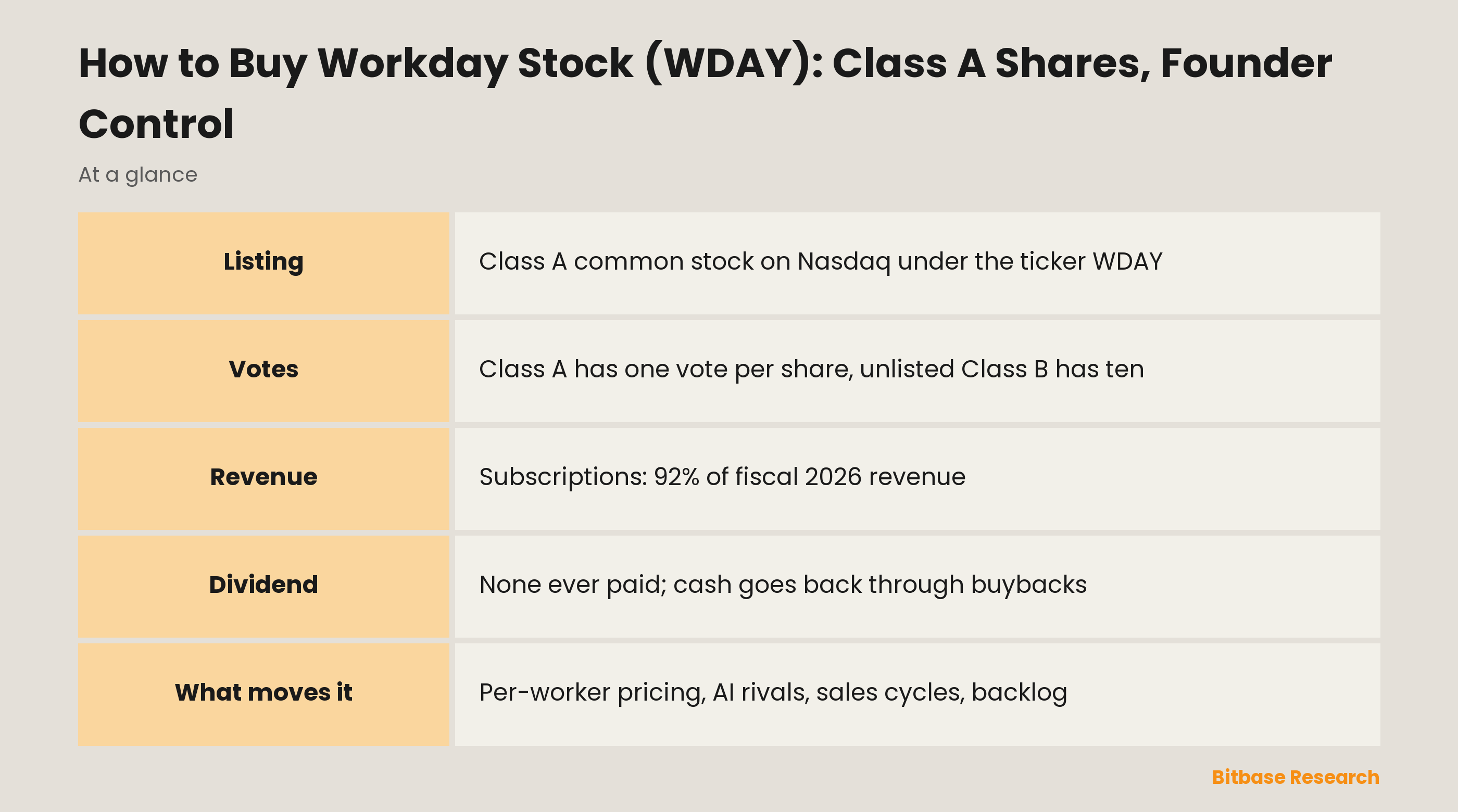
Anybody hoping to own part of Workday buys its Class A common stock, which trades on Nasdaq as WDAY and can be bought through any broker with US market access. That share carries one vote, while the unlisted Class B stock, held by insiders including the co-founders, carries ten, and a voting agreement between co-founders Aneel Bhusri and David Duffield covered about 68% of the company's voting power at the end of January 2026. Below: what Workday sells, how the subscription model turns into revenue, how an order works, and the pressures its filings describe, from AI rivals to slower renewals.
What Does Workday Do?
Workday sells cloud software that large and mid-sized organizations use to manage people and money. Its 10-K sums it up in one line: "Workday is the enterprise AI platform for managing people, money, and agents." The company was started in 2005, "when we pioneered HCM in the cloud," and it says it now serves more than 11,500 organizations, with more than 75 million users under contract and more than 65% of the Fortune 500 among its customers.
The product line has four main parts. Human capital management (HCM) covers the employee lifecycle "from recruitment to retirement." Financial Management handles accounting jobs such as payables, receivables and the period-end close. Spend Management covers sourcing, supplier contracts and expenses, and Planning models budgets and headcount. Workday GO is a version priced for medium-sized organizations.
All of it runs on one platform that Workday updates every week. In fiscal 2026 the company put AI agents at the center of its pitch, software that helps with tasks such as hiring or parts of a financial close, and bought four companies to speed that up: Flowise, a low-code tool for building agents; Paradox, a conversational recruiting assistant; Sana, an enterprise knowledge company; and Pipedream, an integration platform for agents. On 12 October 2026 it agreed to buy ConductorOne, an identity governance company, a deal still subject to customary conditions.
Workday sells through its own sales teams, through partners and resellers, and on Workday Marketplace. Some partners are also rivals: ADP and Microsoft appear in the 10-K both as partners and as competitors, next to the two vendors Workday calls its primary competitors, Oracle and SAP.
At the end of January 2026 Workday employed over 21,000 people in 36 countries, about 58% of them in the United States. Its headquarters are in Pleasanton, California.
How Workday Makes Money
Almost all of Workday's revenue is rent on its software. In fiscal 2026, the year ended 31 January 2026, subscription services made up about 92% of total revenue; the rest came from professional services such as deployment, optimization and training.
| Revenue line | Share of fiscal 2026 revenue | Change from fiscal 2025 | What it covers |
|---|---|---|---|
| Subscription services | 92% | +14% | Access to the cloud applications, with support |
| Professional services | 8% | −1% | Deployment, optimization and training |
| Total | 100% | +13% |
Subscription fees depend on four things: "the number of customers, the number of workers at each customer, the specific applications subscribed to by each customer, and the price of our applications." Contracts "typically have a term of three years or longer and are generally noncancelable," and Workday usually bills a year in advance. So revenue changes slowly: most of what a quarter reports comes from contracts signed earlier.
Growth in fiscal 2026 came mostly from existing customers. About 60% of the increase in subscription revenue was expansion within customers Workday already had, and 40% came from new ones. The company puts its gross revenue retention rate, recurring revenue kept from existing customers before any upsell, at about 97%.
Professional services revenue fell 1% in fiscal 2026, which Workday attributes to project size and mix "as we continue to expand and leverage our service partners."
The subscription revenue backlog, the value of signed contracts not yet booked as revenue, rose 12% over fiscal 2026, and the part expected to be recognized within twelve months rose 16%. Split by where customers are based, about 75% of revenue came from the United States and 25% from other countries.
Profitability depends on which yardstick you use. The GAAP operating margin was 7.5% in fiscal 2026, up from 4.9%, while the non-GAAP margin, which excludes items such as share-based compensation and restructuring costs, was 29.6%. Share-based compensation alone equaled 16.4% of revenue. In the second quarter of fiscal 2027, ended 31 July 2026, revenue grew 13%, subscription revenue 14%, and the GAAP operating margin reached 11.8%.
WDAY Stock at a Glance
| Feature | WDAY |
|---|---|
| Exchange | Nasdaq Global Select Market |
| Ticker | WDAY |
| Listed security | Class A common stock, one vote per share |
| Other class | Class B common stock, ten votes per share, not listed |
| Sector | Enterprise application software: HR, finance, spend and planning |
| Index membership | S&P 500 |
| Headquarters | Pleasanton, California |
| Incorporated | Delaware |
| Fiscal year | Ends 31 January |
| Dividend | None; the company has never paid one |
| SEC identifier | CIK 1327811 |
Price and market value move all session; for current numbers, check the Workday stock page on Bitbase.
How to Buy Workday Stock
As a US company, Workday has no depositary receipt: you buy the Class A common stock itself. The steps:
1. Choose a broker that reaches Nasdaq. Outside the United States that can be a local firm with US market access or an international broker; find out which legal entity runs your account and which regulator oversees it.
2. Open the account and pass verification. Individuals outside the US generally certify their status on IRS Form W-8BEN, which the IRS says to submit "when requested by the withholding agent or payer."
3. Fund it. If you deposit another currency, the exchange rate is part of the cost, so compare it as well as the commission.
4. Find the right line. Search WDAY and confirm it reads Workday, Inc. Class A common stock. The 10-K cover lists it as the only class registered on an exchange.
5. Choose an order type. FINRA says a market order "provides the most certainty that your order will be executed," while a limit order fills only "at or better than a specified price."
6. Decide the size. Fractional shares let you put in a set sum rather than whole shares, but some brokers offer them only for "large-cap stocks or ETFs" or not at all, and FINRA warns that "as a fractional share owner, you might not have shareholder voting rights."
7. Keep your records. Trade confirmations and statements set your cost basis for any later sale.
Tax for holders outside the US. According to the IRS, "most types of U.S. source income received by a foreign person are subject to U.S. tax of 30%," which a tax treaty can reduce. Dividends are the usual example, but Workday pays none, so your home country's rules on gains matter more.
Through index funds. Workday is part of the S&P 500: on 6 November 2026 it appeared in the daily holdings of State Street's SPY, which tracks that index. In such a fund, Workday is a small slice of a much larger basket.
What Moves WDAY Stock
AI and the per-worker price. Workday's fees depend partly on how many workers a customer has, so anything that changes headcount, or the way software is paid for, reaches its revenue. Both its 10-K and its latest 10-Q describe "reduced growth in headcount-level commitments upon renewals of existing customers," and the 10-Q says the company is answering shifts in buying behavior with "new pricing models." One is Flex Credits, introduced in fiscal 2026 as "a new subscription-based flexible pricing model for certain AI solutions and platform capabilities." AI products could raise revenue per customer, while slower headcount growth at customers weighs on it; the quarterly filings show which force is winning.
New competition. The 10-K also names a newer kind of rival: "non-specialist solutions relying on generic large language models," generative AI and general-purpose agents. That sits beside Oracle and SAP, the two large suites Workday competes with most directly, and specialists such as ServiceNow in workflow software, which our ServiceNow stock guide covers.
Sales cycles and public budgets. Workday says deals have faced more scrutiny and longer sales cycles, "particularly evident in the government, higher education, and healthcare industries which are tied to federal funding." A slowdown in signings shows up in backlog before revenue. In the second quarter of fiscal 2027 total subscription backlog grew 8% year on year, slower than the 14% rise in the twelve-month portion.
The fourth quarter. Workday signs "a significantly higher percentage" of new and renewal agreements in the last quarter of its fiscal year, which ends in January. Results and backlog for that quarter, reported in late February in both 2025 and 2026, carry extra weight.
Cost cuts and margins. Workday has announced three rounds of job reductions in under two years: about 7.5% of the workforce in February 2025, about 2% in February 2026 and about 2.5% in September 2026, the last mainly in its Product and Technology team. The GAAP margin shows whether savings stick; it rose from 4.9% in fiscal 2025 to 7.5% in fiscal 2026.
Capital decisions. In August 2026 the board approved a new Class A buyback program, and in October Workday sold four series of senior notes due between 2029 and 2036. Buybacks shrink the share count; new debt adds interest costs.
AI Rivals, Long Sales Cycles and Founder Votes
Of the risk factors in the 10-K, these matter most for someone holding WDAY:
Competition. "The markets in which we participate are intensely competitive," and Oracle and SAP have "long-standing relationships with customers and partners."
Delayed signals. "Downturns or upturns in new sales will not be immediately reflected in our operating results." Typical sales cycles for new customers "are six to twelve months but can extend for eighteen months or more."
Renewals. "Our future success depends on the rate of customer subscription renewals."
AI liability. Workday is "currently defending against a lawsuit alleging that certain of our AI-related products and services enable discrimination"; it believes the claims "lack merit" and says "the majority of the claims have been dismissed," but warns the case can be lengthy and that the plaintiff "may seek to also litigate against certain of Workday's customers."
Security. Workday's applications handle customers' HR and financial data, and it says its protections "may not be effective against all cybersecurity threats or perceived threats."
Voting control. "The dual class structure of our common stock has the effect of concentrating voting control with our Co-Founders." Both classes merge into one on the earliest of four events: 17 October 2032; Class B falling below 9% of all common shares; nine months after the deaths of both Duffield and Bhusri; or a vote of a majority of Class B holders.
Two risks sit above the business. Its own record shows how widely it can swing: by the 10-K's performance graph, money put into it at the end of January 2021 had lost about 23% five years later, while the S&P 500 roughly doubled. And one stock ties your outcome to one company, with no dividend to cushion it.
How to Research WDAY Yourself
Workday files with the SEC under CIK 1327811: the 10-K each March, 10-Qs for the quarters ending in April, July and October, and earnings releases on Form 8-K, which in 2026 came on 24 February, 21 May and 27 August. Workday also says it uses blog.workday.com "as a means of disclosing material non-public information," so check that site as well as its investor pages.
In the 10-K, the business section describes the products and names competitors, the risk factors follow, and the market section covers the listing, the dividend policy and the performance graph. In the MD&A, three figures capture the subscription model: subscription revenue growth, the split between existing and new customers, and backlog, in total and within twelve months.
Two checks avoid common mistakes. Workday reports both GAAP and non-GAAP results, and the gap between them is wide, so compare like with like. And fiscal years carry the label of the January in which they end, so "fiscal 2027" is mostly calendar 2026. For a European rival, see our SAP stock guide. For other companies, browse all US stock pages on Bitbase; WDAY quotes sit on the page linked above.
Workday Stock FAQ
Can I buy Workday stock with crypto?
Not directly. A broker sells WDAY shares for US dollars, so crypto must first be converted to cash and moved to the broker, and in many countries that is a taxable sale. Our guide on buying stocks with crypto walks through how the two steps fit together.
Does Workday pay a dividend?
No. Workday's 10-K says it has "never declared or paid cash dividends" on its capital stock and does not expect to "in the foreseeable future." It has returned cash through share buybacks instead, under programs that can be suspended at any time.
What is the difference between Workday's Class A and Class B shares?
Only Class A trades on an exchange, and it carries one vote per share. Class B carries ten votes, is held by insiders including the co-founders, executive officers and directors, and converts to Class A when it is sold, with limited exceptions. Apart from voting and conversion, the two classes have identical rights.
Is WDAY in the S&P 500?
Yes. On 6 November 2026 Workday's Class A stock appeared in the daily holdings of SPY, State Street's S&P 500 fund. Index weights change every day.
Who runs Workday?
Co-founder Aneel Bhusri, who became chief executive again on 6 February 2026, replacing Carl Eschenbach, and also chairs the board. He had been CEO from 2014 to August 2020 and co-CEO until January 2024.
Conclusion
Placing the order is simple: a broker with Nasdaq access, the WDAY line for Workday's Class A stock, and either order type. Understanding the holding is the harder part: a subscription business whose revenue changes slowly, whose growth depends on how many workers its customers employ and how AI changes that, and whose Class B holders, the founders among them, keep control of the vote until 2032 at the latest. Work through the newest 10-K and 10-Q, follow backlog as closely as revenue, and cap how much of your money one software company carries.
Related reading
Other Bitbase articles on this topic:
- How to Buy MSCI Stock (MSCI): Indexes, ETF Fees and BlackRock
- How to Buy Nebius Stock (NBIS): AI Cloud, Ex-Yandex and Perps
- How to Buy Okta Stock (OKTA): Auth0, AI Agents and Class B Votes
Disclaimer: This article is educational content from Bitbase Academy, provided for information only. It explains what a company or fund does and how the instruments referenced here differ from one another; it does not constitute investment, trading, tax, or financial advice, and it is neither a recommendation nor an endorsement of any security, token, or trading strategy. A tokenized stock is issued by a third party and is designed to give economic exposure to an underlying asset: it is not a share, it carries no shareholder rights, and it depends on the issuer's structure, eligibility rules, and redemption terms, which the issuer can change. Perpetual futures are leveraged derivatives that hold no underlying asset and can be liquidated, and trading hours, product availability, and eligibility differ by instrument and by jurisdiction and can change at any time. Written as of November 2026; verify everything yourself through company filings, the issuer's own documentation, and the product pages of the venue you trade on.
References
[1] Workday Form 10-K for fiscal 2026 (SEC EDGAR) www.sec.gov
[2] Workday fiscal 2026 Form 10-K, XBRL cover page (SEC EDGAR) www.sec.gov
[3] Workday Form 10-Q, quarter ended 31 July 2026 (SEC EDGAR) www.sec.gov
[4] Workday Form 8-K, February 2026: new chief executive (SEC EDGAR) www.sec.gov
[5] Workday Form 8-K, September 2026: reorganization (SEC EDGAR) www.sec.gov
[6] Workday Form 8-K, October 2026: agreement to acquire ConductorOne (SEC EDGAR) www.sec.gov
[7] Workday Form 8-K, August 2026: results and buyback (SEC EDGAR) www.sec.gov
[8] Workday Form 8-K, October 2026: senior notes offering (SEC EDGAR) www.sec.gov
[9] State Street: SPY daily holdings, 6 November 2026 www.ssga.com
[10] FINRA: Order Types www.finra.org
[11] FINRA: Investing in Fractional Shares www.finra.org
[12] IRS: NRA Withholding www.irs.gov
[13] IRS: About Form W-8 BEN www.irs.gov





