
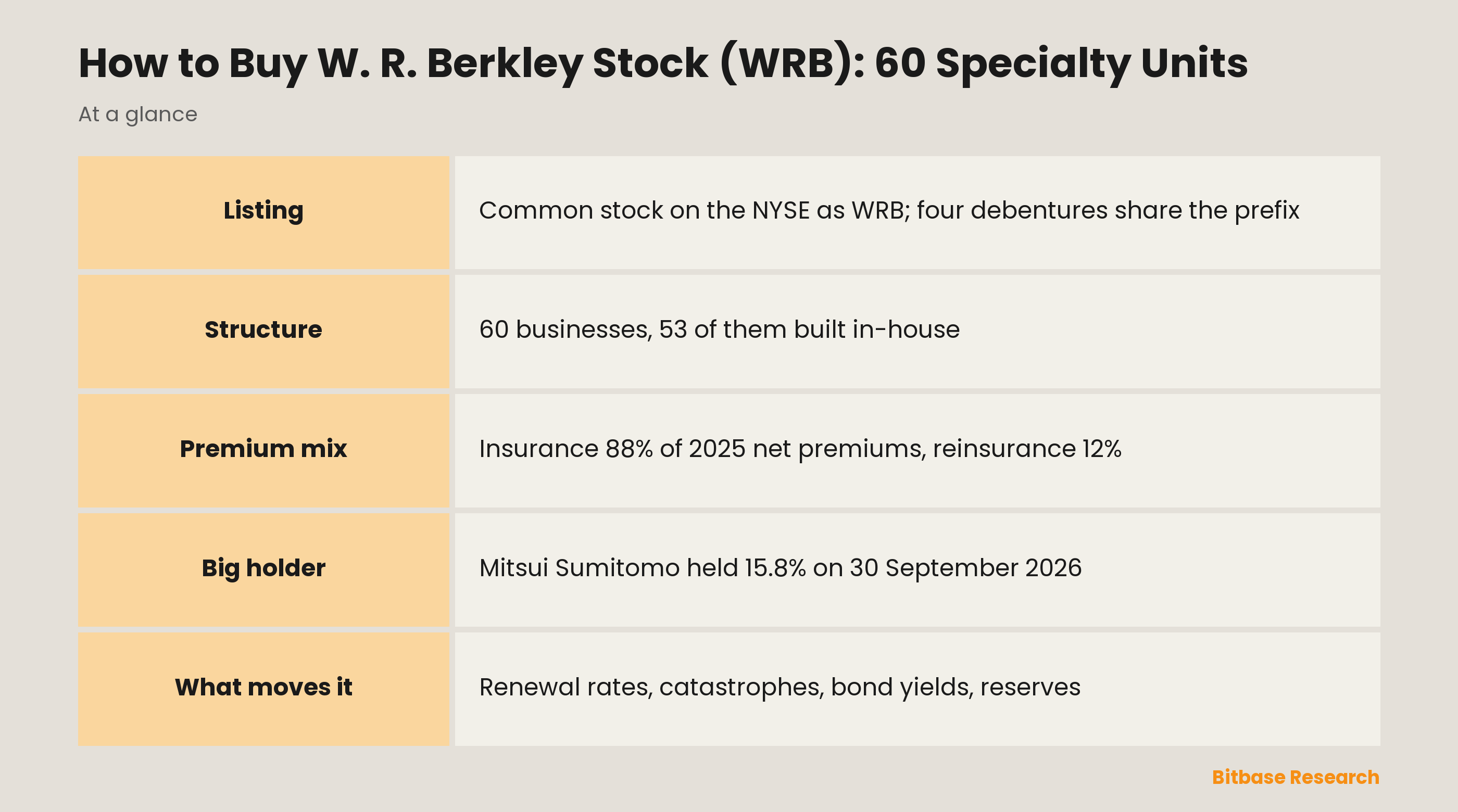
Under the symbol WRB, the New York Stock Exchange lists the common stock of W. R. Berkley Corporation, and any broker that offers US shares can buy it for you, provided you pick that line and not one of the four company debentures quoted as WRB-PE to WRB-PH. The Connecticut insurer runs 60 separate businesses, most of them started from scratch, and a Japanese carrier, Mitsui Sumitomo Insurance, held 15.8% of its stock on 30 September 2026 under a 2025 agreement that lets the Berkley family steer how those shares vote. Below: what the group insures, how to place the order, and what its filings say drives results.
What Does W. R. Berkley Do?
W. R. Berkley is an insurance holding company. Its 10-K describes it as "among the largest commercial lines writers in the United States," active worldwide in two segments of property and casualty insurance. William R. Berkley founded the business in 1967; the current corporation was formed in Delaware in 1970, and its head office is on Steamboat Road in Greenwich, Connecticut.
What sets the group apart is how it is organised: a federation of businesses, each serving a niche defined by geography, product or industry. The filing puts the count plainly: "Of our 60 businesses, 53 have been organized and developed internally and seven have been added through acquisition." Each unit is meant to sit close to its customers, while capital, investments, reinsurance buying and actuarial work stay at the centre. New units are opened, the company says, "when opportunities are identified and when the right talent and expertise are found to lead a business."
The Insurance segment wrote 88% of net premiums in 2025. The 10-K sorts its work into four areas: excess and surplus lines, for risks that fall outside standard insurers' underwriting guidelines; industry specialty, where underwriters serve one trade; product specialty, such as workers' compensation or professional liability; and regional units selling standard commercial policies to small and midsized businesses in 45 states and the District of Columbia.
The unit names show the range. Admiral Insurance, the largest by premiums at 7.9% of the segment's 2025 gross premiums, writes "hard-to-place, specialized risks" and sells only through wholesale brokers. Berkley Environmental covers contractors, consultants and facility operators, Berkley Life Sciences covers drug and medical device companies, and Berkley Accident and Health writes medical stop-loss and other health cover. Berkley One sells home, auto and collectibles cover to wealthy families, so the group is not purely commercial. Abroad, it has branches or offices in 52 cities outside the United States, in Asia, Australia, Canada, Continental Europe, Mexico, Scandinavia, South America and the United Kingdom, and uses Lloyd's global licences.
The Reinsurance & Monoline Excess segment wrote the other 12%. It insures other insurers through treaty and facultative reinsurance; its largest unit, Berkley Re America, wrote 33.2% of the segment's 2025 gross premiums. Midwest Employers Casualty, with 20.0%, sells excess workers' compensation cover and captive insurance, and part of the segment only retains risk on an excess basis.
How W. R. Berkley Makes Money
Earnings come from two places: the gap between premiums and the cost of claims and expenses, and the return on the money held until claims are paid. In 2025 net premiums earned supplied about 85% of total revenue and net investment income about 10%; fees, service businesses and investment gains supplied the rest.
Liability lines are the largest block of the Insurance segment, though short-tail lines have gained ground:
| Insurance segment line | Share of 2023 gross premiums | Share of 2025 gross premiums |
|---|---|---|
| Other liability | 38.7% | 38.6% |
| Short-tail lines (commercial multi-peril property, inland marine, accident and health, surety, high net worth homes and others) | 24.7% | 27.3% |
| Auto | 12.7% | 12.9% |
| Professional liability | 13.1% | 11.4% |
| Workers' compensation | 10.8% | 9.8% |
Long-tail liability claims can take years to settle, so pricing them well and reserving for them accurately is the core skill. The yardstick is the combined ratio: losses and expenses as a share of earned premiums, where anything under 100 means an underwriting profit. In 2025 the Insurance segment ran at 91.7%, the Reinsurance & Monoline Excess segment at 83.7% and the group at 90.7%.
Measured by income before taxes, Insurance supplied about 80% of what the two operating segments earned in 2025, against its 88% of premiums. A third line, Other, which holds corporate expenses, investment gains and losses and some non-insurance businesses, posted a pre-tax loss.
The investment side is large and mostly bonds: at the end of 2025 fixed maturity securities made up 75.3% of the portfolio, including cash. Net investment income rose 7% in 2025, mainly because the bond book grew. The rest of the portfolio holds equities, merger arbitrage positions, investment funds, private equity, loans and real estate, which the 10-K warns "are subject to significant volatility."
The company's own scorecard is return on equity. The fourth-quarter 2025 earnings release reported 21.2% for the year, and book value per share up 26.7% before dividends and share repurchases.
WRB Stock at a Glance
| Feature | WRB |
|---|---|
| Exchange | New York Stock Exchange |
| Ticker | WRB (common stock) |
| Other listed securities | Four series of subordinated debentures due 2058 to 2061, tickers WRB-PE, WRB-PF, WRB-PG and WRB-PH |
| Sector | Specialty commercial property and casualty insurance and reinsurance |
| Index membership | S&P 500 |
| Headquarters | Greenwich, Connecticut |
| Incorporated | Delaware, 1970 (founded 1967) |
| Fiscal year | Calendar year, ending 31 December |
| Payouts | Quarterly cash dividend; two special dividends were declared in 2025 |
| Stock splits | 3-for-2 in April 2019, March 2022 and July 2024 |
| SEC identifier | CIK 11544 |
The share price, market value and yield move through every session; the W. R. Berkley stock page on Bitbase carries them live.
How to Buy W. R. Berkley Stock
Because W. R. Berkley is a Delaware company filing a 10-K, no depositary receipt stands between you and the shares: what trades on the NYSE is the common stock. The order itself takes six moves:
1. Pick a regulated broker. Any firm that routes orders to US exchanges will do; abroad, many local banks and brokers offer this, as do international brokers. Note the company that actually holds your assets and the authority that licenses it.
2. Complete onboarding. Investors outside the US usually file IRS Form W-8BEN, which the IRS says to submit "when requested by the withholding agent or payer."
3. Fund in dollars. A deposit in another currency is converted, and the spread on that conversion can cost more than the commission.
4. Select the right security. A search for WRB may also show the four debentures, which are fixed-rate loans to the company rather than ownership. Make sure the result reads W. R. Berkley Corporation common stock, with no suffix after the ticker.
5. Decide how the order executes. A market order buys at whatever price is available when it arrives; a limit order caps what you pay and may never fill.
6. Decide the amount. Some brokers sell fractions of a share for a set sum of money; their terms, including any voting rights, vary.
Tax on dividends. Under IRS rules, most US-source income paid to a foreign person is taxed at 30%, and a tax treaty or code provision can reduce or remove that rate. Regular and special dividends both count, and your own country may tax them again.
Holding it indirectly. WR Berkley Corp appeared on 10 November 2026 in the daily SPY holdings published by State Street, so S&P 500 index funds own a small slice of it.
A ceiling for very large buyers. Insurance holding company laws generally presume that anyone with 10% or more of the voting shares has control, which needs regulators' prior approval. Ordinary investors never come near that line; Mitsui Sumitomo's purchases, by contrast, were subject to regulatory approvals.
What Moves WRB Stock
The pricing cycle. Property and casualty insurers swing between "hard" markets, when rates rise, and "soft" markets, when competition pushes them down. Average renewal rates at W. R. Berkley rose 6.7% in 2025, then 4.5% over the first nine months of 2026 and 3.6% in the third quarter. The 10-K adds that cycles in different lines no longer move together: rates have moderated for many lines, some property business has seen decreases, and workers' compensation and some professional liability rates continue to fall. Chief executive W. Robert Berkley, Jr. argues that "the breadth of our offering through our 60 specialty businesses allows for greater stability."
A shrinking reinsurance book. In the first nine months of 2026 gross premiums in Reinsurance & Monoline Excess fell 10%, with casualty reinsurance down 17%, while its combined ratio improved to 80.4% from 84.6% a year earlier.
Catastrophes. Catastrophe losses added 2.7 points to the combined ratio in the third quarter of 2026, when it came in at 90.8%; over the first nine months they were lower than a year earlier, mainly in reinsurance.
Interest rates and markets. Net investment income rose 11% in the first nine months of 2026, and the company says reinvestment yields "continue to meaningfully exceed our portfolio's book yield." Higher rates raise that income but lower the value of bonds already held. Equity holdings work through net income: in the third quarter of 2026 net income per diluted share fell about 11% from a year earlier, mainly on unrealized losses on equity securities, while operating income per share, which excludes investment gains and losses, rose 6.4%.
Ownership and succession. On 28 March 2025 Mitsui Sumitomo Insurance agreed with a company owned by the Berkley family to buy 15% of the common stock on the market or from third parties, never from the family or the company. Once past 4.9%, MSI votes its shares as the family recommends, with limited exceptions. It held 13.4% at the end of 2025 and 15.8% on 30 September 2026, and its nominee was elected to the board at the 2026 annual meeting. On 9 June 2026 founder William R. Berkley died at 80, and his son W. Robert Berkley, Jr., already president and chief executive, was named chairman.
Capital returns. Earnings have gone back to shareholders as buybacks and special dividends. In its fourth-quarter 2025 release the company said it had paid "the largest special dividends in our history" that year.
Reserves, Storms and Control at W. R. Berkley
Of the risk factors in the 10-K, these bear most directly on the stock:
Reserves. "Our actual claims losses may exceed our reserves for claims, which may require us to establish additional reserves." Reserves are estimates, and the filing notes that uncertainty is greater where "long periods of time elapse before a definitive determination of liability is made." In 2025 the Insurance segment strengthened reserves for earlier years while Reinsurance & Monoline Excess released some.
Social inflation and mass torts. Rate adequacy depends on "the effects of economic and social inflation on the amount of claims payments." The company also names potential mass tort exposure, such as claims linked to "lead paint, polyfluoroalkyl substances, talc and opioids."
Catastrophes and climate. As a property insurer the group faces natural and man-made disasters, and "changing climate conditions may alter the frequency and increase the severity of catastrophic events."
Competition. Rivals include "major U.S. and non-U.S. insurers and reinsurers," mutual companies, underwriting agencies and insurtechs, and new capital entering the market can push rates down.
Investments. Bond values fall when rates rise, and alternative holdings "may decline in value."
Holding company and control. The parent relies on dividends from its insurance subsidiaries, which regulators limit, to pay its own dividends, buy back shares and service debt. Governance also matters: the 10-K says provisions in its charter and "voting and other arrangements with Mitsui Sumitomo Insurance Co., Ltd." may hinder a takeover, so holders may never be offered a takeover premium.
Beyond the business itself, a single stock concentrates your money in one company. And special dividends are discretionary: two in 2025 say nothing certain about the next year.
How to Research WRB Yourself
The company files with the SEC under CIK 11544. The 10-K is the anchor document; the 10-Qs cover the first three quarters, and 8-Ks report events, including the quarterly earnings releases that in 2026 came on 26 January, 21 April, 20 July and 19 October. Results, call webcasts and presentations also sit on the company's investor relations site at ir.berkley.com.
Inside the 10-K, the business section lists every unit with its share of segment premiums over three years, which shows which niches are growing. The MD&A breaks premiums down by line and gives renewal rate changes, catastrophe losses and prior-year reserve development by segment. The notes to the financial statements track the Mitsui Sumitomo stake and its reinsurance dealings with the company.
The section on the market for the stock compares its total return with the S&P 500 and the S&P 500 Property and Casualty Insurance Index, whose members at the end of 2025 included Chubb and Travelers, profiled in our Chubb stock guide and Travelers stock guide.
Two habits help. Read the combined ratio both as reported and before catastrophes and prior-year reserve development, because a quiet storm season can flatter the headline. And check whether a share count or per-share figure predates the July 2024 split. For quotes, use the WRB page mentioned in the table section; Bitbase's list of US stock pages covers other companies.
W. R. Berkley Stock FAQ
Can I buy W. R. Berkley stock with crypto?
Not directly. WRB shares are bought in US dollars through a brokerage account, so crypto has to be sold for cash and the money moved to the broker first, and that sale may be taxable where you live. The share you end up with is a stake in a registered company, with dividend and voting rights, a contrast explained in how stocks differ from crypto assets.
Does W. R. Berkley pay a dividend?
Yes. The board declares a regular quarterly cash dividend, and in 2025 it also declared special dividends in the second and fourth quarters. Specials depend on board decisions each time, so check the latest 10-Q and earnings release for current amounts and dates.
Has WRB stock ever split?
Yes, three times in recent years, each a 3-for-2 split paid as a stock dividend: in April 2019, March 2022 and July 2024. Per-share figures in later filings are restated for them.
Who owns a large stake in W. R. Berkley?
Mitsui Sumitomo Insurance, part of Japan's MS&AD group, owned 15.8% of the common stock on 30 September 2026. It bought the shares on the market or from third parties, and under its agreements with the Berkley family it votes them as the family recommends, with limited exceptions. When the deal was announced in March 2025, the family company held about 16%.
Is WRB in the S&P 500?
Yes. W. R. Berkley appeared in State Street's daily holdings file for SPY on 10 November 2026, and its own 10-K lists it in the S&P 500 Property and Casualty Insurance Index.
Conclusion
W. R. Berkley is less a single insurer than sixty specialist underwriting shops sharing one balance sheet, family leadership and an investment portfolio built mostly from bonds. That structure kept combined ratios below 100 in the years covered here, but the stock still answers to the pricing cycle, to how well long-tail reserves hold up, to interest rates and to a voting arrangement that gives the Berkley family a large say. Before buying, read the latest 10-K and quarterly release, follow renewal rates and reserve development for a few quarters, and remember that a single stock carries all of one company's risks.
Related reading
Other Bitbase articles on this topic:
- How to Buy Prudential Financial Stock (PRU): Not Prudential plc
- How to Buy Prudential plc Stock (PUK): Asia and Africa, Not the US
- How to Buy Sun Life Stock (SLF): MFS Funds, US Dental and Asia
- How to Buy WTW Stock (WTW): Willis Towers Watson, Irish plc
Disclaimer: This article is educational content from Bitbase Academy, provided for information only. It explains what a company or fund does and how the instruments referenced here differ from one another; it does not constitute investment, trading, tax, or financial advice, and it is neither a recommendation nor an endorsement of any security, token, or trading strategy. A tokenized stock is issued by a third party and is designed to give economic exposure to an underlying asset: it is not a share, it carries no shareholder rights, and it depends on the issuer's structure, eligibility rules, and redemption terms, which the issuer can change. Perpetual futures are leveraged derivatives that hold no underlying asset and can be liquidated, and trading hours, product availability, and eligibility differ by instrument and by jurisdiction and can change at any time. Written as of November 2026; verify everything yourself through company filings, the issuer's own documentation, and the product pages of the venue you trade on.
References
[1] W. R. Berkley Form 10-K for 2025 (SEC EDGAR) www.sec.gov
[2] W. R. Berkley 2025 Form 10-K, XBRL cover page (SEC EDGAR) www.sec.gov
[3] W. R. Berkley Form 10-Q for the third quarter of 2026 (SEC EDGAR) www.sec.gov
[4] W. R. Berkley third-quarter 2026 results release (SEC EDGAR) www.sec.gov
[5] W. R. Berkley fourth-quarter 2025 results release (SEC EDGAR) www.sec.gov
[6] W. R. Berkley release on Mitsui Sumitomo's planned 15% stake, March 2025 (SEC EDGAR) www.sec.gov
[7] W. R. Berkley release on the passing of founder William R. Berkley, June 2026 (SEC EDGAR) www.sec.gov
[8] W. R. Berkley Form 10-K for 2024 (SEC EDGAR) www.sec.gov
[9] W. R. Berkley Form 10-K for 2022 (SEC EDGAR) www.sec.gov
[10] W. R. Berkley Form 10-K for 2019 (SEC EDGAR) www.sec.gov
[11] State Street, SPY fund page and daily holdings www.ssga.com
[12] IRS, NRA withholding www.irs.gov
[13] IRS, About Form W-8 BEN www.irs.gov





