
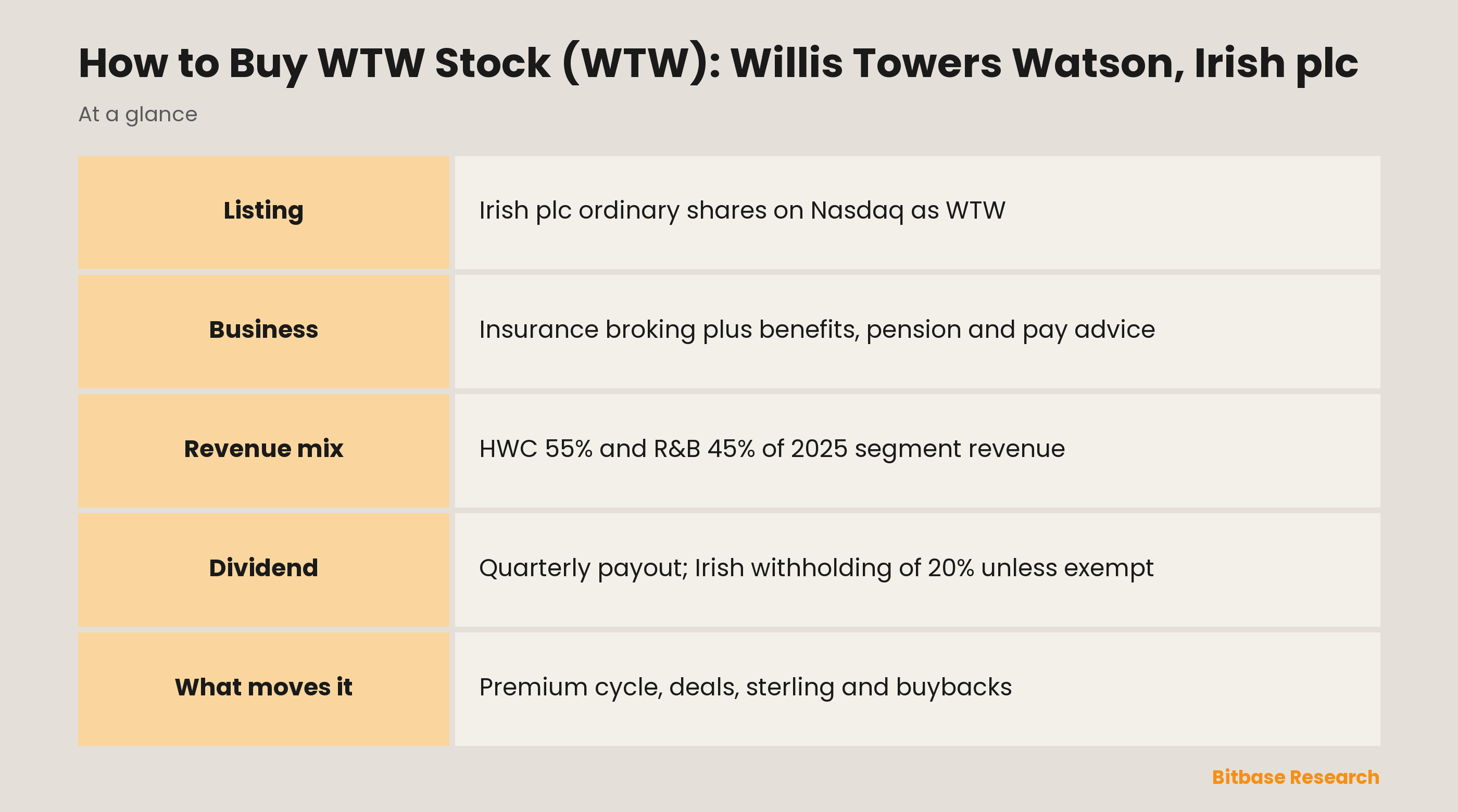
An Irish parent company does not complicate the purchase: the ordinary shares of Willis Towers Watson Public Limited Company trade directly on Nasdaq under the ticker WTW, so any broker with access to that exchange can take the order, with no depositary receipt involved. The company runs its principal executive offices from Lime Street in London, yet it is not an insurer: it brokers cover for companies and advises employers on benefits, pensions and pay, and that people-focused side still produced 55% of segment revenue in 2025. Below: where the money comes from, how to place the order, and what Irish dividend withholding means for you.
What Does WTW Do?
WTW calls itself "a leading global advisory, broking and solutions company that provides data-driven, insight-led solutions in the areas of people, risk and capital." Its annual report counts approximately 47,000 colleagues serving more than 140 countries and markets. The 10-K says WTW works with about 93% of the FTSE 100, 89% of the Fortune 1000 and 92% of the Fortune Global 500, and that no single client brought in more than 10% of revenue in any of the past three years.
The filing is explicit: "We are not an insurance company, and therefore we do not underwrite insurable risks for our own account." As a broker, WTW sits between a client and the insurers, advising on how to manage risk and negotiating the placement. It works with approximately 2,500 carriers, none of which accounted for a significant share of the premiums it placed in 2023, 2024 or 2025.
The business is managed as two segments.
Health, Wealth & Career (HWC) is the larger one. Health covers the design, broking and administration of medical, dental, disability and life plans. Wealth combines Retirement, which does actuarial, plan design and administration work for pension plans, with Investments, which advises and runs discretionary mandates for pension funds, insurers, endowments and private investors. Career covers executive and broad-based pay advice, compensation surveys and employee experience tools. Benefits Delivery & Outsourcing runs a private Medicare marketplace in the United States and administers benefit plans in North America, the UK, Ireland and Germany.
Risk & Broking (R&B) has two businesses. Corporate Risk & Broking handles property and casualty, affinity programs and specialty lines such as aerospace, construction, marine, natural resources, surety, credit and political risk, and financial and executive risks. Insurance Consulting and Technology sells software and risk and capital advice to insurers themselves.
A company assembled by mergers. The group in its present form dates from 4 January 2016, when Willis Group Holdings and Towers Watson & Co. completed their merger. EDGAR still lists the filer's former names: Willis Group Holdings Ltd until January 2010 and Willis Group Holdings plc until January 2016. The shares traded as WLTW from 2016 and switched to WTW at the open on 10 January 2022, with the CUSIP unchanged.
The portfolio has kept moving. A business combination with Aon, agreed on 9 March 2020, was ended by mutual consent on 26 July 2021, and Aon agreed to pay WTW a termination fee. WTW sold Willis Re, its treaty reinsurance broker, to Arthur J. Gallagher & Co. on 1 December 2021 and collected the related earnout in April 2025. It returned to reinsurance broking in the fourth quarter of 2024 through a minority stake in a joint venture with Bain Capital, and it sold TRANZACT, part of its benefits delivery business, on 31 December 2024. In 2026 it completed three purchases: Newfront, a technology-led US broker, on 27 January; Cushon, a workplace pensions and savings company, on 30 April; and the remaining 51% of Al-Futtaim Willis, its broking venture in the United Arab Emirates, on 30 September.
How WTW Makes Money
"We derive the majority of our revenue from either commissions or fees for brokerage or from consulting services," the 10-K says. WTW does not set the premiums its commissions are based on, and "Commission levels generally follow the same trend as premium levels as they are derived from a percentage of the premiums paid by the insureds." Consulting is paid in fees, investment work largely through retainer contracts, and much of the health, retirement and outsourcing work recurs under annual or multi-year contracts.
The two segments contributed in different proportions to sales and to profit:
| Segment | Share of 2025 segment revenue | Share of 2025 segment operating income | Main businesses |
|---|---|---|---|
| Health, Wealth & Career | 55% | 61% | Health, Retirement, Investments, Career, benefits outsourcing |
| Risk & Broking | 45% | 39% | Corporate Risk & Broking; Insurance Consulting and Technology |
Operating income shares are calculated from the segment note, which leaves out corporate costs and amortization.
By type of service, broking brought in about 45% of 2025 revenue, consulting about 34%, outsourced administration about 12% and other services about 7%. Inside Risk & Broking, broking alone was about 79% of the segment's revenue.
HWC's lead has been narrowing. Its share of segment revenue was 60% in 2023 and 59% in 2024 before falling to 55% in 2025, mostly because TRANZACT left at the end of 2024. Total revenue fell 2% in 2025 on a reported basis, but organic growth, a non-GAAP measure that strips out currency, acquisitions and disposals, was 5%: about 4% in HWC and 6% in R&B.
The work is done mainly in two countries. In 2025 the United States accounted for 46% of revenue by where work was performed and the United Kingdom 21%, followed by France at 5%, Canada at 3% and Germany at 3%; Ireland does not appear in that top five. By currency, 54% of revenue was in US dollars, while sterling made up 13% of revenue but 20% of the expenses counted in the 10-K's comparison.
The calendar matters too. Revenue "is typically higher during the Company's first and fourth quarters due primarily to the timing of broking-related activities," so compare a quarter with the same quarter a year earlier.
WTW Stock at a Glance
| Item | Detail |
|---|---|
| Exchange | Nasdaq Global Select Market |
| Ticker | WTW since 10 January 2022 (WLTW from 2016) |
| Security | Ordinary shares, the only class registered under Section 12(b); no depositary receipt |
| Legal form | Willis Towers Watson Public Limited Company, incorporated in Ireland |
| Principal executive offices | 51 Lime Street, London |
| Sector | Insurance broking and risk advice; benefits, retirement and pay consulting |
| Index membership | S&P 500 |
| Fiscal year | Calendar year, ending 31 December |
| Dividend practice | Quarterly cash dividend, normally to holders of record on 31 March, 30 June, 30 September and 31 December |
| SEC reports | 10-K, 10-Q and 8-K, like a US domestic filer; CIK 1140536 |
The WTW share price, market value and yield move with every trade, so they are not printed here; the WTW stock page on Bitbase shows them live.
How to Buy WTW Stock
Being Irish does not change the mechanics: a WTW order is placed like an order for any US-listed company.
1. Pick a broker that reaches Nasdaq. Abroad, check which legal entity holds your account and who regulates it.
2. Complete the account checks. Non-US individuals are usually asked for IRS Form W-8BEN, which the IRS says to submit "when requested by the withholding agent or payer."
3. Fund the account. If your money starts in another currency, the conversion rate is a cost in its own right.
4. Search for WTW and read the result line. It should show Willis Towers Watson ordinary shares on Nasdaq. Older articles and charts may still use WLTW, the symbol retired in January 2022.
5. Choose the order type. A market order puts execution first; a limit order sets the highest price you will pay and may not fill.
6. Decide the size. Some brokers sell fractional shares, but availability varies by firm, and fractional holders may not get voting rights.
7. Keep the records. Contract notes and statements document your cost and the dividends you receive.
Irish dividend withholding. This is where WTW differs from a US company. The 10-K explains that where none of Ireland's many exemptions applies, dividends "will be subject to Irish DWT (currently 20 percent)." US residents "should be exempt from Irish DWT provided relevant documentation supporting the exemption has been put in place," and US residents entitled to that exemption generally owe no Irish income tax on the dividends. If you live elsewhere, ask your broker which declaration it needs, and remember that dividends may be taxed again where you live.
Through an index fund. WTW is an S&P 500 member: State Street's daily holdings file for SPY, dated 9 November 2026, lists Willis Towers Watson plc. A fund that tracks the index gives you a small slice of WTW alongside hundreds of other companies.
What Moves WTW Stock
The premium cycle. Because commissions track premiums, insurance pricing feeds straight into broking revenue. The 10-K says a "soft" market of low or declining premium rates "generally leads to downward pressure on commission revenue," and adds: "Overall, at the time of filing this Annual Report, we are seeing a softening market." In the third-quarter 2026 10-Q, WTW said "market conditions continue to soften, with the exception of U.S. Casualty and a few specialty product lines."
Reported growth against organic growth. In 2025 reported revenue fell 2% while organic revenue rose 5%. In the first nine months of 2026 the pattern reversed: reported revenue grew 8%, helped partly by the Newfront and Cushon purchases, while organic growth was 4%.
Integration of new businesses. The 10-K warns that Newfront "requires the integration of a technology-enabled brokerage platform and digital-first operating model" into WTW's broking operations, and that Cushon brings UK pension regulation with it. The performance-based part of the Newfront price is payable mainly in equity and will be recognized as compensation expense.
Sterling and the London market. About a fifth of the work is done in the UK, and sterling weighs more heavily in costs than in revenue, so moves between the pound and the dollar can shift margins. The risk factors single out "our London market operations" as a source of currency and other exposures.
Buybacks. WTW repurchases shares by redemption under an open-ended program with no expiration date. The 10-K cover reported 94,545,903 shares outstanding on 20 February 2026, and the third-quarter 10-Q reported 92,216,232 on 26 October 2026, a decline of about 2.5%. Under Irish law, buybacks and dividends can only come out of "distributable profits," which the parent company has to maintain.
Soft Markets, Claims and Irish Law at WTW
These risk factors from the 10-K bear most directly on a WTW share:
Dependence on insurers. "Many of our businesses are heavily dependent on the insurance industry," the filing says, and weaker relationships with carriers could hurt results. In US private health insurance, consolidation has reduced the number of carriers, and WTW may have to offer plans from fewer of them.
Professional claims. Claims and lawsuits against WTW "principally relate to alleged errors and omissions in connection with the provision of our services or the placement of insurance and reinsurance."
How brokers are paid. "The ways in which intermediaries are compensated can receive scrutiny from regulators, clients and other interested parties," and WTW lists allegations of conflicts of interest or anti-competitive behavior as a separate risk.
Pensions and debt. "We have material pension liabilities, some of which represent unfunded and underfunded pension and postretirement liabilities," and interest rates, investment returns and inflation can change them. A credit rating downgrade could also raise its borrowing costs.
Irish company law. Directors' duties "generally are owed to the company only," and a US court judgment for money "would not automatically be enforceable in Ireland." The board's authority to issue shares lasts at most five years before shareholders must renew it.
Large US holders. A US person treated as owning at least 10% of the shares may face extra US tax reporting under the controlled foreign corporation rules.
As with any single stock, your money depends on one company's results, and the dividend is a practice, not a promise: the 10-K says WTW "normally" pays quarterly, and Irish law ties every payment to distributable profits.
How to Research WTW Yourself
WTW's SEC filings are under CIK 1140536 on EDGAR. It files the same forms as a US company: an annual 10-K, 10-Qs for the first three quarters, and 8-Ks for events such as each results release, acquisition financing and the votes at the annual general meeting. The 10-K says the same reports are free on wtwco.com.
Within the 10-K, the business section describes the segments and names competitors, and the revenue note breaks sales into broking, consulting and outsourced administration for each segment. Two cautions: segment revenue excludes expenses that clients reimburse, so it is slightly smaller than total revenue, and organic growth is WTW's own non-GAAP measure, defined in the MD&A.
The 10-K names Aon, Arthur J. Gallagher, Brown & Brown and Marsh & McLennan among its competitors. Our Aon stock guide covers another Irish-incorporated broker listed in New York, and the Marsh McLennan stock guide covers the owner of Mercer, which WTW names as one of its largest rivals in pension consulting. Live prices for these and other companies are on the list of US stock pages on Bitbase.
WTW Stock FAQ
Can I buy WTW stock with crypto?
Not directly. WTW shares are bought through a brokerage account in US dollars, so crypto has to be sold for cash and the money moved to the broker first, and that sale may be taxable where you live. Treat these as two separate decisions: an ordinary share carries dividend and voting rights in an Irish company, which is how a share differs from a crypto asset.
Does WTW pay a dividend?
Yes. WTW normally pays a cash dividend each quarter to shareholders of record at the end of March, June, September and December, with each payment declared by the board. Because the parent is Irish, a 20% Irish dividend withholding tax applies unless an exemption is documented; US residents should qualify for one.
Is WTW the same company as Willis Towers Watson?
Yes. WTW is the name used by Willis Towers Watson Public Limited Company and its subsidiaries, a group formed when Willis Group Holdings and Towers Watson merged in January 2016. The Nasdaq ticker changed from WLTW to WTW on 10 January 2022.
Is WTW an insurance company?
No. It is a broker and adviser. It does not underwrite insurable risks for its own account; it earns commissions and fees for placing insurance with carriers and for consulting, outsourcing and investment work.
Is WTW in the S&P 500?
Yes. The 9 November 2026 holdings file of State Street's SPY, a fund that tracks the S&P 500, includes Willis Towers Watson plc. Its weight changes every day.
Conclusion
WTW is a fees-and-commissions business inside an Irish legal shell, and both halves matter to a shareholder. The broking side rises and falls with insurance pricing, which the company describes as softening, while the larger people side depends on what employers spend on benefits, pensions and pay advice. Recent purchases make reported growth hard to read on its own, and Irish law shapes both the withholding on your dividends and the way the company returns capital. Read the latest 10-K and quarterly report, compare organic with reported growth over several quarters, and decide how much one broker should weigh in your portfolio.
Related reading
Other Bitbase articles on this topic:
- How to Buy Prudential Financial Stock (PRU): Not Prudential plc
- How to Buy Prudential plc Stock (PUK): Asia and Africa, Not the US
- How to Buy Sun Life Stock (SLF): MFS Funds, US Dental and Asia
Disclaimer: This article is educational content from Bitbase Academy, provided for information only. It explains what a company or fund does and how the instruments referenced here differ from one another; it does not constitute investment, trading, tax, or financial advice, and it is neither a recommendation nor an endorsement of any security, token, or trading strategy. A tokenized stock is issued by a third party and is designed to give economic exposure to an underlying asset: it is not a share, it carries no shareholder rights, and it depends on the issuer's structure, eligibility rules, and redemption terms, which the issuer can change. Perpetual futures are leveraged derivatives that hold no underlying asset and can be liquidated, and trading hours, product availability, and eligibility differ by instrument and by jurisdiction and can change at any time. Written as of November 2026; verify everything yourself through company filings, the issuer's own documentation, and the product pages of the venue you trade on.
References
[1] WTW Form 10-K for 2025 (SEC EDGAR) www.sec.gov
[2] WTW 2025 Form 10-K, XBRL cover page (SEC EDGAR) www.sec.gov
[3] WTW Form 10-Q for the third quarter of 2026 (SEC EDGAR) www.sec.gov
[4] WTW Form 8-K on the ticker change to WTW, January 2022 (SEC EDGAR) www.sec.gov
[5] WTW Form 8-K on ending the Aon combination agreement, July 2021 (SEC EDGAR) www.sec.gov
[6] State Street, SPY daily holdings www.ssga.com
[7] IRS, About Form W-8 BEN www.irs.gov





