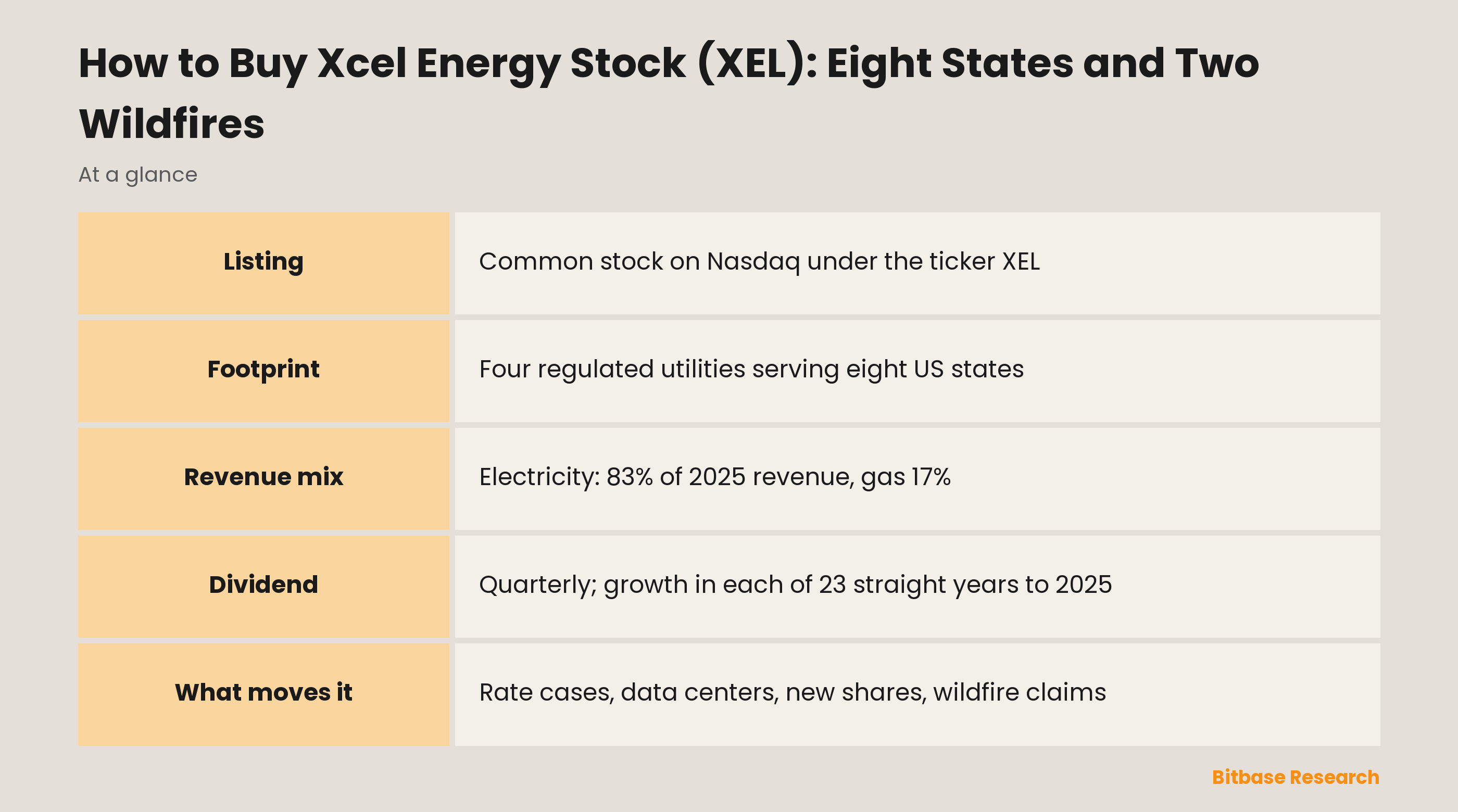
Buying into Xcel Energy takes one order for the ticker XEL at any broker that reaches Nasdaq, where the Minneapolis company's common stock is listed. What the share buys is a holding company whose four regulated utilities sell power across eight states, from Minnesota to the Texas Panhandle, and in 2025 electricity brought in about 83% of its operating revenue. Two wildfires, one in Colorado in 2021 and one in Texas in 2024, still run through its filings, and both appear below with the purchase steps, the dividend and the forces that move the stock.
What Does Xcel Energy Do?
Xcel Energy describes itself as "a major U.S. regulated electric and natural gas delivery company headquartered in Minneapolis, Minnesota." It was incorporated in Minnesota in 1909. Its service area covers parts of Colorado, Michigan, Minnesota, New Mexico, North Dakota, South Dakota, Texas and Wisconsin, and at the end of 2025 it served about 3.9 million electric customers and 2.2 million natural gas customers.
The parent company does not run power plants itself. The work is done by four utility subsidiaries, each regulated by the states where it operates:
| Utility | States | Electric customers | Gas customers |
|---|---|---|---|
| NSP-Minnesota (Northern States Power Company, Minnesota) | Minnesota, North Dakota, South Dakota | 1.6 million | 0.6 million |
| NSP-Wisconsin (Northern States Power Company, Wisconsin) | Wisconsin, Michigan | 0.3 million | 0.1 million |
| PSCo (Public Service Company of Colorado) | Colorado | 1.6 million | 1.5 million |
| SPS (Southwestern Public Service Company) | Texas, New Mexico | 0.4 million | none |
NSP-Minnesota and NSP-Wisconsin run their electric operations as one integrated network, the NSP System.
At the end of 2025 the utilities owned about 20,800 MW of generating capacity and roughly 115,000 conductor miles of transmission lines. Wind capacity, owned and contracted, is about 11,000 MW. NSP-Minnesota runs two nuclear plants, Prairie Island and Monticello, with about 1,700 MW of capacity. The company owns about 9,000 MW of gas-fired plants and about 4,500 MW of coal units, and it plans "to retire or convert to natural gas all of its existing coal generation by the end of 2030." The 10-K estimates that by 2025 carbon emissions from the generation serving its customers were about 58% below 2005 levels, and it keeps a goal of zero-carbon electricity by 2050.
How Xcel Energy Makes Money
A regulated utility earns money in a specific way: state commissions set the rates it may charge, and those rates are meant to cover its costs and give it "an opportunity to earn a reasonable rate of return on invested capital." Profit grows mainly when regulators let new investment into rates.
Xcel reports two segments, and electricity dominates both measures:
| Segment (2025) | Share of operating revenue | Share of segment net income | What it covers |
|---|---|---|---|
| Regulated electric utility | about 83% | about 88% | Generation, transmission, distribution and sale of electricity in all eight states, plus wholesale sales and trading |
| Regulated natural gas utility | about 17% | about 12% | Buying, storing and delivering gas, mainly in Colorado, Minnesota, Wisconsin, Michigan and North Dakota |
Other revenue was well under 1% of the total, and operating revenue rose about 9.1% in 2025.
Fuel is mostly a pass-through. The 10-K says changes in revenue tied to fuel and purchased power, or to gas sold and transported, "generally do not significantly impact earnings," since costs and revenue move together.
In 2025 residential customers were 86% of electric customers but bought 24% of the electricity and paid 32% of electric revenue. Commercial and industrial customers were 12% of customers, took 61% of the volume and paid 49% of the revenue. The 10-K also notes that "the oil and gas industry represents our largest C&I customer base."
By subsidiary, two utilities carry most of the earnings. Of the ongoing earnings per share that the regulated utilities produced in 2025, NSP-Minnesota and PSCo each accounted for about 38%, SPS for about 17% and NSP-Wisconsin for about 7%. "Ongoing" is the company's adjusted measure; in 2025 it excluded the Marshall Fire settlement charge at PSCo, discussed below.
Electricity sales usually peak in summer and gas sales in winter, so results "may fluctuate substantially on a seasonal basis."
XEL Stock at a Glance
| Feature | XEL |
|---|---|
| Exchange | Nasdaq Global Select Market |
| Ticker | XEL, common stock with a par value of 2.50 US dollars per share |
| Other listed security | XELLL, junior subordinated notes due 2085, also on Nasdaq |
| Sector | Regulated electric and natural gas utility |
| Index membership | S&P 500 (in SPY's daily holdings file of 5 November 2026) |
| Headquarters | Minneapolis, Minnesota |
| Incorporated | Minnesota, 1909 |
| Fiscal year | Calendar year, ending 31 December |
| Dividend | Quarterly cash dividend; a dividend reinvestment program is available |
| SEC identifier | CIK 72903 |
Prices, market value and yield change through the trading day; the Xcel Energy stock page on Bitbase shows them live.
How to Buy Xcel Energy Stock
Xcel Energy Inc. is a Minnesota corporation listed at home, so there is no depositary receipt in the chain: the XEL line on Nasdaq is the actual common stock.
1. Pick a broker that can route orders to Nasdaq. Abroad, check which legal entity holds your account and who regulates it.
2. Verify your identity and tax status. Non-US individuals generally complete IRS Form W-8BEN, which the IRS says to submit "when requested by the withholding agent or payer."
3. Fund the account. Currency conversion can cost more than the commission.
4. Search for XEL and read the name. The result should be Xcel Energy Inc. common stock. XELLL is a different security, a long-dated note that pays interest rather than dividends.
5. Choose the order type. According to FINRA, a market order "provides the most certainty that your order will be executed," while a limit order fills only "at or better than a specified price."
6. Decide on whole or fractional shares. Some brokers sell fractions, others limit them to "large-cap stocks or ETFs," and FINRA notes that "as a fractional share owner, you might not have shareholder voting rights."
7. File the records. Confirmations and dividend statements establish your cost basis.
Reinvesting dividends. Xcel runs a dividend reinvestment program; the 10-K says it "allows shareholders to reinvest their dividends directly in Xcel Energy Inc. common stock." Eligibility and terms are in the plan documents.
Withholding on dividends. The IRS states that "most types of U.S. source income received by a foreign person are subject to U.S. tax of 30%," with lower rates available under some tax treaties. Your home country may tax the same dividend, and with a target payout ratio of 45% to 55% of earnings, dividends make up a large part of what an XEL holder receives.
Holding it through a fund. On 5 November 2026 Xcel Energy appeared in the daily holdings files of State Street's SPDR S&P 500 ETF Trust (SPY) and of its Utilities Select Sector SPDR ETF (XLU). XLU also holds peers such as Duke Energy.
What Moves XEL Stock
Rate cases. State commissions set each utility's revenue and allowed return on equity, and two large cases closed in 2026. In July the Minnesota commission issued its order in NSP-Minnesota's electric case, with an allowed return on equity of 9.60%, an equity ratio of 52.5% and increases averaging 2.9% a year over two years; final rates take effect in the first quarter of 2027. In September Colorado regulators decided PSCo's electric case, allowing a 9.3% return on equity and a 54.5% equity ratio, with a total revenue increase of 5.2%. PSCo had asked for 9.8%.
Data centers and large loads. The 10-K cites "rapid growth from AI and data centers, industrial electrification and electric vehicle adoption" in its territories. In the first quarter of 2026 NSP-Minnesota signed an electric service agreement to power a new Google data center in Minnesota, under which Google "will pay all costs for its new service for the duration of the contract"; regulators are expected to decide on it in early 2027. Minnesota approved a large-load tariff in June 2026 that is mandatory for new loads over 100 MW and carries a minimum initial term of 15 years.
Capital spending and new shares. The 2026 to 2030 base plan in the 10-K puts about 48% of its spending into transmission and distribution. Of the planned funding, about half comes from operating cash flow, about 38% from new debt and about 12% from equity issuance. That last part shows up in the share count: common shares outstanding rose about 8.6% during 2025, and diluted weighted average shares in the third quarter of 2026 were about 6% higher than a year earlier. Xcel sells stock through at-the-market programs and forward sale agreements, and in November 2026 it issued convertible senior notes due December 2027. Debt rose to 62% of total capitalization at 30 September 2026, from 59% at the end of 2025.
Interest rates. Higher financing costs partly offset the rise in third-quarter 2026 earnings, which the release attributed mainly to "increased recovery of electric infrastructure investments, earnings on equity method investments and unseasonably warm weather."
Federal energy policy. The tax law signed on 4 July 2025 ends production and investment tax credits for wind and solar facilities placed in service after 2027 if construction begins after 4 July 2026. Federal orders can also delay coal retirements: in December 2025 the Department of Energy ordered the co-owners of Craig Unit 1 in Colorado, Xcel among them, to keep the unit available through 30 March 2026.
Weather. The 10-K says results have historically been weaker "when weather conditions are warmer in the winter and cooler in the summer," except where decoupling offsets it, and it lists changes in wind patterns among its operating risks, a real exposure for a company with this much wind capacity.
Wildfire, Regulatory and Financing Risks at Xcel Energy
These risk factors bear most directly on an XEL share:
Wildfires. "Our utilities have significant risks associated with wildfires," the 10-K says, and "given an extreme event, damage amounts could exceed our coverage (as experienced with the Marshall Wildfire settlement in 2025)." Two fires show what that means:
| Marshall Fire | Smokehouse Creek Fire Complex | |
|---|---|---|
| When and where | 30 December 2021, Boulder County, Colorado | From 26 February 2024, Texas Panhandle |
| Utility involved | PSCo | SPS |
| What the record says | The Boulder County Sheriff's report put the second ignition about 80 to 110 feet from PSCo's power lines | The Texas A&M Forest Service found the fires were caused by SPS power lines after wooden poles failed |
| Status | Settlement agreements reached in September 2025, with no admission of fault; by September 2026 settlements had been executed with all plaintiffs and subrogation insurers | 358 complaints and claims settled; a lawsuit by the Texas Attorney General seeking damages and civil penalties, filed in December 2025, is in discovery expected to run into 2027 |
The Texas fire complex burned about 1,055,000 acres. Xcel's estimate for it excludes possible penalties or fines, exemplary or punitive damages and claims by government entities, and the 10-Q says the remaining claims "could exceed our insurance coverage." Under Texas law, the 10-K explains, a utility's liability for fire damage turns on negligence rather than strict liability, and the company notes that "supportive utility wildfire legislation" passed in Texas and North Dakota in 2025.
Cost recovery. "Our profitability depends on the ability of our utility subsidiaries to recover their costs." Regulators may find costs imprudent, and the 10-K adds that they "may challenge rate increases due to increased customer affordability pressures."
Nuclear operations. The two plants bring radioactive hazards, limited insurance and uncertain decommissioning costs, and "if a nuclear incident did occur, it could have a material impact."
Credit ratings and capital markets. Xcel frequently taps capital markets, and a ratings downgrade "could lead to higher borrowing costs or lower proceeds from equity issuances."
A holding company structure. Xcel Energy Inc. has no operations of its own; its cash comes mainly from dividends paid by its utilities, and federal law bars those utilities from paying dividends out of capital accounts. If the subsidiaries stopped paying, "our ability to pay dividends on our common stock" could suffer.
Beyond the business itself, owning one stock ties your money to a single company. And dividends are decided by the board each quarter: the 10-K describes a long-term objective of annual dividend increases of 4% to 6% and a payout ratio of 45% to 55%, which are aims, not promises. The third-quarter 10-Q reported no material changes to these risk factors.
Reading Xcel Energy's SEC Filings
Xcel files with the SEC under CIK 72903: the 10-K (the one for 2025 was filed on 25 February 2026), quarterly 10-Qs, and 8-Ks when something material happens. In 2026 the quarterly results came with 8-Ks filed on 5 February, 30 April, 30 July and 29 October, and xcelenergy.com posts the same reports free of charge.
In the 10-K, the business section has the subsidiary tables; management's discussion holds the reconciliation from GAAP to ongoing earnings and the financing plan; the note on commitments and contingencies tracks the wildfire cases; and the segment note sets electric beside gas. The equity section of the 10-K compares Xcel's total shareholder return with the S&P 500 and the EEI Investor-Owned Electrics Index, 37 companies at the end of 2025.
Three checks prevent common errors. First, separate GAAP from ongoing earnings: in 2025 the gap was the Marshall Fire charge, and the release explains each adjustment. Second, read rate case outcomes in the 10-Q, not in press headlines, since the 10-Q gives the allowed return and equity ratio. Third, compare like with like: NextEra Energy pairs a Florida utility with a contracted renewables business. For live quotes, use the XEL page linked in the glance section; Bitbase's full list of US stock pages has other companies.
Xcel Energy Stock FAQ
Can I buy Xcel Energy stock with crypto?
Not directly. A broker sells XEL shares for US dollars, so crypto has to be converted to cash and sent to the broker first, and that conversion can be taxable in your country. What you end up holding also differs: a share gives you a claim on dividends and a vote in a registered company, and that is how a share differs from a crypto asset.
Does Xcel Energy pay a dividend?
Yes, a quarterly cash dividend, and the 10-K for 2025 says the company has delivered "dividend growth for 23 consecutive years." Its stated long-term aim is annual increases of 4% to 6%, but each payment is declared by the board, so check the latest 10-Q or earnings release for the current amount.
Is XEL in the S&P 500?
Yes. Xcel Energy was listed in the daily holdings file of SPY, the State Street fund that tracks the S&P 500, on 5 November 2026. Weights change daily.
What is XELLL?
XELLL is the ticker of Xcel Energy's junior subordinated notes due 2085, which are also registered on Nasdaq. They are debt: holders receive interest, not dividends, and have no shareholder votes.
Is Xcel Energy still facing wildfire lawsuits?
For the 2021 Marshall Fire in Colorado, settlements had been executed with all plaintiffs and subrogation insurers by September 2026. For the 2024 Smokehouse Creek Fire Complex in Texas, hundreds of claims are settled but others remain, including the Texas Attorney General's lawsuit, so the matter is still open in the latest 10-Q.
Conclusion
Placing the order is quick: a broker with Nasdaq access, the XEL line for Xcel Energy Inc. common stock, and either a market or a limit order. Judging the share takes longer, because its earnings depend on state regulators, on a capital plan funded partly with new stock, and on how the remaining Texas wildfire claims are resolved. Read the latest 10-K and 10-Q, follow the rate case decisions in Minnesota and Colorado, and decide how much one regulated utility should weigh in your portfolio.
Related reading
Other Bitbase articles on this topic:
- How to Buy Eversource Stock (ES): The Utility, Not the Futures
- How to Buy Exelon Stock (EXC): Six Utilities, No Power Plants
- How to Buy FirstEnergy Stock (FE): Wires, Rate Cases and HB 6
Disclaimer: This article is educational content from Bitbase Academy, provided for information only. It explains what a company or fund does and how the instruments referenced here differ from one another; it does not constitute investment, trading, tax, or financial advice, and it is neither a recommendation nor an endorsement of any security, token, or trading strategy. A tokenized stock is issued by a third party and is designed to give economic exposure to an underlying asset: it is not a share, it carries no shareholder rights, and it depends on the issuer's structure, eligibility rules, and redemption terms, which the issuer can change. Perpetual futures are leveraged derivatives that hold no underlying asset and can be liquidated, and trading hours, product availability, and eligibility differ by instrument and by jurisdiction and can change at any time. Written as of November 2026; verify everything yourself through company filings, the issuer's own documentation, and the product pages of the venue you trade on.
References
[1] Xcel Energy Form 10-K for 2025 (SEC EDGAR) www.sec.gov
[2] Xcel Energy 2025 Form 10-K, XBRL cover page (SEC EDGAR) www.sec.gov
[3] Xcel Energy 2025 Form 10-K, XBRL segment data (SEC EDGAR) www.sec.gov
[4] Xcel Energy Form 10-Q for the third quarter of 2026 (SEC EDGAR) www.sec.gov
[5] Xcel Energy third-quarter 2026 earnings report, filed with Form 8-K (SEC EDGAR) www.sec.gov
[6] Xcel Energy Form 8-K, 5 November 2026: convertible senior notes (SEC EDGAR) www.sec.gov
[7] State Street SPDR S&P 500 ETF Trust (SPY): daily holdings file www.ssga.com
[8] State Street Utilities Select Sector SPDR ETF (XLU): daily holdings file www.ssga.com
[9] FINRA: Order Types www.finra.org
[10] FINRA: Investing in Fractional Shares www.finra.org
[11] IRS: NRA Withholding www.irs.gov
[12] IRS: About Form W-8 BEN www.irs.gov





