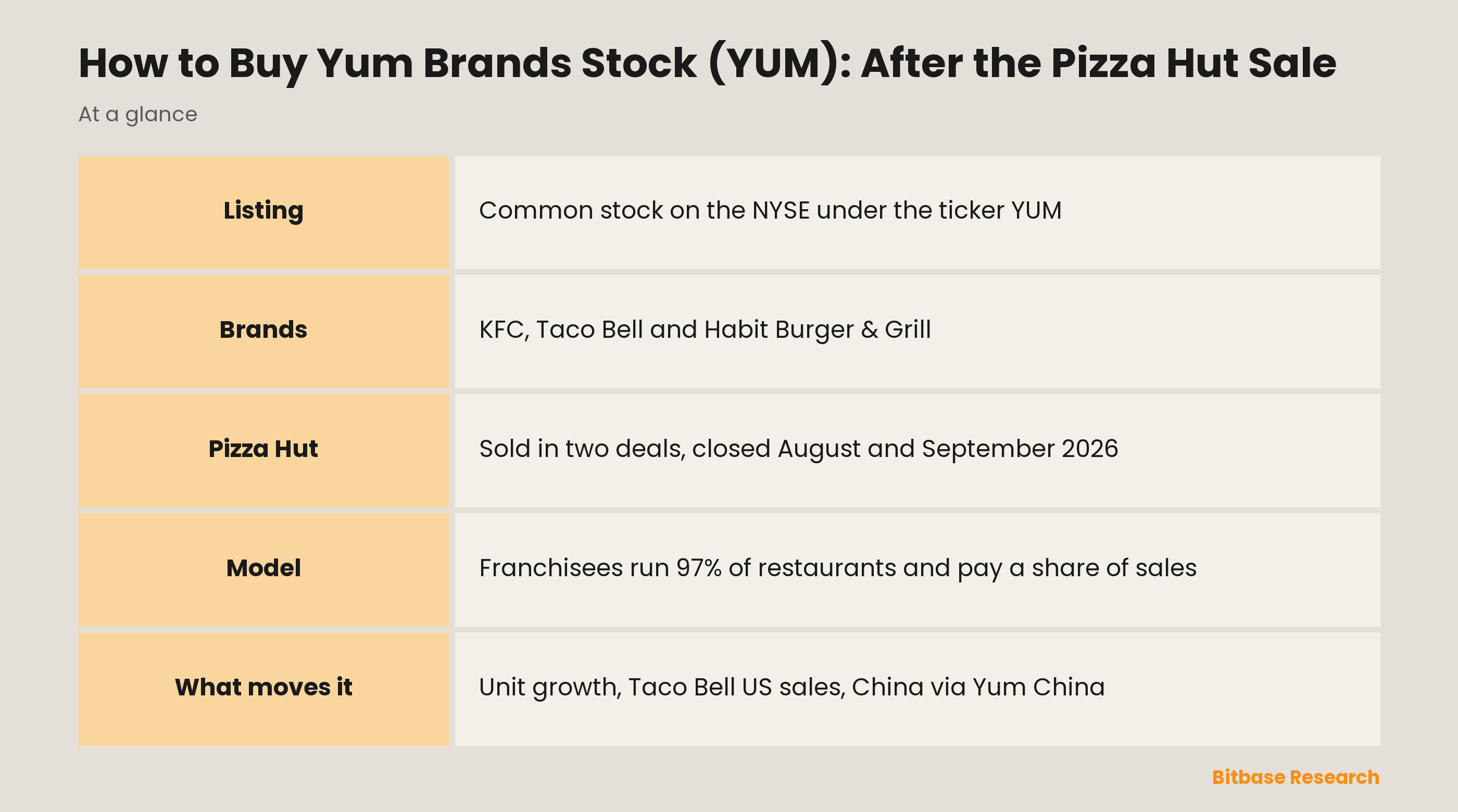
Since the sale of Pizza Hut closed in September 2026, buying Yum Brands stock means buying a KFC and Taco Bell franchisor, and the order goes through any broker that offers US shares: the common stock trades on the New York Stock Exchange under the ticker YUM. Franchisees run 97% of its restaurants, so most of Yum's revenue comes from what they pay it rather than from its own kitchens. Below: the business today, how an order works, and what moves the stock.
What Does Yum Brands Do?
The company's legal name is Yum! Brands, Inc., with an exclamation mark; this guide writes it as Yum Brands. It was incorporated in North Carolina in 1997, called itself Tricon Global Restaurants until 2002, and has its head office in Louisville, Kentucky. Its 10-K adds: "YUM does not directly own or operate any restaurants." Subsidiaries do that, and franchisees run almost everything else.
Today Yum owns three restaurant brands, which it calls Concepts:
KFC was founded in Corbin, Kentucky, by Colonel Harland Sanders, who perfected his blend of 11 herbs and spices in 1939 and signed his first franchisee in 1952. It is by far the most international brand: at the end of 2025, 90% of KFC units were outside the US, spread over 149 countries and territories, and 99% were franchised.
Taco Bell opened its first restaurant in Downey, California, in 1962 and sold its first franchise in 1964. It is the reverse of KFC: only 14% of its units were outside the US at the end of 2025, and 93% were franchised.
Habit Burger & Grill, a fast-casual chain founded in Santa Barbara in 1969, makes chargrilled burgers to order. It is small and mostly company-run: 22% of its units were franchised at the end of 2025.
Until 2026 there was a fourth brand. Yum began reviewing options for Pizza Hut in November 2025 and agreed in June 2026 to sell it in two pieces. The business in mainland China went to Yum China Holdings on 7 August 2026, and the rest of the world went to LongRange Capital on 1 September 2026, with an earn-out that depends on how Pizza Hut performs in later years. Since then Yum has reported three segments, and its third-quarter 10-Q counts "over 44,000 restaurants in more than 150 countries and territories." Yum still supplies Byte by Yum!, its technology platform for ordering, kitchens and delivery, to the Pizza Hut business it sold.
Yum China is the other name to know. Yum spun off its China business as a separate listed company on 31 October 2016, and that company remains Yum's master franchisee for KFC and Taco Bell in mainland China.
How Yum Brands Makes Money
Yum's revenue comes in three streams. In 2025 company-run restaurant sales made up 36% of revenue, franchise and property revenues 42%, and franchisees' contributions for advertising and other services 22%. The last is money franchisees pay in for marketing and services.
The franchise stream is the core of the model. Store-level franchisees pay upfront fees, then "monthly continuing fees based on a percentage of their restaurants' sales (typically between 4% to 6%)." About 40% of franchised units operate under master franchise programs, where a large operator develops a territory and sub-franchises restaurants. The biggest is Yum China, which pays a 3% fee on system sales of Yum's brands in mainland China.
By segment, the 2025 figures, the last full year that still included Pizza Hut, looked like this:
| Segment | Share of 2025 revenue | Share of 2025 division operating profit | Ownership after 2026 |
|---|---|---|---|
| KFC | 43% | 51% | Kept |
| Taco Bell | 38% | 38% | Kept |
| Pizza Hut | 12% | 11% | Sold in August and September 2026 |
| Habit Burger & Grill | 7% | Operating loss | Kept |
Division operating profit is the sum of the four segments before corporate costs. Take Pizza Hut out of the 2025 numbers and KFC and Taco Bell together made up about 92% of the remaining division revenue.
Total revenue rose 8.8% in 2025. By customer location, the United States produced about 55% of it and the United Kingdom about 12%. System sales, a different measure, count the sales of every restaurant, franchised or not; in 2025 KFC accounted for 53% of them, Taco Bell for 27% and Pizza Hut for 19%.
Because fees are a percentage of sales, Yum's revenue tracks franchisees' sales rather than their profits. And because so few restaurants are company-run, franchisees pay most of the cost of growth: the 10-K says they "supply capital by purchasing or leasing the land, building, equipment, signs, seating, inventories and supplies."
Digital orders are a growing share. In 2025 system restaurants generated digital sales approaching 60% of overall system sales, and in the third quarter of 2026, excluding Pizza Hut, the digital mix reached 64%.
YUM Stock at a Glance
| Feature | YUM |
|---|---|
| Exchange | New York Stock Exchange |
| Ticker | YUM |
| Security | Common stock, no par value, the only class registered under Section 12(b) |
| Sector | Restaurants: franchising of quick-service brands |
| Brands | KFC, Taco Bell, Habit Burger & Grill |
| Index membership | S&P 500 |
| Headquarters | Louisville, Kentucky |
| Incorporated | North Carolina, 1997 |
| Fiscal year | Calendar year, ending 31 December |
| Payouts | Quarterly cash dividend, plus share repurchases |
| SEC identifier | CIK 1041061 |
The table leaves out what moves with each trade, such as price, market value and dividend yield; the Yum Brands stock page on Bitbase shows them live.
How to Buy Yum Brands Stock
Yum is a North Carolina corporation listed in New York, so there is no depositary receipt in between: what trades under YUM is the common stock itself, bought in six steps:
1. Choose a broker that reaches the NYSE. Abroad, check which legal entity holds your account and who regulates it.
2. Open the account and pass verification. Investors outside the US usually certify their status on IRS Form W-8BEN, which the IRS says to submit "when requested by the withholding agent or payer."
3. Fund it. If your money is in another currency, converting it costs something too: look at the exchange rate, not only the commission.
4. Find the right line. Search YUM and check that the result reads Yum! Brands, Inc. common stock on the NYSE, not Yum China, which has its own ticker, YUMC.
5. Choose an order type. FINRA says a market order "provides the most certainty that your order will be executed," while a limit order executes only "at or better than a specified price."
6. Decide on size. Fractional shares let you invest a fixed sum, but some firms offer them only for "large-cap stocks or ETFs" or not at all, and "as a fractional share owner, you might not have shareholder voting rights."
Taxes for investors abroad. The IRS states that "most types of U.S. source income received by a foreign person are subject to U.S. tax of 30%," and a tax treaty can lower that rate or remove it, which is why the broker asks for the W-8BEN. Your home country may tax the same dividends again.
Through index funds. YUM is in the S&P 500, so funds tracking that index, such as State Street's SPY, hold it as one position among many.
What Moves YUM Stock
Unit growth. New restaurants are the main engine of a franchisor, and Yum publishes a long-term target first set in 2022: 5% unit growth, 7% system sales growth excluding currency, and at least 8% core operating profit growth, on average over time. In the third quarter of 2026, units excluding Pizza Hut grew 7%, and KFC opened 878 gross new restaurants across 66 countries.
Same-store sales at Taco Bell US. Taco Bell is mostly an American business, and in 2025 its US restaurants produced 43% of Yum's company-run restaurant sales. In the third quarter of 2026 Taco Bell's same-store sales fell 4%, against a 7% rise a year earlier, while Taco Bell's international same-store sales grew 5%. The CEO, Chris Turner, said Taco Bell US had been "outpacing the QSR industry on same-store sales growth" since the end of September.
KFC around the world. In 2025 China made up 26% of KFC system sales, Europe 13% and the United States 12%. In the third quarter of 2026 KFC's same-store sales grew 1% and its unit count 7%.
China through Yum China. Yum's income from mainland China arrives as a license fee from Yum China. When Pizza Hut China was sold, the two companies also amended their master license agreement so that Yum China can earn incentives tied to KFC system sales growth targets over the next 12 years, and agreed to work on long-term growth plans for Taco Bell in mainland China.
Food safety. Yum's risk factors list Cyclospora among the pathogens behind food-borne illnesses, which they say "have occurred and may occur within our system from time to time," and its third-quarter 2026 release lists among its forward-looking factors "the impact of the July 2026 cyclospora outbreak" and its effect "on sales and pace of recovery." The release does not tie the outbreak to a brand.
Capital returns after the sale. When it agreed to sell Pizza Hut, the board approved an additional share repurchase authorization, and the company says the net proceeds go to investing in the business and "returning excess capital to shareholders." The number of shares issued fell by about 3% in the first nine months of 2026.
Franchisees, China Fees and Debt at Yum Brands
These items from the 10-K's Item 1A bear most directly on a YUM share.
Franchisee health. "The vast majority (97%) of our restaurants are operated by our Concepts' franchisees," and Yum has "limited control over how our Concepts' franchisees' businesses are run." If they struggle, royalties and unit growth suffer.
China exposure. "A meaningful portion of our total business, particularly with respect to our KFC Concept, is conducted in mainland China through our largest franchisee, Yum China." US-China relations, Chinese law and currency controls are listed as risks to the license fee.
Currency. A stronger US dollar lowers the value of royalties paid in the renminbi, the pound, the euro and other currencies.
Debt. "Our level of indebtedness makes us more sensitive to adverse economic conditions." The balance sheet carried a total shareholders' deficit at 30 September 2026, meaning total liabilities exceeded total assets.
Food safety and changing tastes. The filing names food-borne illness, avian flu that could make customers wary of chicken, and "the increased adoption of weight loss medications" among the forces that can cut demand.
Technology and labor. A ransomware attack announced on 18 January 2023 closed fewer than 300 restaurants in one market for one day, and the filing also cites rising labor costs.
Beyond the business itself, holding one stock concentrates your money in one company, and dividends carry no promise: future dividend decisions are "at the discretion of the Company's Board of Directors."
Where to Check Yum Brands' Numbers
Yum files with the SEC under CIK 1041061: the 10-K, a 10-Q for each of the first three quarters, and 8-Ks for events, including each earnings release (in 2026: 4 February, 29 April, 30 July and 3 November).
Read 2026 with care. The third-quarter 10-Q and release include Pizza Hut up to the sale dates and a large one-time gain on the sale, so reported growth looks very different from the underlying business. The release also gives figures excluding Pizza Hut and what it calls Special Items, with reconciliation tables.
In the 10-K, Item 1 has the brand table and franchise terms, Item 1A the risks, and Item 5 the dividend, buybacks and a comparison of Yum's shareholder return with the S&P 500 and the S&P 500 Consumer Discretionary index. The segment note puts each brand's revenue and operating profit in one table.
Two other restaurant companies are covered in our McDonald's stock guide and our Starbucks stock guide. Live YUM quotes are on the stock page linked above, and Bitbase's full list of US stock pages leads to other listed companies.
Yum Brands Stock FAQ
Can I buy Yum Brands stock with crypto?
Not directly. A brokerage account buys YUM in US dollars, which means selling the crypto first, sending the cash to the broker, and checking whether that sale is taxable where you live. The two are different things: a share is ownership in a registered company with dividend and voting rights, which is how a share differs from a crypto asset.
Does Yum Brands still own Pizza Hut?
No. Yum sold Pizza Hut in mainland China to Yum China on 7 August 2026 and the rest of Pizza Hut to LongRange Capital on 1 September 2026. It keeps KFC, Taco Bell and Habit Burger & Grill, and still provides its Byte by Yum! technology platform to Pizza Hut outside mainland China.
Does Yum Brands pay a dividend?
Yes. Yum paid four quarterly cash dividends in 2025 and raised the quarterly amount in February 2026. Future payments are at the board's discretion; the current amount is in the most recent earnings release and 10-Q.
Is Yum Brands the same company as Yum China?
No. Yum China Holdings was spun off from Yum on 31 October 2016 and is a separate listed company with its own ticker, YUMC. It is Yum's largest franchisee and runs KFC and Taco Bell in mainland China under license, paying Yum a fee on sales.
Is YUM in the S&P 500?
Yes. State Street's daily file for SPY, a fund that tracks the S&P 500, listed Yum Brands among its holdings on 6 November 2026.
Conclusion
A percentage of franchisees' sales is now most of what Yum earns: since September 2026 it has been a franchisor of KFC and Taco Bell plus a small burger chain. It also carries a large exposure to China through Yum China and a balance sheet whose liabilities exceed its assets, and both matter more than the few minutes the order takes. Before deciding how large a position one restaurant company deserves, read the newest 10-K and quarterly release, and keep the Pizza Hut years apart when you compare growth.
Related reading
Other Bitbase articles on this topic:
- How to Buy Ford Stock (F): One Letter, Family Votes and EV Reset
- How to Buy Honda Stock (HMC): Motorcycle Profits and an EV Reset
- How to Buy IHG Stock (IHG): Holiday Inn Fees and a One-Share ADS
Disclaimer: This article is educational content from Bitbase Academy, provided for information only. It explains what a company or fund does and how the instruments referenced here differ from one another; it does not constitute investment, trading, tax, or financial advice, and it is neither a recommendation nor an endorsement of any security, token, or trading strategy. A tokenized stock is issued by a third party and is designed to give economic exposure to an underlying asset: it is not a share, it carries no shareholder rights, and it depends on the issuer's structure, eligibility rules, and redemption terms, which the issuer can change. Perpetual futures are leveraged derivatives that hold no underlying asset and can be liquidated, and trading hours, product availability, and eligibility differ by instrument and by jurisdiction and can change at any time. Written as of November 2026; verify everything yourself through company filings, the issuer's own documentation, and the product pages of the venue you trade on.
References
[1] Yum! Brands Form 10-K for 2025 (SEC EDGAR) www.sec.gov
[2] Yum! Brands 2025 Form 10-K, XBRL cover page (SEC EDGAR) www.sec.gov
[3] Yum! Brands 2025 Form 10-K, XBRL segment details (SEC EDGAR) www.sec.gov
[4] Yum! Brands Form 10-Q for the third quarter of 2026 (SEC EDGAR) www.sec.gov
[5] Yum! Brands third-quarter 2026 results release, Form 8-K (SEC EDGAR) www.sec.gov
[6] Yum! Brands release on agreements to sell Pizza Hut, Form 8-K, 16 June 2026 (SEC EDGAR) www.sec.gov
[7] Yum! Brands Form 8-K on the sale of Pizza Hut China and the amended license agreement, 7 August 2026 (SEC EDGAR) www.sec.gov
[8] Yum! Brands release on completing the sale of Pizza Hut, Form 8-K, 1 September 2026 (SEC EDGAR) www.sec.gov
[9] SEC EDGAR filer record for Yum! Brands, including former names data.sec.gov
[10] State Street, SPY daily holdings www.ssga.com
[11] FINRA: Types of Orders www.finra.org
[12] FINRA: Investing in Fractional Shares www.finra.org
[13] IRS: NRA Withholding www.irs.gov
[14] IRS: About Form W-8 BEN www.irs.gov





