
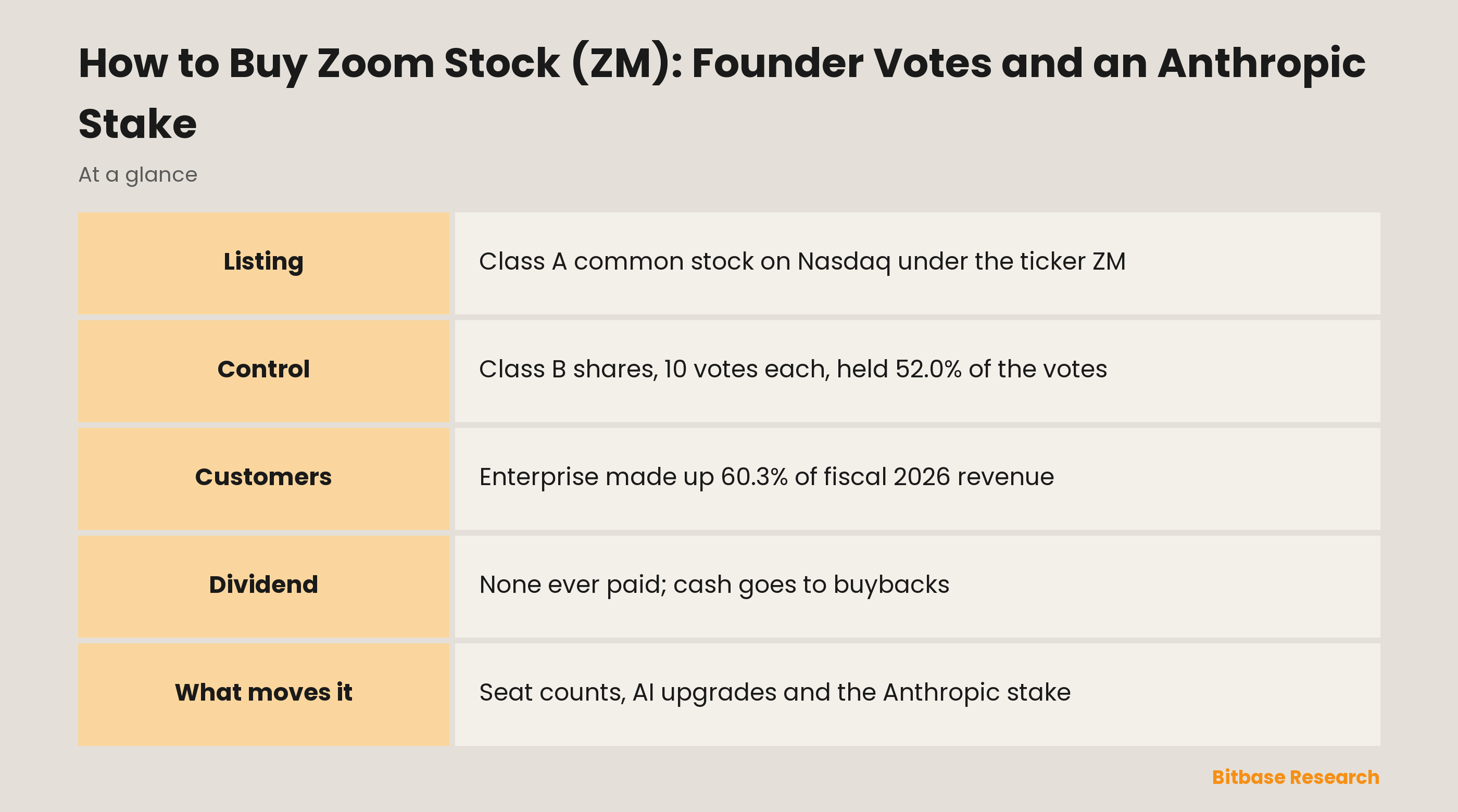
You become a Zoom shareholder by buying its Class A common stock, which trades on the Nasdaq Global Select Market under the ticker ZM, through any broker that offers US shares. The company behind the video meetings app went public in April 2019, saw revenue jump 326% in the pandemic year to January 2021 and now grows in single digits, while unlisted Class B shares with 10 votes each still control just over half of the votes. Its latest quarter added a twist of a different kind: gains on a stake in the AI developer Anthropic pushed net income above revenue.
What Does Zoom Do?
Zoom sells cloud software for talking and working together. Its annual report describes the company as "redefining modern work as a system of action, turning live collaboration into completed results." The products fall into two families. Zoom Workplace covers tools employees use with one another: Meetings, Phone, Team Chat, Docs, Whiteboard, Clips, the Zoom Rooms conference-room software and Workvivo, an employee communication platform. Zoom Business Services faces a customer's own clients: Zoom Contact Center, the Zoom Virtual Agent chat and voice bot, the Revenue Accelerator analytics tool for sales teams, and Zoom Events and Webinars.
Meetings remain the entry point. Free users bring others into calls, and the 10-K pairs this lead-generation model with direct sales, resellers and online sign-ups to move accounts onto paid plans. Zoom Phone, a cloud replacement for the office switchboard, had native links to the public telephone network in more than 45 countries and territories on 31 January 2026.
AI now runs across the lineup. Zoom AI Companion, launched in September 2023, writes meeting summaries, drafts chat replies and assists contact-center agents; it comes at no additional cost with eligible paid plans and is also sold on its own. Zoom routes tasks between its own models and third-party ones, including models from OpenAI, Anthropic and NVIDIA, and says it does not use customer audio, video or chat to train them. In the quarter to July 2026 it added ZoomMate, an assistant that carries meeting context into follow-up work. Acquisitions widen the platform: BrightHire, a recruiting tool, in December 2025 and Common Room, which gathers buyer signals for sales teams, on 17 July 2026.
The company was incorporated in Delaware in April 2011 as Saasbee, Inc., became Zoom Communications in February 2012 and Zoom Video Communications three months later, the name it carried through its IPO. On 25 November 2024 it switched back to Zoom Communications, Inc., keeping the ZM ticker. Founder Eric S. Yuan is president and chief executive, and headquarters are in San Jose, California.
No single customer accounted for more than 10% of revenue in fiscal 2026. The rivals named in the 10-K include Cisco Webex and GoTo, Microsoft 365 with Teams and Google Workspace with Meet, RingCentral and 8x8 in cloud telephony, and Five9, Genesys and NICE in contact centers. Webex's owner is covered in our Cisco stock guide.
How Zoom Makes Money
Almost all revenue comes from subscriptions; services such as consulting and event hosting are a small extra. Zoom reports one business but tracks two kinds of customer. Enterprise customers are business units reached by its sales team, resellers or partners. Online customers sign up through the website, from individuals to small firms. Fiscal years end on 31 January, so fiscal 2026 is the twelve months to 31 January 2026.
| Measure (fiscal year to 31 January) | 2024 | 2025 | 2026 |
|---|---|---|---|
| Enterprise share of revenue | 57.9% | 59.0% | 60.3% |
| Online share of revenue | 42.1% | 41.0% | 39.7% |
| Revenue growth | n/a | 3.1% | 4.4% |
| Net dollar expansion rate, Enterprise | 101% | 98% | 98% |
| Online average monthly churn | 3.1% | 2.9% | 2.8% |
| Revenue from outside the Americas | 28.7% | 28.2% | 27.9% |
Enterprise subscription revenue grew 6.5% in fiscal 2026, with 68.4% of the increase coming from existing customers, while Online revenue rose only 1.2%. The net dollar expansion rate compares what the same Enterprise customers pay now with a year earlier; below 100% means seat cuts and cancellations outweighed upgrades, which the 10-K ties to "slower hiring and higher seat count downsells." Customers above the company's six-figure annual spending threshold produced 32.8% of revenue, up from 29.2% two years earlier. By billing address, the Americas supplied 72.1% of revenue.
The business is profitable on standard accounting. Gross margin was 77.0% in fiscal 2026 and income from operations 23.1% of revenue, helped by stock-based pay falling from about 23% of revenue in fiscal 2024 to about 16%. Net income reached 39.0% of revenue, but much of it came from below the operating line: gains on strategic investments equalled 19.9% of revenue, "primarily driven by changes in the fair value of our privately held securities."
ZM Stock at a Glance
| Item | Detail |
|---|---|
| Exchange | Nasdaq Global Select Market |
| Ticker | ZM |
| Listed class | Class A common stock, one vote per share |
| Unlisted class | Class B common stock, 10 votes per share |
| Legal name | Zoom Communications, Inc. (Zoom Video Communications, Inc. until November 2024) |
| Incorporated | Delaware, April 2011 |
| Headquarters | San Jose, California |
| Listed since | April 2019 initial public offering |
| Fiscal year end | 31 January |
| Industry | Video meetings, cloud phone, contact center and collaboration software |
| Dividend | Never declared or paid |
| Buybacks | Class A repurchase program authorized in February 2024, enlarged in November 2024 and November 2025 |
| Index funds | Not held by SPY (S&P 500) or QQQ (Nasdaq-100) on 10 November 2026 |
| SEC identifier | CIK 1585521 |
Prices, trading volume and market value change all day; follow them on the Zoom stock page on Bitbase.
How to Buy Zoom Stock
Zoom is a Delaware corporation and ZM is its own common stock, not a depositary receipt, so a buyer anywhere gets the same security US investors hold:
1. Find a broker that reaches Nasdaq, and check which legal entity holds your account and who supervises it.
2. Pass the onboarding checks. Non-US residents are usually asked for IRS Form W-8BEN, which the IRS says to submit "when requested by the withholding agent or payer."
3. Fund the account. Paying in euros, pounds, yen or another currency means a conversion, and the exchange rate can cost more than the commission.
4. Search for ZM. The line should read Zoom Communications Class A common stock; older charts may still show the pre-2024 name.
5. Choose the order type. FINRA says a market order "provides the most certainty that your order will be executed," while a limit order fills only "at or better than a specified price."
6. Decide on whole or fractional shares. FINRA notes that some firms offer fractions only for "large-cap stocks or ETFs" and that "as a fractional share owner, you might not have shareholder voting rights."
Taxes abroad. The IRS says "most types of U.S. source income received by a foreign person are subject to U.S. tax of 30%," with lower rates possible under a tax treaty. Dividends are the usual example, and Zoom pays none, so for most foreign holders the question is how their own country taxes a gain on sale. This is general information, not tax advice.
Through funds. ZM was not among the holdings of SPY or QQQ on 10 November 2026. Broader total-market or software funds may hold it; search the fund's current holdings file for Zoom before relying on that.
What Moves ZM Stock
Enterprise growth against the Online drag. In the quarter to July 2026, Enterprise revenue rose 7.8%, which Yuan called "its strongest growth rate in three years," while Online revenue grew 0.6% and the total 4.9%.
Seat counts. The Enterprise net dollar expansion rate edged up to 99% at 31 July 2026 from 98% a year earlier. A return above 100% would mean existing customers were adding more than they cut.
Whether AI earns revenue. AI Companion comes free with eligible paid plans, so it mainly has to win upgrades and keep customers; Custom AI Companion is an add-on and the customer-experience products are sold separately. Yuan said the Zoom Virtual Agent customer count rose 256% year over year in that quarter.
The Anthropic stake. At 31 July 2026, preferred stock of Anthropic made up about 83% of Zoom's privately held securities. Zoom revalues such holdings when there are observable transactions, and in the quarter to July 2026 it booked unrealized gains on the stake based in part on a financing round Anthropic announced on 28 May 2026, which is why quarterly net income exceeded revenue. The 10-Q warns that valuation changes "could result in material gains or losses," so GAAP earnings per share can swing for reasons unrelated to meetings or phones; Zoom's non-GAAP net income excludes these gains.
Buybacks and dilution. Repurchased Class A shares are retired; about 44.2 million had been bought back under the current program by the end of July 2026.
Bundled rivals. Microsoft includes Teams in Microsoft 365 and Google includes Meet in Workspace, so suite consolidation by large customers reaches Zoom directly.
Seat Cuts, Bundled Rivals and Other Zoom Risks
These points from the risk factors in the 10-K bear most directly on a ZM holder.
Renewals. "Customers are not obligated to, and may choose not to, renew their subscriptions after their existing subscriptions expire," and the 10-K says cuts become more likely when IT budgets tighten.
Slowing growth. "Our revenue growth rate has fluctuated in prior periods, and may decline in future periods." With growth of 3.1% and 4.4% in the last two fiscal years, even small changes in the rate draw attention.
Outages and security. Interruptions at its data centers or cloud hosts "would impair, and in the past have impaired, the delivery of our services," and Zoom says its security measures "have been compromised in the past and may be compromised in the future."
China and government inquiries. "A significant portion of our research and development organization resides in China," the company states, and restrictions there could slow product work. In June 2020 it received a grand jury subpoena from federal prosecutors in the Eastern District of New York about its dealings with foreign governments, including the Chinese government, and about user data. The SEC closed its own inquiry in July 2025 without recommending enforcement, and prosecutors in Northern California closed theirs on 17 August 2026; the New York inquiry was still open in the latest 10-Q.
Founder control. Class B shares held 52.0% of the voting power at 31 July 2026. Yuan and his affiliates owned about 7.1% of the stock but about 37.7% of the votes, and because transferred Class B shares convert to Class A, the filing says he "could, in the future, control a majority of the combined voting power." Class B converts to one vote per share at the earliest of several triggers, including six months after Yuan stops providing services and the 15th anniversary of the April 2019 IPO closing.
Private valuations. The Anthropic stake that lifted earnings can also cut them: a lower funding round or an impairment would flow through net income.
Single-stock exposure. No dividend cushion and one company's results: owning ZM is a concentrated bet on Zoom alone.
How to Research ZM Yourself
Zoom files with the SEC under CIK 1585521. The 10-K for the year to 31 January 2026 was filed on 27 February 2026; results arrive in 8-K filings, which came on 25 February, 21 May and 25 August in 2026, followed by 10-Qs. Filings before November 2024 carry the Zoom Video Communications name, and the same documents sit at investors.zoom.us.
The key business metrics section of the MD&A gives the Enterprise and Online split, net dollar expansion and churn. The strategic investments note and each 10-Q's market-risk section show the size of the Anthropic position. The legal proceedings note tracks the government inquiries, and the proxy statement filed on 30 April 2026 covers the board and voting structure. Zoom Meetings integrates with ServiceNow among others, a platform covered in our ServiceNow buying guide; all US stock pages on Bitbase list quotes for other companies.
Zoom Stock FAQ
Can I buy Zoom stock with crypto?
Not directly. ZM shares are bought through a brokerage account funded in cash, so crypto has to be sold first and the proceeds moved to the broker, a sale that may be taxable where you live. The routes from coins to shares are explained in buying stocks with crypto.
Does Zoom pay a dividend?
No. The 10-K states: "We have never declared or paid any cash dividends on our capital stock," and the company does "not expect to pay any dividends in the foreseeable future." It returns cash through Class A share repurchases instead.
Did Zoom change its name?
Yes. Zoom Video Communications, Inc. became Zoom Communications, Inc. on 25 November 2024. The ticker stayed ZM and the shares did not change. The company had used the Zoom Communications name once before, from February to May 2012.
Is Zoom in the S&P 500 or the Nasdaq-100?
No. Zoom did not appear in the 10 November 2026 holdings of State Street's SPY, which tracks the S&P 500, or Invesco's QQQ, which tracks the Nasdaq-100. Membership can change, so check a current holdings list.
Conclusion
Zoom has turned from a pandemic sensation into a steady subscription business whose Enterprise side is growing again while its Online base stands still. Two things set ZM apart from other software listings: a founder-controlled share structure that leaves Class A holders with limited say, and reported earnings that now move with the private valuation of Anthropic. Before buying, read how the latest 10-Q describes seat trends, AI revenue and that investment, and size the position for a company whose profit can swing with an asset it does not run.
Related reading
Other Bitbase articles on this topic:
- How to Buy Nebius Stock (NBIS): AI Cloud, Ex-Yandex and Perps
- How to Buy Okta Stock (OKTA): Auth0, AI Agents and Class B Votes
- How to Buy PayPal Stock (PYPL): Venmo, Braintree and a Dividend
Disclaimer: This article is educational content from Bitbase Academy, provided for information only. It explains what a company or fund does and how the instruments referenced here differ from one another; it does not constitute investment, trading, tax, or financial advice, and it is neither a recommendation nor an endorsement of any security, token, or trading strategy. A tokenized stock is issued by a third party and is designed to give economic exposure to an underlying asset: it is not a share, it carries no shareholder rights, and it depends on the issuer's structure, eligibility rules, and redemption terms, which the issuer can change. Perpetual futures are leveraged derivatives that hold no underlying asset and can be liquidated, and trading hours, product availability, and eligibility differ by instrument and by jurisdiction and can change at any time. Written as of November 2026; verify everything yourself through company filings, the issuer's own documentation, and the product pages of the venue you trade on.
References
[1] Zoom Communications Form 10-K for fiscal 2026 (SEC EDGAR) www.sec.gov
[2] Zoom fiscal 2026 Form 10-K, XBRL cover page (SEC EDGAR) www.sec.gov
[3] Zoom Form 10-Q for the quarter ended 31 July 2026 (SEC EDGAR) www.sec.gov
[4] Zoom second-quarter fiscal 2027 results release, Exhibit 99.1 to Form 8-K (SEC EDGAR) www.sec.gov
[5] Zoom Form 8-K of 25 November 2024: name change to Zoom Communications (SEC EDGAR) www.sec.gov
[6] Zoom Video Communications Form 10-K for fiscal 2021 (SEC EDGAR) www.sec.gov
[7] Zoom Form 8-K of 23 April 2019 on the closing of its IPO (SEC EDGAR) www.sec.gov
[8] State Street SPDR S&P 500 ETF Trust (SPY): fund page and daily holdings www.ssga.com
[9] Invesco QQQ: fund overview www.invesco.com
[10] FINRA: Order Types www.finra.org
[11] FINRA: Investing in Fractional Shares www.finra.org
[12] IRS: NRA Withholding www.irs.gov
[13] IRS: About Form W-8 BEN www.irs.gov





