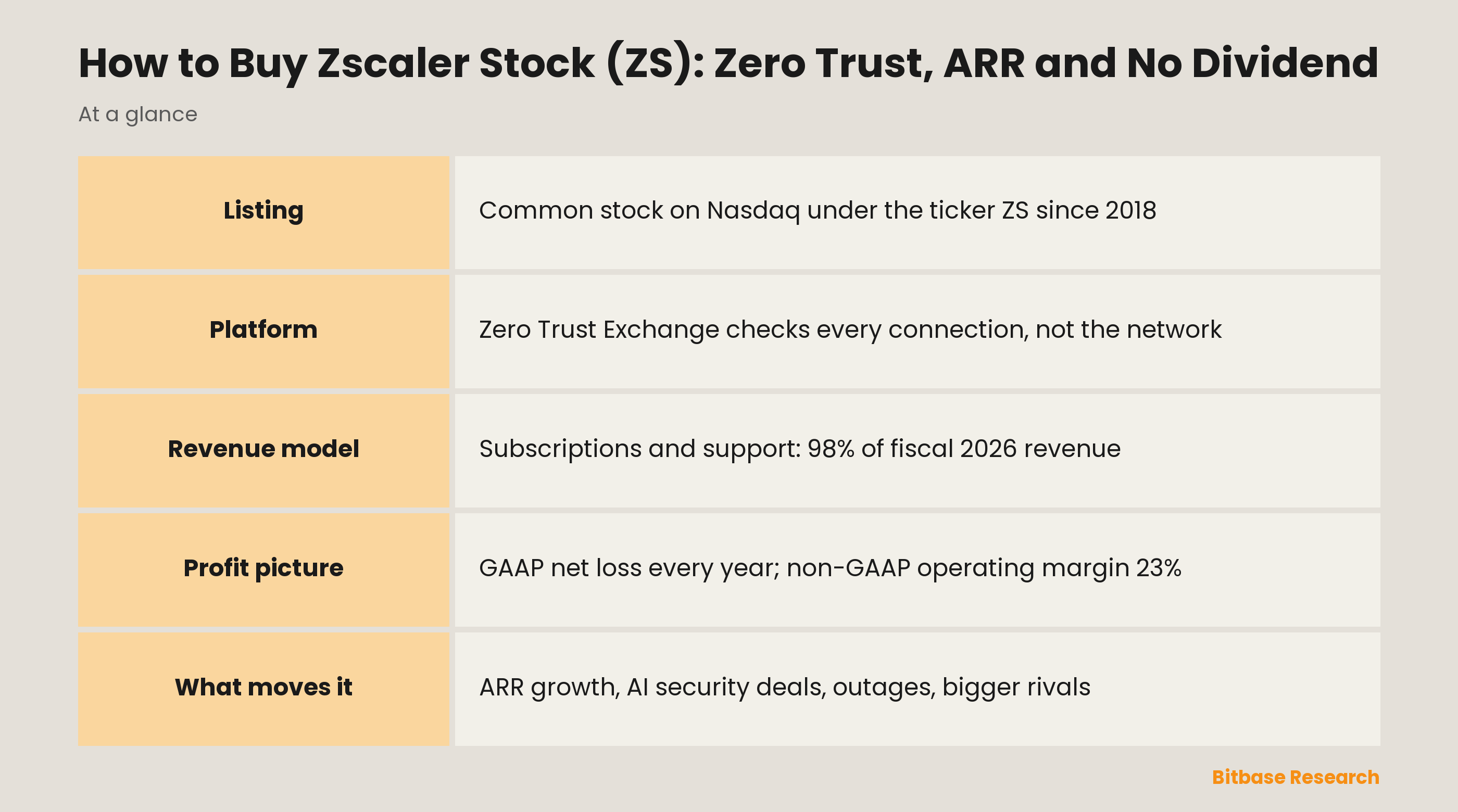
Anyone looking to own a piece of Zscaler can do it through a brokerage account that reaches Nasdaq, where the company's common stock has traded under the ticker ZS since 16 March 2018. In fiscal 2026, the year to 31 July, subscriptions and support made up 98% of its revenue and channel partners placed 85% of sales, yet the company still reported a GAAP net loss, as it has in every annual period since its founding. Below: what the Zero Trust Exchange does, how an order works, and the numbers and risks Zscaler's own filings point to.
What Does Zscaler Do?
Zscaler sells security delivered from the cloud to large organizations. Its 10-K opens with "We are the cybersecurity platform for the AI era," and traces the company to a 2007 bet that "the internet would become the new corporate network, the cloud would become the new data center and perimeter-based security would fail to protect users, applications and data." It was incorporated in Delaware in September 2007 as SafeChannel, Inc. and took the Zscaler name in August 2008. Jay Chaudhry, the founder, is chief executive officer and chairman.
The central product is the Zero Trust Exchange. A firewall and a VPN put an employee onto the corporate network and then trust much of the traffic inside it. Zscaler instead checks identity, device posture and business policy on every connection, and links each user, device, workload or AI agent only to the application or data it is allowed to reach, a principle the filing calls "never trust and always verify." Because applications stay hidden from the internet, the company argues, an intruder who compromises one laptop cannot move sideways through the network.
The 10-K sorts the products into four pillars:
| Pillar | What it covers | Products named in the 10-K |
|---|---|---|
| Zero Trust SASE | Secure connections for users, branches, clouds and devices | Zscaler Internet Access (ZIA), Zscaler Private Access (ZPA), Zero Trust Branch, Zero Trust Cloud, Zero Trust Browser |
| Security for AI | Finding, governing and protecting AI apps, models and agents | AI Asset Management, Secure Access to AI, AI Gateway |
| Data Security | Keeping sensitive data from leaking across web, SaaS, cloud and endpoints | Data loss prevention, SaaS Security, Data Security Posture Management |
| Agentic Security Operations | Spotting exposures and handling incidents | Deception, Managed Detection and Response, Agentic SOC |
It all runs on one network of more than 200 public data centers plus thousands of private edge sites, reaching users in over 185 countries; the company says it processes over 750 billion transactions a day. As of 31 July 2026 Zscaler counted about 11,000 customers, including over 40% of the Forbes Global 2000 and over 50% of the Fortune 500, and employed more than 8,700 people.
Fiscal 2026 brought four acquisitions. Red Canary, a managed detection and response technology company, joined on 1 August 2025, the first day of the fiscal year. SPLX and Symmetry Systems were bought to extend AI security, and SquareX to extend browser protection.
How Zscaler Makes Money
Zscaler reports a single segment and earns almost everything from subscriptions, priced "primarily ... on a per-user and metered-usage basis." Subscription and support accounted for 98% of fiscal 2026 revenue; the rest came from professional services such as implementation and training. Contracts generally run one to five years and are recognized evenly across the term, so a large deal reaches revenue in slices.
Most sales pass through intermediaries: telecommunications carriers, system integrators, resellers and cloud marketplaces. Channel partners accounted for 85% of revenue in fiscal 2026, down from 91% in fiscal 2024, while direct customers rose to 15%. The five biggest partners and their affiliates alone made up 31%. "Although we have a channel sales model, we use a joint sales approach," the 10-K says, and end customers generally sign a subscription agreement with Zscaler itself. No end customer exceeded 10% of revenue in any of the last three years.
| Fiscal 2026 measure | Reading | Context |
|---|---|---|
| Revenue growth | 25% | 23% in fiscal 2025 |
| Revenue growth without Red Canary | 20% | Per the earnings release |
| ARR growth | 25% | Measured at 31 July 2026 |
| Revenue from the United States | 53% | EMEA 28%, Asia Pacific 15%, other 4% |
| GAAP gross margin | 77% | Non-GAAP: 80% |
| GAAP operating result | Loss of about 4% of revenue | Non-GAAP operating margin: 23% |
Existing customers drove most of the growth: about 70% of the fiscal 2026 revenue increase came from more users and added subscriptions at accounts Zscaler already served, while the customer base grew 16%. Management's favourite gauge is ARR, "the next 12 months of revenue from subscription contracts as of the measurement date."
The gap between a GAAP loss and a 23% non-GAAP operating margin is mostly stock-based pay. Stock-based compensation and related payroll taxes equaled about 25% of fiscal 2026 revenue, and the non-GAAP figures leave them out, along with acquisition amortization and restructuring charges. Sales and marketing consumed about 45% of revenue and research and development about 27%. Interest on the company's cash nearly offset the operating loss, but income taxes left a net loss for the year.
ZS Stock at a Glance
| Feature | ZS |
|---|---|
| Exchange | Nasdaq Global Select Market |
| Ticker | ZS |
| Security | Common stock, the only class registered under Section 12(b) |
| Listed since | 16 March 2018, by initial public offering |
| Sector | Cloud security software |
| Headquarters | San Jose, California |
| Incorporated | Delaware, September 2007 |
| Fiscal year | Ends 31 July |
| Dividends | None declared or paid to date |
| S&P 500 | Not in State Street's SPY holdings file of 9 November 2026 |
| SEC identifier | CIK 1713683 |
Price, market value and volume change all day; for live figures, open the Zscaler stock page on Bitbase.
How to Buy Zscaler Stock
Zscaler is a Delaware corporation listed in the United States, so there is no depositary receipt or overseas line to choose between: the shares quoted on Nasdaq are the common stock itself. A first purchase runs like this:
1. Find a broker that routes orders to Nasdaq. Check which legal entity will hold your shares and which regulator supervises it.
2. Pass the account checks. Expect identity verification and, outside the United States, a tax status form; the IRS tells a foreign beneficial owner to "give Form W-8 BEN to the withholding agent or payer."
3. Fund the account. If your money is not in dollars, the conversion spread is a real cost.
4. Search for ZS. Two-letter tickers are easy to mistype; the result should read Zscaler, Inc. common stock on Nasdaq.
5. Pick the order type. FINRA notes that brokers "typically enter your order as a market order unless you specify otherwise," while "a buy limit order can be executed only at or below the limit price." Regular hours run 9:30 a.m. to 4 p.m. Eastern Time.
6. Choose whole or fractional shares. Some brokers sell a fraction of one share, but FINRA adds: "At the moment, you can't transfer fractional shares to another brokerage firm," so changing brokers later means selling first.
7. Save the confirmations. They record what you paid, which you need when you sell.
Investors outside the United States. The IRS says "most types of U.S. source income received by a foreign person are subject to U.S. tax of 30%," a rate a treaty can lower. Zscaler pays no dividend, so for now there is no dividend for that rule to reach; how a gain on a sale is taxed depends on where you live.
Through a fund. A plain S&P 500 tracker will not get you Zscaler: the company was absent from the 9 November 2026 holdings file of State Street's SPY. Sector funds may hold it; check their published holdings first.
What Moves ZS Stock
ARR, with and without acquisitions. Each quarterly release reports ARR and net new ARR. At the end of fiscal 2026 ARR was up 25%, but the release also gave 20% excluding Red Canary, the same rate as revenue on that basis. Because Red Canary arrived on the first day of fiscal 2026, from the first quarter of fiscal 2027 it sits in both the current and the prior-year figures.
The calendar of deal-making. The 10-K says Zscaler typically signs "a higher percentage of agreements with new customers, as well as renewal agreements with existing customers, in the second half of our fiscal year," that is, between February and July. Because subscriptions are recognized over their terms, "downturns or upturns in new business may not be immediately reflected in our operating results."
The bet on AI security. Two of the four acquisitions targeted AI security, and on 1 September 2026 Zscaler committed to cutting its worldwide headcount by about 3%, "strategically reallocating resources to provide additional capacity to support our AI and growth initiatives," with most charges expected in the first half of fiscal 2027. A new chief revenue officer, Ross Tackett, took over on 1 October 2026, and an investor day followed in New York on 6 October.
Rivals with deeper pockets. Zscaler's 10-K describes competitors by type, not name, and admits that "many of our competitors have substantially greater financial, technical and other resources." Other filings supply names: Palo Alto Networks and Fortinet both list Zscaler as a competitor in their own 10-Ks. Our Palo Alto Networks stock guide and Fortinet stock guide cover those two.
Dilution and capital spending. Stock pay near a quarter of revenue is largely settled in new shares, and the weighted-average share count rose about 4% in fiscal 2026. Zscaler also has 0.0% convertible senior notes due July 2028, which holders may convert under certain conditions before 15 April 2028 and at any time after; conversions settled in stock dilute existing holders. Free cash flow came to 23% of revenue in fiscal 2026, down from 27%, after capital spending jumped in the fourth quarter.
Outages, Breaches and Partners: Zscaler's Main Risks
These passages from Item 1A of the 10-K bear most directly on a ZS holding:
Continued losses. "We have a history of annual net losses and may not be able to achieve or sustain profitability in the future."
Outages. Customers route their internet traffic through Zscaler, so "our customers depend on the continuous availability of our cloud platform to access the internet," and any interruption or delay "will negatively impact our customers."
Its own security record. "The actual or perceived failure of our cloud platform to block malware or prevent a security breach or incident could harm our reputation and adversely impact our business."
Partners. With 31% of revenue flowing through five partners and their affiliates, the warning that partners "may also cease marketing or reselling our platform with limited or no notice and without penalty" matters.
One founder, concentrated holdings. Zscaler is "highly dependent on the services of Jay Chaudhry," who with his affiliates owned about 16.5% of the stock at 31 July 2026; officers, directors, large holders and affiliates together held about 39.7%, enough to sway director elections and major transactions.
India. About 36% of the workforce is based in India, mostly in research and development, finance and operations, and wage and benefit costs there "are increasing at a faster rate than in the United States."
The share price. "The market price of our common stock may be volatile, and you could lose all or part of your investment." The 10-K's performance graph shows it: over the five years to 31 July 2026, Zscaler's cumulative total return ended about 36% below its starting point, while the S&P 500 gained about 83%. With no dividend, any return on ZS comes from the price.
How to Research ZS Yourself
Zscaler files under CIK 1713683 on SEC EDGAR. With a fiscal year ending 31 July, the 10-K arrives in early autumn (the fiscal 2026 report on 3 September 2026), and 10-Qs cover the quarters ending in October, January and April. Earnings releases come as 8-Ks; for fiscal 2026 they were filed on 25 November 2025, 26 February 2026, 26 May 2026 and 3 September 2026. The 10-K says the reports are free at ir.zscaler.com.
In the 10-K, Item 1 explains the pillars and customer base, Item 1A the risks, and the MD&A defines ARR and reconciles each non-GAAP measure to GAAP. The revenue recognition note splits revenue by region and by channel versus direct, and adds a forward look: about 45% of remaining performance obligations, contracted revenue not yet recognized, was expected to be recognized within 12 months, and about 90% within three years. Note 6 covers the acquisitions.
Two habits help: read growth both as reported and excluding acquisitions, and put the GAAP and non-GAAP lines side by side. For other listed companies, browse the US stock pages on Bitbase.
Zscaler Stock FAQ
Can I buy Zscaler stock with crypto?
Not directly. ZS shares are bought in US dollars through a brokerage account, so you would first sell the crypto for cash, which may be taxable where you live, and move the money to the broker. What you end up holding is a share in a registered company with voting rights, which is how a share differs from a crypto asset.
Does Zscaler pay a dividend?
No. "We have never declared or paid cash dividends on our common stock," the 10-K states, and the company does not expect to pay any in the foreseeable future.
Is Zscaler profitable?
Not on a GAAP basis: it has reported a net loss in every annual period since its inception, fiscal 2026 included. On its non-GAAP measures, which exclude stock-based compensation, acquisition amortization and restructuring costs, the operating margin was 23%, and free cash flow equaled 23% of revenue.
Is ZS in the S&P 500?
It was not in State Street's daily holdings file for SPY, the S&P 500 tracker, dated 9 November 2026. Membership can change, so check the latest file.
When did Zscaler go public?
In March 2018. The final prospectus offered 12,000,000 new shares, and the stock has been listed on the Nasdaq Global Select Market under ZS since 16 March 2018.
Conclusion
Zscaler asks investors to believe in one architecture: that companies will send their traffic, and now their AI agents, through a security cloud rather than defend a network perimeter. The filings show what comes with that bet: subscription growth partly bought through acquisitions, a non-GAAP margin that rests on excluding stock pay worth about a quarter of revenue, and a platform whose outages or breaches would reach thousands of customers at once. Read the latest 10-K and quarterly release, separate organic growth from acquired growth, and size the position knowing that the return depends on the share price alone.
Related reading
Other Bitbase articles on this topic:
- How to Buy Nebius Stock (NBIS): AI Cloud, Ex-Yandex and Perps
- How to Buy Okta Stock (OKTA): Auth0, AI Agents and Class B Votes
- How to Buy PayPal Stock (PYPL): Venmo, Braintree and a Dividend
Disclaimer: This article is educational content from Bitbase Academy, provided for information only. It explains what a company or fund does and how the instruments referenced here differ from one another; it does not constitute investment, trading, tax, or financial advice, and it is neither a recommendation nor an endorsement of any security, token, or trading strategy. A tokenized stock is issued by a third party and is designed to give economic exposure to an underlying asset: it is not a share, it carries no shareholder rights, and it depends on the issuer's structure, eligibility rules, and redemption terms, which the issuer can change. Perpetual futures are leveraged derivatives that hold no underlying asset and can be liquidated, and trading hours, product availability, and eligibility differ by instrument and by jurisdiction and can change at any time. Written as of November 2026; verify everything yourself through company filings, the issuer's own documentation, and the product pages of the venue you trade on.
References
[1] Zscaler Form 10-K for fiscal 2026 (SEC EDGAR) www.sec.gov
[2] Zscaler fiscal 2026 Form 10-K, XBRL cover page (SEC EDGAR) www.sec.gov
[3] Zscaler fiscal 2026 Form 10-K, XBRL revenue by region and channel (SEC EDGAR) www.sec.gov
[4] Zscaler fourth-quarter and fiscal 2026 results release, filed with Form 8-K (SEC EDGAR) www.sec.gov
[5] Zscaler Form 8-K of 3 September 2026: results and workforce restructuring (SEC EDGAR) www.sec.gov
[6] Zscaler Form 8-K of 24 September 2026: new chief revenue officer (SEC EDGAR) www.sec.gov
[7] Zscaler 2026 Investor Day release, filed with Form 8-K (SEC EDGAR) www.sec.gov
[8] Zscaler initial public offering prospectus, March 2018 (SEC EDGAR) www.sec.gov
[9] State Street: SPDR S&P 500 ETF Trust (SPY) holdings www.ssga.com
[10] Palo Alto Networks Form 10-K for fiscal 2026: competition (SEC EDGAR) www.sec.gov
[11] Fortinet Form 10-K for 2025: competition (SEC EDGAR) www.sec.gov
[12] FINRA: Order Types www.finra.org
[13] FINRA: Investing in Fractional Shares www.finra.org
[14] IRS: NRA Withholding www.irs.gov
[15] IRS: About Form W-8 BEN www.irs.gov





