Original | Odaily Planet Daily
Author | Asher
Yesterday, Pump.fun announced that on December 4 it will charge an additional fee on the first-block transactions of newly issued tokens, with the exception of Dev wallets. Of this fee, 50% will be used for platform ecosystem development, and the other 50% will be used for PUMP buybacks and burns.
Issuing a token, bundling buys, and waiting for retail investors to take over the bags has long been a money-making routine for some Meme coin developers. Now, Pump.fun is finally going after this "gray industry chain."
The moment a new coin opens, the supply has already been divided up in advance
Pump.fun is a Meme token issuance platform in the Solana ecosystem that uses a bonding curve mechanism, where the token price rises as more funds are used to buy. Among these, Block0 is the block containing the token creation transaction, and Block1 and Block2 are the first and second blocks after it. As the token issuer, the Dev can buy first in Block0 to grab low-priced supply.
In addition to buying directly with the issuing wallet, the Dev can also use bundling tools to have multiple seemingly unrelated wallets complete purchases in the same block in which the token is created, thereby hiding the real holdings and even creating the illusion that the new coin is in high demand in the market. According to Bitquery statistics, from October 30, 2025 to October 7, 2026, among approximately 8.2 million newly issued Pump.fun tokens counted, 38% had first-block purchases by non-Dev wallets. In terms of profit, as of the end of June this year, the Dev and their bundled wallets had cumulatively profited at least $579 million, more than 18 times that of independent sniper bots ($31.5 million).
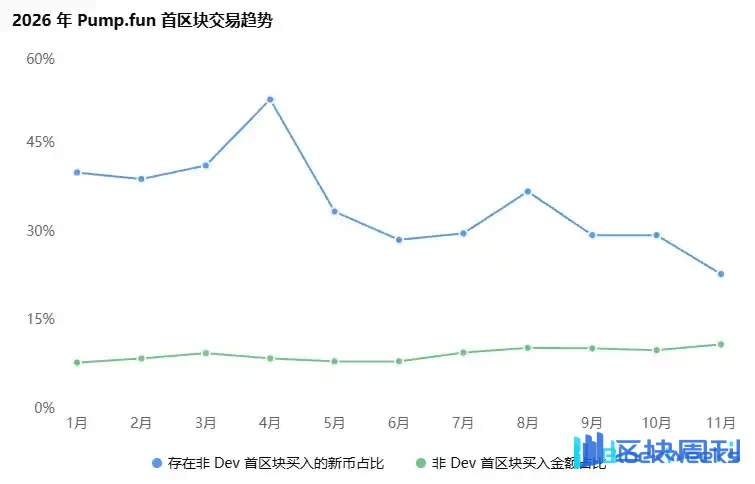
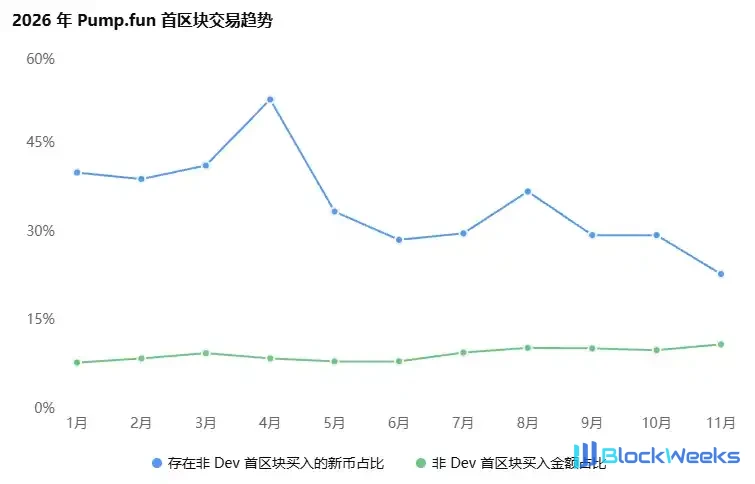
Judging from this year's on-chain transaction data, the share of funds grabbing supply in the first block has not fallen but risen. According to pumpdata.fun statistics, the proportion of new coins with first-block purchases by non-Dev wallets has dropped from 52.3% in April this year to 22.7% in November, but the share of purchase amount in such transactions in the total purchase amount on the bonding curve has risen from 7.7% at the beginning of the year to 10.8%.
At the same time, first-block transaction funds are highly concentrated. Since November alone, non-Dev wallets have cumulatively bought 1.1835 million SOL in the first block, of which only 973 high-frequency wallets (participating in first-block purchases of at least 100 new coins) contributed 41.4% of the purchase amount. For ordinary Meme coin players, the difficulty of grabbing low-priced supply at the opening is easy to imagine.
With first-block fees, will sniper bots move to the next block?
According to the new rules announced by Pump.fun, starting December 4, except for Dev wallets, all transactions completed within the token creation block will require an additional fee, with the specific rate to be announced before formal implementation. After the new rules take effect, if the Dev wants to grab low-priced supply, they must either buy publicly through the issuing wallet and expose their holding ratio, or continue to bundle purchases through multiple wallets and bear additional transaction costs.
The community's overall reaction to this update is fairly positive, but many players have also raised new questions: if the Dev and sniper bots shift their supply-grabbing target from Block0 to Block1 and Block2, how much will ordinary players' situation really improve? According to pumpdata.fun statistics, during the same period, about 96,500 new coins had no non-Dev wallet purchases in Block0 but did have such transactions in Block1 and Block2, with cumulative purchase amount reaching 129,800 SOL. Pump.fun co-founder Alon also said that in the future they do not rule out introducing a fee mechanism for subsequent blocks such as Block1 and Block2. However, as ordinary players gradually enter, the difficulty of identifying Dev-related wallets also increases, and expanding the fee scope may inadvertently harm normal transactions.
The initial rate for this first-block fee will be at a relatively low level, and Pump.fun does not expect the new rules to bring obvious changes on the first day. The team will observe how the Dev, sniper bots, and trading tools respond to the new rules, and gradually adjust the rate and fee scope based on actual transaction data and community feedback.
With annualized revenue exceeding $600 million, why does Pump.fun still need reform?
In addition to improving the new coin opening mechanism, another highlight of this update is PUMP's buyback and burn. According to the official announcement, 50% of the first-block fees will be used for ecosystem development such as the issuance platform, Pump.fun App, and trading terminal, including trading rewards and competition activities; the other 50% will be used for programmatic buyback and burn of PUMP.
According to on-chain analyst 0xMadaba, Pump.fun's annualized revenue reaches $636 million, second only to Hyperliquid among the crypto projects they track. This first-block fee will further broaden Pump.fun's revenue sources. Based on the average daily purchase amount by non-Dev wallets in Block0 since November (about 51,500 SOL), assuming a SOL price of $80 and unchanged transaction scale, the additional fees and PUMP buyback amounts corresponding to different rates are as follows:

Compared with the new revenue brought by the first-block fee, Pump.fun hopes more to improve the new coin opening environment, attract ordinary players back, and drive an overall recovery in platform trading volume. In the past, when the Meme coin market had ample liquidity, even if the Dev and sniper bots took away a large amount of low-priced supply in advance, subsequent buying could still support the token in pushing toward a higher market cap. But now, as market enthusiasm declines, the profit space left for ordinary players is getting smaller and smaller.
Pump.fun has never lacked people issuing coins; what it lacks is people willing to keep buying coins. If the opening of new coins becomes a harvesting game for a few, when ordinary players gradually leave, who will the Dev and sniper bots sell their low-priced supply to?