











Every Monday, Wednesday, and Friday, we focus on the crypto market, Japan, South Korea, A-shares, and Hong Kong stocks, reviewing the market with data and seizing opportunities with trends, produced by PANews.
Market buying power dries up, bulls capitulate, Bitcoin begins the battle to defend 60K
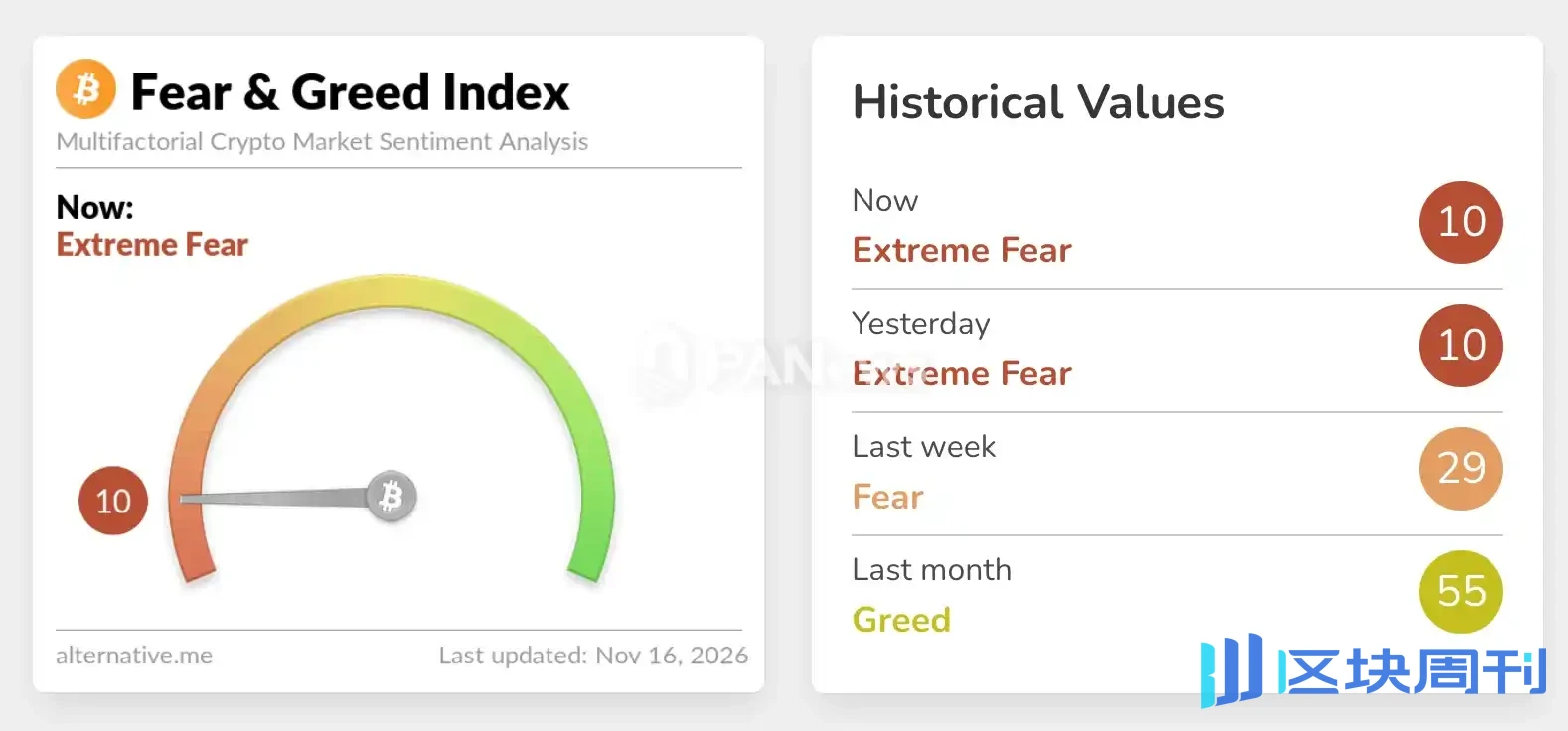
The crypto market is experiencing a rare liquidity drain, with the total global cryptocurrency market capitalization evaporating by about $600 billion over the past two weeks, falling back to $2.26 trillion. Bitcoin briefly flash-crashed 9% over the weekend and touched a four-month low of $61,900, plunging nearly 15% cumulatively over the past week, marking a "six consecutive weekly declines" that has occurred only 4 times in history. Although it barely rebounded to around $65,000 during Asian trading hours on Monday, the market Fear and Greed Index has plummeted to a freezing point of 10, indicating "extreme fear".
Regarding this crash that broke the "four-year cycle law," Binance founder Changpeng Zhao analyzed that it was mainly because Anthropic's massive $90.4 billion IPO plan siphoned off a large amount of capital, compounded by rising Fed rate hike expectations pushing the 10-year U.S. Treasury yield above 5.15%, regulatory clouds after the U.S. midterm elections, and frequent recent security incidents such as exchange hacks and Luxor (a Bitcoin mining pool) suffering an AI-assisted cyberattack that hijacked computing power, all of which dampened investor confidence. In addition, the ongoing global push for crypto tax transparency has also led funds to choose safe-haven观望 in the short term.
On-chain data shows that market buying power is almost exhausted. U.S. spot Bitcoin ETFs have seen net outflows for three consecutive weeks, "bleeding" $1.065 billion last week. Analyst The DeFi Edge calculated that the average cost basis for BlackRock IBIT buyers is as high as $80,700, meaning mainstream ETF institutional investors are currently sitting on about a 19% unrealized loss; although the vast majority of ETF holdings have not yet capitulated in panic (IBIT holdings are only down 4% from their peak), this massive trapped supply will form heavy overhead selling pressure above $81,000 as investors look to break even. Meanwhile, the total stablecoin supply has shrunk by $15.5 billion over the past 30 days, compounded by Glassnode monitoring that whales have been net depositing about $55 million worth of BTC to exchanges daily in recent weeks, and short-term whales who built positions within the past 155 days are carrying a record $8 billion in unrealized losses, leaving dip-buying ammunition on the sidelines stretched thin.
The shakeout has caused former believers to "surrender" one after another. Renowned trader Killa, who once precisely exited at the top and bought the bottom, announced a stop-loss on a long position chased at $76,000, lamenting that this bear market has already lasted longer than those of 2018 and 2022, and that supportive buying below $57,000 has been withdrawn; another legendary bull "First Set 10 Big Targets," who had over $110 million in unrealized profit in early October, has also deleveraged, giving back about $93 million in profits.
Currently, Wall Street and crypto traders are fixated on the "maximum pain zone" of $60,000 to $62,000: Miller Tabak chief strategist Matt Maley warned that after Bitcoin effectively broke below its 50-week moving average, it must defend the yearly low line at $60,000 to the death; 22V Research technical strategist John Roque went further, saying that BTC is approaching the completion of a massive "head-and-shoulders" right shoulder, and once it loses the $60,000 neckline, downside space will open up to $38,000 (Whale Scan even predicted a possible sharp drop to $35,000 based on 2017 and 2021 fractals).
However, some traders believe that around $60,000 is an excellent buying zone. Trader Doctor Profit pointed out that Bitcoin's daily RSI has fallen to an extremely oversold level of 19 and formed a triple bottom, and the current price is infinitely close to Bitcoin's mining production cost line of about $61,200. He is aggressively accumulating spot in the $60,000 to $64,000 range just like in July this year, and insists that as long as the bear market bottom of $57,000 is not broken (VirtualBacon likewise believes there is a 95% probability that $58,000 holds), the bears have not yet won. Traders such as Michaël van de Poppe believe that below $62,500 is an excellent accumulation zone, but a V-shaped reversal will not happen overnight; early in the week there may be a second retest of the low in the $60,000 range, while the first life-or-death watershed above lies at $68,000 to $72,000 (the four-year average price and prior high congestion zone). Only by reclaiming and holding above $68,000 to $69,000 can it be confirmed that the selling wave is cooling.
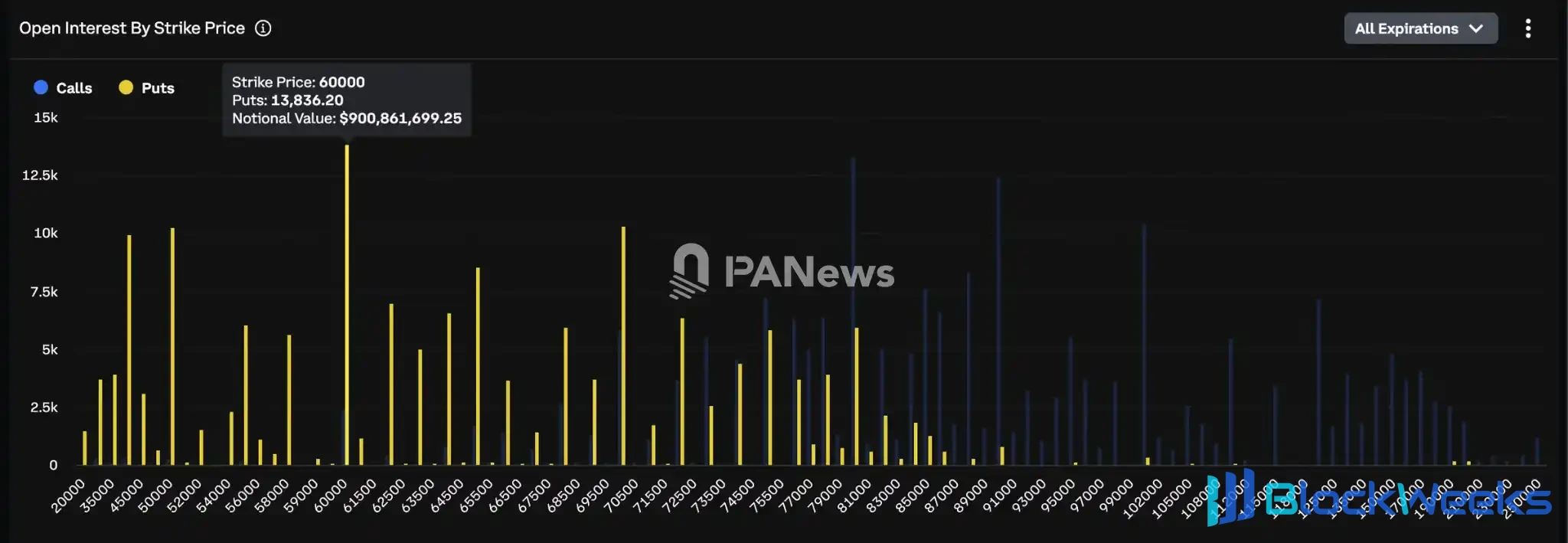
Options market data also reflects this tension: the scale of put options betting on "Bitcoin falling below $60,000" currently on the market has surpassed the previously popular call options betting on "rising to $100,000," becoming the market's largest single bet. This shows that institutional investors are frantically buying insurance to guard against further downside risk.
ETH approaches key support, whale funds buy the dip against the trend
Ethereum plunged 19.5% over the past week, at one point spiking down to $1,710 intraday, not only wiping out all gains since August but also dragging mainstream altcoins such as Solana, BNB, and XRP to double-digit declines across the board. Institutional capital withdrawal and collapsing trust are accelerating the valuation bubble deflation, with U.S. spot Ethereum ETFs seeing net outflows for seven consecutive weeks, including $399 million in outflows last week alone.
Against the backdrop of on-chain native narratives being nearly barren and VCs accelerating their pivot to AI, Binance co-CEO He Yi's social media post showing a "single-month unrealized loss of $100 million" bill (the market, based on her 94% BNB holdings, calculated that her roughly 757,000 BNB holdings shrank to $476 million) has become a microcosm of the deep correction in exchange tokens and altcoin leaders. In addition, crypto market maker giant Amber Group was embroiled over the weekend in an anonymous whistleblower storm from a former executive; although the company urgently issued a statement firmly denying the false allegations and reserving the right to pursue accountability, its core U.S.-listed subsidiary Amber International (AMBR) still fell 3.57% in overnight trading.
Although retail investors are leaving in despair, on-chain data shows positive signals. CryptoQuant author Darkfost pointed out that Binance's ETH reserves have dropped to about 2.9 million coins, the lowest since 2021 (the last time reserves were at this level, ETH was priced at about $400), and the 30-day moving average net flow has remained negative, indicating that a large number of investors are taking advantage of the crash to withdraw ETH to cold wallets or put it into DeFi for yield. On-chain analyst Yu Jin monitored that four major whales and institutions bucked the trend and spent $253 million frantically buying the dip in ETH during the recent bloodbath, including suspected early pioneer Erik Voorhees and F2Pool co-founder Wang Chun. Currently, the $1,800 integer mark has become the life-or-death line in the battle between bulls and bears. Bull representative Doctor Profit emphasized that this level sits on the four-year macro uptrend support line since 2020 and is an excellent long-term positioning point; bears warn that if $1,800 is effectively broken, the downside target will point directly to $1,485.
Today's Key Points:
Data: Tokens such as CRO, ZRO, and ARB will see large unlocks this week, with CRO's unlock valued at approximately $51.4 million
This Week's Preview | Nvidia earnings take the stage, Anthropic lands on Nasdaq; predict.fun (PREDICT) conducts TGE
Upbit delists Sophon
MEXC fully exits the Dutch market
dYdX completes on-chain vote on "USDC reserves to migrate from Noble to Injective"
Saturn Season 1 and Season 2 airdrop registration deadline
Cronos (CRO) unlocks approximately 1.17 billion tokens, valued at approximately $60 million
Arbitrum (ARB) unlocks approximately 92.65 million tokens, valued at approximately $15.27 million
Upbit 24-hour trading volume ranking: XRP, BTC, ETH, SOL, NCT
Bitcoin spot ETFs saw net outflows of $1.065 billion last week, marking three consecutive weeks of net outflows
Ethereum spot ETFs saw net outflows of $399 million last week, marking seven consecutive weeks of net outflows
SOL spot ETFs saw net outflows of $32.0538 million last week, the second-highest in history
XRP spot ETFs saw net outflows of $19.1274 million last week
HYPE spot ETFs saw net outflows of $4.3257 million last week, marking six consecutive weeks of net outflows
Top gainers among the top 100 coins by market cap today: RAIN up 90.3%, QNT up 7.7%, PEARL up 7.3%, VVV up 6%, CC up 5.1%.

Japanese and Korean Chip Stocks Massacred, Goldman Sachs Bullish on Hong Kong Stocks
South Korea's KOSPI opened higher but fell throughout the day, closing down 3.60%, while the KOSDAQ index plunged 4.86%. The core trigger for the stampede in Korean stocks was last Friday's 3.43% plunge in the Philadelphia Semiconductor Index, compounded by a latest Bank of America research report warning that NAND flash spot prices in memory chips fell sharply by 12% in a single week (with consumer-grade NAND expected to fall another 5%-10% early next year), which thoroughly shook foreign investors' confidence in the AI hardware and memory cycle.
On the trading floor, Korean semiconductor heavyweights and equipment stocks suffered indiscriminate selling. Memory giant SK Hynix plunged 7.89%, investment holding company SK Square tumbled 9.71%, Samsung Electronics fell 4.47% (despite Korean media just disclosing that Samsung plans to spend $1.9 billion to expand its Austin, Texas plant to manufacture laser communication chips for SpaceX's Starlink satellites), and Samsung Electro-Mechanics also fell 8.19%; upstream semiconductor equipment maker Park Systems crashed 24.14%, while Hana Micron, Eugene Technology, and PSK all fell more than 14%.
Japanese stocks were equally unable to escape, plunging sharply under the pincer of "economic stall" and "hawkish central bank rhetoric." The Nikkei 225 closed down 2.42%, and the TOPIX fell 1.02%. The initial estimate of Japan's Cabinet Office for third-quarter real GDP annualized quarter-on-quarter unexpectedly contracted 0.1%, falling into negative growth for the first time in four quarters. Meanwhile, Bank of Japan Policy Board member Takata Hajime released a hawkish signal, calling for flexible rate hikes to push interest rates toward 1.5% and describing 2026 as a year of "regime change." Goldman Sachs' FX team also noted in its latest 2027 outlook that the yen is currently severely undervalued by 30% and is the world's best "AI bubble burst hedge," expecting the Bank of Japan to raise rates three times to 2% before June 2027, pushing USD/JPY back from the current 160 level to 150.
Affected by both rate hike expectations and turmoil in the US AI chain, Japanese chip equipment heavyweight stocks became the main drivers of the selloff. Semiconductor test equipment leader Advantest plunged 11.12%, lithography inspection giant Lasertec tumbled 12.84%, Kokusai Electric fell 9.19%, wafer giant SUMCO fell 8.37%, memory giant Kioxia fell 7.69%, Tokyo Electron fell 7.05%, and SoftBank Group also fell 3.69%. Conversely, bank stocks benefiting from rate hike expectations boosting net interest margins and defensive consumer stocks bucked the trend to support the market: home furnishing chain giant Nitori surged 9.15%, sportswear brand Asics jumped 7.70%, KDDI Telecom rose 3.81%, Mizuho Financial Group rose 2.78%, and Uniqlo parent Fast Retailing also steadily closed up 1.97%.
Hong Kong stocks showed resilience, boosted by Wall Street investment bank Goldman Sachs upgrading its rating to "overweight," with the Hang Seng Index bucking the trend to close up 0.49% and the Hang Seng Tech Index dipping 0.30%. Goldman Sachs on Monday released its heavyweight "2027 China Market Strategy Outlook," upgrading Hong Kong stocks from "neutral" to "overweight" and setting a target gain of 23% for the MSCI China Index by the end of 2027. Goldman Sachs noted that with the fading of the food delivery subsidy war and growth in AI cloud revenue, earnings growth in Hong Kong's internet and soft tech sectors will significantly accelerate, and combined with an estimated $100 billion in southbound capital inflows, Hong Kong stocks are welcoming a dual resonance of valuation repair and an earnings inflection point. In addition, this Friday the Hang Seng Index Company will announce the results of its quarterly review, expanding the Hang Seng Tech Index constituents to 50 for the first time; CICC estimates this will trigger a rush of approximately HK$31 billion in passive ETF funds.
On the trading floor, Tencent Holdings, which will report earnings after Wednesday's close, rose 0.98%; Alibaba, which will report earnings on Thursday and has just officially released its flagship large model Qwen4-Max with costs slashed by 62%, dipped 0.44%. Affected by valuation bubble deflation, Hong Kong AI large model and computing power stocks were heavily sold off, with MINIMAX-W plunging 18.04% and Zhipu tumbling 13.42%, Manycore Tech fell about 11%, Yangtze Optical Fibre and Cable fell 10%, GDS Holdings and Lenovo Group both fell about 6%, and SMIC also fell 5.03%; in addition, biopharmaceutical stock Akeso plunged 22.11%, and property stock New World Development plummeted 40.76%.
The A-share market opened lower and fell throughout the day, with institutions making drastic position adjustments in the AI hard tech sector. The Shanghai Composite Index closed down 0.87%, the ChiNext Index plunged 4.37%, and the STAR 50 Index crashed 5.16%. Goldman Sachs on the same day downgraded A-shares to "neutral," noting that A-shares face threefold pressure: earnings growth expectations for AI hard tech stocks will halve from 85% this year to 46% next year, sell-side consensus expectations face downward revisions, and domestic public funds are overly crowded in AI hardware positions; combined with regulators' statements warning of valuation bubbles in tech company listings, this triggered a dramatic rotation of capital from high-flying computing power to low-valuation dividend and consumer stocks.