
Author: Alea Research
Compiled by: Shenchao TechFlow
Shenchao Introduction: In the decentralized perpetual contract sector, Hyperliquid is undergoing a peculiar microeconomic evolution. The decline in the secondary market price of the token and the expansion of underlying capital inflows are occurring simultaneously, resulting in a dramatic compression of valuation multiples.
Alea Research disclosed in an in-depth research report that, thanks to the protocol's original aligned quote asset rules, the USDC reserve interest paid by Coinbase contributed as much as 23.8% of the Assistance Fund's cash flow in October, far higher than the 10.5% in the third quarter.
Although the opening of the HIP-3 module diluted the commission ratio per transaction, the surge in total trading volume caused the fund's daily coin purchasing capacity to rise against the trend by 7.8%, sufficient to fully absorb all the selling pressure from staking unlocks during the period. This article deeply deconstructs its tokenomics closed loop and institutional market-making architecture.
Core Summary: A Token That Became Cheaper Twice and the Reconstruction of Buying Pressure
Over the past six weeks, HYPE has experienced two distinctly different processes of "becoming cheaper": one occurred at the nominal price level, and the other occurred at the level of capital inflow support.
As of the close on November 9, the price of HYPE closed at $75.10, down 17.5% from its previous peak. But at the same time, the influx of cash flow at the protocol level and the underlying buying capacity have shown a completely opposite expansion trend.
First, USDC reserve yield has become a key pillar. The interest paid by Coinbase contributed 23.8% of the Assistance Fund's capital inflow in October, doubling compared with 10.5% in the third quarter. This new liquidity directly offset the dilution effect of the trading fee rate.
Second, the Assistance Fund's daily purchasing power increased by 7.8% compared with the third quarter. Even considering fluctuations in the average token price, the protocol's daily deployed support funds are still rising, effectively absorbing all the selling pressure from staking and circulating releases.
In addition, the contract markets deployed by external market-making teams through the HIP-3 mechanism had already carried 43.8% of the network's perpetual contract trading volume in early November, pushing the ecosystem into a completely different stage of volume-price competition.

Figure: Historical evolution of the proportion of USDC reserve interest contribution to the Assistance Fund's cash flow
Implementation of the Compliance Framework: Institutional Entry at All Levels of U.S. Perpetual Contracts
Hyperliquid integrates the order book, margin system, and fund settlement on a single high-performance public chain. Any team that stakes 500,000 HYPE can independently launch new perpetual contract products.
At the regulatory compliance level, the entire chain is rapidly becoming clearer. Intercontinental Exchange (ICE) and trade[XYZ] are building a compliant trading stack, while another architecture supported by Payward, the parent company of Kraken, has also emerged.
On the day ICE announced that it had chosen Hyperliquid as the clearing infrastructure, HYPE rose 10.3% against the trend, while Bitcoin fell 4.2% during the same period, demonstrating the market's strong expectations for compliant institutions to access the order book.
In overseas markets, leading financial applications are seamlessly connecting native users to the same deep pool. For example, Latin American fintech giant Bitso has opened more than 200 Hyperliquid derivatives trading pairs to its 9 million Latin American users.
Evolution of the HIP-3 Mechanism: Surging Trading Volume and the Game of Commission Ratios
In the first nine days of November, the platform's average daily perpetual contract trading volume reached $9.89 billion, a significant increase of 27% compared with the average in the third quarter, completely breaking away from the sluggish trading period in October.
Among them, markets deployed by external teams under HIP-3 accounted for 43.8% of the share. This shift in product structure has a direct impact on protocol revenue: trading volume determines the total fees, while product structure determines the actual commission ratio of the Assistance Fund.

Figure: Negative correlation between the HIP-3 trading volume share and the protocol's base commission rate
Historical data shows that for every 10 percentage point increase in HIP-3 market share, the base fee commission obtained by the fund is diluted by about 3.7 basis points. However, this dilution gap is perfectly filled by more than double the USDC reserve income.
According to the aligned asset rules, Coinbase must continuously return interest to the fund based on the scale of funds held on-chain, and must stake 500,000 HYPE to accept on-chain slashing constraints, thereby ensuring a high degree of certainty for reserve capital inflows.

Chart: Estimated daily actual disposable purchasing power of the assistance fund and token absorption capacity
Valuation compression of 22.4x: Passive buyers' complete absorption of new selling pressure
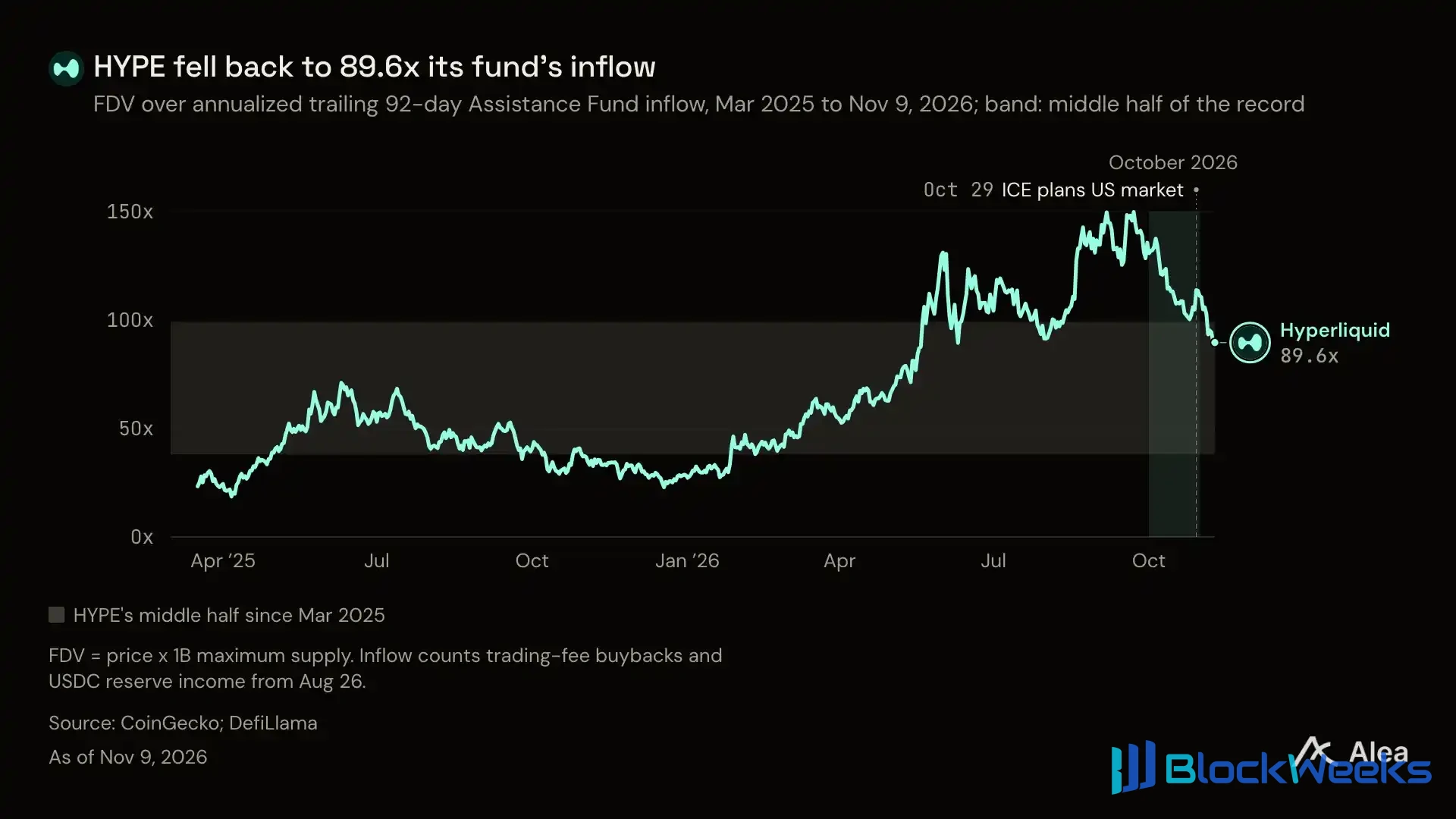
In terms of comprehensive valuation metrics, HYPE's valuation multiples have undergone a severe deflation of the bubble. The decline in nominal token price reduced valuation by 23.7x, while strong capital inflows further accelerated the reversion of the price-to-sales ratio to normal levels.

Chart: The scissors gap between HYPE valuation multiple compression and annualized capital inflow growth
On the supply side, staking and emissions in the third quarter generated an average of approximately 41,600 new HYPE per day. Based on cash flow calculations since the fourth quarter, the purchase funds mobilized daily by the assistance fund are sufficient to completely absorb this new supply in the secondary market.
More importantly, the platform strategy fund still has ample ammunition on hand. As of late October, the relevant accounts still held a substantial cash reserve of $245.3 million, ready at any time to provide abundant liquidity support in accordance with the rules when the market encounters extreme irrational selling.

Chart: Horizontal benchmarking of valuation multiples and cash flow yields of mainstream derivatives protocols
Fourth quarter projection: Support floor and two core driving forces
The assistance fund received a total of $169.1 million in the third quarter. As of November 9, the fourth quarter has already recorded $88.4 million in capital inflows, completing more than half of the previous quarter's target in only one-third of the time.
Calculations show that as long as the subsequent average daily derivatives trading volume remains above $6.2 billion, the total capital inflow in the fourth quarter will surpass the third quarter and reach a new high.
Hyperliquid today has already built a dual-wheel-driven cash generation model of "trading fees + stablecoin reserve interest." The former relies on trading volume expansion to break through the ceiling, while the latter establishes a solid floor independent of market conditions, jointly establishing its most solid moat as an on-chain derivatives giant.